Quartz and silica
Glass, optics, filtration, structural ceramics, solar silicon, sand batteries, transparent dashboards and the first safe vitrified tiles.
Minjerribah's sand story can become a hands-on material sovereignty doorway: quartz and silica, titanium minerals, zircon ceramics, rare-earth discipline, recycled inputs, subterranean infrastructure and future home products made for real local people.
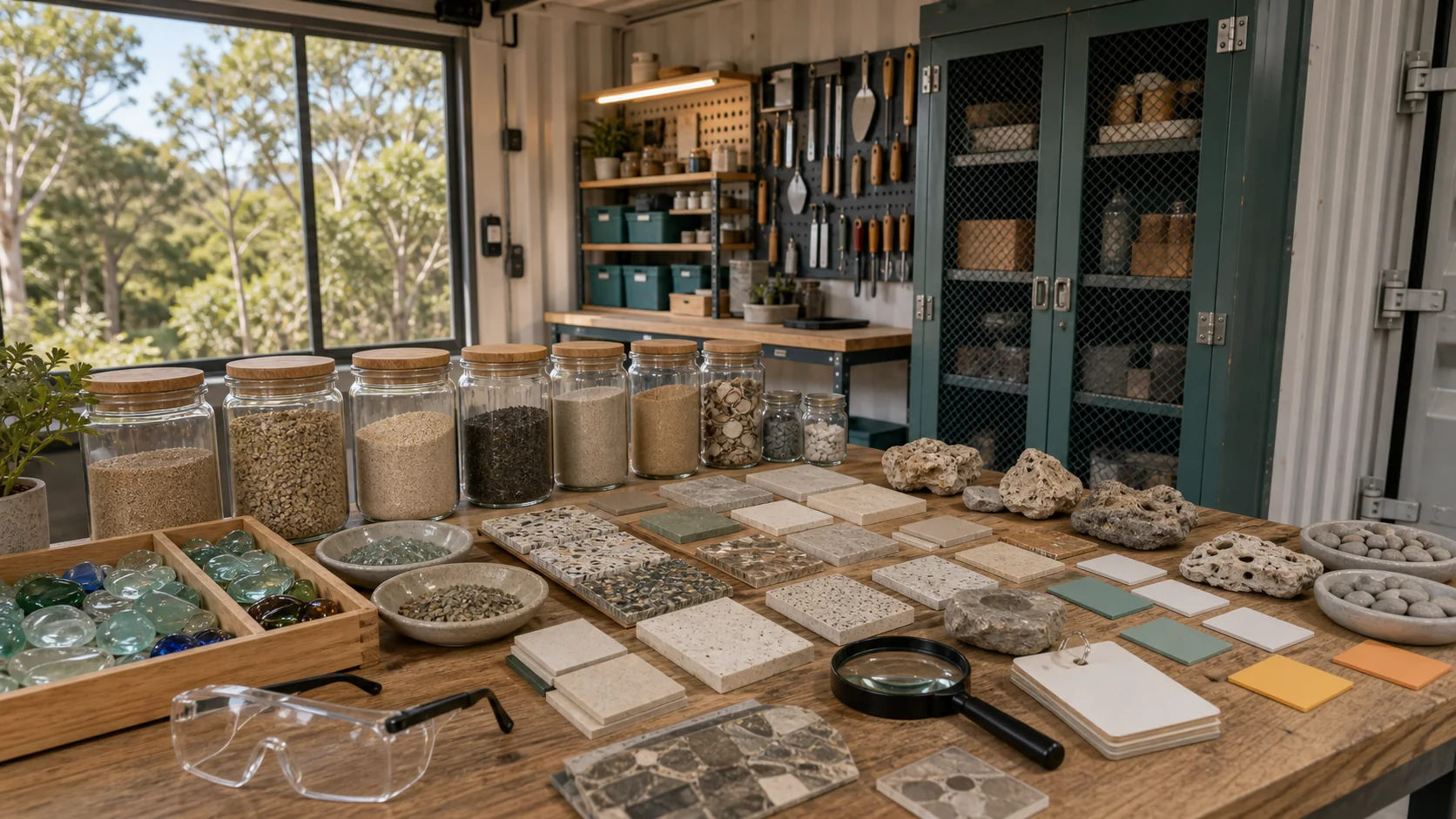
The archive material around local mineral sands is huge: quartz, rutile, ilmenite, zircon, monazite, silica, glass, ceramics, titanium, zirconium, sand batteries, geopolymers, silicon, clean energy and Sandworm infrastructure all sit in the wider source notes.
What public experiments let people understand the stack while the heavier questions of law, culture, Country, environment, processing and authority stay visible?
This page does not propose new sand mining or unauthorised mineral extraction. It points to public-safe education, recycled glass, waste streams, tiny test samples, lawful spoil questions, clean processing research and future pathways that need proper authority before real-world action.
These are not decorative facts. They are the first map of what a sand-informed island manufacturing stack might learn to make.
Glass, optics, filtration, structural ceramics, solar silicon, sand batteries, transparent dashboards and the first safe vitrified tiles.
Titanium dioxide pigments, marine-grade titanium pathways, corrosion-resistant parts, photocatalytic surfaces, alloy research and future 3D-printing powders.
High-temperature ceramics, glaze opacifiers, thermal barriers, oxygen sensors, pump bearings, cutter-head ideas and durable underground components.
Neodymium magnets, phosphors, catalysts and thorium stewardship belong in the horizon map, with clean separation and storage treated as the central challenge.
Glass bottles, aluminium cans, e-waste, plastics, organics and rubble become lawful feedstocks before anyone touches sensitive sand questions.
Silica stores heat beautifully. Tiny thermal-storage models can teach the path from benchtop physics to industrial process heat and resilient microgrids.
The moonshot does not need to sprawl across the island. The better design direction is compact public rooms above ground, lockable container labs where they fit, industrial sister sites where they make sense, and deeper infrastructure that carries freight, storage, agritech, utilities and future fabrication with minimal surface disruption.
Public learning, repair, sampling, CAD, media, tool sharing, clean demonstrations and family-friendly material literacy stay visible.
The dump loop, concrete plant, containers, secure stores, glass crushing, casting, noisy work and supervised recycling sit where trucks and industry already make sense.
Sandworm research points toward freight tunnels, utility galleries, thermal batteries, agri-galleries, protected storage and future fabrication below the surface footprint.
The first wins can be useful, beautiful and ordinary, while still pointing straight at the civilisation-scale material stack.
Recycled powders, timber dust, glass fines and safe binders can repair furniture, signs or small fixtures.
Modular stall weights, signs, cable covers, shade fixings and storage crates can come from reclaimed materials.
Students can make labelled sample tiles showing texture, heat, strength, water and colour differences.
Small plates, cups, glaze samples, knobs, handles, tiles, splashbacks and heat-safe rests can test the path toward homeware.
3D prints, CNC-cut forms, sand-cast fittings and ceramic moulds can make the room better at making the next thing.
A living wall of local and recycled materials can show source, use, risk, recipe, result and next experiment.
The endgame is not novelty objects. When mineral processing becomes simple, safe, clean and lawful, the island can ask a better question: what if ordinary home tools were locally made, repairable, beautiful, modular and custom to the person who uses them?
Custom ceramic knives, boards, bowls, jars, strainers, grinder parts, heat-safe trivets, bench inserts and repairable appliance housings.
Glass filters, ceramic membranes, mineral-safe storage, hydroponic fittings, mushroom-room fixtures and food-preserving gear.
Tools sized for the hand, home, mobility, cooking style, culture, storage space, maintenance ability and aesthetic taste of the person using them.
Locally replaceable knobs, feet, seals, housings, clips, blades, ceramic liners and modular parts instead of throwaway whitegoods logic.
Each object can carry a public-safe recipe: what it is made from, how it is repaired, what should never be done with it, and where it returns at end of life.
Small-batch design files, tool libraries and mentor sessions let homes request better objects without needing every household to own every machine.
The sister site carries the larger materials imagination. This page is the hands-on public doorway: samples, repair, recycling, clean processing questions, subterranean footprint logic and home-scale product dreams.
The public bridge matters. A resident does not have to read the whole civilisation stack to see why sand becomes glass, why zircon matters to ceramics, why titanium survives salt, why neodymium changes motors, why waste is an ore body, or why underground infrastructure protects the living surface.