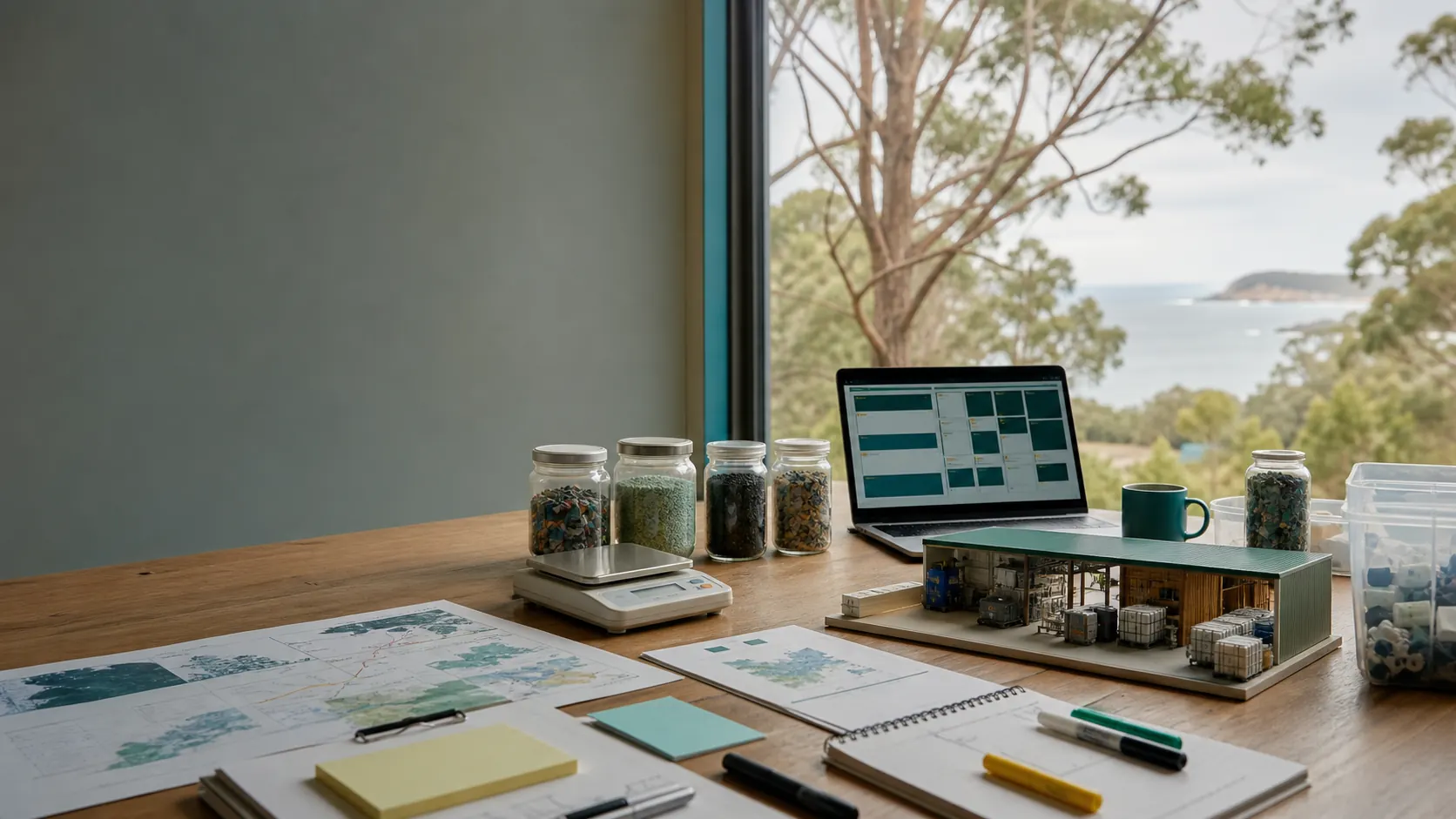
Pilot scope
A small pre-tip diversion and documentation pilot could start with a few legible streams, then expand as local skill and confidence grow.
Caution can become a clear test design when the evidence, permissions, risks and public benefit are visible.
Waste, stored energy, land, insurance, culture, public money and data all deserve literacy. The useful move is to turn those concerns into a pilot design so care becomes a learning pathway, not a wall.
A small pre-tip diversion and documentation pilot could start with a few legible streams, then expand as local skill and confidence grow.
Photos, weights, stream labels, outcomes, repair hours, parts recovered and open questions can show what the island actually handles.
Verified public-good work such as repair, mentoring, sorting and ecological stewardship could later connect to a Community-Hour receipt model.
Open C-Hour pageA test pilot could ask for clear rules around non-speculative regenerative contribution, public records and local value creation.
The Parliament of Australia submissions page lists Luke Nathan Hayes as submission 2 for the Local Government Funding and Fiscal Sustainability inquiry.
Open submissions pageSubmission 2 sets out the incomplete ledger, C-Hour, Community Sovereign Wealth Fund and regenerative-asset carve-out argument.
Open PDFLuke's Local Government Funding and Fiscal Sustainability submission appears as submission 2 on the Parliament of Australia inquiry page, with the actual PDF available through APH's document store. The site can point to that public proof without pretending the proposal has already been accepted.
For this repo, the connection is practical: local government often carries the cost of waste, community care, ecology and public assets while normal ledgers barely count that work. A tip-loop pilot could become one visible way to measure repair, learning, stewardship and local capability.
What would a lawful Minjerribah pilot need so repair, sorting, training, component recovery, battery literacy, data sovereignty and material stewardship can be counted without becoming speculation, surveillance or charity theatre?
These asks are framed as discussion points, not demands.
Consentful intake. How can owners, Council, operators and local partners shape a handover that keeps choice visible?
Data-sovereign records. How can the lab record what is useful while leaving owner data, private histories and repair choices under human control?
Human judgement. How can AI tools draft, classify or suggest while accountable people keep the final call?
Local skills. How can value be measured in repairs, training, material literacy, recovered parts, avoided waste and local confidence?
Rule-change evidence. If the pilot works, what evidence could support a broader regenerative-asset or civic-contribution sandbox conversation?
These are the places where a serious project can stay expansive without becoming careless.
Minjerribah is Quandamooka Country. Place-based work needs respect, protocol and local legitimacy.
The lab can explore diversion, but waste-centre rules, operator contracts and Council authority still matter.
Machines, dust, sharp metal, glass, mould, heat and batteries become teachable systems when procedures explain the reasons.
Phones, laptops, drives and smart devices carry owner-controlled data as well as right-to-repair value.
Public workshops, lending, repair and transport can link to prevention, mutual-care reserves and community wealth thinking.
Open mutual care indexAny C-Hour or regenerative-asset idea needs legal review before real-world issuance or redemption.