Show the donor, wallet or payment trail where lawful, project purpose, amount bands, contractor, invoice status and conflicts.
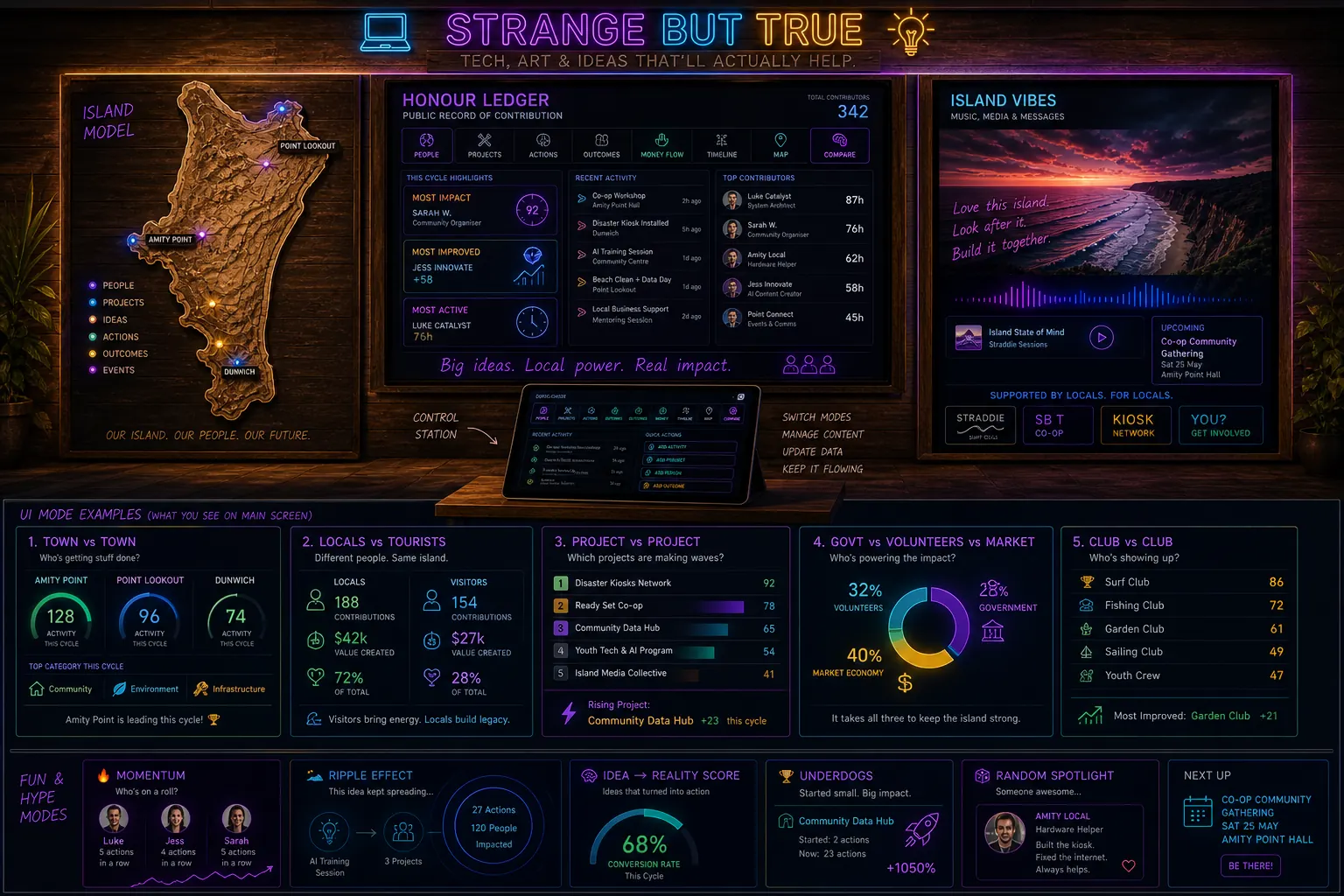
Trust layer / Receipts before belief
Public Ledger and Electorate Fronts
If P4A asks people for money, time, skills or trust, the receipts should be visible by default. The local Strange But True model becomes the first layer of a political transparency system.
What Strange But True proves
Start as help. Graduate to public trust.
Most people should meet the system through something ordinary: a tech problem, a local event, a grant form, a phone issue, a website, a song, or a gripe that finally gets heard. The ledger only appears when someone chooses public support, public work or public accountability.
Working example
Straddie noticeboard network.
The Straddie noticeboard is the first practical community-page example: local notices, public help pathways, visible community information and a gentler doorway into the ledger pattern.
Reminder
A young ideal.
We more intended to get across we are two unlike-minded private citizens who had a conversation over a cold one, and postulated... how does one create (with the assistance of the public) a political party in Australia? This political party being truly representative of the nation as a whole, with the maximum amount of input from said nation, whilst being fully transparent and corruption proof.
The fractal ladder
L0 Sovereign private nodeIndividual, home and private property bounds: private help, private notes, optional profile.md, no politics required.
L1 Shared local meshStreet neighbours, community groups, clubs, care circles and local projects that people choose to participate in.
L2 Civic frontOne future-forward local front per council area, ward or electorate: tech help, listening post, local projects and public contribution records.
Higher layers arrive only when the lower layers have earned it: party records, state dashboards, constitutional version control, public audit trails and a mature Cyber-Republic referendum pathway.
What gets tracked
Record useful time: mentoring, care, media, training, tech help, research, door-knocking, event support and civic repair. Actual C-Hour receipts wait for accepted data pipelines and human checkpoints.
Let members, donors and contractors publish a plain public profile: skills, electorate, roles, interests, limits and disclosure choices.
Mode overlays
Lenses, not rankings.
Comparison modes should create energy without turning civic work into humiliation. They show movement, balance and gaps. They do not create permanent winners and losers.
Electorate vs electorateActivity, contributors, value created, public questions answered.
Project vs projectMost active, most supported, rising project, blocked project needing help.
Govt vs volunteers vs marketWho is carrying the load: public funding, donated time, paid local services.
MomentumRecent activity velocity, streaks, new contributors, rabbit-hole rooms waking up.
Ripple effectOne gripe becomes a meeting, a grant, a prototype, a policy draft or a public repair.
Random spotlightRotate people, projects and actions so quiet contributors are seen.
Lightweight tags
The first version can be plain text and Git-friendly. The important thing is standard fields, not heavy software.
electorate:role:contribution_type:source:project:wallet:visibility:version:Guardrails
Ordinary service customers stay private. Public profiles are opt-in. Political money follows election law. Contractor records should be boringly clear. Time donations need verification without surveillance. The point is public trust, not public exposure for its own sake.