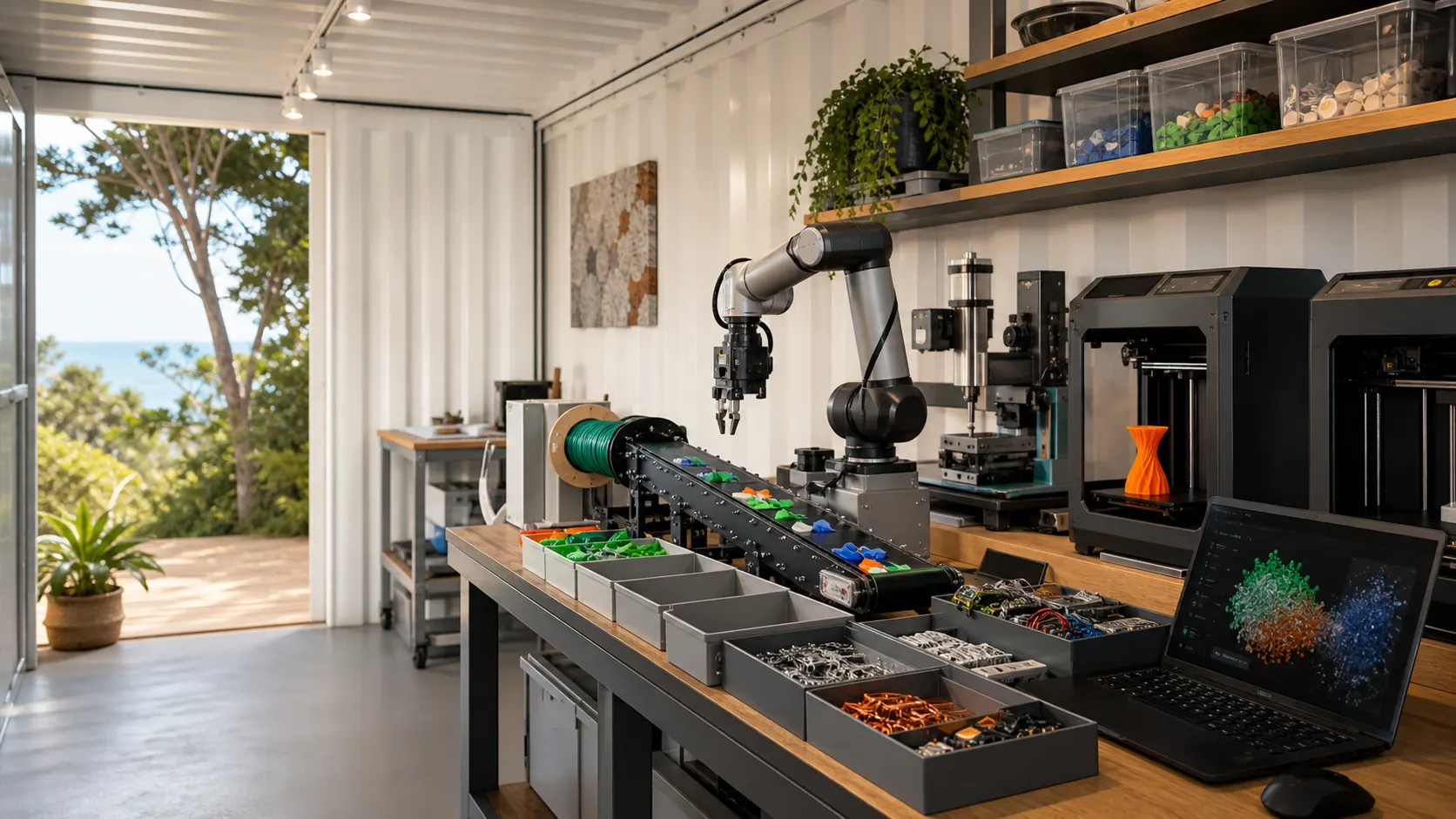
AI sorting aide
A camera bench could help classify common items, compare possibilities, surface uncertainty and invite a human learning conversation.
AI, robotics and 3D printers can help more when they leave skills behind instead of hiding the work somewhere else.
The local goal is not to beat industrial recycling at every scale. It is to build enough island capability that more people can identify, repair, remake, inspect, recover and understand the material world around them.
A camera bench could help classify common items, compare possibilities, surface uncertainty and invite a human learning conversation.
Shredder, injector, sheet press or extruder experiments could begin with clean known plastics and shared tool literacy.
Recycled filament and part-replacement workflows could make small repair clips, knobs, brackets, jigs and learning objects.
A consent-led bench can recover switches, motors, screws, heat sinks, fans, speakers, sensors, chips and boards while owners choose the data pathway.
Glass cullet and sand-adjacent research can connect to geopolymers, terrazzo, art, aggregate and Civilisation of Sand pathways.
Cutting, pulping, pressing and packaging tests can turn a boring stream into cheap prototypes and event infrastructure.
Some streams might still travel to Brisbane, Redlands or specialist processors. The self-sovereign question is what can be learned, repaired, measured, harvested, documented or prototyped locally before that choice is made.
A local microfactory can turn waste handling into workforce learning: sorting, risk literacy, logistics, CAD, electronics, small manufacturing, maintenance, public records, human-in-the-loop AI and right-to-repair judgement.
I See Infinity. I Choose Infinity. AI and robotics can widen the explorer's lens while consent, repair rights, material literacy and local skill-building stay alive.
The Mineral Moonshots supercomputer brief gives the deeper horizon: maze theory, pathfinding, quartz-to-silicon maps, FPGA benches, EDA simulation, lithography, etching, deposition and small-batch rapid evolution. The tip-loop lab can become the humble front door where people first learn to read parts, boards, heat, signals, power and value.
Could repair sorting teach graphs, nodes, edges, dead ends, path cost and AI planning before anyone says chip design?
Could circuit boards become maps of power, signal, memory, heat and component relationships instead of anonymous e-waste?
Could recovered components and ordinary PCs lead into visual FPGA demos for logic, timing, memory and signal flow?
Could the island maintain an honest map from quartz and e-waste through purification, crystal growth, doping, lithography and packaging?
Could Brisbane's Kaohsiung sister-city relationship become a respectful doorway into older lithography knowledge and Taiwanese manufacturing literacy?
Could maze theory, AI layout search and small-batch chip learning point toward space-radiation-hardened experiments over time?
Each lane can begin as a one-bench demonstration before becoming a larger claim.
Could printers make simple replacement parts that keep appliances, bikes, furniture and workshop tools in use?
Could cleaned plastic become durable sheet for signs, shelves, jigs, clipboards, planter labels or public furniture details?
Could local sorting and weighing reveal enough about aluminium, steel and copper flows before any thermal process is imagined?
Could motors, sensors, fasteners, chips and boards become school kits, repair stock and a bridge into local electronics capability?
Could battery packs become a supervised pathway for chemistry, pack design, balancing, failure modes, fire behaviour and storage literacy?
Could a small robot arm teach repeatability, sorting, vision, tool paths and the human judgement that keeps a lab sovereign?
Could e-waste, sand literacy and older lithography access become a long runway toward small-batch silicon and radiation-hardened chip experiments?
Could a public dashboard show kilograms diverted, repairs attempted, skills learned, parts recovered and questions still open, then publish updates through Straddie Noticeboards?