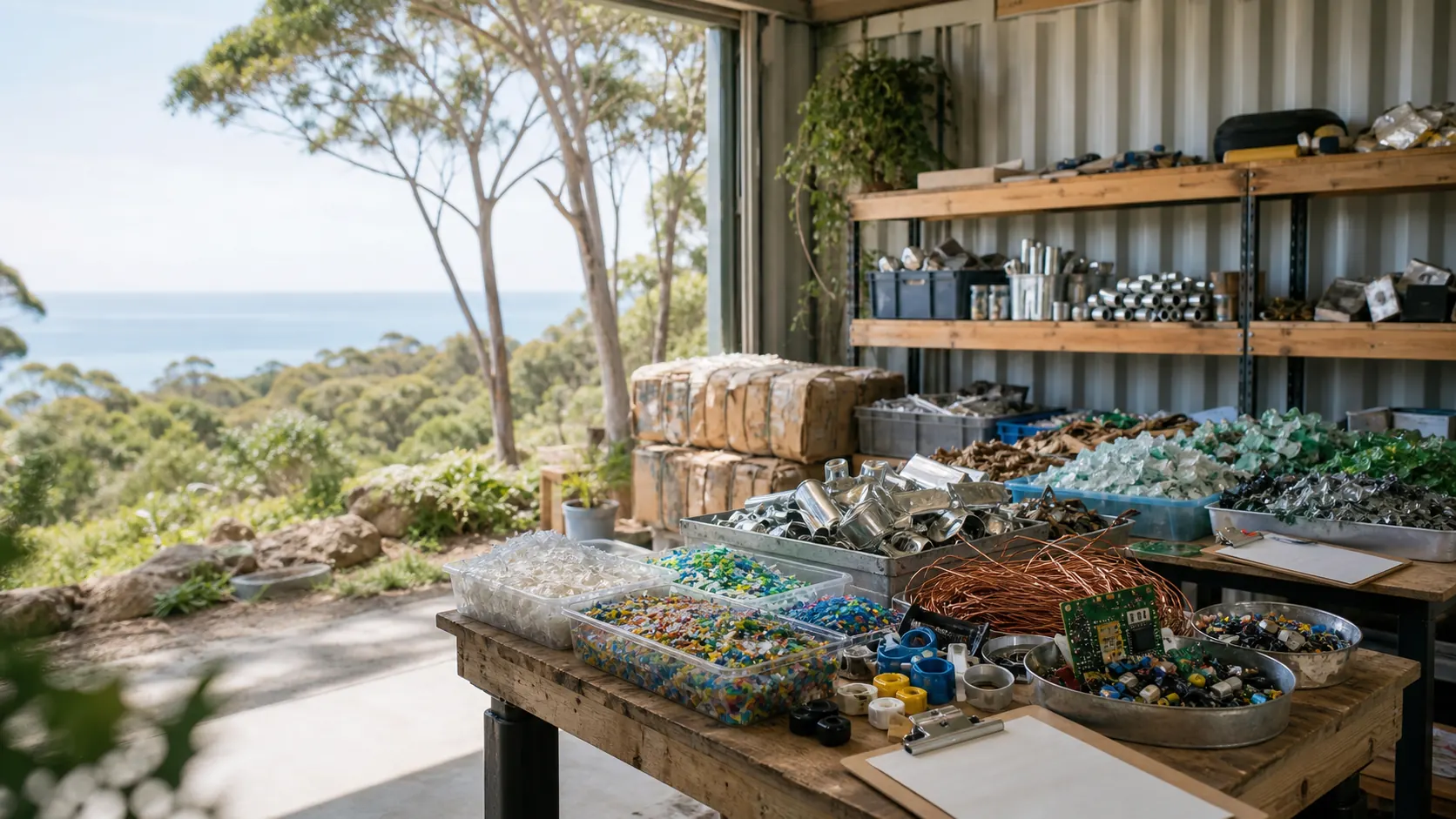
Precious Plastic pathway
Clean plastic can move from type check to wash, dry, shred, flake library, mould test, sheet press or filament trial.
Plastic, metals, cans, cardboard, glass and e-waste can become more than a disposal problem when the island can see and sort them.
Every material has a different story: how it is identified, cleaned, stored, repaired, remade, studied, sold, donated, shipped, paused or kept for a future learning pathway. The practical win is not just diversion. It is shared material literacy.
Clean plastic can move from type check to wash, dry, shred, flake library, mould test, sheet press or filament trial.
Aluminium cans, clean scrap, copper wire, brackets and frames can become weighing, sorting, fastener and fabrication lessons.
Cardboard can become moving boxes, event packaging, pulp tests, compost-adjacent carbon, templates or prototype panels.
Bottle glass, cullet and broken ceramics can connect to art, aggregate, terrazzo, geopolymer and sand-stack questions.
Devices can be read as repairable objects, component libraries, data-sovereign devices, battery-chemistry lessons or future chip-learning stock.
Clean timber, shelves, chairs and frames can teach repair, sanding, finishing, jigs, signage and community event furniture.
A simple material passport can record what the item is, where it came from, what people noticed, what is still unknown, who has consented, what skills are needed, and where it went next.
That record could stay small at first: a Markdown file, a photo, a weight, a stream, a learning note, an outcome and a human reviewer. The deeper digital-twin version can come later.
A good first passport might only ask: what is it, who offered it, what do people need to understand before touching it, who controls the data, and what pathway did the owner choose?
These are not orders. They are useful questions for a self-sovereign public conversation.
Which polymer types are common enough on-island to justify washing, shredding, storage and product trials?
Could cans and clean offcuts become a quantified local stream before any melting or fabrication pathway is considered?
Where could glass stay art, where could it become aggregate, and where could a specialist pathway teach the island something useful?
Could clean cardboard become a local packaging and prototyping material before it leaves the island?
Which boards help people learn repair, signals, chips, sensors, heat, power and value before any export pathway is chosen?
How could lithium, swollen cells and unknown packs become a chemistry, fire-behaviour and stewardship learning pathway rather than a fear label?
Could small motors, fans, switches and sensors become a repair-learning library for schools and workshops?
Which repairs suit public sessions, which invite mentoring, and which ask for a more skilled pathway?