Second build · the worked example
There is no bridge. Every crossing is a boat, and your car may not fit on today's. The second twin answers both on one page. Every number names its file. Every blank gives a date. The crossing is one worked example of the method.
Copernicus Sentinel-2, 13 July 2026 · sources
The front page
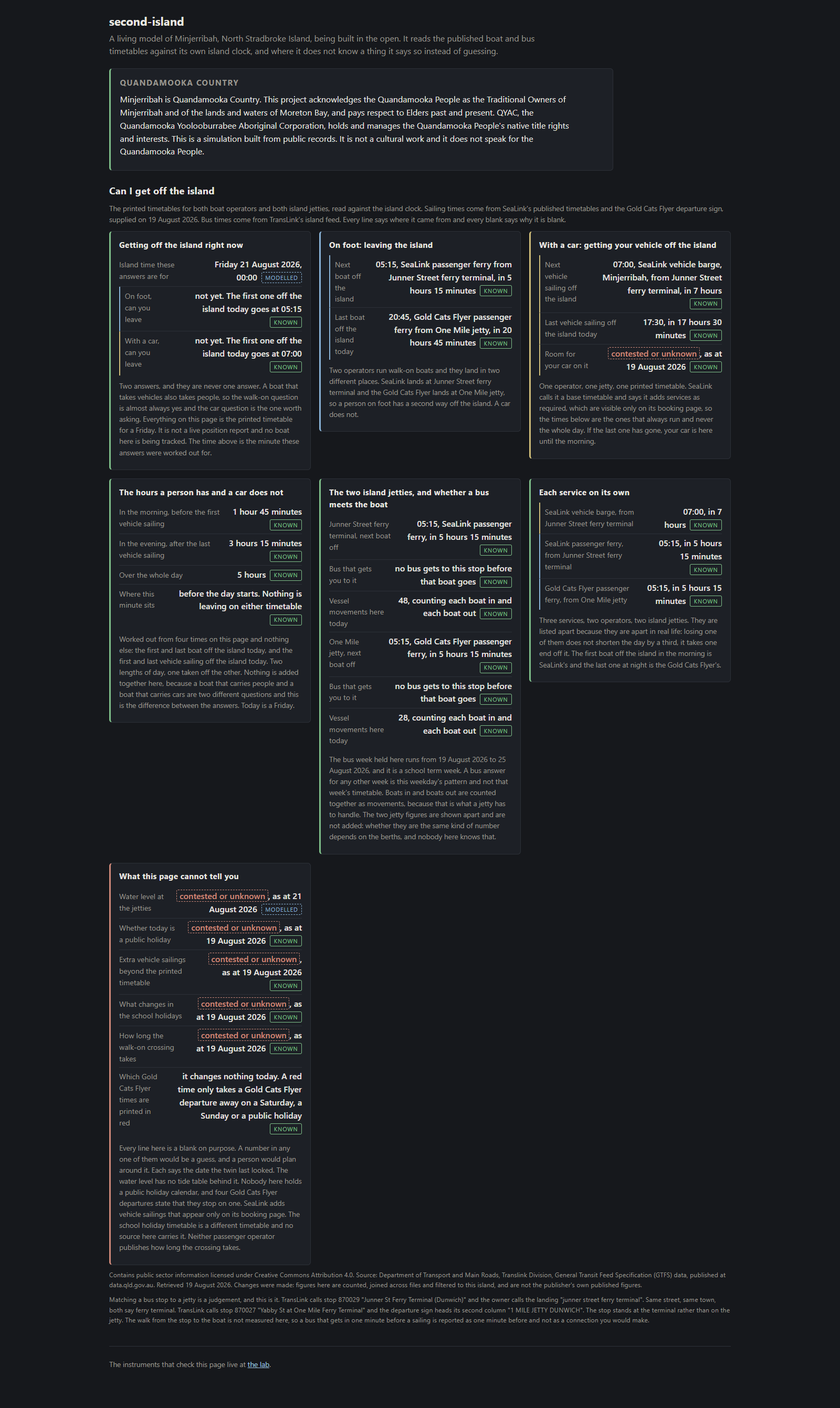
A digital twin is a working model of a real place that says where each number came from. Each row: a label, a value, a chip, a file on disk.
Sailing times come from SeaLink's timetables and the Gold Cats Flyer sign, supplied 19 August 2026. Bus times come from TransLink's island feed. Every blank says why it is blank.
Panel by panel
A pack is a data file the twin reads. Crossings pack: two operators' timetables and the departure sign. Bus pack: TransLink's island feed. Tide pack: no tide table, and it says so.
The acknowledgement of Country comes up as the page loads, out of the lore pack. No menu hides it. A rule checks the wording word for word.
Three rows. The island minute, MODELLED, off the twin's clock. Then on foot, and with a car. Each answers yes, not yet with the first time, or no with the last. Crossings pack.
The next boat off and the last boat off today. SeaLink goes from Junner Street, the Gold Cats Flyer from One Mile. On foot you have two ways off. A car has one. Crossings pack.
The next vehicle sailing and the last one today, or tomorrow morning if it has gone. Room for your car is a dated blank: nobody knows yet whether you book or queue. Crossings pack.
Four rows off four times. The morning gap before the first vehicle sailing, the evening gap after the last, the whole day, and where this minute sits. Crossings pack.
For each jetty: the next boat off, the bus that meets it, boats in and out today. On the captured Friday, 48 at Junner Street and 28 at One Mile, never added. Bus week 19 to 25 August 2026, a school term. Crossings and bus packs.
One row per service, built from the pack, so a fourth turns up the day it lands. SeaLink's vehicle barge and passenger ferry from Junner Street, the Gold Cats Flyer from One Mile. Lose one and the note says "it takes one end off it." Crossings pack.
Six rows, five blank on purpose. Water level at the jetties (tide pack, MODELLED). Public holidays. Extra vehicle sailings. School holiday changes. Walk-on crossing time. The sixth asks whether the red-printed Gold Cats Flyer times change today's answer.
The chips
A record can make four kinds of claim: known, modelled, proposed and contributed. Two turn up here.
Known Read off a timetable, a sign or a feed. The next boat and the last vehicle sailing are KNOWN.
Modelled The twin worked it out. The minute at the top comes off its own clock.
Not known When the twin is not sure, it prints "contested or unknown" with a date and no number. The date is when it last looked. Timetable blanks show 19 August 2026. The water level shows 21 August 2026, the island day on the clock.
A checker runs over the page. On 20 August 2026 it passed 10 rules over 8 panels and 28 values, two minutes into the island day.
The two-crossings rule
The crossings pack states its own rule: "you can almost always get off the island; you cannot always get your car off." Every service and sailing is tagged vehicles or passengers, never both. No field adds cars to passengers. A vehicle sailing takes people too, and the pack refuses the sum.
The walk-on day runs 05:15 to 20:45, seven days a week. The vehicle day runs 07:00 to 17:30. That leaves 1 hour 45 minutes in the morning and 3 hours 15 minutes at night. Five hours a day when a person can leave and a car cannot.
SeaLink calls its vehicle timetable a base and adds sailings as required. Those extras show only on its booking page. The pack has the ten printed departures each way. A count from this build is a floor, so the extra-sailings row is a dated blank.
Each vessel record keeps cars and deck passengers as two named fields with no total. Three faults tested the rule: a summed figure, a count with no source, and a boat declared to take both.
The foot of the page
GTFS is a file format for published timetables. TransLink publishes one for the island's buses, two routes and 44 stops. Its stops include Junner St Ferry Terminal (Dunwich) and Yabby St at One Mile Ferry Terminal. The feed is CC BY 4.0: free to reuse if you credit the source and say you changed it. The page prints it at the foot, out of the bus pack:
"Contains public sector information licensed under Creative Commons Attribution 4.0. Source: Department of Transport and Main Roads, Translink Division, General Transit Feed Specification (GTFS) data, published at data.qld.gov.au. Retrieved 19 August 2026. Changes were made: figures here are counted, joined across files and filtered to this island, and are not the publisher's own published figures."
TransLink names a stop, the operators name a jetty, and the two share no id. A second line says why stop 870029 is Junner Street and 870027 One Mile. Nobody has measured the walk from stop to boat. A bus one minute before a sailing is printed as one minute before.
No boat is tracked
The first panel says: "no boat here is being tracked." Behind every time is an operator with a web page and a sign at a jetty. A row changes when a person reads one again and posts it. The 19 August 2026 timetable is sealed, and a changed time stops the build.
The island clock ticks once a minute, and the page names the minute its answers are for. It checks itself every frame. If the minute or the next departure disagrees with the timetable, the page says so on itself.
A live boat position would beat a printed timetable. TransLink publishes a live bus feed and nobody has wired it up. Neither boat operator publishes one.
Open it: the live page and the repository. Inside the second build covers the record, the ladder and the gate. Open them yourself has the one command for your machine.