Inside the first build · Minjerribah Living Twin

An island you can fly over.

The first twin runs Minjerribah in a browser game engine. This site lists 0 of its parts.

Copernicus Sentinel-2, 13 July 2026 · sources

Arriving

First an acknowledgement, then three doors.

The build opens on an acknowledgement of Quandamooka Country, over the island at night. Under it, a list headed "What this project will not do". No language words, story, art, cultural practice or sacred places go in, from anyone.

Three doors follow. Two open onto the island. The third opens How it works: seven short screens over the island.

The clock starts at 5:20am. Sunrise is 5:39am, so the island is a silhouette. A strip says the sun sits five degrees under the horizon. It offers a jump to twenty minutes after sunrise, and back. The jump goes in the record.
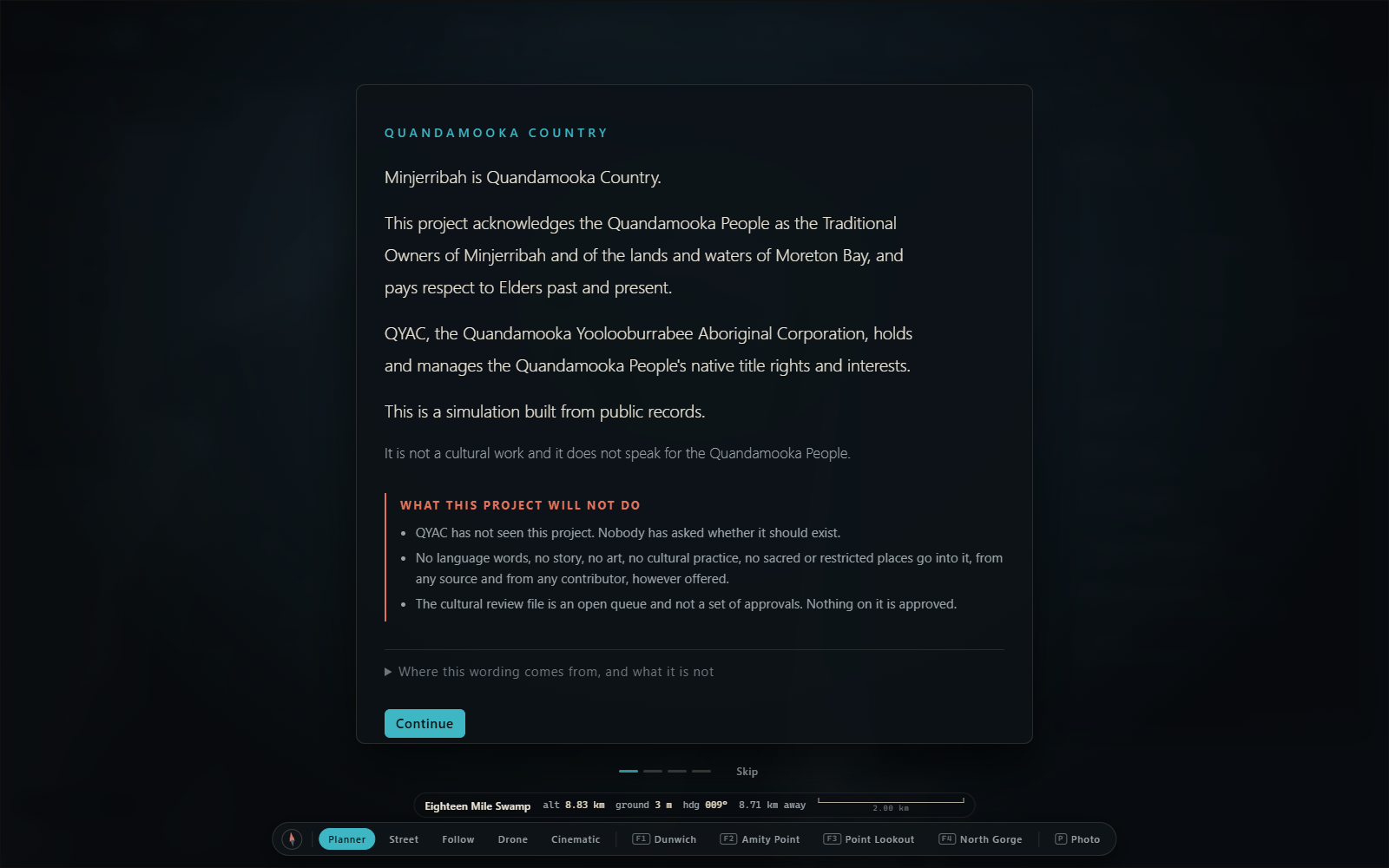
The arrival screen. An acknowledgement of Quandamooka Country over a dark island, the list of what the project will not do, a Continue button, and the camera bar.
The arrival screen, captured 2 September 2026.

Today on Minjerribah

The island opens as a noticeboard.

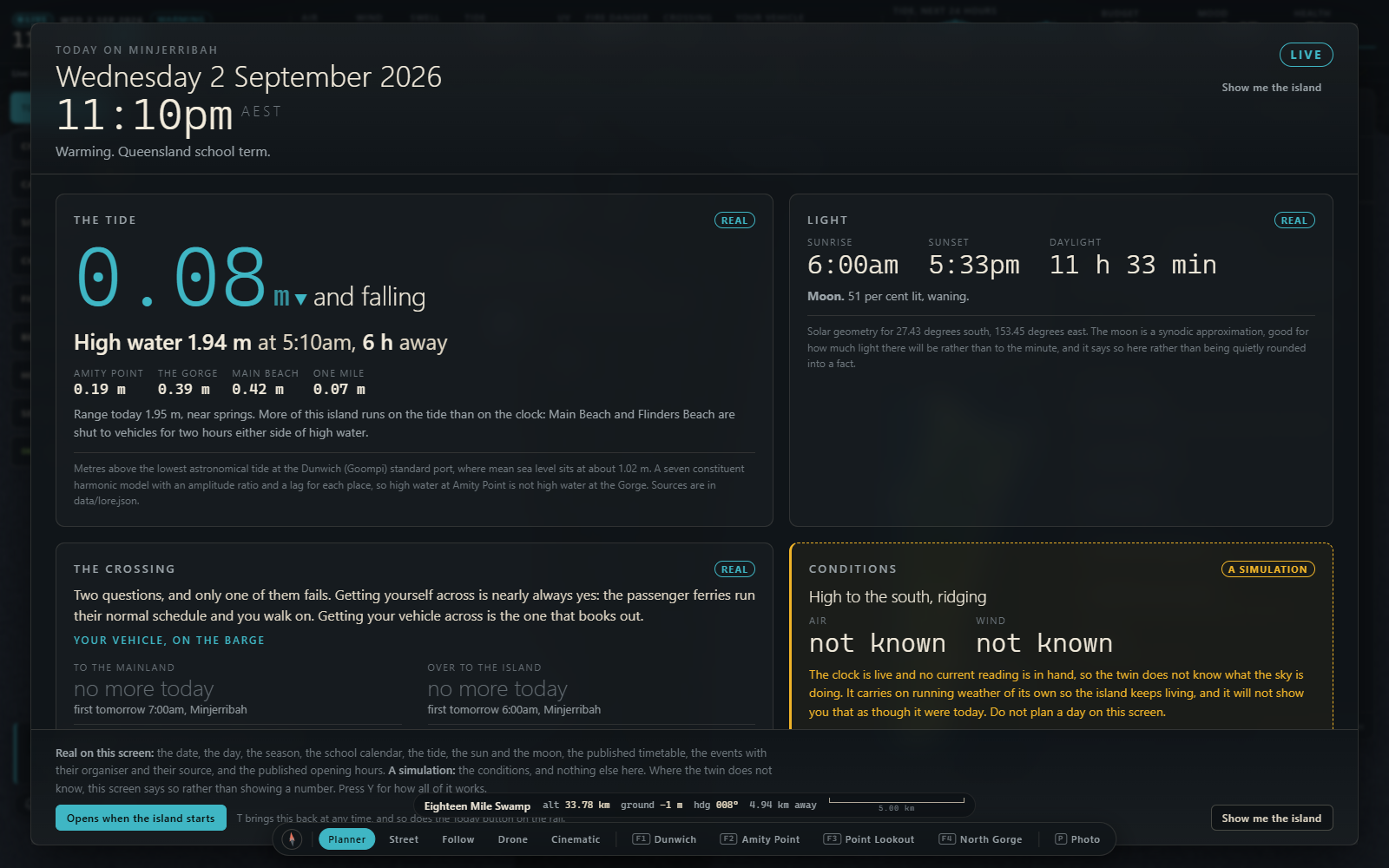
The Today noticeboard over the island at night: date, tide 0.08 metres and falling, sunrise and sunset, the crossing, and weather marked as a simulation.
The Today board, 2 September 2026, 11:10pm island time, clock live. Tide, light and crossing marked REAL. Weather marked A SIMULATION.

T brings the board back once you dismiss it. Each tile has a chip, Real or A simulation.

The date reads Wednesday 2 September 2026, 11:10pm. The season line reads "Warming. Queensland school term." The tide tile shows 0.08 m and falling, high water 1.94 m at 5:10am. Four stations: Amity Point 0.19 m, the Gorge 0.39 m, Main Beach 0.42 m, One Mile 0.07 m. The tide is worked out at Dunwich (Goompi) from seven regular waves added together. Each place gets a ratio and a delay. High water at Amity Point is not high water at the Gorge.

The light tile gives sunrise 6:00am, sunset 5:33pm, 11 hours 33 minutes of daylight. The moon is 51 per cent lit and waning. The crossing tile asks two questions. Only one bites: getting a vehicle across is what books out. At 11:10pm both directions read "no more today", first tomorrow 7:00am to the mainland and 6:00am back.

The weather tile is marked A SIMULATION. Air and wind read "not known". No live reading comes in, so the twin runs its own weather and will not pass it off as today. The tile ends: "Do not plan a day on this screen." A footer lists what is real: the tide, the sun and moon, the timetable, the events with their source, opening hours.

The bar

The bar names the kind of time.

The top bar shows air, wind, swell, tide, UV, fire danger, the crossing, and the clock with its mode. Three kinds of time:

  • Simulated is the default. The clock starts at a moment in the record and runs from one fixed starting number. The same island then happens again on anybody's machine.
  • Live puts the island's clock at the real Queensland moment, taken once and stamped into the record. Nothing reaches the network. Island time is AEST all year.
  • Scrub parks the clock at a moment the island is not at. The sun, the moon, the tide at every station and the calendar work out for any minute, so they follow you. Weather, the ramp queue and which shops are open stay at the island's present, tagged HELD. Forward of now is a forecast.

The time keys, from the build's keyboard file:

SpacePause and unpause. From a parked clock, back to the island's present and play.
1 2 3 4Speed: 1x, 3x, 12x, 60x. Choosing a speed is how you leave live.
0Pause.
, .Step an hour back and forward. With Shift, a day.

The bar puts going live and coming back to now on buttons, not keys.

Cameras

Five cameras and four bookmarks.

The camera bar runs along the bottom. Planner looks from above. Street puts you on foot. Follow tracks what you picked. Drone flies, with Space to climb. Cinematic runs shots, and C moves to the next. Tab steps forward, Shift + Tab back.

Four bookmarks sit beside the modes. Shift with a function key saves your view over a slot. Alt + 1 to 4 do the same jumps.

Photo mode hides the interface. Its time slider runs the bar's clock, and says so. Nothing in photo mode advances the island.

KeyCamera
TabNext camera mode: planner, street, follow, drone, cinematic
F1 to F4Dunwich, Amity Point, Point Lookout, North Gorge
HomeFrame the whole island
W A S DPan, walk or fly, depending on the mode
Drag, right drag, wheelMove the ground, orbit and tilt, zoom
PPhoto mode
B L HLetterbox bars, place labels, hide the interface
EscapeClose whatever is open; clear the selection

The number key 5 does nothing: five camera modes, four speeds.

Boards and views

Fifteen boards and twenty-two data views.

A board is a panel that opens over the island. There are 0 running, each with its key.

BoardWhat it doesKey
TodayThe noticeboard the island opens as.T
Heads-up barThe strip along the top.always on screen
NotificationsWhat just happened.I
Info viewsThe switch for the views.V
InspectorWhat a thing is, where its data came from, how solid.click the island
Civic boardLevers, who decides them, the in tray, groups, consultation, budget.G
Siting benchTry a thing in a place. No build button.K
EventsThe island calendar, organiser and source.E
Below the sandProposed works below the sand, none of them built.U
ChronicleWhat happened, with filters and search.J
LegislationWhich Acts apply to whom, and why.X
MapDocked or full screen. Click to fly there.M, Shift + M
Arrival screensThe screens you meet first.?
How it worksSeven short screens over the island.Y
SettingsQuality, sound, interface. N mutes; Shift + N opens the mixer.O

Two more boards are designed and not written: a stewardship board, and a place for real scanned objects. That folder is empty.

The twenty-two views

An info view paints one kind of data over the ground in colour. V opens the picker: land, water, life, people, networks. [ and ] step through, Alt with a letter jumps to one, Alt + V turns it off. Every view names where its data came from.

  • Land cover
  • Elevation and contours
  • Slope
  • Land tenure
  • Vegetation communities
  • Fire: what it burns
  • Dune erosion and accretion
  • Groundwater and the lakes
  • Koala country and road strikes
  • Shorebird roosts and disturbance
  • Whales on migration
  • Sea Country: banks and reefs
  • Who is home tonight
  • Rental availability
  • Visitor density
  • Business viability
  • Roads, access and the tide
  • Power
  • Water and wastewater
  • Waste
  • Mobile coverage and the ridge
  • Noise

The civic chain

You are not the mayor.

Those three words come from the build's explainer. The board has sixty-four levers. A lever is one thing a council or another body could decide to do. Each one has a build cost, a running cost, how long it takes, and who decides it. Who decides is the field that matters.

19
levers are yours to decide
How it works, section 5
17
you can fund but not decide
How it works, section 5
25
you can only ask for
How it works, section 5
1
you can only watch
How it works, section 5

All nineteen you can decide belong to Redland City Council. The seat is Division 2: Cleveland on the mainland and North Stradbroke Island together, one councillor for both. The Queensland Government is named on twenty-five levers, QYAC on fourteen, joint management of the national park on ten. SeaLink is on six, Minjerribah Camping on four. The barge is a commercial service: commercial timetable, no ballot, no resident quota. On a long weekend your lever is asking.

Pick a lever and read who decides it and what it claims. Open a file, and the in tray gives you:

  1. Nine forms you can lodge, seven of them with a week count and a price you pay.
  2. A lodge-it-anyway path, which comes back as an information request twelve weeks later.
  3. A consultation, and a submission you can make properly.
  4. A petition, which the board calls a list of names unless a consultation came back in favour.

Where a decision belongs to a body the twin will not model, it stops and says so. Leave the matter pending, or record your own assumption and wear the label. Anything QYAC decides sits there.

Checked 9 August 2026

What works today, and what does not.

Both lists come from the build's README, dated 9 August 2026. That check played the build end to end and ran a simulated year with no picture.

Works

  • 271 km² of land, high point 233 m, on a grid of heights 908 by 1314 cells at 32 m. That is about 1.2 million cells, built in under a second. A cell is a bit over one and a half cricket pitches across.
  • 55 systems and layers load with zero console errors, after driving every panel and pressing every key.
  • A simulated year finishes with zero runtime errors. Two runs from the same starting number agree over 1,440 ticks, ten simulated days.
  • 13 boards and 15 render layers. A render layer is one kind of thing drawn: terrain, ocean, sky, trees, buildings, roads, people, vehicles, fauna, weather, the works below the sand, the data views, the selection, the finishing pass.
  • About 2,300 people at a township, about forty-six busloads, in four draw calls. A draw call is one instruction to the graphics chip. Vehicles run the road graph, whales off the headland in daylight, koalas in the trees.
  • The civic chain, end to end.
  • A koala hit reaches the rescue call, the notification bar, the chronicle and the conservation groups' mood. A cancelled barge rolls vehicles and gets written up. Eighteen of twenty-two lived-event channels fire over a simulated year.

Does not

  • The tick is over budget: 6.23 ms against 4 ms. A tick is one step of the simulation, ten simulated minutes. Six thousandths of a second is a sliver of a blink. The budget keeps sixty frames a second on a laptop's built-in graphics. Draw calls are fine, 115 to 179 against 900. The cost is in the simulation, not the drawing.
  • Up close it looks hazy and washed out. Street level in a township has almost no contrast. The bay-side water comes out a saturated green rather than turquoise.
  • Five modules in the design are not written: fire, coastal erosion, groundwater, shared presentation read models, the stewardship board. The build reports them as planned at start-up.
  • Several read models describe the instant rather than the day. A read model is the summary a part publishes for the boards. A probe at 5:20am reports zeros for a ferry that carried thousands of people the day before. The daily counters reset at midnight.
  • Fifteen per cent of vehicle route requests fail, every one because the street is missing from the geography pack. That is 328,801 out of 2,182,279 over a simulated year, about nine hundred failed trips a day. The twin counts the failure instead of drawing a car on a road that is not there. So the roads look quiet.
  • The story layer is thin against its brief. Over a simulated year, 12 threads opened and 35 beats fired against 514 cast failures. A cast failure is the story needing a person and finding none. Most days are quiet.

The engineering handover, with the numbers and the traps, is docs/STATE-OF-PLAY.md. Next: every part of both builds, or open this one now.