

GAJRA Earth Civic AI Commons Business Plan for an A$250 Billion Protopian Gambit
Read the complete supplied reference online, or download the original file.
Original source material, including its historical dates and proposals.
Page 1 of 23
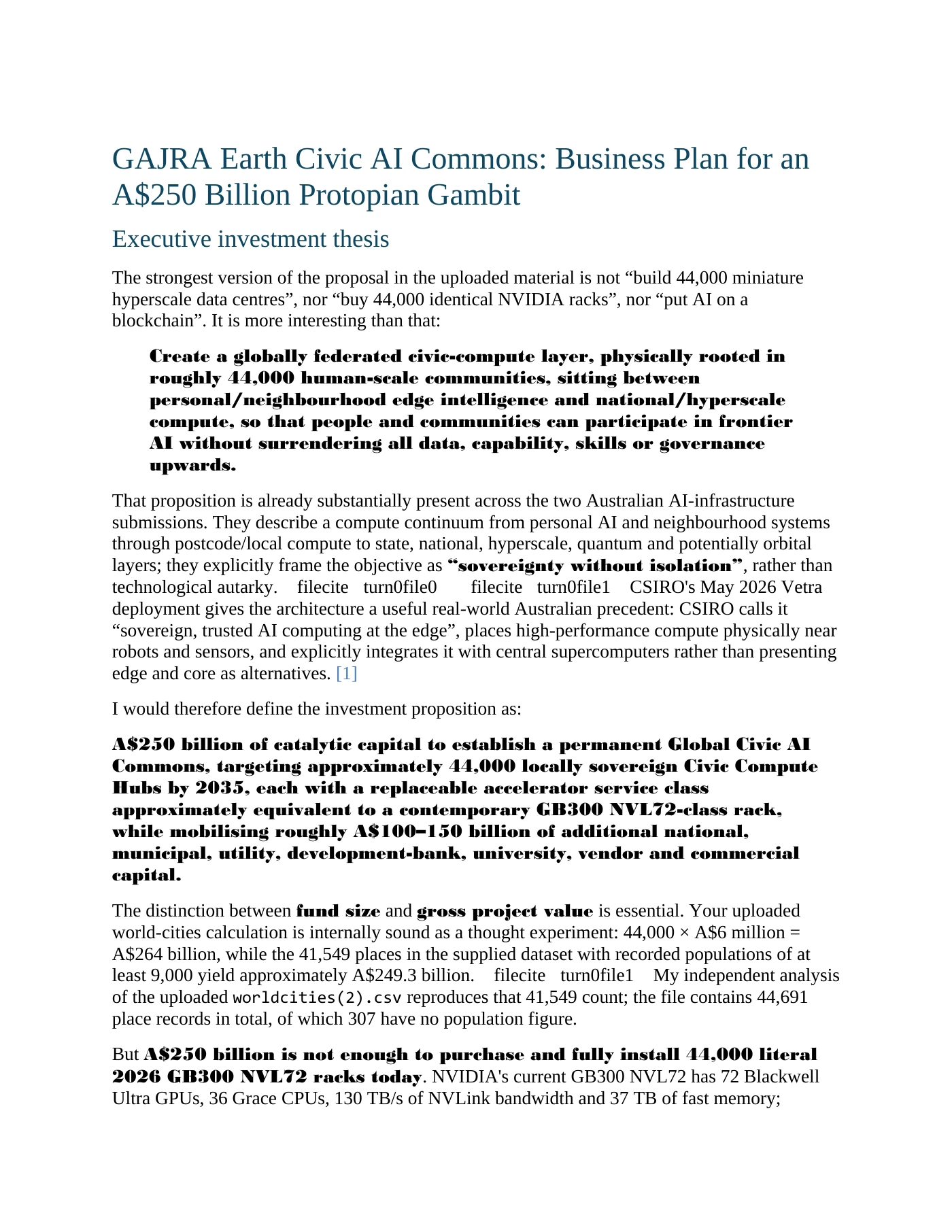
Read selectable text for page 1
Text extracted from this page. Use the page image for its original layout, tables and figures.
A$250 Billion Protopian Gambit
Executive investment thesis
The strongest version of the proposal in the uploaded material is not “build 44,000 miniature
hyperscale data centres”, nor “buy 44,000 identical NVIDIA racks”, nor “put AI on a
blockchain”. It is more interesting than that:
Create a globally federated civic-compute layer, physically rooted in
roughly 44,000 human-scale communities, sitting between
personal/neighbourhood edge intelligence and national/hyperscale
compute, so that people and communities can participate in frontier
AI without surrendering all data, capability, skills or governance
upwards.
That proposition is already substantially present across the two Australian AI-infrastructure
submissions. They describe a compute continuum from personal AI and neighbourhood systems
through postcode/local compute to state, national, hyperscale, quantum and potentially orbital
layers; they explicitly frame the objective as “sovereignty without isolation”, rather than
technological autarky. fileciteturn0file0 fileciteturn0file1 CSIRO's May 2026 Vetra
deployment gives the architecture a useful real-world Australian precedent: CSIRO calls it
“sovereign, trusted AI computing at the edge”, places high-performance compute physically near
robots and sensors, and explicitly integrates it with central supercomputers rather than presenting
edge and core as alternatives. [1]
I would therefore define the investment proposition as:
A$250 billion of catalytic capital to establish a permanent Global Civic AI
Commons, targeting approximately 44,000 locally sovereign Civic Compute
Hubs by 2035, each with a replaceable accelerator service class
approximately equivalent to a contemporary GB300 NVL72-class rack,
while mobilising roughly A$100–150 billion of additional national,
municipal, utility, development-bank, university, vendor and commercial
capital.
The distinction between fund size and gross project value is essential. Your uploaded
world-cities calculation is internally sound as a thought experiment: 44,000 × A$6 million =
A$264 billion, while the 41,549 places in the supplied dataset with recorded populations of at
least 9,000 yield approximately A$249.3 billion. fileciteturn0file1 My independent analysis
of the uploaded worldcities(2).csv reproduces that 41,549 count; the file contains 44,691
place records in total, of which 307 have no population figure.
But A$250 billion is not enough to purchase and fully install 44,000 literal
2026 GB300 NVL72 racks today. NVIDIA's current GB300 NVL72 has 72 Blackwell
Ultra GPUs, 36 Grace CPUs, 130 TB/s of NVLink bandwidth and 37 TB of fast memory;
Page 2 of 23
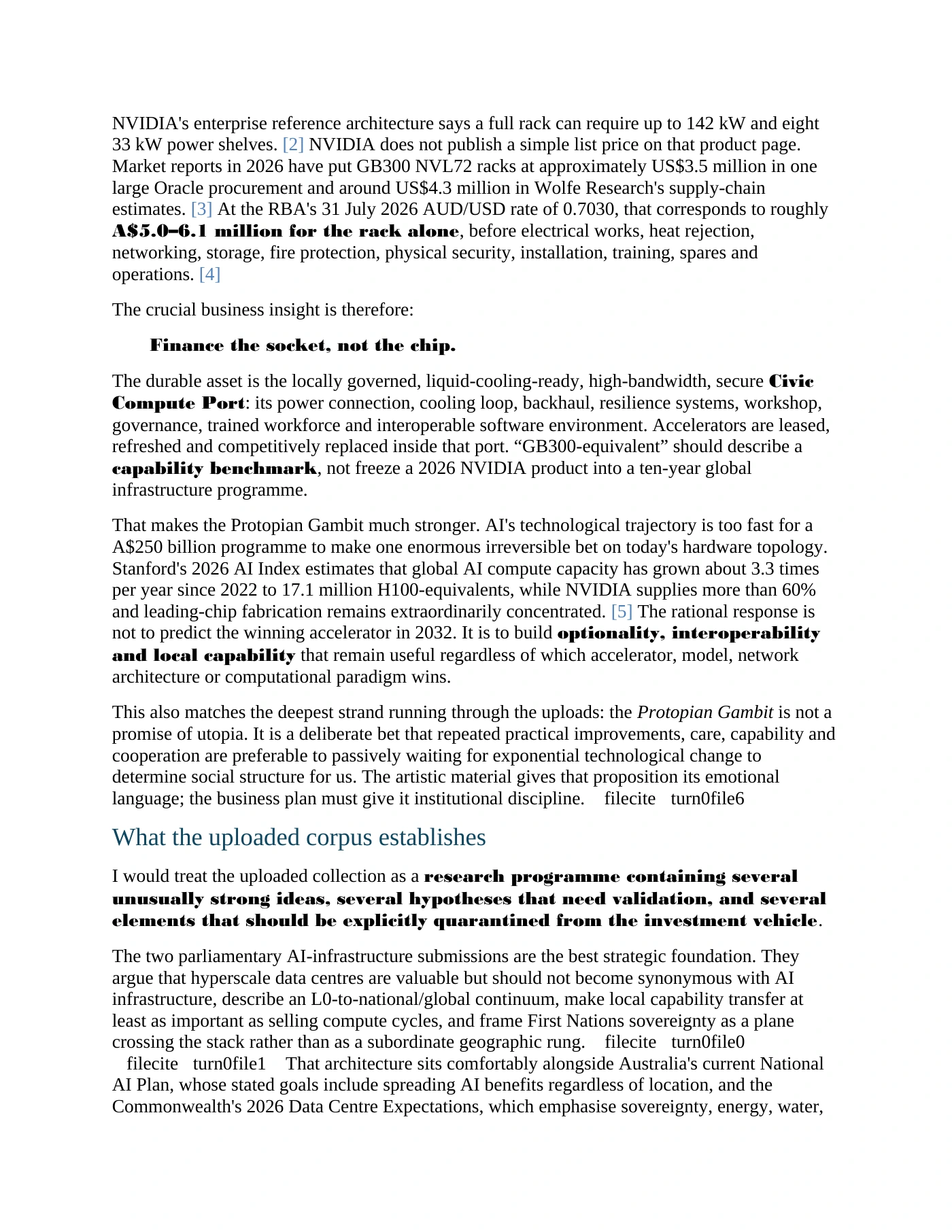
Read selectable text for page 2
Text extracted from this page. Use the page image for its original layout, tables and figures.
33 kW power shelves. [2] NVIDIA does not publish a simple list price on that product page.
Market reports in 2026 have put GB300 NVL72 racks at approximately US$3.5 million in one
large Oracle procurement and around US$4.3 million in Wolfe Research's supply-chain
estimates. [3] At the RBA's 31 July 2026 AUD/USD rate of 0.7030, that corresponds to roughly
A$5.0–6.1 million for the rack alone, before electrical works, heat rejection,
networking, storage, fire protection, physical security, installation, training, spares and
operations. [4]
The crucial business insight is therefore:
Finance the socket, not the chip.
The durable asset is the locally governed, liquid-cooling-ready, high-bandwidth, secure Civic
Compute Port: its power connection, cooling loop, backhaul, resilience systems, workshop,
governance, trained workforce and interoperable software environment. Accelerators are leased,
refreshed and competitively replaced inside that port. “GB300-equivalent” should describe a
capability benchmark, not freeze a 2026 NVIDIA product into a ten-year global
infrastructure programme.
That makes the Protopian Gambit much stronger. AI's technological trajectory is too fast for a
A$250 billion programme to make one enormous irreversible bet on today's hardware topology.
Stanford's 2026 AI Index estimates that global AI compute capacity has grown about 3.3 times
per year since 2022 to 17.1 million H100-equivalents, while NVIDIA supplies more than 60%
and leading-chip fabrication remains extraordinarily concentrated. [5] The rational response is
not to predict the winning accelerator in 2032. It is to build optionality, interoperability
and local capability that remain useful regardless of which accelerator, model, network
architecture or computational paradigm wins.
This also matches the deepest strand running through the uploads: the Protopian Gambit is not a
promise of utopia. It is a deliberate bet that repeated practical improvements, care, capability and
cooperation are preferable to passively waiting for exponential technological change to
determine social structure for us. The artistic material gives that proposition its emotional
language; the business plan must give it institutional discipline. fileciteturn0file6
What the uploaded corpus establishes
I would treat the uploaded collection as a research programme containing several
unusually strong ideas, several hypotheses that need validation, and several
elements that should be explicitly quarantined from the investment vehicle.
The two parliamentary AI-infrastructure submissions are the best strategic foundation. They
argue that hyperscale data centres are valuable but should not become synonymous with AI
infrastructure, describe an L0-to-national/global continuum, make local capability transfer at
least as important as selling compute cycles, and frame First Nations sovereignty as a plane
crossing the stack rather than as a subordinate geographic rung. fileciteturn0file0
fileciteturn0file1 That architecture sits comfortably alongside Australia's current National
AI Plan, whose stated goals include spreading AI benefits regardless of location, and the
Commonwealth's 2026 Data Centre Expectations, which emphasise sovereignty, energy, water,
Page 3 of 23
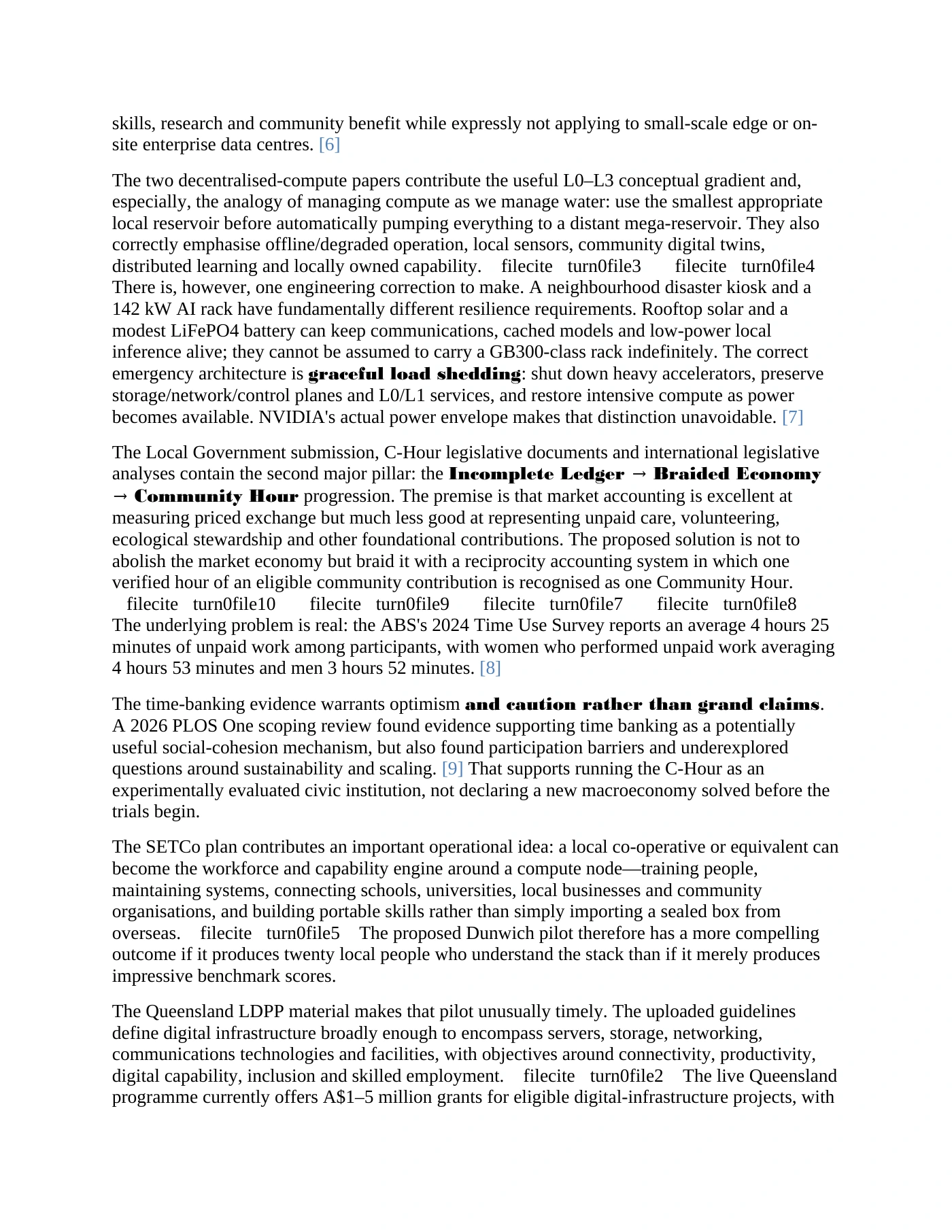
Read selectable text for page 3
Text extracted from this page. Use the page image for its original layout, tables and figures.
site enterprise data centres. [6]
The two decentralised-compute papers contribute the useful L0–L3 conceptual gradient and,
especially, the analogy of managing compute as we manage water: use the smallest appropriate
local reservoir before automatically pumping everything to a distant mega-reservoir. They also
correctly emphasise offline/degraded operation, local sensors, community digital twins,
distributed learning and locally owned capability. fileciteturn0file3 fileciteturn0file4
There is, however, one engineering correction to make. A neighbourhood disaster kiosk and a
142 kW AI rack have fundamentally different resilience requirements. Rooftop solar and a
modest LiFePO4 battery can keep communications, cached models and low-power local
inference alive; they cannot be assumed to carry a GB300-class rack indefinitely. The correct
emergency architecture is graceful load shedding: shut down heavy accelerators, preserve
storage/network/control planes and L0/L1 services, and restore intensive compute as power
becomes available. NVIDIA's actual power envelope makes that distinction unavoidable. [7]
The Local Government submission, C-Hour legislative documents and international legislative
analyses contain the second major pillar: the Incomplete Ledger Braided Economy →
Community Hour→ progression. The premise is that market accounting is excellent at
measuring priced exchange but much less good at representing unpaid care, volunteering,
ecological stewardship and other foundational contributions. The proposed solution is not to
abolish the market economy but braid it with a reciprocity accounting system in which one
verified hour of an eligible community contribution is recognised as one Community Hour.
fileciteturn0file10 fileciteturn0file9 fileciteturn0file7 fileciteturn0file8
The underlying problem is real: the ABS's 2024 Time Use Survey reports an average 4 hours 25
minutes of unpaid work among participants, with women who performed unpaid work averaging
4 hours 53 minutes and men 3 hours 52 minutes. [8]
The time-banking evidence warrants optimism and caution rather than grand claims.
A 2026 PLOS One scoping review found evidence supporting time banking as a potentially
useful social-cohesion mechanism, but also found participation barriers and underexplored
questions around sustainability and scaling. [9] That supports running the C-Hour as an
experimentally evaluated civic institution, not declaring a new macroeconomy solved before the
trials begin.
The SETCo plan contributes an important operational idea: a local co-operative or equivalent can
become the workforce and capability engine around a compute node—training people,
maintaining systems, connecting schools, universities, local businesses and community
organisations, and building portable skills rather than simply importing a sealed box from
overseas. fileciteturn0file5 The proposed Dunwich pilot therefore has a more compelling
outcome if it produces twenty local people who understand the stack than if it merely produces
impressive benchmark scores.
The Queensland LDPP material makes that pilot unusually timely. The uploaded guidelines
define digital infrastructure broadly enough to encompass servers, storage, networking,
communications technologies and facilities, with objectives around connectivity, productivity,
digital capability, inclusion and skilled employment. fileciteturn0file2 The live Queensland
programme currently offers A$1–5 million grants for eligible digital-infrastructure projects, with
Page 4 of 23
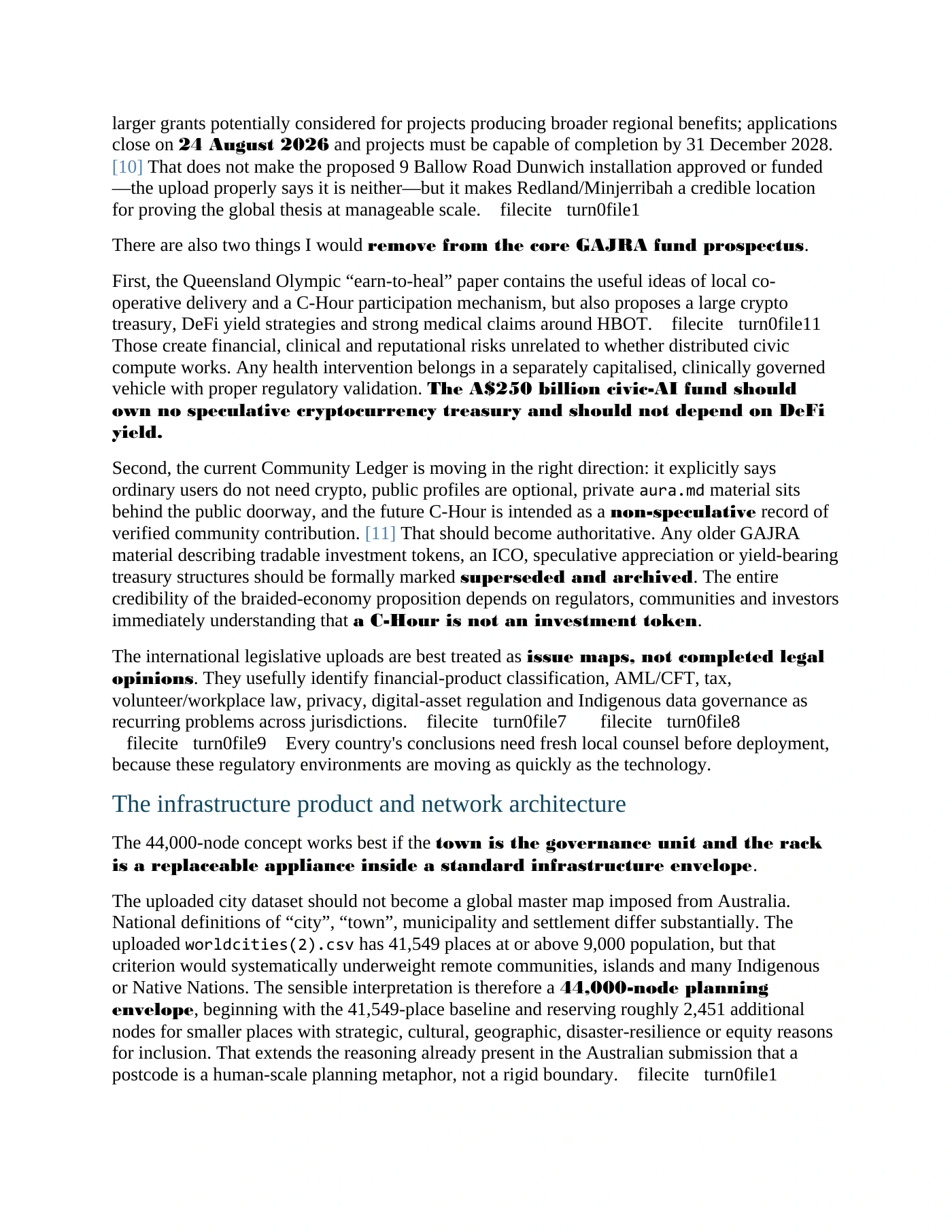
Read selectable text for page 4
Text extracted from this page. Use the page image for its original layout, tables and figures.
close on 24 August 2026 and projects must be capable of completion by 31 December 2028.
[10] That does not make the proposed 9 Ballow Road Dunwich installation approved or funded
—the upload properly says it is neither—but it makes Redland/Minjerribah a credible location
for proving the global thesis at manageable scale. fileciteturn0file1
There are also two things I would remove from the core GAJRA fund prospectus.
First, the Queensland Olympic “earn-to-heal” paper contains the useful ideas of local co-
operative delivery and a C-Hour participation mechanism, but also proposes a large crypto
treasury, DeFi yield strategies and strong medical claims around HBOT. fileciteturn0file11
Those create financial, clinical and reputational risks unrelated to whether distributed civic
compute works. Any health intervention belongs in a separately capitalised, clinically governed
vehicle with proper regulatory validation. The A$250 billion civic-AI fund should
own no speculative cryptocurrency treasury and should not depend on DeFi
yield.
Second, the current Community Ledger is moving in the right direction: it explicitly says
ordinary users do not need crypto, public profiles are optional, private aura.md material sits
behind the public doorway, and the future C-Hour is intended as a non-speculative record of
verified community contribution. [11] That should become authoritative. Any older GAJRA
material describing tradable investment tokens, an ICO, speculative appreciation or yield-bearing
treasury structures should be formally marked superseded and archived. The entire
credibility of the braided-economy proposition depends on regulators, communities and investors
immediately understanding that a C-Hour is not an investment token.
The international legislative uploads are best treated as issue maps, not completed legal
opinions. They usefully identify financial-product classification, AML/CFT, tax,
volunteer/workplace law, privacy, digital-asset regulation and Indigenous data governance as
recurring problems across jurisdictions. fileciteturn0file7 fileciteturn0file8
fileciteturn0file9 Every country's conclusions need fresh local counsel before deployment,
because these regulatory environments are moving as quickly as the technology.
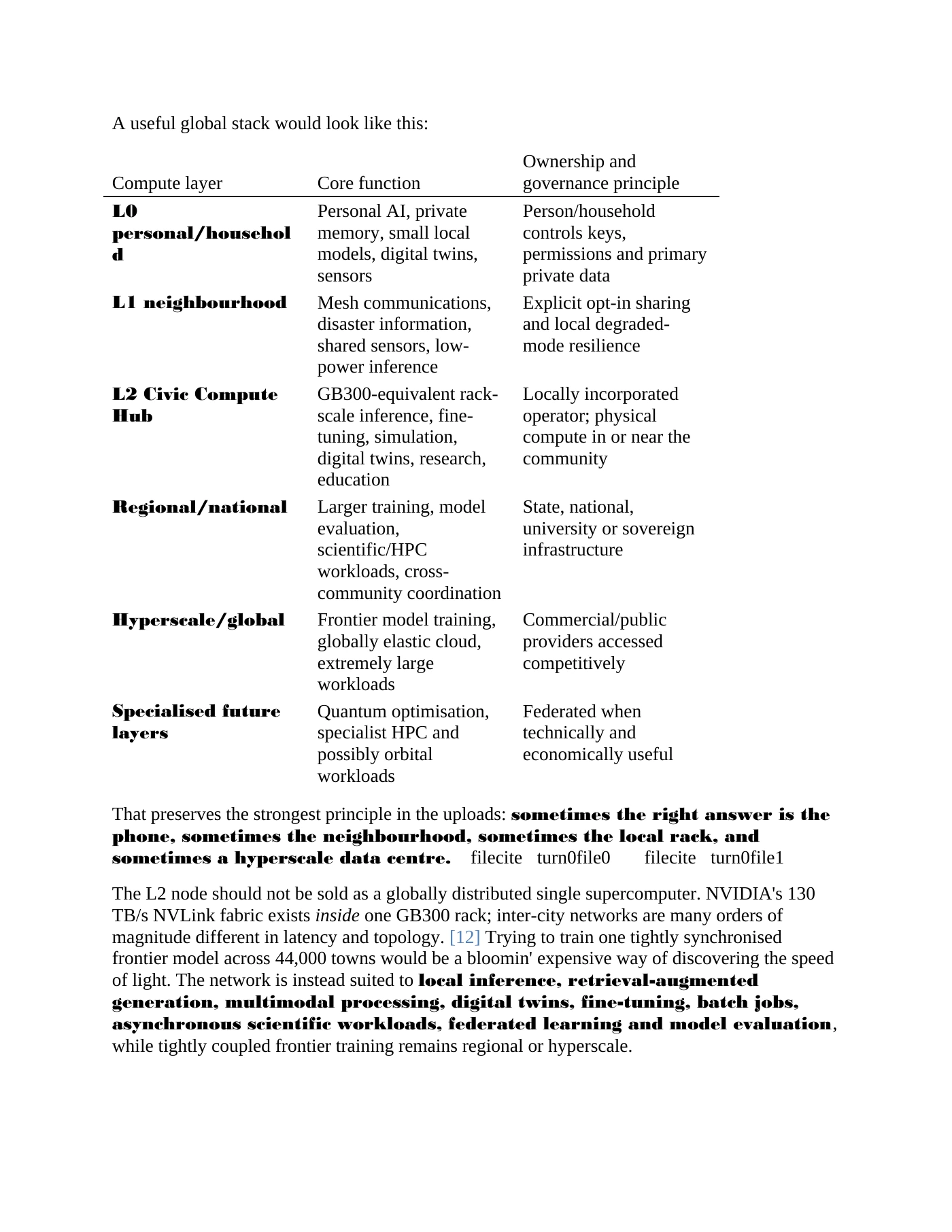
The infrastructure product and network architecture
The 44,000-node concept works best if the town is the governance unit and the rack
is a replaceable appliance inside a standard infrastructure envelope.
The uploaded city dataset should not become a global master map imposed from Australia.
National definitions of “city”, “town”, municipality and settlement differ substantially. The
uploaded worldcities(2).csv has 41,549 places at or above 9,000 population, but that
criterion would systematically underweight remote communities, islands and many Indigenous
or Native Nations. The sensible interpretation is therefore a 44,000-node planning
envelope, beginning with the 41,549-place baseline and reserving roughly 2,451 additional
nodes for smaller places with strategic, cultural, geographic, disaster-resilience or equity reasons
for inclusion. That extends the reasoning already present in the Australian submission that a
postcode is a human-scale planning metaphor, not a rigid boundary. fileciteturn0file1
Page 5 of 23
Read selectable text for page 5
Text extracted from this page. Use the page image for its original layout, tables and figures.
Compute layer Core function
Ownership and
governance principle
L0
personal/househol
d
Personal AI, private
memory, small local
models, digital twins,
sensors
Person/household
controls keys,
permissions and primary
private data
L1 neighbourhood Mesh communications,
disaster information,
shared sensors, low-
power inference
Explicit opt-in sharing
and local degraded-
mode resilience
L2 Civic Compute
Hub
GB300-equivalent rack-
scale inference, fine-
tuning, simulation,
digital twins, research,
education
Locally incorporated
operator; physical
compute in or near the
community
Regional/national Larger training, model
evaluation,
scientific/HPC
workloads, cross-
community coordination
State, national,
university or sovereign
infrastructure
Hyperscale/global Frontier model training,
globally elastic cloud,
extremely large
workloads
Commercial/public
providers accessed
competitively
Specialised future
layers
Quantum optimisation,
specialist HPC and
possibly orbital
workloads
Federated when
technically and
economically useful
That preserves the strongest principle in the uploads: sometimes the right answer is the
phone, sometimes the neighbourhood, sometimes the local rack, and
sometimes a hyperscale data centre. fileciteturn0file0 fileciteturn0file1
The L2 node should not be sold as a globally distributed single supercomputer. NVIDIA's 130
TB/s NVLink fabric exists inside one GB300 rack; inter-city networks are many orders of
magnitude different in latency and topology. [12] Trying to train one tightly synchronised
frontier model across 44,000 towns would be a bloomin' expensive way of discovering the speed
of light. The network is instead suited to local inference, retrieval-augmented
generation, multimodal processing, digital twins, fine-tuning, batch jobs,
asynchronous scientific workloads, federated learning and model evaluation,
while tightly coupled frontier training remains regional or hyperscale.
Page 6 of 23
Read selectable text for page 6
Text extracted from this page. Use the page image for its original layout, tables and figures.
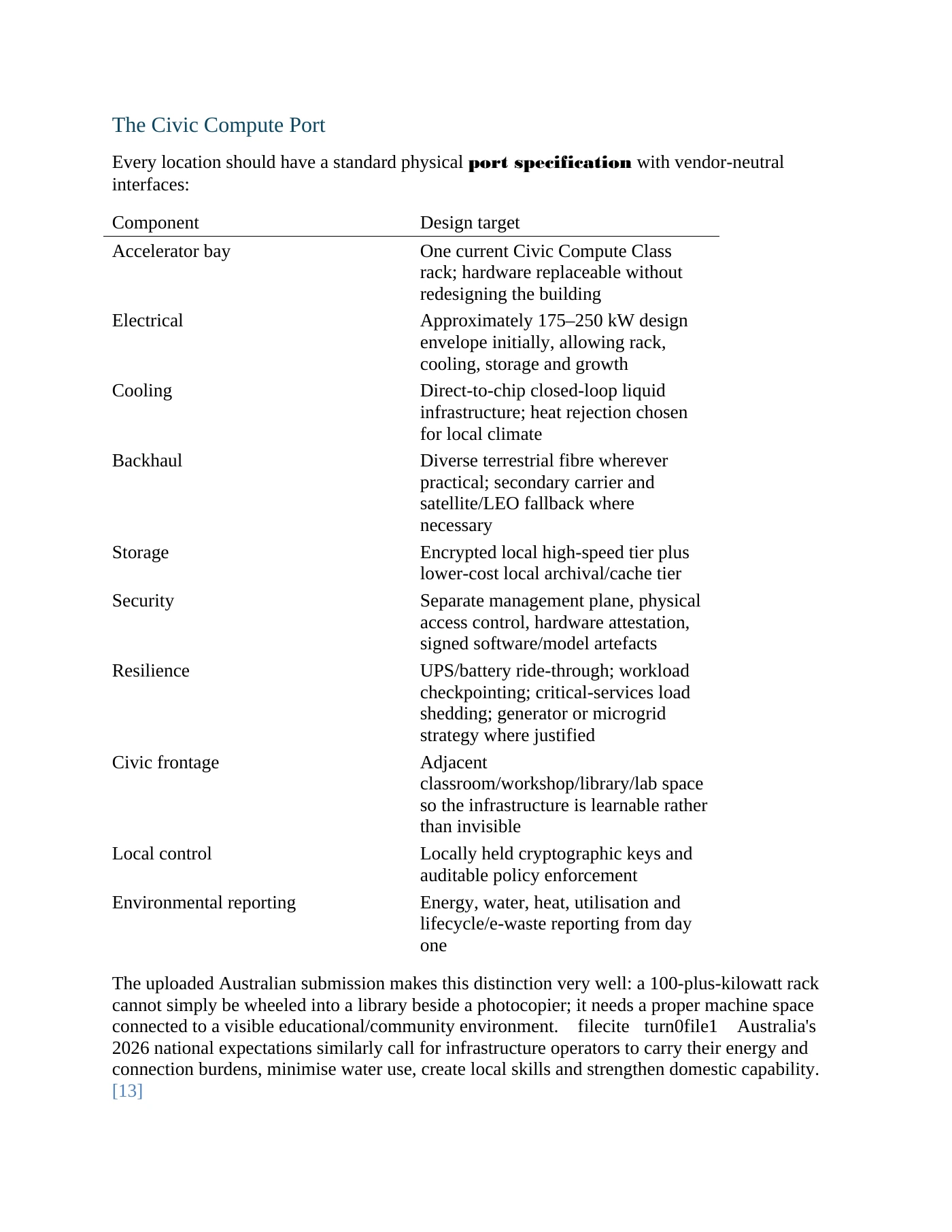
Every location should have a standard physical port specification with vendor-neutral
interfaces:
Component Design target
Accelerator bay One current Civic Compute Class
rack; hardware replaceable without
redesigning the building
Electrical Approximately 175–250 kW design
envelope initially, allowing rack,
cooling, storage and growth
Cooling Direct-to-chip closed-loop liquid
infrastructure; heat rejection chosen
for local climate
Backhaul Diverse terrestrial fibre wherever
practical; secondary carrier and
satellite/LEO fallback where
necessary
Storage Encrypted local high-speed tier plus
lower-cost local archival/cache tier
Security Separate management plane, physical
access control, hardware attestation,
signed software/model artefacts
Resilience UPS/battery ride-through; workload
checkpointing; critical-services load
shedding; generator or microgrid
strategy where justified
Civic frontage Adjacent
classroom/workshop/library/lab space
so the infrastructure is learnable rather
than invisible
Local control Locally held cryptographic keys and
auditable policy enforcement
Environmental reporting Energy, water, heat, utilisation and
lifecycle/e-waste reporting from day
one
The uploaded Australian submission makes this distinction very well: a 100-plus-kilowatt rack
cannot simply be wheeled into a library beside a photocopier; it needs a proper machine space
connected to a visible educational/community environment. fileciteturn0file1 Australia's
2026 national expectations similarly call for infrastructure operators to carry their energy and
connection burdens, minimise water use, create local skills and strengthen domestic capability.
[13]
Page 7 of 23
Read selectable text for page 7
Text extracted from this page. Use the page image for its original layout, tables and figures.
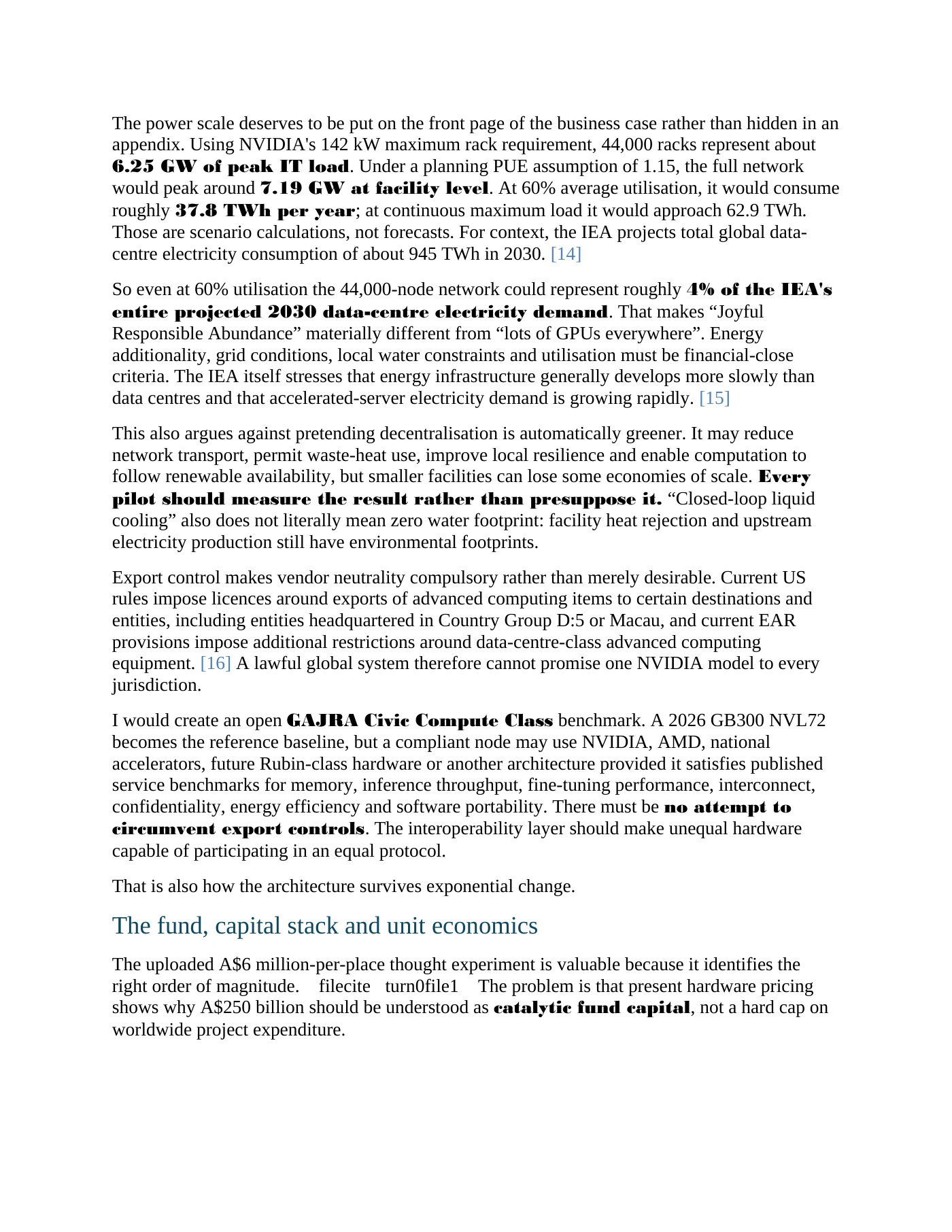
appendix. Using NVIDIA's 142 kW maximum rack requirement, 44,000 racks represent about
6.25 GW of peak IT load. Under a planning PUE assumption of 1.15, the full network
would peak around 7.19 GW at facility level. At 60% average utilisation, it would consume
roughly 37.8 TWh per year; at continuous maximum load it would approach 62.9 TWh.
Those are scenario calculations, not forecasts. For context, the IEA projects total global data-
centre electricity consumption of about 945 TWh in 2030. [14]
So even at 60% utilisation the 44,000-node network could represent roughly 4% of the IEA's
entire projected 2030 data-centre electricity demand. That makes “Joyful
Responsible Abundance” materially different from “lots of GPUs everywhere”. Energy
additionality, grid conditions, local water constraints and utilisation must be financial-close
criteria. The IEA itself stresses that energy infrastructure generally develops more slowly than
data centres and that accelerated-server electricity demand is growing rapidly. [15]
This also argues against pretending decentralisation is automatically greener. It may reduce
network transport, permit waste-heat use, improve local resilience and enable computation to
follow renewable availability, but smaller facilities can lose some economies of scale. Every
pilot should measure the result rather than presuppose it. “Closed-loop liquid
cooling” also does not literally mean zero water footprint: facility heat rejection and upstream
electricity production still have environmental footprints.
Export control makes vendor neutrality compulsory rather than merely desirable. Current US
rules impose licences around exports of advanced computing items to certain destinations and
entities, including entities headquartered in Country Group D:5 or Macau, and current EAR
provisions impose additional restrictions around data-centre-class advanced computing
equipment. [16] A lawful global system therefore cannot promise one NVIDIA model to every
jurisdiction.
I would create an open GAJRA Civic Compute Class benchmark. A 2026 GB300 NVL72
becomes the reference baseline, but a compliant node may use NVIDIA, AMD, national
accelerators, future Rubin-class hardware or another architecture provided it satisfies published
service benchmarks for memory, inference throughput, fine-tuning performance, interconnect,
confidentiality, energy efficiency and software portability. There must be no attempt to
circumvent export controls. The interoperability layer should make unequal hardware
capable of participating in an equal protocol.
That is also how the architecture survives exponential change.
The fund, capital stack and unit economics
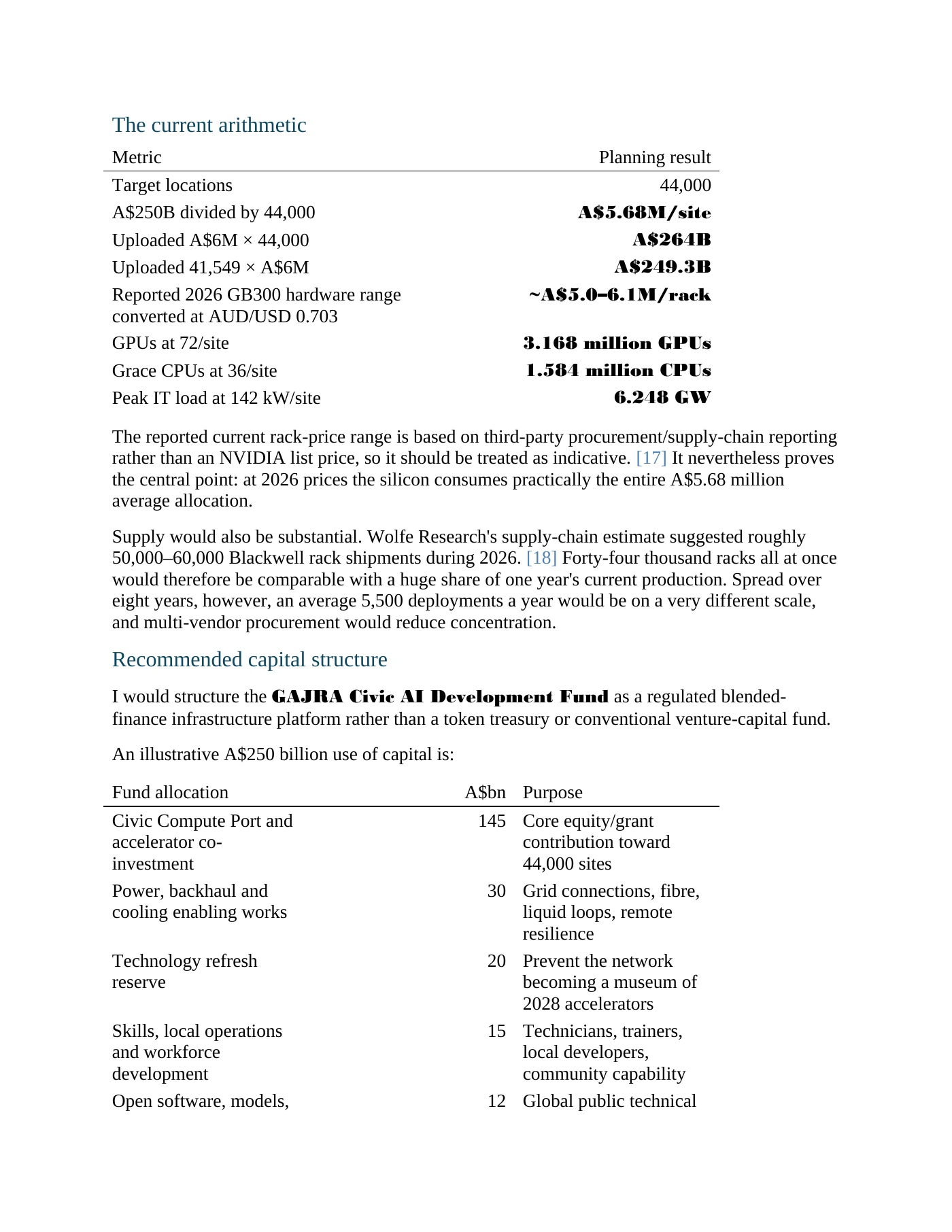
The uploaded A$6 million-per-place thought experiment is valuable because it identifies the
right order of magnitude. fileciteturn0file1 The problem is that present hardware pricing
shows why A$250 billion should be understood as catalytic fund capital, not a hard cap on
worldwide project expenditure.
Page 8 of 23
Read selectable text for page 8
Text extracted from this page. Use the page image for its original layout, tables and figures.
Metric Planning result
Target locations 44,000
A$250B divided by 44,000 A$5.68M/site
Uploaded A$6M × 44,000 A$264B
Uploaded 41,549 × A$6M A$249.3B
Reported 2026 GB300 hardware range
converted at AUD/USD 0.703
~A$5.0–6.1M/rack
GPUs at 72/site 3.168 million GPUs
Grace CPUs at 36/site 1.584 million CPUs
Peak IT load at 142 kW/site 6.248 GW
The reported current rack-price range is based on third-party procurement/supply-chain reporting
rather than an NVIDIA list price, so it should be treated as indicative. [17] It nevertheless proves
the central point: at 2026 prices the silicon consumes practically the entire A$5.68 million
average allocation.
Supply would also be substantial. Wolfe Research's supply-chain estimate suggested roughly
50,000–60,000 Blackwell rack shipments during 2026. [18] Forty-four thousand racks all at once
would therefore be comparable with a huge share of one year's current production. Spread over
eight years, however, an average 5,500 deployments a year would be on a very different scale,
and multi-vendor procurement would reduce concentration.
Recommended capital structure
I would structure the GAJRA Civic AI Development Fund as a regulated blended-
finance infrastructure platform rather than a token treasury or conventional venture-capital fund.
An illustrative A$250 billion use of capital is:
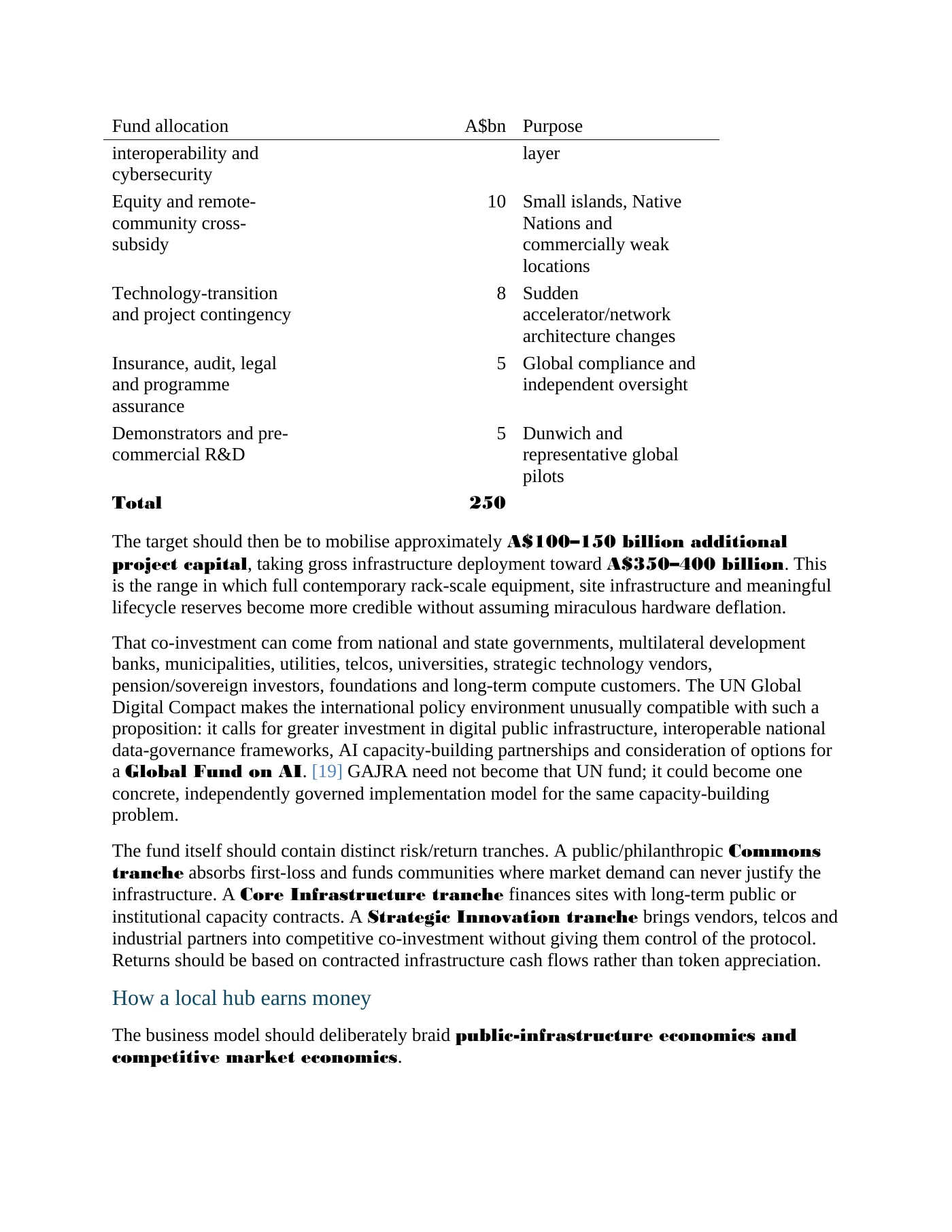
Fund allocation A$bn Purpose
Civic Compute Port and
accelerator co-
investment
145 Core equity/grant
contribution toward
44,000 sites
Power, backhaul and
cooling enabling works
30 Grid connections, fibre,
liquid loops, remote
resilience
Technology refresh
reserve
20 Prevent the network
becoming a museum of
2028 accelerators
Skills, local operations
and workforce
development
15 Technicians, trainers,
local developers,
community capability
Open software, models, 12 Global public technical
Page 9 of 23
Read selectable text for page 9
Text extracted from this page. Use the page image for its original layout, tables and figures.
interoperability and
cybersecurity
layer
Equity and remote-
community cross-
subsidy
10 Small islands, Native
Nations and
commercially weak
locations
Technology-transition
and project contingency
8 Sudden
accelerator/network
architecture changes
Insurance, audit, legal
and programme
assurance
5 Global compliance and
independent oversight
Demonstrators and pre-
commercial R&D
5 Dunwich and
representative global
pilots
Total 250
The target should then be to mobilise approximately A$100–150 billion additional
project capital, taking gross infrastructure deployment toward A$350–400 billion. This
is the range in which full contemporary rack-scale equipment, site infrastructure and meaningful
lifecycle reserves become more credible without assuming miraculous hardware deflation.
That co-investment can come from national and state governments, multilateral development
banks, municipalities, utilities, telcos, universities, strategic technology vendors,
pension/sovereign investors, foundations and long-term compute customers. The UN Global
Digital Compact makes the international policy environment unusually compatible with such a
proposition: it calls for greater investment in digital public infrastructure, interoperable national
data-governance frameworks, AI capacity-building partnerships and consideration of options for
a Global Fund on AI. [19] GAJRA need not become that UN fund; it could become one
concrete, independently governed implementation model for the same capacity-building
problem.
The fund itself should contain distinct risk/return tranches. A public/philanthropic Commons
tranche absorbs first-loss and funds communities where market demand can never justify the
infrastructure. A Core Infrastructure tranche finances sites with long-term public or
institutional capacity contracts. A Strategic Innovation tranche brings vendors, telcos and
industrial partners into competitive co-investment without giving them control of the protocol.
Returns should be based on contracted infrastructure cash flows rather than token appreciation.
How a local hub earns money
The business model should deliberately braid public-infrastructure economics and
competitive market economics.
Page 10 of 23
Read selectable text for page 10
Text extracted from this page. Use the page image for its original layout, tables and figures.
communities will not produce a smooth commercial load curve. Instead, financial close should
require a base of long-term availability contracts that pay for sovereign capability to exist,
just as governments pay for emergency, telecommunications, research and transport capacity
even when it is not continuously saturated.
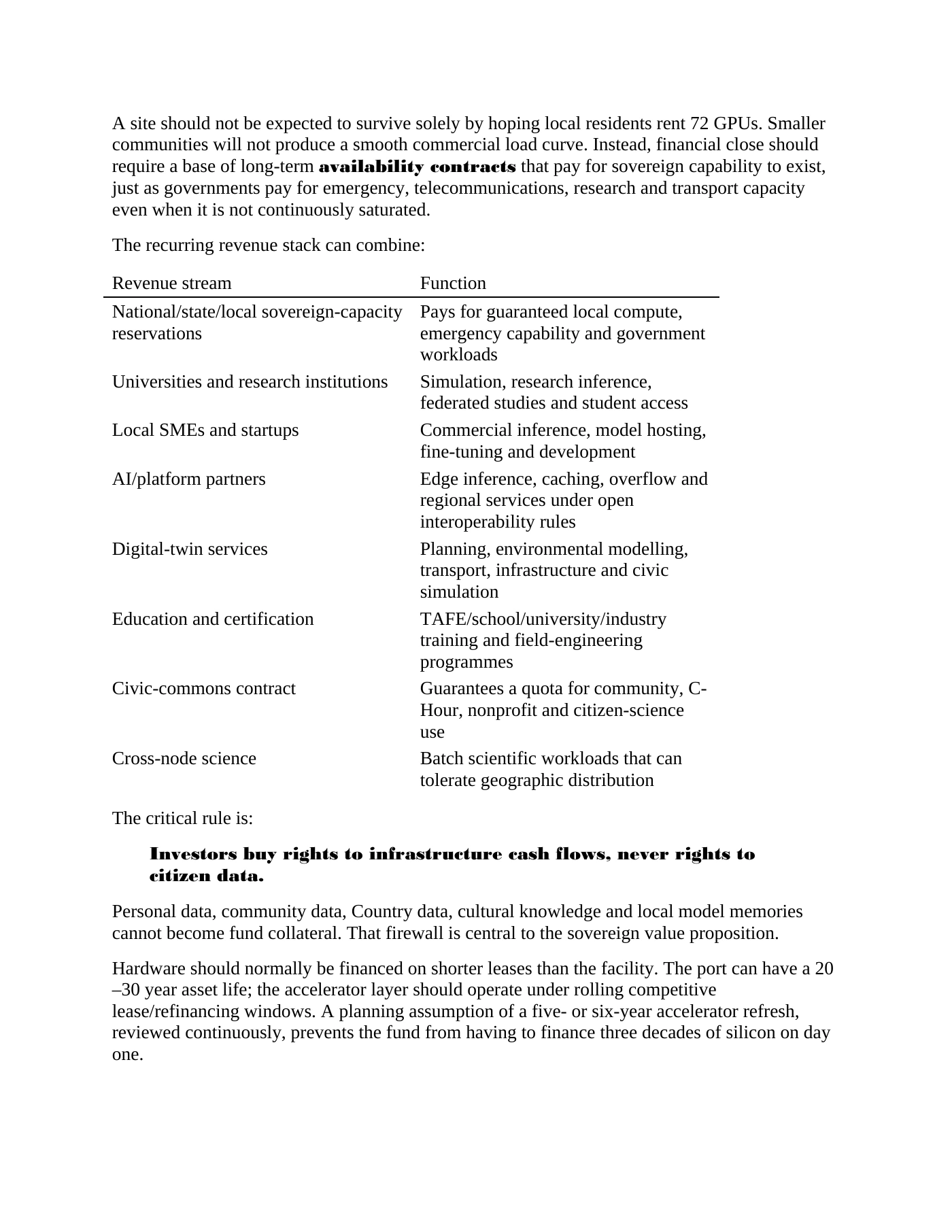
The recurring revenue stack can combine:
Revenue stream Function
National/state/local sovereign-capacity
reservations
Pays for guaranteed local compute,
emergency capability and government
workloads
Universities and research institutions Simulation, research inference,
federated studies and student access
Local SMEs and startups Commercial inference, model hosting,
fine-tuning and development
AI/platform partners Edge inference, caching, overflow and
regional services under open
interoperability rules
Digital-twin services Planning, environmental modelling,
transport, infrastructure and civic
simulation
Education and certification TAFE/school/university/industry
training and field-engineering
programmes
Civic-commons contract Guarantees a quota for community, C-
Hour, nonprofit and citizen-science
use
Cross-node science Batch scientific workloads that can
tolerate geographic distribution
The critical rule is:
Investors buy rights to infrastructure cash flows, never rights to
citizen data.
Personal data, community data, Country data, cultural knowledge and local model memories
cannot become fund collateral. That firewall is central to the sovereign value proposition.
Hardware should normally be financed on shorter leases than the facility. The port can have a 20
–30 year asset life; the accelerator layer should operate under rolling competitive
lease/refinancing windows. A planning assumption of a five- or six-year accelerator refresh,
reviewed continuously, prevents the fund from having to finance three decades of silicon on day
one.
Page 11 of 23
Read selectable text for page 11
Text extracted from this page. Use the page image for its original layout, tables and figures.
distributing profits. A local node that boasts a healthy operating margin while accumulating
no capital for the next generation of accelerators is not financially sustainable.
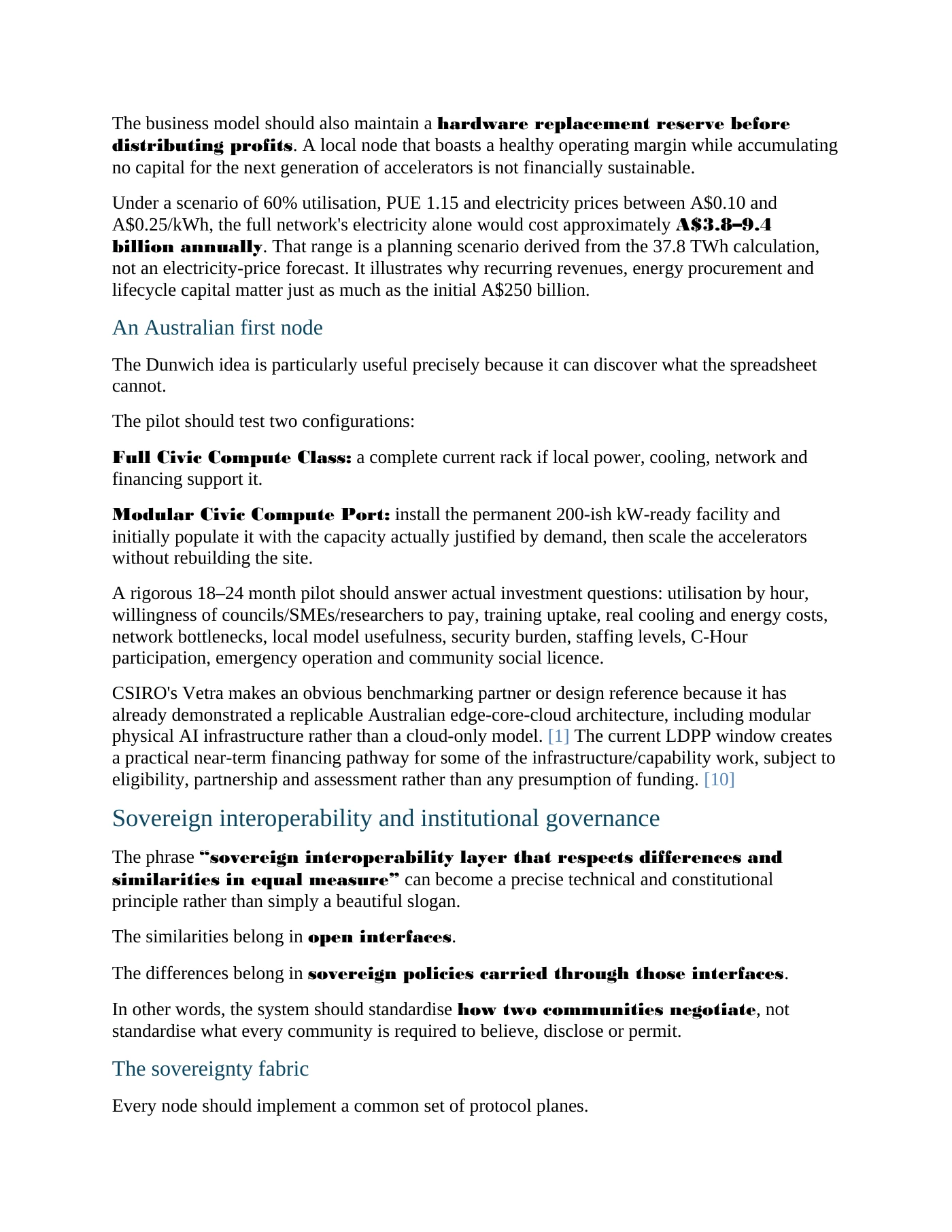
Under a scenario of 60% utilisation, PUE 1.15 and electricity prices between A$0.10 and
A$0.25/kWh, the full network's electricity alone would cost approximately A$3.8–9.4
billion annually. That range is a planning scenario derived from the 37.8 TWh calculation,
not an electricity-price forecast. It illustrates why recurring revenues, energy procurement and
lifecycle capital matter just as much as the initial A$250 billion.
An Australian first node
The Dunwich idea is particularly useful precisely because it can discover what the spreadsheet
cannot.
The pilot should test two configurations:
Full Civic Compute Class: a complete current rack if local power, cooling, network and
financing support it.
Modular Civic Compute Port: install the permanent 200-ish kW-ready facility and
initially populate it with the capacity actually justified by demand, then scale the accelerators
without rebuilding the site.
A rigorous 18–24 month pilot should answer actual investment questions: utilisation by hour,
willingness of councils/SMEs/researchers to pay, training uptake, real cooling and energy costs,
network bottlenecks, local model usefulness, security burden, staffing levels, C-Hour
participation, emergency operation and community social licence.
CSIRO's Vetra makes an obvious benchmarking partner or design reference because it has
already demonstrated a replicable Australian edge-core-cloud architecture, including modular
physical AI infrastructure rather than a cloud-only model. [1] The current LDPP window creates
a practical near-term financing pathway for some of the infrastructure/capability work, subject to
eligibility, partnership and assessment rather than any presumption of funding. [10]
Sovereign interoperability and institutional governance
The phrase “sovereign interoperability layer that respects differences and
similarities in equal measure” can become a precise technical and constitutional
principle rather than simply a beautiful slogan.
The similarities belong in open interfaces.
The differences belong in sovereign policies carried through those interfaces.
In other words, the system should standardise how two communities negotiate, not
standardise what every community is required to believe, disclose or permit.
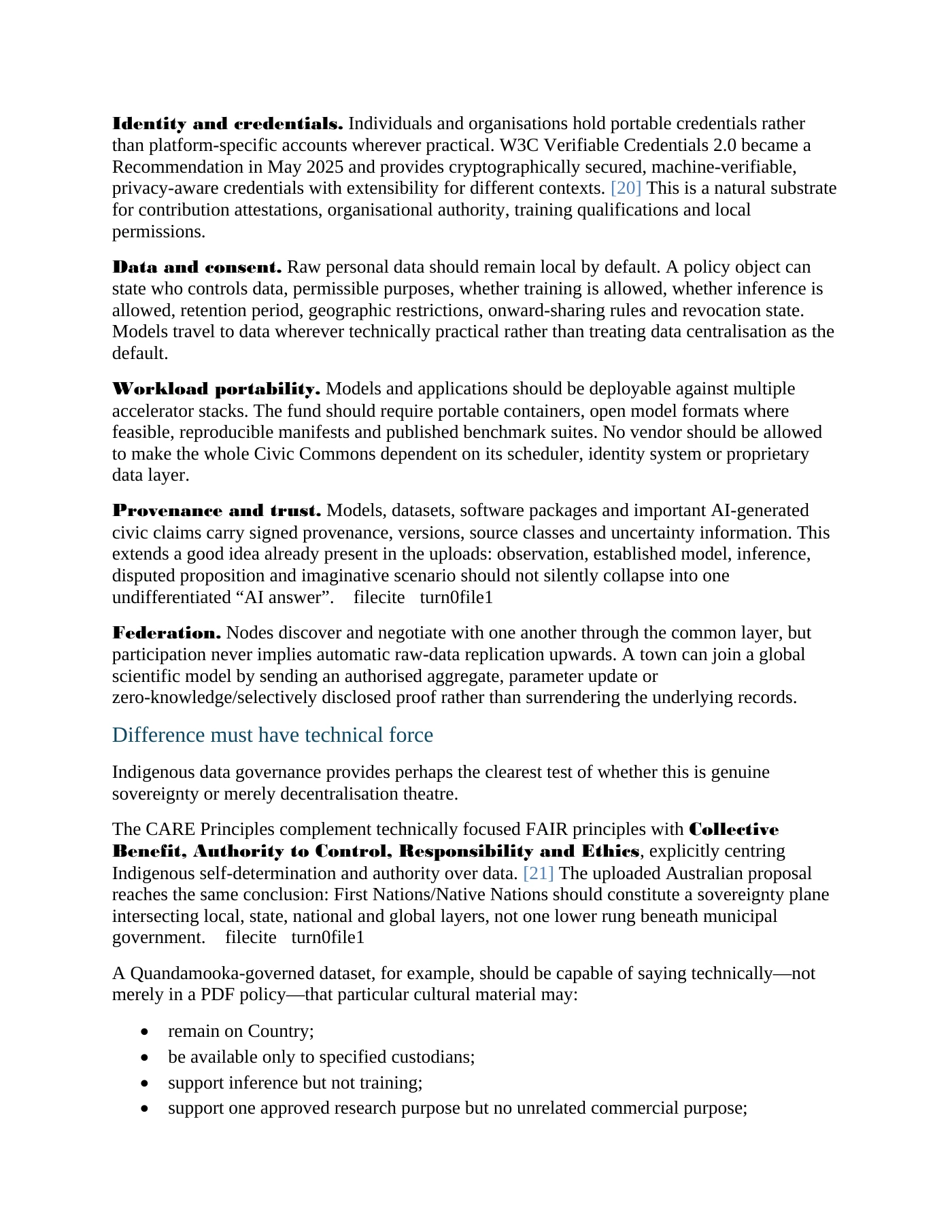
The sovereignty fabric
Every node should implement a common set of protocol planes.
Page 12 of 23
Read selectable text for page 12
Text extracted from this page. Use the page image for its original layout, tables and figures.
than platform-specific accounts wherever practical. W3C Verifiable Credentials 2.0 became a
Recommendation in May 2025 and provides cryptographically secured, machine-verifiable,
privacy-aware credentials with extensibility for different contexts. [20] This is a natural substrate
for contribution attestations, organisational authority, training qualifications and local
permissions.
Data and consent. Raw personal data should remain local by default. A policy object can
state who controls data, permissible purposes, whether training is allowed, whether inference is
allowed, retention period, geographic restrictions, onward-sharing rules and revocation state.
Models travel to data wherever technically practical rather than treating data centralisation as the
default.
Workload portability. Models and applications should be deployable against multiple
accelerator stacks. The fund should require portable containers, open model formats where
feasible, reproducible manifests and published benchmark suites. No vendor should be allowed
to make the whole Civic Commons dependent on its scheduler, identity system or proprietary
data layer.
Provenance and trust. Models, datasets, software packages and important AI-generated
civic claims carry signed provenance, versions, source classes and uncertainty information. This
extends a good idea already present in the uploads: observation, established model, inference,
disputed proposition and imaginative scenario should not silently collapse into one
undifferentiated “AI answer”. fileciteturn0file1
Federation. Nodes discover and negotiate with one another through the common layer, but
participation never implies automatic raw-data replication upwards. A town can join a global
scientific model by sending an authorised aggregate, parameter update or
zero-knowledge/selectively disclosed proof rather than surrendering the underlying records.
Difference must have technical force
Indigenous data governance provides perhaps the clearest test of whether this is genuine
sovereignty or merely decentralisation theatre.
The CARE Principles complement technically focused FAIR principles with Collective
Benefit, Authority to Control, Responsibility and Ethics, explicitly centring
Indigenous self-determination and authority over data. [21] The uploaded Australian proposal
reaches the same conclusion: First Nations/Native Nations should constitute a sovereignty plane
intersecting local, state, national and global layers, not one lower rung beneath municipal
government. fileciteturn0file1
A Quandamooka-governed dataset, for example, should be capable of saying technically—not
merely in a PDF policy—that particular cultural material may:
remain on Country;
be available only to specified custodians;
support inference but not training;
support one approved research purpose but no unrelated commercial purpose;
Page 13 of 23
Read selectable text for page 13
Text extracted from this page. Use the page image for its original layout, tables and figures.
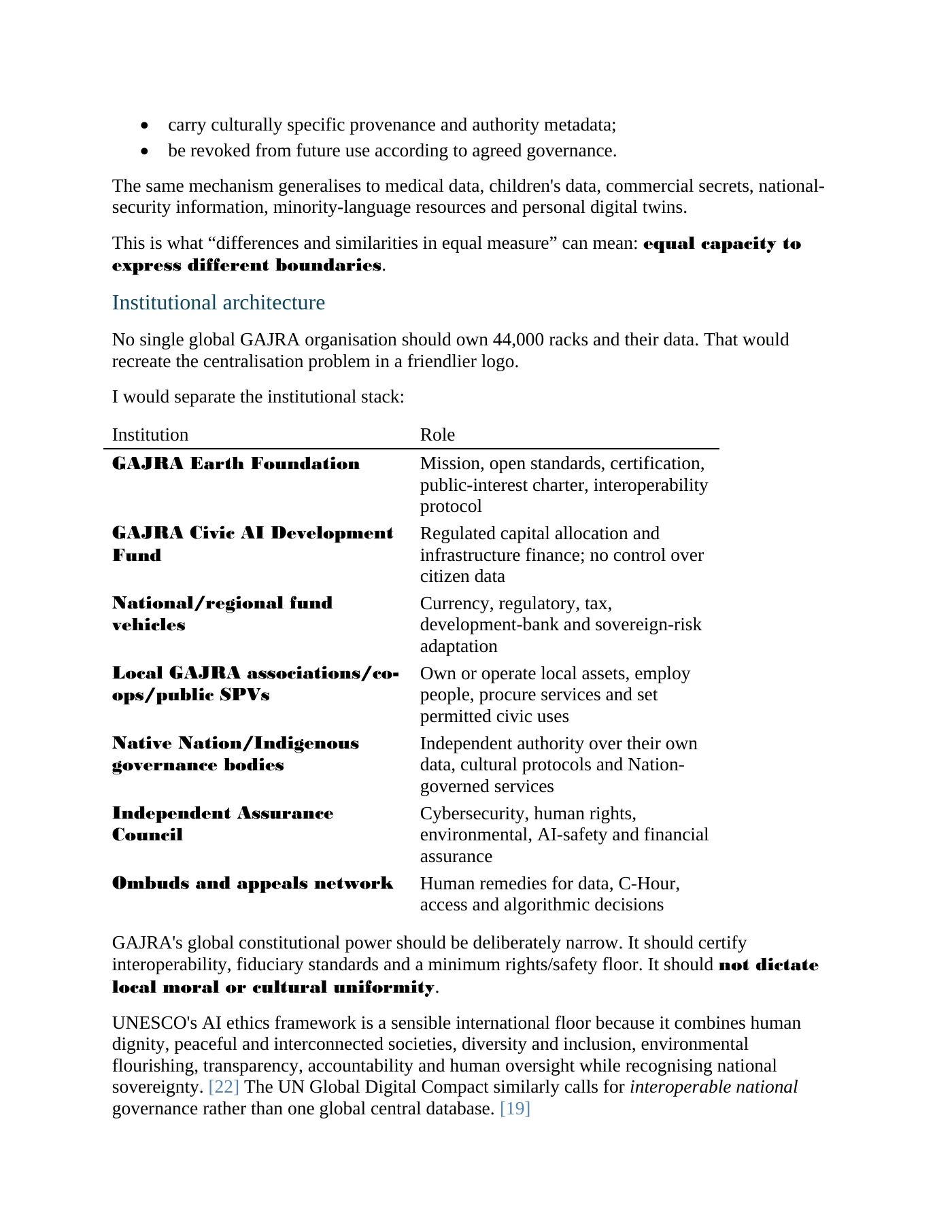
be revoked from future use according to agreed governance.
The same mechanism generalises to medical data, children's data, commercial secrets, national-
security information, minority-language resources and personal digital twins.
This is what “differences and similarities in equal measure” can mean: equal capacity to
express different boundaries.
Institutional architecture
No single global GAJRA organisation should own 44,000 racks and their data. That would
recreate the centralisation problem in a friendlier logo.
I would separate the institutional stack:
Institution Role
GAJRA Earth Foundation Mission, open standards, certification,
public-interest charter, interoperability
protocol
GAJRA Civic AI Development
Fund
Regulated capital allocation and
infrastructure finance; no control over
citizen data
National/regional fund
vehicles
Currency, regulatory, tax,
development-bank and sovereign-risk
adaptation
Local GAJRA associations/co-
ops/public SPVs
Own or operate local assets, employ
people, procure services and set
permitted civic uses
Native Nation/Indigenous
governance bodies
Independent authority over their own
data, cultural protocols and Nation-
governed services
Independent Assurance
Council
Cybersecurity, human rights,
environmental, AI-safety and financial
assurance
Ombuds and appeals network Human remedies for data, C-Hour,
access and algorithmic decisions
GAJRA's global constitutional power should be deliberately narrow. It should certify
interoperability, fiduciary standards and a minimum rights/safety floor. It should not dictate
local moral or cultural uniformity.
UNESCO's AI ethics framework is a sensible international floor because it combines human
dignity, peaceful and interconnected societies, diversity and inclusion, environmental
flourishing, transparency, accountability and human oversight while recognising national
sovereignty. [22] The UN Global Digital Compact similarly calls for interoperable national
governance rather than one global central database. [19]
Page 14 of 23
Read selectable text for page 14
Text extracted from this page. Use the page image for its original layout, tables and figures.
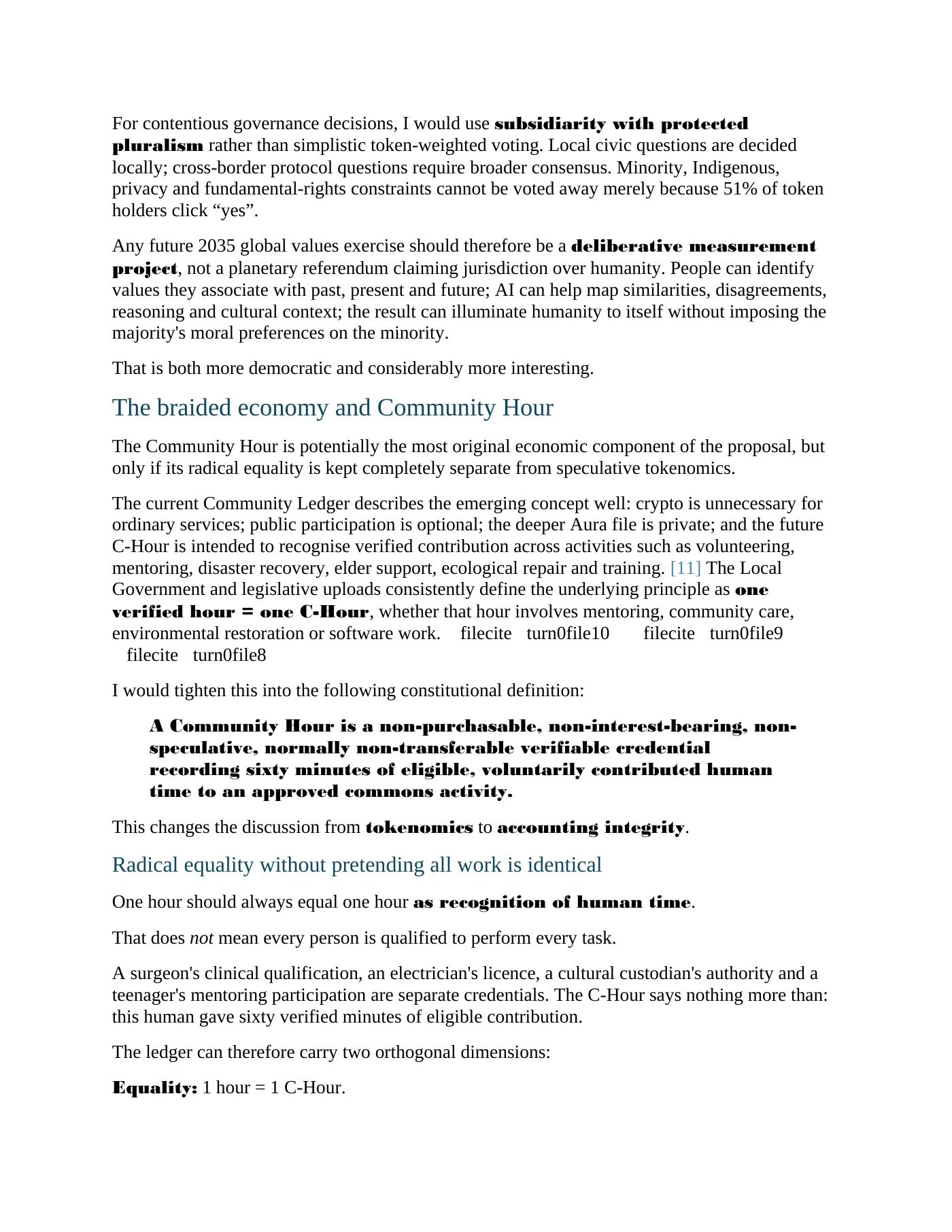
pluralism rather than simplistic token-weighted voting. Local civic questions are decided
locally; cross-border protocol questions require broader consensus. Minority, Indigenous,
privacy and fundamental-rights constraints cannot be voted away merely because 51% of token
holders click “yes”.
Any future 2035 global values exercise should therefore be a deliberative measurement
project, not a planetary referendum claiming jurisdiction over humanity. People can identify
values they associate with past, present and future; AI can help map similarities, disagreements,
reasoning and cultural context; the result can illuminate humanity to itself without imposing the
majority's moral preferences on the minority.
That is both more democratic and considerably more interesting.
The braided economy and Community Hour
The Community Hour is potentially the most original economic component of the proposal, but
only if its radical equality is kept completely separate from speculative tokenomics.
The current Community Ledger describes the emerging concept well: crypto is unnecessary for
ordinary services; public participation is optional; the deeper Aura file is private; and the future
C-Hour is intended to recognise verified contribution across activities such as volunteering,
mentoring, disaster recovery, elder support, ecological repair and training. [11] The Local
Government and legislative uploads consistently define the underlying principle as one
verified hour = one C-Hour, whether that hour involves mentoring, community care,
environmental restoration or software work. fileciteturn0file10 fileciteturn0file9
fileciteturn0file8
I would tighten this into the following constitutional definition:
A Community Hour is a non-purchasable, non-interest-bearing, non-
speculative, normally non-transferable verifiable credential
recording sixty minutes of eligible, voluntarily contributed human
time to an approved commons activity.
This changes the discussion from tokenomics to accounting integrity.
Radical equality without pretending all work is identical
One hour should always equal one hour as recognition of human time.
That does not mean every person is qualified to perform every task.
A surgeon's clinical qualification, an electrician's licence, a cultural custodian's authority and a
teenager's mentoring participation are separate credentials. The C-Hour says nothing more than:
this human gave sixty verified minutes of eligible contribution.
The ledger can therefore carry two orthogonal dimensions:
Equality: 1 hour = 1 C-Hour.
Page 15 of 23
Read selectable text for page 15
Text extracted from this page. Use the page image for its original layout, tables and figures.
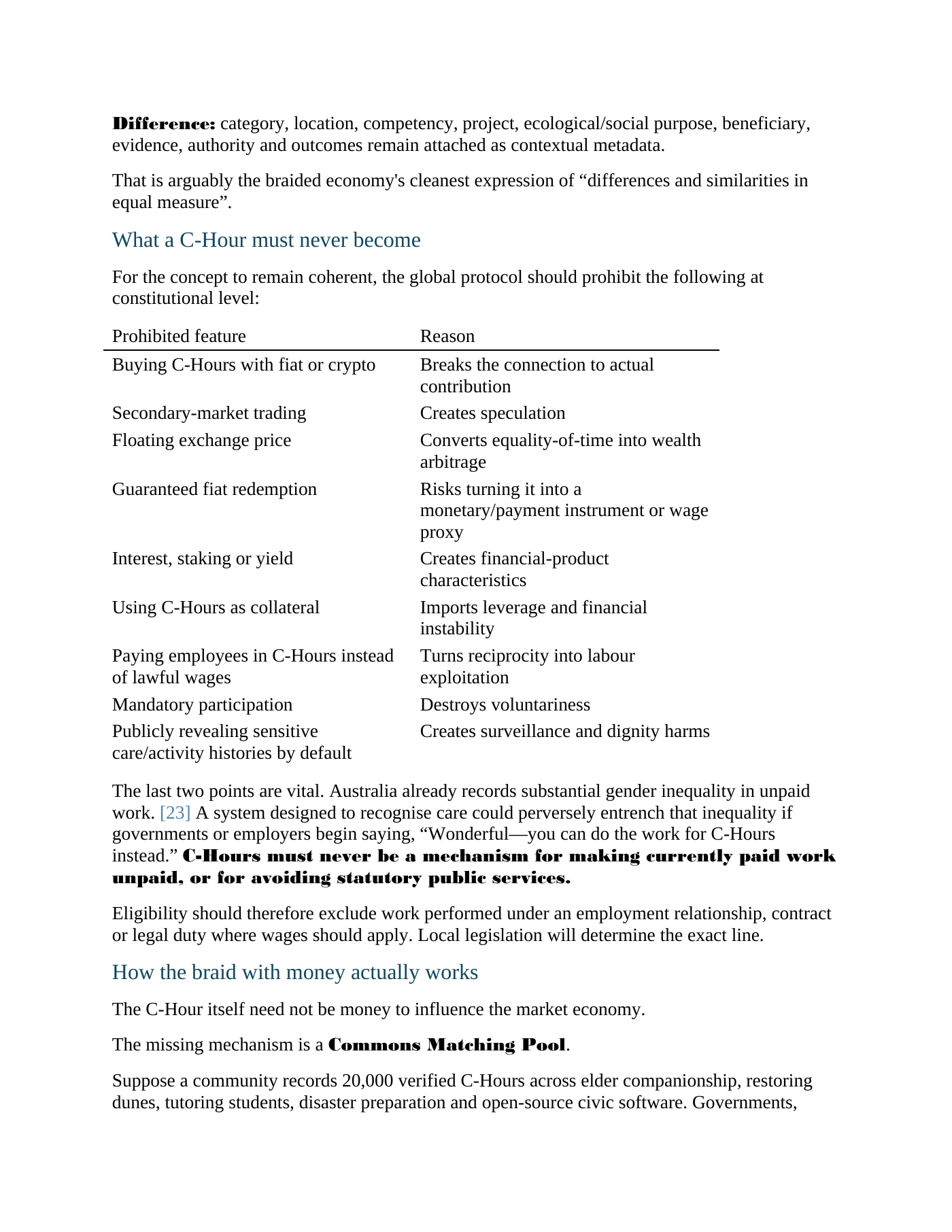
evidence, authority and outcomes remain attached as contextual metadata.
That is arguably the braided economy's cleanest expression of “differences and similarities in
equal measure”.
What a C-Hour must never become
For the concept to remain coherent, the global protocol should prohibit the following at
constitutional level:
Prohibited feature Reason
Buying C-Hours with fiat or crypto Breaks the connection to actual
contribution
Secondary-market trading Creates speculation
Floating exchange price Converts equality-of-time into wealth
arbitrage
Guaranteed fiat redemption Risks turning it into a
monetary/payment instrument or wage
proxy
Interest, staking or yield Creates financial-product
characteristics
Using C-Hours as collateral Imports leverage and financial
instability
Paying employees in C-Hours instead
of lawful wages
Turns reciprocity into labour
exploitation
Mandatory participation Destroys voluntariness
Publicly revealing sensitive
care/activity histories by default
Creates surveillance and dignity harms
The last two points are vital. Australia already records substantial gender inequality in unpaid
work. [23] A system designed to recognise care could perversely entrench that inequality if
governments or employers begin saying, “Wonderful—you can do the work for C-Hours
instead.” C-Hours must never be a mechanism for making currently paid work
unpaid, or for avoiding statutory public services.
Eligibility should therefore exclude work performed under an employment relationship, contract
or legal duty where wages should apply. Local legislation will determine the exact line.
How the braid with money actually works
The C-Hour itself need not be money to influence the market economy.
The missing mechanism is a Commons Matching Pool.
Suppose a community records 20,000 verified C-Hours across elder companionship, restoring
dunes, tutoring students, disaster preparation and open-source civic software. Governments,
Page 16 of 23
Read selectable text for page 16
Text extracted from this page. Use the page image for its original layout, tables and figures.
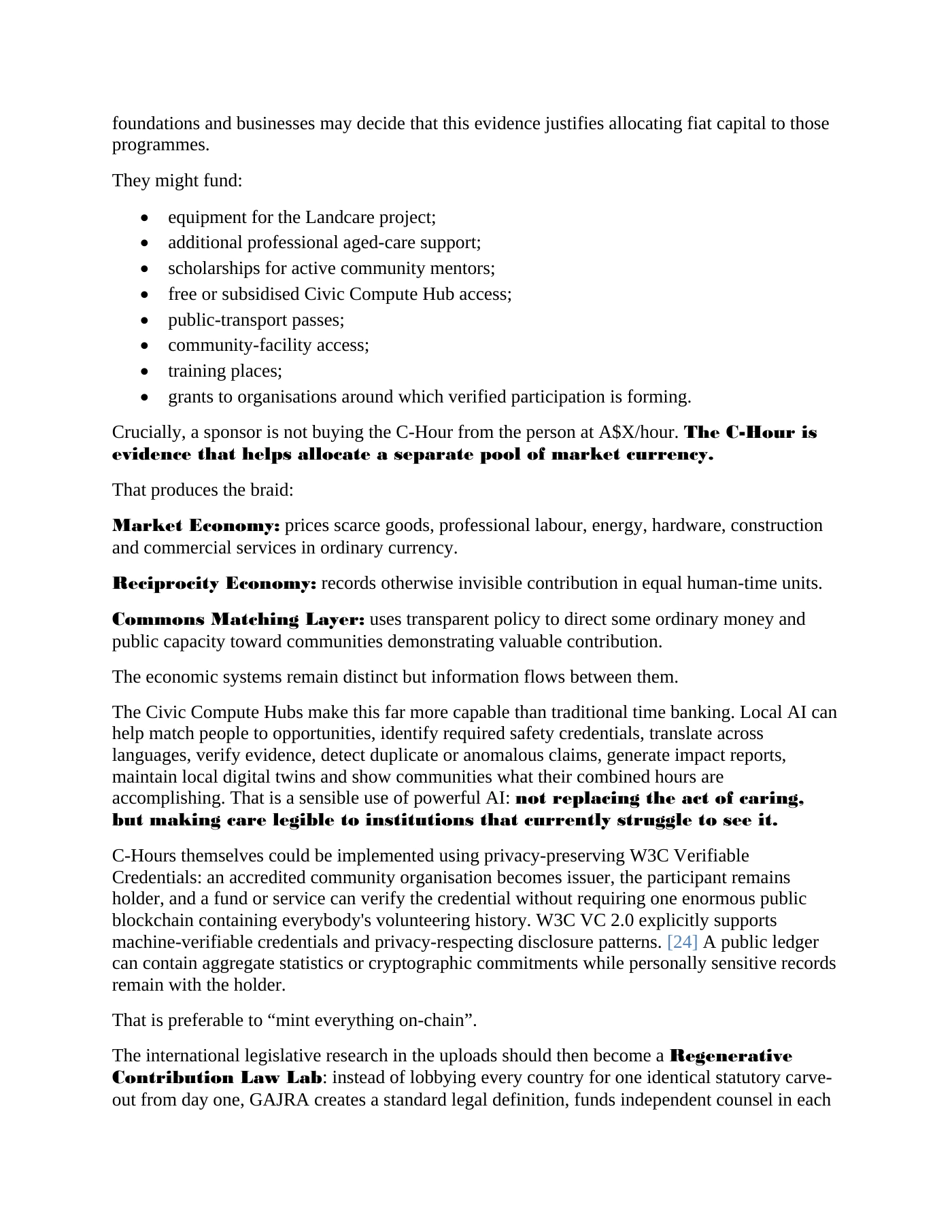
programmes.
They might fund:
equipment for the Landcare project;
additional professional aged-care support;
scholarships for active community mentors;
free or subsidised Civic Compute Hub access;
public-transport passes;
community-facility access;
training places;
grants to organisations around which verified participation is forming.
Crucially, a sponsor is not buying the C-Hour from the person at A$X/hour. The C-Hour is
evidence that helps allocate a separate pool of market currency.
That produces the braid:
Market Economy: prices scarce goods, professional labour, energy, hardware, construction
and commercial services in ordinary currency.
Reciprocity Economy: records otherwise invisible contribution in equal human-time units.
Commons Matching Layer: uses transparent policy to direct some ordinary money and
public capacity toward communities demonstrating valuable contribution.
The economic systems remain distinct but information flows between them.
The Civic Compute Hubs make this far more capable than traditional time banking. Local AI can
help match people to opportunities, identify required safety credentials, translate across
languages, verify evidence, detect duplicate or anomalous claims, generate impact reports,
maintain local digital twins and show communities what their combined hours are
accomplishing. That is a sensible use of powerful AI: not replacing the act of caring,
but making care legible to institutions that currently struggle to see it.
C-Hours themselves could be implemented using privacy-preserving W3C Verifiable
Credentials: an accredited community organisation becomes issuer, the participant remains
holder, and a fund or service can verify the credential without requiring one enormous public
blockchain containing everybody's volunteering history. W3C VC 2.0 explicitly supports
machine-verifiable credentials and privacy-respecting disclosure patterns. [24] A public ledger
can contain aggregate statistics or cryptographic commitments while personally sensitive records
remain with the holder.
That is preferable to “mint everything on-chain”.
The international legislative research in the uploads should then become a Regenerative
Contribution Law Lab: instead of lobbying every country for one identical statutory carve-
out from day one, GAJRA creates a standard legal definition, funds independent counsel in each
Page 17 of 23
Read selectable text for page 17
Text extracted from this page. Use the page image for its original layout, tables and figures.
volunteering, employment, social-security interactions, AML/CFT, consumer law and privacy.
fileciteturn0file7 fileciteturn0file8 fileciteturn0file9
The C-Hour's strategic advantage is precisely that it can remain valuable even where
the law does not permit it to be a transferable digital asset. A signed civic-
contribution credential still works.
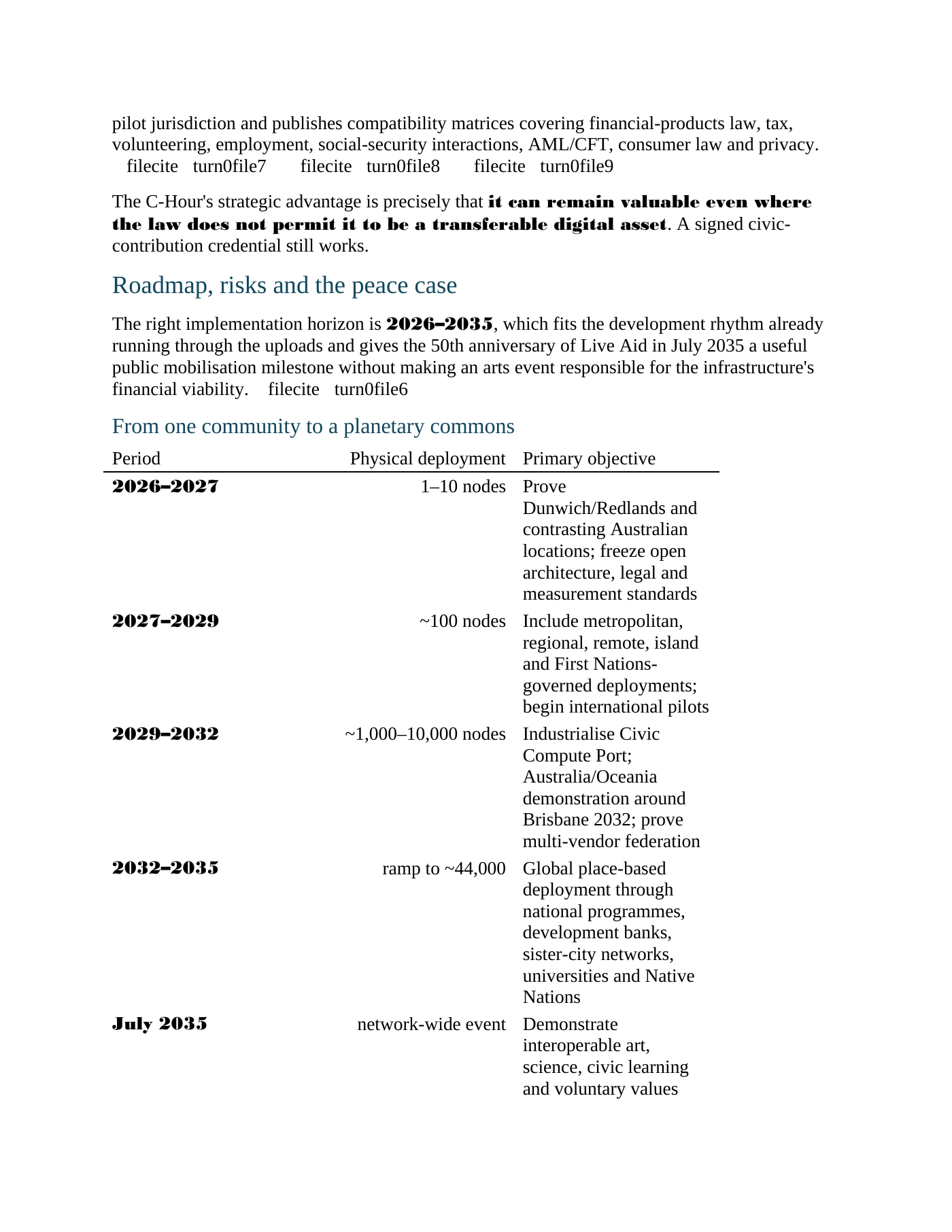
Roadmap, risks and the peace case
The right implementation horizon is 2026–2035, which fits the development rhythm already
running through the uploads and gives the 50th anniversary of Live Aid in July 2035 a useful
public mobilisation milestone without making an arts event responsible for the infrastructure's
financial viability. fileciteturn0file6
From one community to a planetary commons
Period Physical deployment Primary objective
2026–2027 1–10 nodes Prove
Dunwich/Redlands and
contrasting Australian
locations; freeze open
architecture, legal and
measurement standards
2027–2029 ~100 nodes Include metropolitan,
regional, remote, island
and First Nations-
governed deployments;
begin international pilots
2029–2032 ~1,000–10,000 nodes Industrialise Civic
Compute Port;
Australia/Oceania
demonstration around
Brisbane 2032; prove
multi-vendor federation
2032–2035 ramp to ~44,000 Global place-based
deployment through
national programmes,
development banks,
sister-city networks,
universities and Native
Nations
July 2035 network-wide event Demonstrate
interoperable art,
science, civic learning
and voluntary values
Page 18 of 23
Read selectable text for page 18
Text extracted from this page. Use the page image for its original layout, tables and figures.
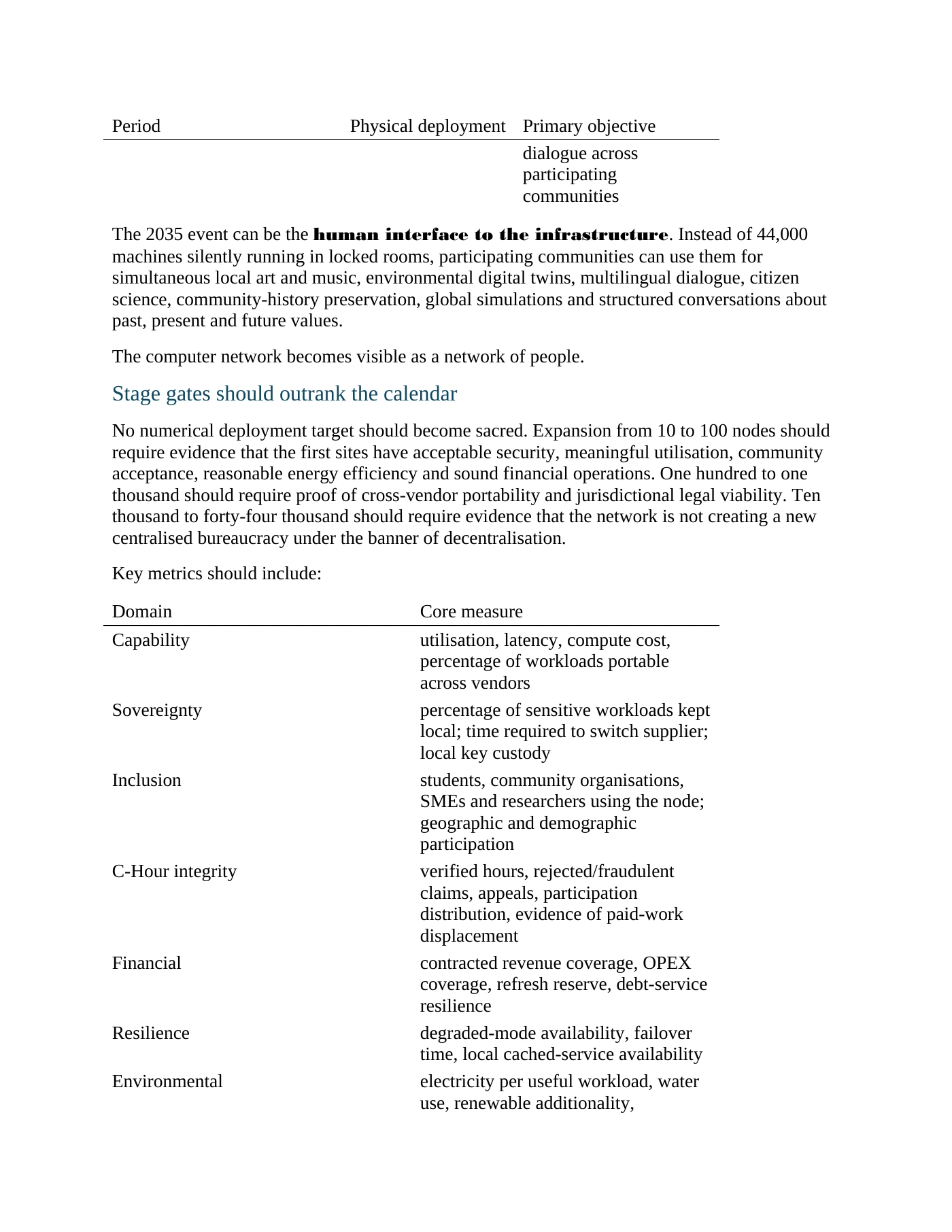
dialogue across
participating
communities
The 2035 event can be the human interface to the infrastructure. Instead of 44,000
machines silently running in locked rooms, participating communities can use them for
simultaneous local art and music, environmental digital twins, multilingual dialogue, citizen
science, community-history preservation, global simulations and structured conversations about
past, present and future values.
The computer network becomes visible as a network of people.
Stage gates should outrank the calendar
No numerical deployment target should become sacred. Expansion from 10 to 100 nodes should
require evidence that the first sites have acceptable security, meaningful utilisation, community
acceptance, reasonable energy efficiency and sound financial operations. One hundred to one
thousand should require proof of cross-vendor portability and jurisdictional legal viability. Ten
thousand to forty-four thousand should require evidence that the network is not creating a new
centralised bureaucracy under the banner of decentralisation.
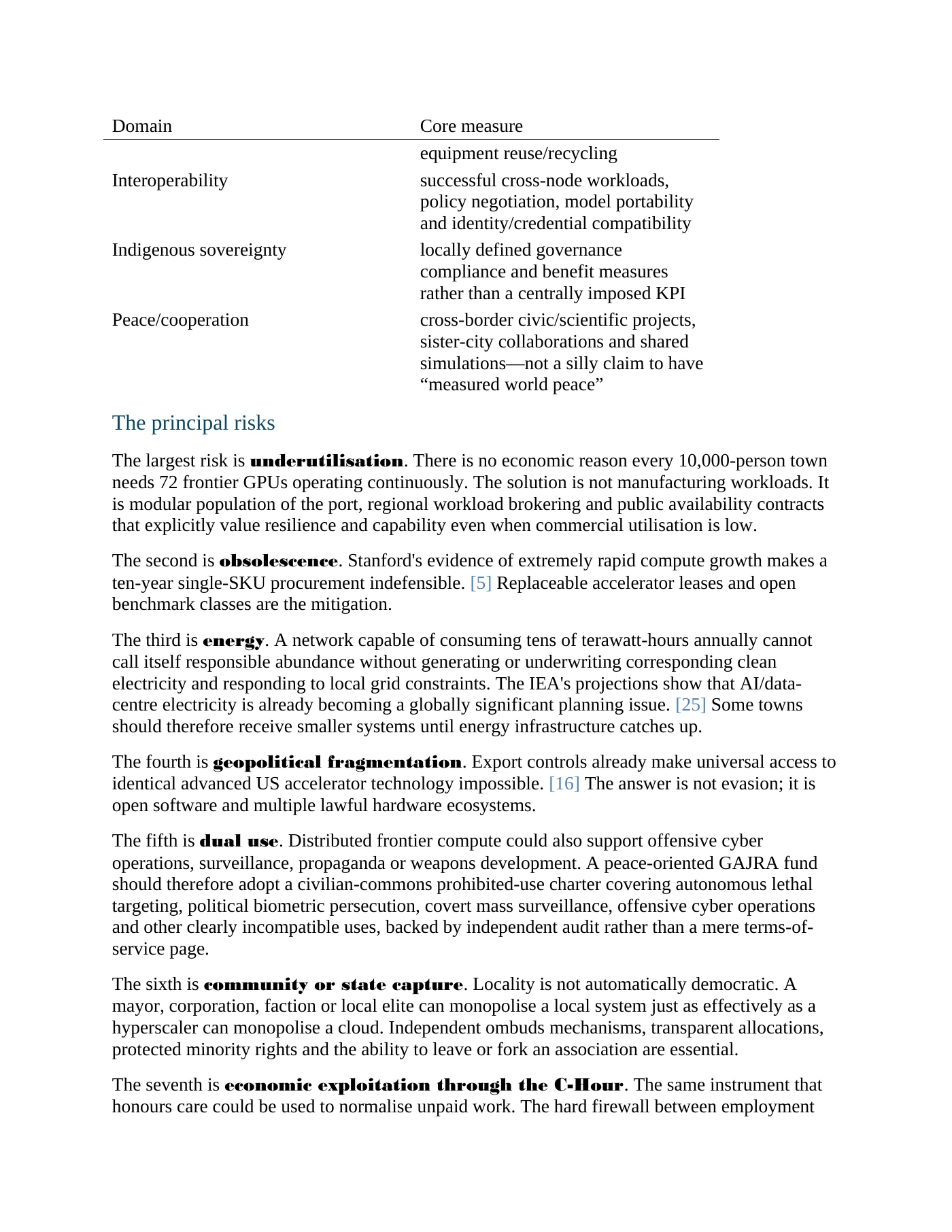
Key metrics should include:
Domain Core measure
Capability utilisation, latency, compute cost,
percentage of workloads portable
across vendors
Sovereignty percentage of sensitive workloads kept
local; time required to switch supplier;
local key custody
Inclusion students, community organisations,
SMEs and researchers using the node;
geographic and demographic
participation
C-Hour integrity verified hours, rejected/fraudulent
claims, appeals, participation
distribution, evidence of paid-work
displacement
Financial contracted revenue coverage, OPEX
coverage, refresh reserve, debt-service
resilience
Resilience degraded-mode availability, failover
time, local cached-service availability
Environmental electricity per useful workload, water
use, renewable additionality,
Page 19 of 23
Read selectable text for page 19
Text extracted from this page. Use the page image for its original layout, tables and figures.
equipment reuse/recycling
Interoperability successful cross-node workloads,
policy negotiation, model portability
and identity/credential compatibility
Indigenous sovereignty locally defined governance
compliance and benefit measures
rather than a centrally imposed KPI
Peace/cooperation cross-border civic/scientific projects,
sister-city collaborations and shared
simulations—not a silly claim to have
“measured world peace”
The principal risks
The largest risk is underutilisation. There is no economic reason every 10,000-person town
needs 72 frontier GPUs operating continuously. The solution is not manufacturing workloads. It
is modular population of the port, regional workload brokering and public availability contracts
that explicitly value resilience and capability even when commercial utilisation is low.
The second is obsolescence. Stanford's evidence of extremely rapid compute growth makes a
ten-year single-SKU procurement indefensible. [5] Replaceable accelerator leases and open
benchmark classes are the mitigation.
The third is energy. A network capable of consuming tens of terawatt-hours annually cannot
call itself responsible abundance without generating or underwriting corresponding clean
electricity and responding to local grid constraints. The IEA's projections show that AI/data-
centre electricity is already becoming a globally significant planning issue. [25] Some towns
should therefore receive smaller systems until energy infrastructure catches up.
The fourth is geopolitical fragmentation. Export controls already make universal access to
identical advanced US accelerator technology impossible. [16] The answer is not evasion; it is
open software and multiple lawful hardware ecosystems.
The fifth is dual use. Distributed frontier compute could also support offensive cyber
operations, surveillance, propaganda or weapons development. A peace-oriented GAJRA fund
should therefore adopt a civilian-commons prohibited-use charter covering autonomous lethal
targeting, political biometric persecution, covert mass surveillance, offensive cyber operations
and other clearly incompatible uses, backed by independent audit rather than a mere terms-of-
service page.
The sixth is community or state capture. Locality is not automatically democratic. A
mayor, corporation, faction or local elite can monopolise a local system just as effectively as a
hyperscaler can monopolise a cloud. Independent ombuds mechanisms, transparent allocations,
protected minority rights and the ability to leave or fork an association are essential.
The seventh is economic exploitation through the C-Hour. The same instrument that
honours care could be used to normalise unpaid work. The hard firewall between employment
Page 20 of 23
Read selectable text for page 20
Text extracted from this page. Use the page image for its original layout, tables and figures.
design. Current ABS time-use data make the existing gender burden impossible to ignore. [23]
The eighth is reputational contamination. The fund should be exceptionally clear that
speculative GAJRA tokens, ICO-style fundraising, leveraged crypto treasury strategies and
unvalidated health claims are outside its mandate. The strongest current Community Ledger
already provides a path away from that by defining the emerging C-Hour as non-speculative and
making crypto optional rather than foundational. [11] The Olympic health paper can continue as
a separate research concept, but it should not sit inside the A$250 billion investment
memorandum. fileciteturn0file11
Why this is rational as a Protopian Gambit
The peace argument becomes stronger when it is presented as an expected-value and real-
options thesis rather than a prediction.
It would be irresponsible to tell investors or governments that installing 44,000 racks will cause
world peace.
The defensible proposition is:
In a period of unusually rapid and geographically concentrated AI
capability growth, there is strategic value in giving thousands of
communities the physical ability to learn, build, model, translate,
cooperate and retain meaningful technological sovereignty.
That could contribute to peace through several mechanisms: reducing the gap between AI-
capable centres and AI-dependent peripheries; creating durable technical relationships among
towns, universities and Native Nations; improving shared climate and disaster modelling;
supporting multilingual communication and cultural preservation; making the infrastructure of
AI understandable to ordinary people; and creating productive positive-sum projects through
which communities encounter one another as collaborators rather than abstractions.
The UN Global Digital Compact's emphasis on AI capacity building, interoperable governance
and avoiding a widening digital divide shows that this is not a fringe problem statement. [19]
Indigenous data-governance scholarship shows equally clearly that interoperability without
authority and benefit-sharing can reproduce old power asymmetries rather than resolve them.
[21] GAJRA's distinctive contribution could be to put those two imperatives together: global
interoperability with local refusal rights.
Most importantly, the gambit has useful downside.
If AI progress slows dramatically, the hubs still function as research, education, simulation,
resilience and digital-skills infrastructure.
If frontier AI advances vastly faster than expected, the hubs become sovereign gateways through
which communities can safely consume that intelligence.
If open models dominate, the network can host them locally.
Page 21 of 23
Read selectable text for page 21
Text extracted from this page. Use the page image for its original layout, tables and figures.
boundary.
If one hardware vendor wins, the ports can adopt it.
If several architectures flourish, the interoperability layer becomes more valuable.
If severe communications outages occur, local models, local data and neighbourhood meshes
continue selected functions.
If the ambitious world-peace hypothesis produces only modest effects, the world is still left with
tens of thousands of communities containing trained people, advanced scientific equipment and
an institutional reason to cooperate.
That asymmetry is what makes it a genuine Protopian Gambit rather than a utopian wager.
The capital also needs perspective. A$250 billion is enormous for a civic initiative, but AI
infrastructure is already operating at extraordinary global scale: Stanford reports rapidly
compounding compute capacity and severe supplier concentration, while the IEA expects
electricity use by data centres to more than double by 2030. [26] The question is therefore not
whether civilisation will spend hundreds of billions on AI infrastructure. It plainly is doing so.
The strategic question is what institutional form some of that infrastructure
should take, who gets to shape it, and where the intelligence physically lives.
The strongest investment proposition I can derive from all of the uploaded material is
consequently this:
Use A$250 billion not to create another global AI company, another
speculative token or another centralised supercomputer, but to
capitalise a federated civic infrastructure institution whose valuable
assets are local compute capability, human skill, open
interoperability and sovereign choice.
Joyful should mean that technology enlarges people's agency, creativity, relationships and
opportunities rather than merely increasing throughput.
Responsible should mean hard energy constraints, safety, human rights, auditability, privacy,
cultural authority and a refusal to finance today's abundance by exporting tomorrow's costs.
Abundance should mean that advanced intelligence ceases to be an exotic resource available
principally to a handful of companies and capitals—not an assertion that physical resources are
infinite.
And the Braided Economy should mean that the market continues doing what markets do
well—pricing hardware, energy, skilled professional work, construction and commercial services
—while a separate Community Hour gives communities a rigorous way to see and recognise the
human time that conventional ledgers routinely miss. fileciteturn0file10
At the centre of the whole plan is one deceptively simple architectural choice:
Page 22 of 23
Read selectable text for page 22
Text extracted from this page. Use the page image for its original layout, tables and figures.
common language through which their differences can remain sovereign.
Forty-four thousand locally governed compute nodes would not constitute a world government.
Properly designed, they could constitute something considerably more Protopian:
a world capable of interoperating without first becoming identical.
[1] https://www.csiro.au/en/news/All/News/2026/May/Vetra-AI-infrastructure
https://www.csiro.au/en/news/All/News/2026/May/Vetra-AI-infrastructure
[2] https://www.nvidia.com/en-au/data-center/gb300-nvl72/
https://www.nvidia.com/en-au/data-center/gb300-nvl72/
[3] https://au.finance.yahoo.com/news/super-micro-tumbles-10-reported-120411450.html/
https://au.finance.yahoo.com/news/super-micro-tumbles-10-reported-120411450.html/
[4] https://www.rba.gov.au/exchange-rates-overview.html
https://www.rba.gov.au/exchange-rates-overview.html
[5] [26] https://hai.stanford.edu/ai-index/2026-ai-index-report/research-and-development
https://hai.stanford.edu/ai-index/2026-ai-index-report/research-and-development
[6] https://www.industry.gov.au/publications/national-ai-plan
https://www.industry.gov.au/publications/national-ai-plan
[7] [12] [14] https://docs.nvidia.com/enterprise-reference-architectures/nvl72-ai-factory/latest/
components.html
https://docs.nvidia.com/enterprise-reference-architectures/nvl72-ai-factory/latest/
components.html
[8] [23] https://www.abs.gov.au/statistics/people/people-and-communities/how-australians-use-
their-time/2024
https://www.abs.gov.au/statistics/people/people-and-communities/how-australians-use-their-
time/2024
[9] https://pubmed.ncbi.nlm.nih.gov/41920919/
https://pubmed.ncbi.nlm.nih.gov/41920919/
[10] https://www.business.qld.gov.au/running-business/support-services/financial/grants/local-
digital-priority-projects
Page 23 of 23
Read selectable text for page 23
Text extracted from this page. Use the page image for its original layout, tables and figures.
priority-projects
[11] https://auraofintelligence.github.io/strange-but-true/community-ledger.html
https://auraofintelligence.github.io/strange-but-true/community-ledger.html
[13] https://www.industry.gov.au/publications/expectations-data-centres-and-ai-infrastructure-
developers
https://www.industry.gov.au/publications/expectations-data-centres-and-ai-infrastructure-
developers
[15] https://www.iea.org/reports/energy-and-ai/energy-demand-from-ai
https://www.iea.org/reports/energy-and-ai/energy-demand-from-ai
[16] https://www.bis.gov/
https://www.bis.gov/
[17] [18] https://au.finance.yahoo.com/news/wolfe-lifts-nvidia-target-25-145211736.html
https://au.finance.yahoo.com/news/wolfe-lifts-nvidia-target-25-145211736.html
[19] https://www.un.org/global-digital-compact/en
https://www.un.org/global-digital-compact/en
[20] [24] https://www.w3.org/news/2025/the-verifiable-credentials-2-0-family-of-specifications-
is-now-a-w3c-recommendation/
https://www.w3.org/news/2025/the-verifiable-credentials-2-0-family-of-specifications-is-now-a-
w3c-recommendation/
[21] https://account.datascience.codata.org/index.php/up-j-dsj/article/view/dsj-2020-043
https://account.datascience.codata.org/index.php/up-j-dsj/article/view/dsj-2020-043
[22] https://www.unesco.org/ar/artificial-intelligence/recommendation-ethics
https://www.unesco.org/ar/artificial-intelligence/recommendation-ethics
[25] https://www.iea.org/reports/energy-and-ai/executive-summary%C2%A0
https://www.iea.org/reports/energy-and-ai/executive-summary%C2%A0