
Local Government 2Funding Inquiry Submission
Read the complete supplied reference online, or download the original file.
Original source material, including its historical dates and proposals.
Page 1 of 11
Read selectable text for page 1
Text extracted from this page. Use the page image for its original layout, tables and figures.
Local Government
Executive Summary Part I: A New Economic Foundation for Local Government Financial Sustainability 1.1 The 'Incomplete Ledger': Diagnosing the Structural Deficit 1.2 Solution Component 1: The 'Braided Economy' & Community-Hour (C-Hour) 1.3 Solution Component 2: The Community Sovereign Wealth Fund (CSWF) 1.4 The Legislative Keystone: The 'Regenerative Asset' Carve-Out Part II: A New Operating System for Local Government Assets and Civic Engagement 2.1 From Static Ledgers to Dynamic, Sovereign Digital Twins 2.2 Fractal Governance in Practice: The L0–L2 Topology 2.3 'Gamify Democracy': A New Model for Civic Engagement Part III: A Market-Based, Community-Funded Model for Public Goods 3.1 Case Study: The Health-Tech Cooperative 3.2 The 'Aura Geode' Micro-Loan Model Part IV: A Sovereign and Scalable Framework for First Nations Partnership 4.1 The Minjerribah Pilot: A New Partnership Protocol 4.2 Global Scaling: Resolving the Indigenous Data Sovereignty (IDS) Paradox 4.3 A 'Civilisation Stack' for Cultural Sovereignty Conclusion and Formal Recommendations Executive Summary 2 Part I: A New Economic Foundation for Local Government Financial Sustainability 2 1.1 The 'Incomplete Ledger': Diagnosing the Structural Deficit 2 1.2 Solution Component 1: The 'Braided Economy' & Community-Hour (C-Hour) 3 1.3 Solution Component 2: The Community Sovereign Wealth Fund (CSWF) 4 1.4 The Legislative Keystone: The 'Regenerative Asset' Carve-Out 5 Part II: A New Operating System for Local Government Assets and Civic Engagement 6 2.1 From Static Ledgers to Dynamic, Sovereign Digital Twins 6 2.2 Fractal Governance in Practice: The L0–L2 Topology 6 2.3 'Gamify Democracy': A New Model for Civic Engagement 8 Part III: A Market-Based, Community-Funded Model for Public Goods 8 3.1 Case Study: The Health-Tech Cooperative 8 3.2 The 'Aura Geode' Micro-Loan Model 9 Part IV: A Sovereign and Scalable Framework for First Nations Partnership 9 4.1 The Minjerribah Pilot: A New Partnership Protocol 9 4.2 Global Scaling: Resolving the Indigenous Data Sovereignty (IDS) Paradox 10 4.3 A 'Civilisation Stack' for Cultural Sovereignty 11 Conclusion and Formal Recommendations 12
Page 2 of 11
Read selectable text for page 2
Text extracted from this page. Use the page image for its original layout, tables and figures.
Executive Summary
Purpose: This submission provides a comprehensive, systems-level response to the Inquiry
into
Local
Government
Funding
and
Financial
Sustainability.
It
presents
a
fully
architected,
"shovel-ready"
techno-economic
framework
designed
to
address
the
root
causes
of
financial
unsustainability,
asset
mismanagement,
and
declining
civic
engagement.
Core Argument: This submission will demonstrate that the chronic financial unsustainability
of
local
government
is
not
merely
a
funding
gap
but
a
systemic
design
flaw
in
our
national
economic
framework.
This
flaw
is
the
"Incomplete
Ledger"
—our
economy's
structural
failure
to
measure,
value,
or
incentivize
the
foundational
work
of
community
care,
social
cohesion,
and
ecological
stewardship.
These
are
the
very
domains
that
local
governments
are
primarily
responsible
for
maintaining,
creating
a
structural
deficit
where
expenses
will
always
outpace
revenue.
The Integrated Solution: We present a robust, integrated framework to solve this structural
flaw.
The
solution
is
two-fold:
1. A New Funding Model (Part I): The "Braided Economy" , a dual-currency system
that
introduces
a
new,
non-speculative
"Regenerative
Asset"
called
the
"Community-Hour"
(C-Hour)
.
This
tool
creates
a
new,
non-tax-based
"Reciprocity
Economy"
by
valuing
and
monetizing
verified
community
contributions.
This
is
coupled
with
the
"Community
Sovereign
Wealth
Fund"
(CSWF)
model
to
build
intergenerational,
non-extractive
wealth
from
local
assets.
2. A New Governance Model (Part II): The "Sovereignty Stack" , a decentralized
digital
twin
architecture
that
provides
a
new
operating
system
for
public
asset
management
and
civic
engagement.
This
system
is
built
on
a
"fractal"
L0-L2
governance
topology
that
enables
real-time,
collaborative
data-sharing
between
citizens
and
councils
while
technically
enforcing
individual
privacy.
Pilot Program: We will detail the advanced state of a proposed pilot on Minjerribah (North
Stradbroke
Island),
within
the
Redland
City
Council
jurisdiction.
This
pilot
integrates
these
models
with
a
foundational,
sovereignty-affirming
First
Nations
partnership
protocol.
Key Recommendation: The central "ask" of this submission is a specific, targeted
legislative
amendment.
The
entire
model
is
unlocked
by
the
creation
of
a
"Regenerative
Asset"
class
via
a
"carve-out"
in
the
Corporations
Act
2001
and
the
draft
Digital
Asset
Platforms
Bill
2025
.
This
amendment
is
the
legal
keystone
required
to
provide
regulatory
certainty
and
unlock
this
new
economic
model
for
the
nation.
Part I: A New Economic Foundation for Local Government Financial
Sustainability
This section directly addresses the Inquiry's Terms of Reference (ToR) on financial
sustainability,
revenue
sources,
and
the
limitations
of
the
existing
funding
model.
1.1 The 'Incomplete Ledger': Diagnosing the Structural Deficit
The persistent, compounding financial stress experienced by local governments across
Australia
is
a
symptom
of
a
deeper,
systemic
design
flaw
in
our
national
economic
framework:
the
"Incomplete
Ledger
of
Capitalism".
The current economic system is built on a "foundational flaw": it is designed to measure and
reward
only
market
transactions
while
treating
the
foundational
economy—the
essential
work
of
community
care,
social
cohesion,
family-building,
and
ecological
stewardship—as
"cost-free
externalities".
This
systemic
failure
to
measure
or
value
regenerative
work
does
not
merely
ignore
it;
it
actively
incentivizes
the
depletion
of
the
social
and
natural
capital
upon
which
all
market
activity
depends.
Page 3 of 11
Read selectable text for page 3
Text extracted from this page. Use the page image for its original layout, tables and figures.
This design flaw creates a structural trap for local government. Local councils are the de
facto
custodians
of
this
unvalued
foundational
economy.
They
are
responsible
for
managing
the
public
assets
and
community
services
(parks,
libraries,
aged
care,
childcare,
environmental
waste
management,
coastal
protection)
that
constitute
the
social
and
natural
capital
of
a
region.
Local governments are thus caught in an impossible position. They are operationally
responsible
for
managing
the
consequences
of
this
systemic
depletion
(social
fragmentation,
environmental
degradation,
infrastructure
decay).
However,
their
funding
base
(primarily
property
rates)
is
tied
exclusively
to
the
market
economy,
which
is
structurally
blind
to
the
value
of
this
foundational
work.
This creates a guaranteed structural deficit. The expenses of local government (managing
the
unvalued
commons
and
its
decay)
are
systemically
destined
to
outpace
revenue
(taxing
the
valued
market).
This
submission
argues
that
new
funding
from
state
or
federal
sources,
while
helpful,
is
merely
a
patch.
A
permanent
solution
requires
correcting
the
foundational
flaw
by
introducing
a
new
economic
framework
that
can
properly
measure,
value,
and
finance
the
foundational
economy.
1.2 Solution Component 1: The 'Braided Economy' & Community-Hour
(C-Hour)
The proposed solution is the "Braided Economy," a dual-currency system designed to correct
the
"incomplete
ledger".
This
model
does
not
seek
to
replace
the
existing
market
economy
but
to
braid
it
with
a
new,
complementary
economic
system.
This framework formally recognizes and separates two value systems: 1. The Market Economy: Driven by Fiat currency (e.g., AUD) for traditional goods and
services.
2. The Reciprocity Economy: Driven by the "Community-Hour" (C-Hour) , a new
instrument
for
valuing
foundational
work.
The C-Hour is defined as a non-speculative digital receipt, or "Regenerative Asset,"
representing
"one
hour
of
verified
contribution"
to
community
well-being.
This
can
include
activities
currently
outside
the
market,
such
as
environmental
restoration,
elder
care,
childcare,
community
mentoring
or
emergency
services
and
disaster
recovery.
This
verified
value
is
recorded
on
a
transparent,
blockchain-based
"Reciprocity
Ledger".
This model provides local government with a powerful new policy tool. For the first time, it
gives
a
council
the
instrumentation
to
formally
measure,
incentivize,
and
reward
the
foundational
work
that
creates
a
healthy,
resilient,
and
productive
community.
This directly addresses the national economic agenda. The Hon. Treasurer, Dr Jim Chalmers
MP,
has
explicitly
called
for
a
"values-based
capitalism"
and
a
solution
to
Australia's
"productivity
puzzle".
The
entire
foundational
economy—the
millions
of
hours
of
care
and
volunteering—is
currently
a
"black
hole"
in
national
productivity
data
precisely
because
it
is
unmeasured.
The C-Hour acts as a new, stable unit of measurement for this economic activity. The
"Reciprocity
Ledger"
is
the
new
instrument
for
"valuing
the
'incomplete
ledger'".
This
system
transforms
the
foundational
economy
from
an
unmeasurable,
invisible
"cost"
into
a
measurable,
tangible,
and
productive
sector
.
The
C-Hour
is
not
a
token
of
charity;
it
is
a
critical
piece
of
21st-century
economic
instrumentation
that
allows
a
local
council
to
invest
in
and
optimize
its
social
and
environmental
productivity,
directly
aligning
with
the
Treasurer's
national
economic
goals.
1.3 Solution Component 2: The Community Sovereign Wealth Fund (CSWF)
The second pillar of the new economic framework is a new asset management model,
prototyped
as
the
"Straddie
Sovereign
Wealth
Fund"
(SSWF).
This
model
is
designed
to
Page 4 of 11
Read selectable text for page 4
Text extracted from this page. Use the page image for its original layout, tables and figures.
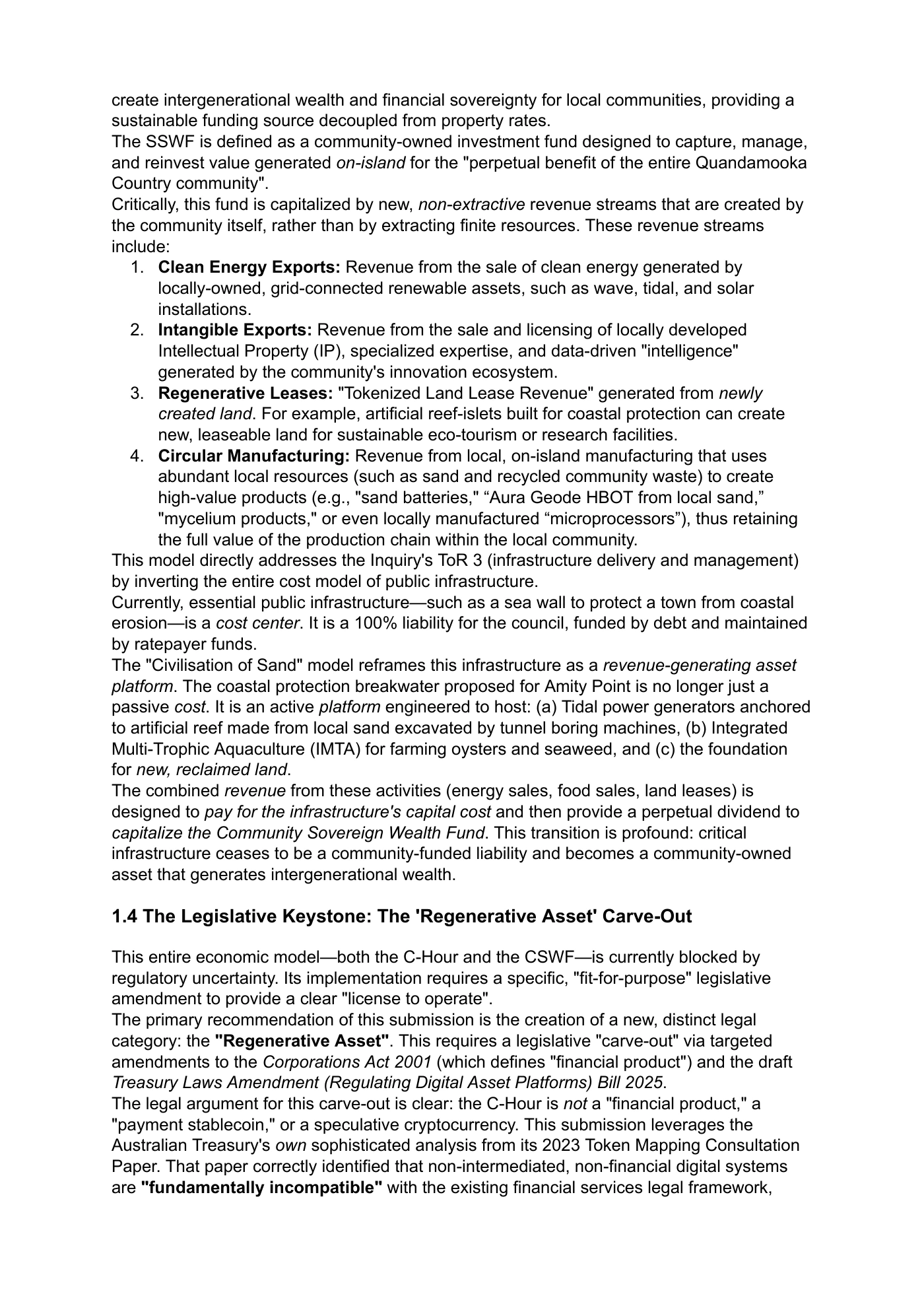
create intergenerational wealth and financial sovereignty for local communities, providing a
sustainable
funding
source
decoupled
from
property
rates.
The SSWF is defined as a community-owned investment fund designed to capture, manage,
and
reinvest
value
generated
on-island
for
the
"perpetual
benefit
of
the
entire
Quandamooka
Country
community".
Critically, this fund is capitalized by new, non-extractive revenue streams that are created by
the
community
itself,
rather
than
by
extracting
finite
resources.
These
revenue
streams
include:
1. Clean Energy Exports: Revenue from the sale of clean energy generated by
locally-owned,
grid-connected
renewable
assets,
such
as
wave,
tidal,
and
solar
installations.
2. Intangible Exports: Revenue from the sale and licensing of locally developed
Intellectual
Property
(IP),
specialized
expertise,
and
data-driven
"intelligence"
generated
by
the
community's
innovation
ecosystem.
3. Regenerative Leases: "Tokenized Land Lease Revenue" generated from newly
created
land
.
For
example,
artificial
reef-islets
built
for
coastal
protection
can
create
new,
leaseable
land
for
sustainable
eco-tourism
or
research
facilities.
4. Circular Manufacturing: Revenue from local, on-island manufacturing that uses
abundant
local
resources
(such
as
sand
and
recycled
community
waste)
to
create
high-value
products
(e.g.,
"sand
batteries,"
“Aura
Geode
HBOT
from
local
sand,”
"mycelium
products,"
or
even
locally
manufactured
“microprocessors”),
thus
retaining
the
full
value
of
the
production
chain
within
the
local
community.
This model directly addresses the Inquiry's ToR 3 (infrastructure delivery and management)
by
inverting
the
entire
cost
model
of
public
infrastructure.
Currently, essential public infrastructure—such as a sea wall to protect a town from coastal
erosion—is
a
cost
center
.
It
is
a
100%
liability
for
the
council,
funded
by
debt
and
maintained
by
ratepayer
funds.
The "Civilisation of Sand" model reframes this infrastructure as a revenue-generating asset
platform
.
The
coastal
protection
breakwater
proposed
for
Amity
Point
is
no
longer
just
a
passive
cost
.
It
is
an
active
platform
engineered
to
host:
(a)
Tidal
power
generators
anchored
to
artificial
reef
made
from
local
sand
excavated
by
tunnel
boring
machines,
(b)
Integrated
Multi-Trophic
Aquaculture
(IMTA)
for
farming
oysters
and
seaweed,
and
(c)
the
foundation
for
new,
reclaimed
land
.
The combined revenue from these activities (energy sales, food sales, land leases) is
designed
to
pay
for
the
infrastructure's
capital
cost
and
then
provide
a
perpetual
dividend
to
capitalize
the
Community
Sovereign
Wealth
Fund
.
This
transition
is
profound:
critical
infrastructure
ceases
to
be
a
community-funded
liability
and
becomes
a
community-owned
asset
that
generates
intergenerational
wealth.
1.4 The Legislative Keystone: The 'Regenerative Asset' Carve-Out
This entire economic model—both the C-Hour and the CSWF—is currently blocked by
regulatory
uncertainty.
Its
implementation
requires
a
specific,
"fit-for-purpose"
legislative
amendment
to
provide
a
clear
"license
to
operate".
The primary recommendation of this submission is the creation of a new, distinct legal
category:
the
"Regenerative
Asset"
.
This
requires
a
legislative
"carve-out"
via
targeted
amendments
to
the
Corporations
Act
2001
(which
defines
"financial
product")
and
the
draft
Treasury
Laws
Amendment
(Regulating
Digital
Asset
Platforms)
Bill
2025
.
The legal argument for this carve-out is clear: the C-Hour is not a "financial product," a
"payment
stablecoin,"
or
a
speculative
cryptocurrency.
This
submission
leverages
the
Australian
Treasury's
own
sophisticated
analysis
from
its
2023
Token
Mapping
Consultation
Paper.
That
paper
correctly
identified
that
non-intermediated,
non-financial
digital
systems
are
"fundamentally
incompatible"
with
the
existing
financial
services
legal
framework,
Page 5 of 11
Read selectable text for page 5
Text extracted from this page. Use the page image for its original layout, tables and figures.
which is built to regulate intermediaries. The C-Hour is a prime example of such a system. It is defined by its non-financial
characteristics:
1. Purpose: Its primary purpose is pro-social (to measure and reward contribution), not
to
generate
a
financial
return
for
an
investor.
2. Issuance: It is "earned" by individuals via "verified contribution" (e.g., one hour of
care),
not
"purchased"
with
an
expectation
of
profit.
3. Value: Its value is fixed and non-speculative by design: one C-Hour is always equal to
one
hour
of
verified
human
contribution.
Creating this "Regenerative Asset" class is the most critical, actionable "ask" for the
Committee.
It
demonstrates
a
sophisticated
understanding
of
the
regulatory
landscape
and
provides
the
precise
legal
key
that
unlocks
this
entire
funding
model.
It
de-risks
the
concept
for
policymakers
by
legally
and
operationally
separating
it
from
the
"crypto
wild
west,"
allowing
Australia
to
lead
the
world
in
legislating
for
the
social-purpose
economy.
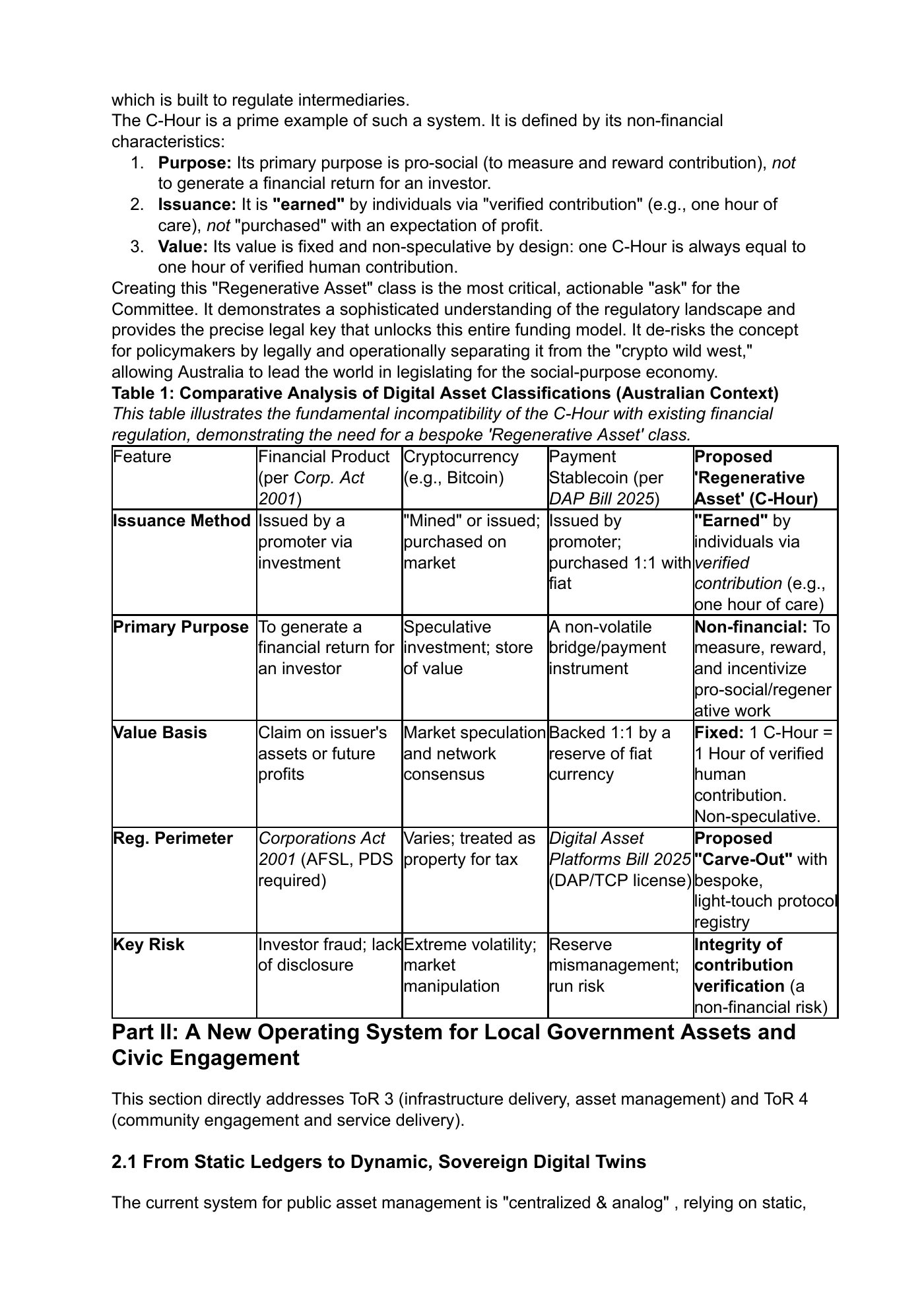
Table 1: Comparative Analysis of Digital Asset Classifications (Australian Context)
This
table
illustrates
the
fundamental
incompatibility
of
the
C-Hour
with
existing
financial
regulation,
demonstrating
the
need
for
a
bespoke
'Regenerative
Asset'
class.
Feature Financial Product (per Corp. Act 2001 )
Cryptocurrency (e.g., Bitcoin)
Payment Stablecoin (per DAP Bill 2025 )
Proposed 'Regenerative Asset' (C-Hour) Issuance Method Issued by a promoter via investment
"Mined" or issued; purchased on market
Issued by promoter; purchased 1:1 with fiat
"Earned" by individuals via verified contribution (e.g., one hour of care) Primary Purpose To generate a financial return for an investor
Speculative investment; store of value
A non-volatile bridge/payment instrument
Non-financial: To measure, reward, and incentivize pro-social/regenerative work Value Basis Claim on issuer's assets or future profits
Market speculation and network consensus
Backed 1:1 by a reserve of fiat currency
Fixed: 1 C-Hour = 1 Hour of verified human contribution. Non-speculative. Reg. Perimeter Corporations Act 2001 (AFSL, PDS required)
Varies; treated as property for tax
Digital Asset Platforms Bill 2025 (DAP/TCP license)
Proposed "Carve-Out" with bespoke, light-touch protocol registry Key Risk Investor fraud; lack of disclosure
Extreme volatility; market manipulation
Reserve mismanagement; run risk
Integrity of contribution verification (a non-financial risk)
Part II: A New Operating System for Local Government Assets and
Civic
Engagement
This section directly addresses ToR 3 (infrastructure delivery, asset management) and ToR 4
(community
engagement
and
service
delivery).
2.1 From Static Ledgers to Dynamic, Sovereign Digital Twins
The current system for public asset management is "centralized & analog" , relying on static,
Page 6 of 11
Read selectable text for page 6
Text extracted from this page. Use the page image for its original layout, tables and figures.
out-of-date registers. This is inefficient, costly, and fails to capture the real-time state of
community
assets.
The
proposed
solution
is
a
new
digital
"operating
system"
for
governance:
the
"Sovereignty
Stack"
.
The "Sovereignty Stack" is a decentralized, privacy-first technical substrate built on open
W3C
standards,
including
Decentralized
Identifiers
(DIDs)
for
verifiable
identity
and
Verifiable
Credentials
(VCs)
for
verifiable
claims.
Its
foundational
component
is
the
"Sovereign
Digital
Twin"
(also
referred
to
as
the
"Aura").
This
is
not
a
typical
corporate-owned
profile;
it
is
a
user-owned
digital
twin,
architected
as
a
"local-first,
privacy-first
app"
where
the
individual
user
owns
and
controls
their
own
data
by
default.
This sovereign individual twin is the foundational building block for the community asset
management
platform,
the
"Sovereign
Space
Builder"
.
This
platform
allows
individuals
and
communities
to
create
a
1:1,
interactive
digital
twin
of
their
environment,
from
their
home
garden
to
their
entire
suburb.
This new stack replaces static council asset ledgers with a real-time, dynamic, and
interactive
digital
twin
of
the
entire
Local
Government
Area
(LGA).
It
allows
for
the
dynamic,
collaborative
management
of
all
public
assets,
from
"grey"
infrastructure
(pipes,
roads,
drains)
to
"green"
infrastructure
(public
parks,
waterways,
urban
tree
canopies,
and
ecological
health).
2.2 Fractal Governance in Practice: The L0–L2 Topology
A primary blocker for "smart city" initiatives—which are essential for efficient asset
management—is
the
profound
and
justified
public
fear
of
centralized,
"surveillance
capitalism"
platforms.
Citizens
are
unwilling
to
provide
granular
data
to
a
central
database
controlled
by
a
council
or
a
third-party
vendor.
The "Sovereignty Stack" solves this political and technical stalemate. It is architected with a
"recursive,
self-similar
logic"
known
as
"Fractal
Governance"
.
This
structure
is
the
key
to
enabling
a
data-rich
environment
while
technically
enforcing
citizen
privacy.
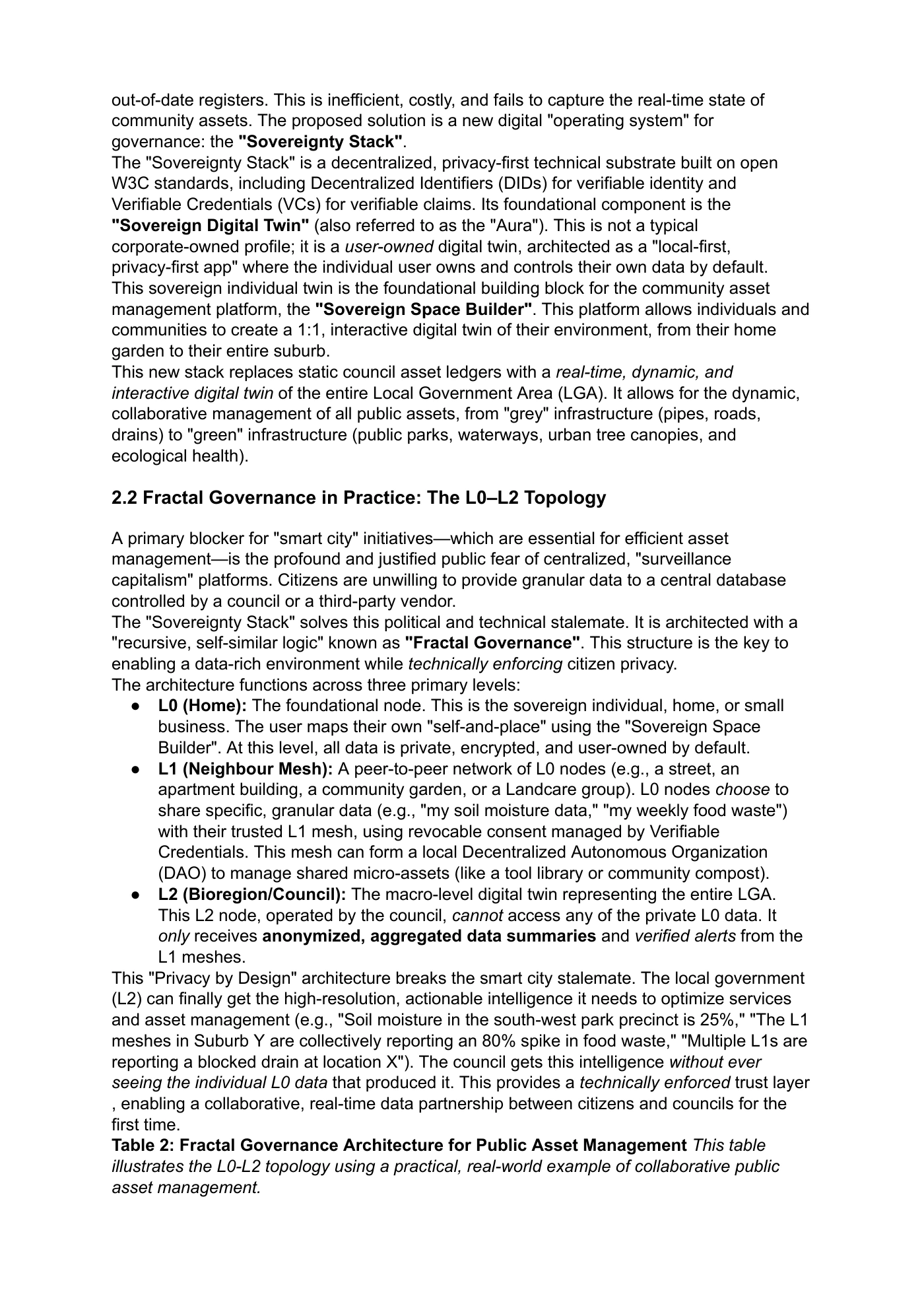
The architecture functions across three primary levels: ● L0 (Home): The foundational node. This is the sovereign individual, home, or small
business.
The
user
maps
their
own
"self-and-place"
using
the
"Sovereign
Space
Builder".
At
this
level,
all
data
is
private,
encrypted,
and
user-owned
by
default.
● L1 (Neighbour Mesh): A peer-to-peer network of L0 nodes (e.g., a street, an
apartment
building,
a
community
garden,
or
a
Landcare
group).
L0
nodes
choose
to
share
specific,
granular
data
(e.g.,
"my
soil
moisture
data,"
"my
weekly
food
waste")
with
their
trusted
L1
mesh,
using
revocable
consent
managed
by
Verifiable
Credentials.
This
mesh
can
form
a
local
Decentralized
Autonomous
Organization
(DAO)
to
manage
shared
micro-assets
(like
a
tool
library
or
community
compost).
● L2 (Bioregion/Council): The macro-level digital twin representing the entire LGA.
This
L2
node,
operated
by
the
council,
cannot
access
any
of
the
private
L0
data.
It
only
receives
anonymized,
aggregated
data
summaries
and
verified
alerts
from
the
L1
meshes.
This "Privacy by Design" architecture breaks the smart city stalemate. The local government
(L2)
can
finally
get
the
high-resolution,
actionable
intelligence
it
needs
to
optimize
services
and
asset
management
(e.g.,
"Soil
moisture
in
the
south-west
park
precinct
is
25%,"
"The
L1
meshes
in
Suburb
Y
are
collectively
reporting
an
80%
spike
in
food
waste,"
"Multiple
L1s
are
reporting
a
blocked
drain
at
location
X").
The
council
gets
this
intelligence
without
ever
seeing
the
individual
L0
data
that
produced
it.
This
provides
a
technically
enforced
trust
layer
,
enabling
a
collaborative,
real-time
data
partnership
between
citizens
and
councils
for
the
first
time.
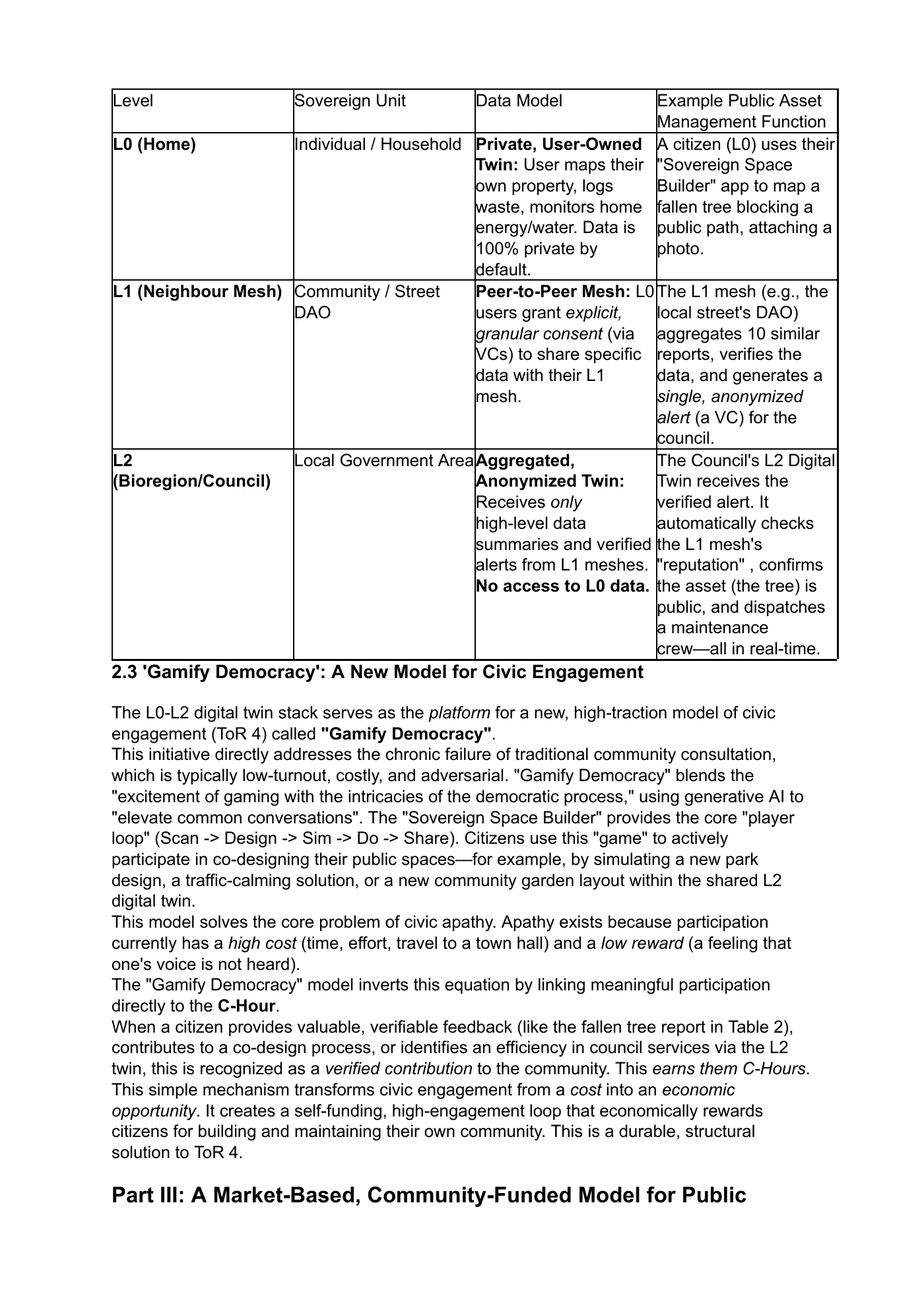
Table 2: Fractal Governance Architecture for Public Asset Management This table
illustrates
the
L0-L2
topology
using
a
practical,
real-world
example
of
collaborative
public
asset
management.
Page 7 of 11
Read selectable text for page 7
Text extracted from this page. Use the page image for its original layout, tables and figures.
Level Sovereign Unit Data Model Example Public Asset Management Function L0 (Home) Individual / Household Private, User-Owned Twin: User maps their own property, logs waste, monitors home energy/water. Data is 100% private by default.
A citizen (L0) uses their "Sovereign Space Builder" app to map a fallen tree blocking a public path, attaching a photo.
L1 (Neighbour Mesh) Community / Street DAO
Peer-to-Peer Mesh: L0 users grant explicit, granular consent (via VCs) to share specific data with their L1 mesh.
The L1 mesh (e.g., the local street's DAO) aggregates 10 similar reports, verifies the data, and generates a single, anonymized alert (a VC) for the council. L2 (Bioregion/Council)
Local Government Area Aggregated, Anonymized Twin: Receives only high-level data summaries and verified alerts from L1 meshes. No access to L0 data.
The Council's L2 Digital Twin receives the verified alert. It automatically checks the L1 mesh's "reputation" , confirms the asset (the tree) is public, and dispatches a maintenance crew—all in real-time. 2.3 'Gamify Democracy': A New Model for Civic Engagement
The L0-L2 digital twin stack serves as the platform for a new, high-traction model of civic
engagement
(ToR
4)
called
"Gamify
Democracy"
.
This initiative directly addresses the chronic failure of traditional community consultation,
which
is
typically
low-turnout,
costly,
and
adversarial.
"Gamify
Democracy"
blends
the
"excitement
of
gaming
with
the
intricacies
of
the
democratic
process,"
using
generative
AI
to
"elevate
common
conversations".
The
"Sovereign
Space
Builder"
provides
the
core
"player
loop"
(Scan
->
Design
->
Sim
->
Do
->
Share).
Citizens
use
this
"game"
to
actively
participate
in
co-designing
their
public
spaces—for
example,
by
simulating
a
new
park
design,
a
traffic-calming
solution,
or
a
new
community
garden
layout
within
the
shared
L2
digital
twin.
This model solves the core problem of civic apathy. Apathy exists because participation
currently
has
a
high
cost
(time,
effort,
travel
to
a
town
hall)
and
a
low
reward
(a
feeling
that
one's
voice
is
not
heard).
The "Gamify Democracy" model inverts this equation by linking meaningful participation
directly
to
the
C-Hour
.
When a citizen provides valuable, verifiable feedback (like the fallen tree report in Table 2),
contributes
to
a
co-design
process,
or
identifies
an
efficiency
in
council
services
via
the
L2
twin,
this
is
recognized
as
a
verified
contribution
to
the
community.
This
earns
them
C-Hours
.
This simple mechanism transforms civic engagement from a cost into an economic
opportunity
.
It
creates
a
self-funding,
high-engagement
loop
that
economically
rewards
citizens
for
building
and
maintaining
their
own
community.
This
is
a
durable,
structural
solution
to
ToR
4.
Part III: A Market-Based, Community-Funded Model for Public
Page 8 of 11
Read selectable text for page 8
Text extracted from this page. Use the page image for its original layout, tables and figures.
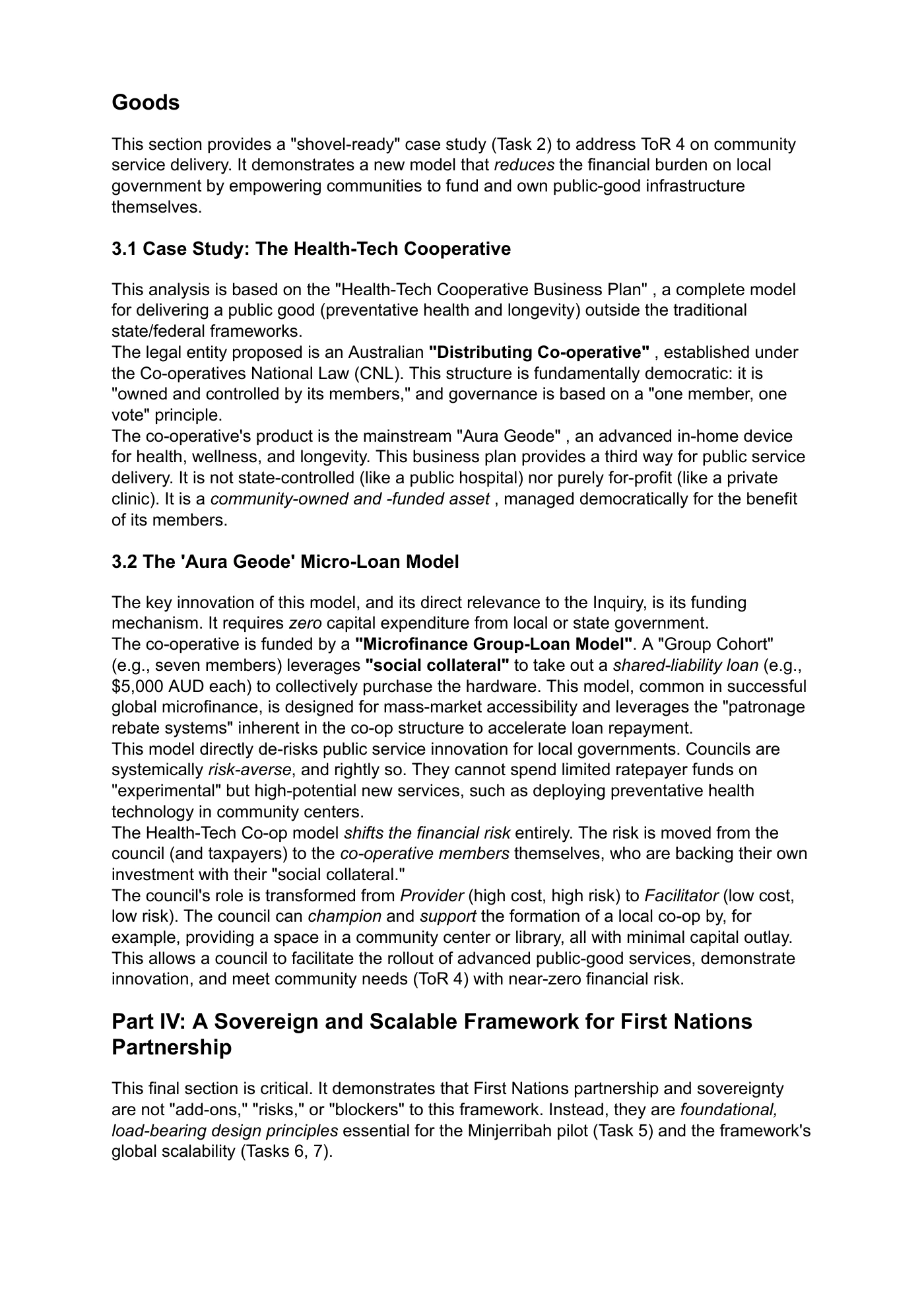
Goods
This section provides a "shovel-ready" case study (Task 2) to address ToR 4 on community
service
delivery.
It
demonstrates
a
new
model
that
reduces
the
financial
burden
on
local
government
by
empowering
communities
to
fund
and
own
public-good
infrastructure
themselves.
3.1 Case Study: The Health-Tech Cooperative
This analysis is based on the "Health-Tech Cooperative Business Plan" , a complete model
for
delivering
a
public
good
(preventative
health
and
longevity)
outside
the
traditional
state/federal
frameworks.
The legal entity proposed is an Australian "Distributing Co-operative" , established under
the
Co-operatives
National
Law
(CNL).
This
structure
is
fundamentally
democratic:
it
is
"owned
and
controlled
by
its
members,"
and
governance
is
based
on
a
"one
member,
one
vote"
principle.
The co-operative's product is the mainstream "Aura Geode" , an advanced in-home device
for
health,
wellness,
and
longevity.
This
business
plan
provides
a
third
way
for
public
service
delivery.
It
is
not
state-controlled
(like
a
public
hospital)
nor
purely
for-profit
(like
a
private
clinic).
It
is
a
community-owned
and
-funded
asset
,
managed
democratically
for
the
benefit
of
its
members.
3.2 The 'Aura Geode' Micro-Loan Model
The key innovation of this model, and its direct relevance to the Inquiry, is its funding
mechanism.
It
requires
zero
capital
expenditure
from
local
or
state
government.
The co-operative is funded by a "Microfinance Group-Loan Model" . A "Group Cohort"
(e.g.,
seven
members)
leverages
"social
collateral"
to
take
out
a
shared-liability
loan
(e.g.,
$5,000
AUD
each)
to
collectively
purchase
the
hardware.
This
model,
common
in
successful
global
microfinance,
is
designed
for
mass-market
accessibility
and
leverages
the
"patronage
rebate
systems"
inherent
in
the
co-op
structure
to
accelerate
loan
repayment.
This model directly de-risks public service innovation for local governments. Councils are
systemically
risk-averse
,
and
rightly
so.
They
cannot
spend
limited
ratepayer
funds
on
"experimental"
but
high-potential
new
services,
such
as
deploying
preventative
health
technology
in
community
centers.
The Health-Tech Co-op model shifts the financial risk entirely. The risk is moved from the
council
(and
taxpayers)
to
the
co-operative
members
themselves,
who
are
backing
their
own
investment
with
their
"social
collateral."
The council's role is transformed from Provider (high cost, high risk) to Facilitator (low cost,
low
risk).
The
council
can
champion
and
support
the
formation
of
a
local
co-op
by,
for
example,
providing
a
space
in
a
community
center
or
library,
all
with
minimal
capital
outlay.
This
allows
a
council
to
facilitate
the
rollout
of
advanced
public-good
services,
demonstrate
innovation,
and
meet
community
needs
(ToR
4)
with
near-zero
financial
risk.
Part IV: A Sovereign and Scalable Framework for First Nations
Partnership
This final section is critical. It demonstrates that First Nations partnership and sovereignty
are
not
"add-ons,"
"risks,"
or
"blockers"
to
this
framework.
Instead,
they
are
foundational,
load-bearing
design
principles
essential
for
the
Minjerribah
pilot
(Task
5)
and
the
framework's
global
scalability
(Tasks
6,
7).
Page 9 of 11
Read selectable text for page 9
Text extracted from this page. Use the page image for its original layout, tables and figures.
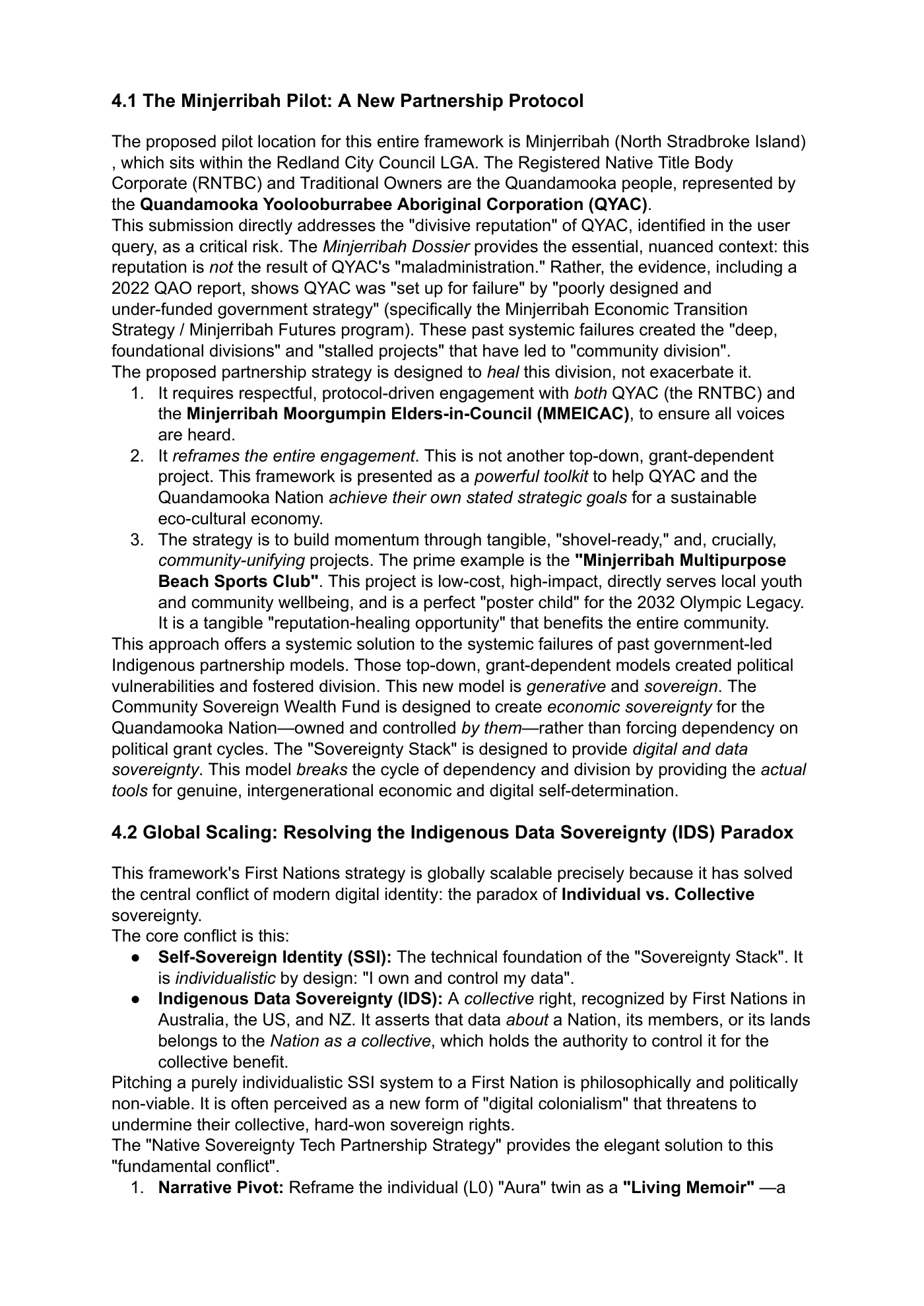
4.1 The Minjerribah Pilot: A New Partnership Protocol
The proposed pilot location for this entire framework is Minjerribah (North Stradbroke Island)
,
which
sits
within
the
Redland
City
Council
LGA.
The
Registered
Native
Title
Body
Corporate
(RNTBC)
and
Traditional
Owners
are
the
Quandamooka
people,
represented
by
the
Quandamooka
Yoolooburrabee
Aboriginal
Corporation
(QYAC)
.
This submission directly addresses the "divisive reputation" of QYAC, identified in the user
query,
as
a
critical
risk.
The
Minjerribah
Dossier
provides
the
essential,
nuanced
context:
this
reputation
is
not
the
result
of
QYAC's
"maladministration."
Rather,
the
evidence,
including
a
2022
QAO
report,
shows
QYAC
was
"set
up
for
failure"
by
"poorly
designed
and
under-funded
government
strategy"
(specifically
the
Minjerribah
Economic
Transition
Strategy
/
Minjerribah
Futures
program).
These
past
systemic
failures
created
the
"deep,
foundational
divisions"
and
"stalled
projects"
that
have
led
to
"community
division".
The proposed partnership strategy is designed to heal this division, not exacerbate it. 1. It requires respectful, protocol-driven engagement with both QYAC (the RNTBC) and
the
Minjerribah
Moorgumpin
Elders-in-Council
(MMEICAC)
,
to
ensure
all
voices
are
heard.
2. It reframes the entire engagement . This is not another top-down, grant-dependent
project.
This
framework
is
presented
as
a
powerful
toolkit
to
help
QYAC
and
the
Quandamooka
Nation
achieve
their
own
stated
strategic
goals
for
a
sustainable
eco-cultural
economy.
3. The strategy is to build momentum through tangible, "shovel-ready," and, crucially,
community-unifying
projects.
The
prime
example
is
the
"Minjerribah
Multipurpose
Beach
Sports
Club"
.
This
project
is
low-cost,
high-impact,
directly
serves
local
youth
and
community
wellbeing,
and
is
a
perfect
"poster
child"
for
the
2032
Olympic
Legacy.
It
is
a
tangible
"reputation-healing
opportunity"
that
benefits
the
entire
community.
This approach offers a systemic solution to the systemic failures of past government-led
Indigenous
partnership
models.
Those
top-down,
grant-dependent
models
created
political
vulnerabilities
and
fostered
division.
This
new
model
is
generative
and
sovereign
.
The
Community
Sovereign
Wealth
Fund
is
designed
to
create
economic
sovereignty
for
the
Quandamooka
Nation—owned
and
controlled
by
them
—rather
than
forcing
dependency
on
political
grant
cycles.
The
"Sovereignty
Stack"
is
designed
to
provide
digital
and
data
sovereignty
.
This
model
breaks
the
cycle
of
dependency
and
division
by
providing
the
actual
tools
for
genuine,
intergenerational
economic
and
digital
self-determination.
4.2 Global Scaling: Resolving the Indigenous Data Sovereignty (IDS) Paradox
This framework's First Nations strategy is globally scalable precisely because it has solved
the
central
conflict
of
modern
digital
identity:
the
paradox
of
Individual
vs.
Collective
sovereignty.
The core conflict is this: ● Self-Sovereign Identity (SSI): The technical foundation of the "Sovereignty Stack". It
is
individualistic
by
design:
"I
own
and
control
my
data".
● Indigenous Data Sovereignty (IDS): A collective right, recognized by First Nations in
Australia,
the
US,
and
NZ.
It
asserts
that
data
about
a
Nation,
its
members,
or
its
lands
belongs
to
the
Nation
as
a
collective
,
which
holds
the
authority
to
control
it
for
the
collective
benefit.
Pitching a purely individualistic SSI system to a First Nation is philosophically and politically
non-viable.
It
is
often
perceived
as
a
new
form
of
"digital
colonialism"
that
threatens
to
undermine
their
collective,
hard-won
sovereign
rights.
The "Native Sovereignty Tech Partnership Strategy" provides the elegant solution to this
"fundamental
conflict".
1. Narrative Pivot: Reframe the individual (L0) "Aura" twin as a "Living Memoir" —a
Page 10 of 11
Read selectable text for page 10
Text extracted from this page. Use the page image for its original layout, tables and figures.
tool for preserving personal and family history. 2. Technical Pivot: Use the federated L0–L3 "Fractal Governance" stack as the solution
itself
.
This federated architecture is designed to resolve this conflict. The individual (L0) maintains
perfect
SSI
over
their
personal
data
(their
"Living
Memoir").
The
Nation
(at
an
L2
or
L3
level)
operates
a
DAO
that
sets
and
enforces
collective
IDS
policies
.
The
stack
provides
the
technical
guardrails.
Data
deemed
"collective"
(e.g.,
cultural
heritage
data,
sacred
site
locations,
collective
health
data)
cannot
be
shared
by
an
individual
L0
node
without
a
verifiable
credential
(VC)
of
approval
from
the
L2/L3
Nation's
DAO.
This federated model provides a global standard. It aligns the needs of Australian
Quandamooka
,
U.S.
Native
Nations
(like
the
Cherokee
or
Tulalip
),
and
NZ
Māori
data
sovereignty
initiatives
(such
as
Te
Mana
Raraunga
,
the
Māori
Data
Sovereignty
Network).
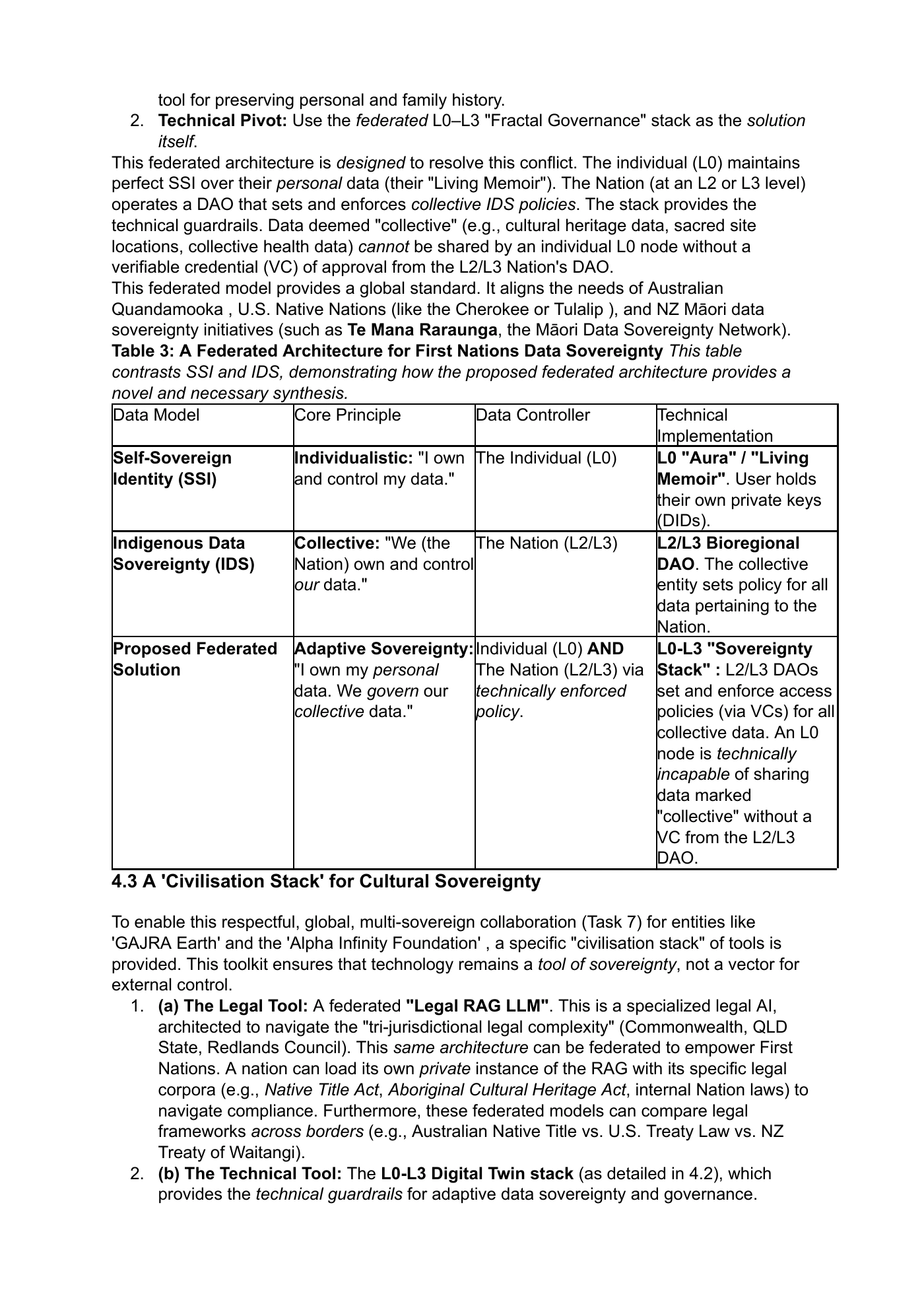
Table 3: A Federated Architecture for First Nations Data Sovereignty This table
contrasts
SSI
and
IDS,
demonstrating
how
the
proposed
federated
architecture
provides
a
novel
and
necessary
synthesis.
Data Model Core Principle Data Controller Technical Implementation Self-Sovereign Identity (SSI)
Individualistic: "I own and control my data."
The Individual (L0) L0 "Aura" / "Living Memoir" . User holds their own private keys (DIDs). Indigenous Data Sovereignty (IDS)
Collective: "We (the Nation) own and control our data."
The Nation (L2/L3) L2/L3 Bioregional DAO . The collective entity sets policy for all data pertaining to the Nation. Proposed Federated Solution
Adaptive Sovereignty: "I own my personal data. We govern our collective data."
Individual (L0) AND The Nation (L2/L3) via technically enforced policy .
L0-L3 "Sovereignty Stack" : L2/L3 DAOs set and enforce access policies (via VCs) for all collective data. An L0 node is technically incapable of sharing data marked "collective" without a VC from the L2/L3 DAO. 4.3 A 'Civilisation Stack' for Cultural Sovereignty
To enable this respectful, global, multi-sovereign collaboration (Task 7) for entities like
'GAJRA
Earth'
and
the
'Alpha
Infinity
Foundation'
,
a
specific
"civilisation
stack"
of
tools
is
provided.
This
toolkit
ensures
that
technology
remains
a
tool
of
sovereignty
,
not
a
vector
for
external
control.
1. (a) The Legal Tool: A federated "Legal RAG LLM" . This is a specialized legal AI,
architected
to
navigate
the
"tri-jurisdictional
legal
complexity"
(Commonwealth,
QLD
State,
Redlands
Council).
This
same
architecture
can
be
federated
to
empower
First
Nations.
A
nation
can
load
its
own
private
instance
of
the
RAG
with
its
specific
legal
corpora
(e.g.,
Native
Title
Act
,
Aboriginal
Cultural
Heritage
Act
,
internal
Nation
laws)
to
navigate
compliance.
Furthermore,
these
federated
models
can
compare
legal
frameworks
across
borders
(e.g.,
Australian
Native
Title
vs.
U.S.
Treaty
Law
vs.
NZ
Treaty
of
Waitangi).
2. (b) The Technical Tool: The L0-L3 Digital Twin stack (as detailed in 4.2), which
provides
the
technical
guardrails
for
adaptive
data
sovereignty
and
governance.
Page 11 of 11
Read selectable text for page 11
Text extracted from this page. Use the page image for its original layout, tables and figures.
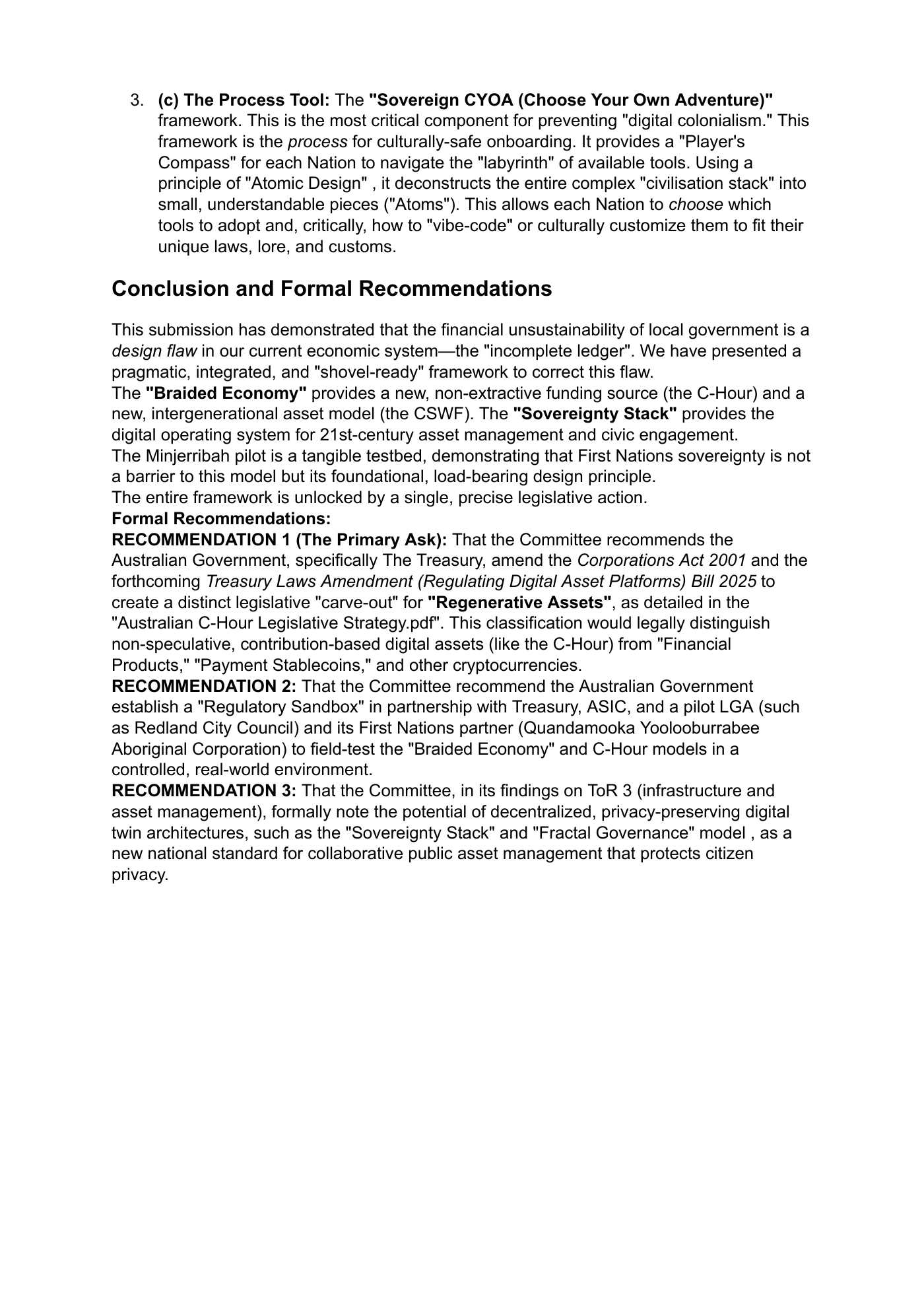
3. (c) The Process Tool: The "Sovereign CYOA (Choose Your Own Adventure)"
framework.
This
is
the
most
critical
component
for
preventing
"digital
colonialism."
This
framework
is
the
process
for
culturally-safe
onboarding.
It
provides
a
"Player's
Compass"
for
each
Nation
to
navigate
the
"labyrinth"
of
available
tools.
Using
a
principle
of
"Atomic
Design"
,
it
deconstructs
the
entire
complex
"civilisation
stack"
into
small,
understandable
pieces
("Atoms").
This
allows
each
Nation
to
choose
which
tools
to
adopt
and,
critically,
how
to
"vibe-code"
or
culturally
customize
them
to
fit
their
unique
laws,
lore,
and
customs.
Conclusion and Formal Recommendations
This submission has demonstrated that the financial unsustainability of local government is a
design
flaw
in
our
current
economic
system—the
"incomplete
ledger".
We
have
presented
a
pragmatic,
integrated,
and
"shovel-ready"
framework
to
correct
this
flaw.
The "Braided Economy" provides a new, non-extractive funding source (the C-Hour) and a
new,
intergenerational
asset
model
(the
CSWF).
The
"Sovereignty
Stack"
provides
the
digital
operating
system
for
21st-century
asset
management
and
civic
engagement.
The Minjerribah pilot is a tangible testbed, demonstrating that First Nations sovereignty is not
a
barrier
to
this
model
but
its
foundational,
load-bearing
design
principle.
The entire framework is unlocked by a single, precise legislative action. Formal Recommendations: RECOMMENDATION 1 (The Primary Ask): That the Committee recommends the
Australian
Government,
specifically
The
Treasury,
amend
the
Corporations
Act
2001
and
the
forthcoming
Treasury
Laws
Amendment
(Regulating
Digital
Asset
Platforms)
Bill
2025
to
create
a
distinct
legislative
"carve-out"
for
"Regenerative
Assets"
,
as
detailed
in
the
"Australian
C-Hour
Legislative
Strategy.pdf".
This
classification
would
legally
distinguish
non-speculative,
contribution-based
digital
assets
(like
the
C-Hour)
from
"Financial
Products,"
"Payment
Stablecoins,"
and
other
cryptocurrencies.
RECOMMENDATION 2: That the Committee recommend the Australian Government
establish
a
"Regulatory
Sandbox"
in
partnership
with
Treasury,
ASIC,
and
a
pilot
LGA
(such
as
Redland
City
Council)
and
its
First
Nations
partner
(Quandamooka
Yoolooburrabee
Aboriginal
Corporation)
to
field-test
the
"Braided
Economy"
and
C-Hour
models
in
a
controlled,
real-world
environment.
RECOMMENDATION 3: That the Committee, in its findings on ToR 3 (infrastructure and
asset
management),
formally
note
the
potential
of
decentralized,
privacy-preserving
digital
twin
architectures,
such
as
the
"Sovereignty
Stack"
and
"Fractal
Governance"
model
,
as
a
new
national
standard
for
collaborative
public
asset
management
that
protects
citizen
privacy.