Solve today's problems in the direction of seven generations
The city is the next step, not the first.
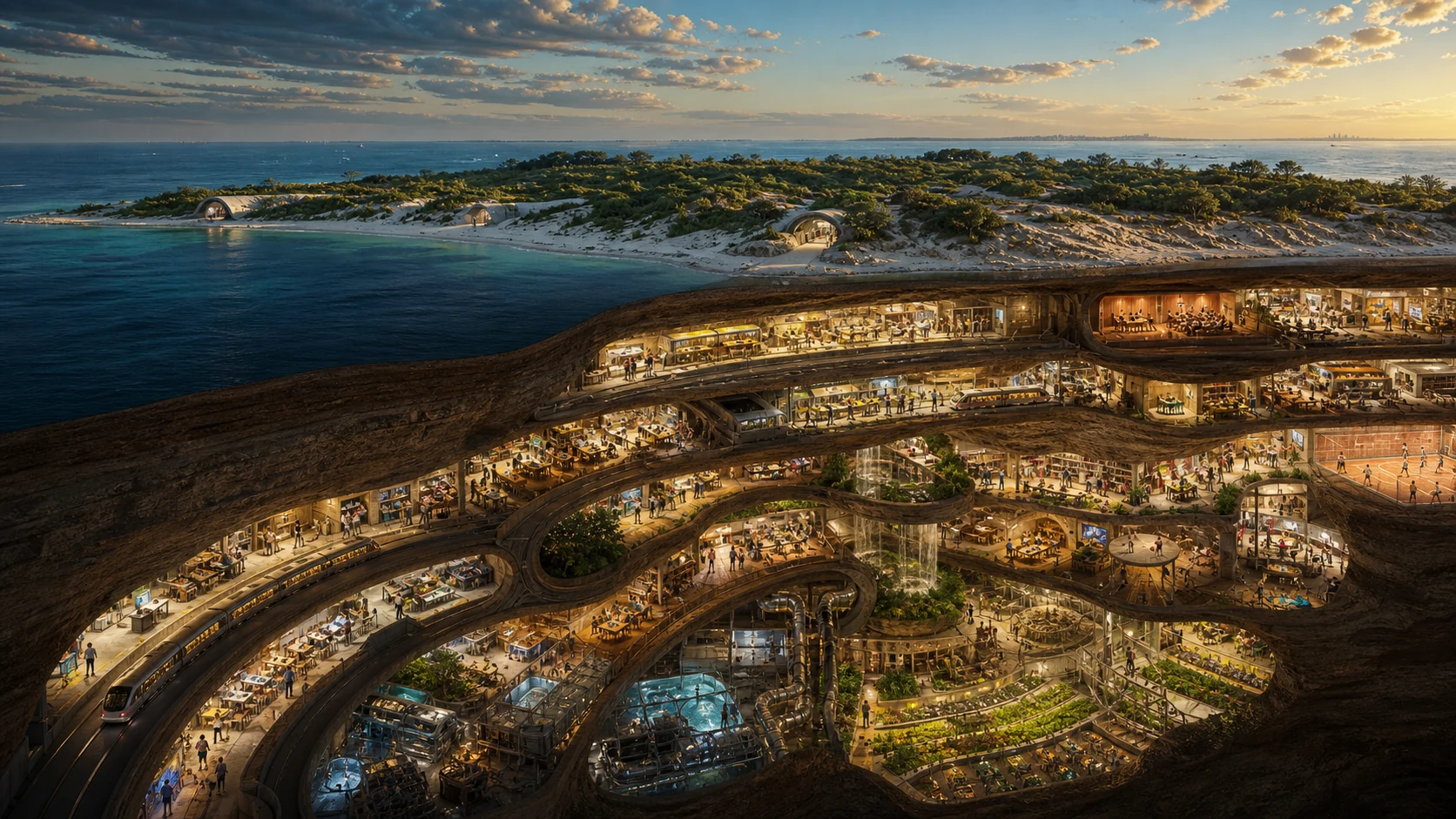
Begin with a Dunwich park-and-ride tunnel loop that improves transport and creates useful community infrastructure from the sand it removes. Extend the transport, services, materials and industrial systems until a 20-million-person subterranean worldship becomes the logical next stage.
GenAI concept image for documentary development.
The campaign objective
Make expansion the easy decision.
Each stage can earn the next by solving existing problems, producing more value than it consumes, caring for Country and leaving useful capability behind even if the generation city remains far over the horizon.
1useful gateway loop to begin
7generations in the care horizon
20mpeople in the civilisation horizon
0spoil as the material ideal
Growth is earned, not assumed.A stage that does not improve transport, community infrastructure, ecology, material capability or long-term care gives no reason to expand it. The path stays open to correction, redesign or a different route.
The physical sequence
Start where the island already has a problem.
The first construction story is not a miniature habitat. It is a useful tunnel-and-material project at the island's main gateway.
Stage 1
Gumpi / Dunwich gateway
Park once. Move without adding more surface traffic.
A park-and-ride loop beside the ferry gateway can explore parking pressure, bus and freight movements, pedestrian access, after-hours transport, road wear and wildlife strikes. The tunnel portal, data layer and first community spaces arrive as one public-infrastructure question.
Existing problemsParking peaks, town separation, heavy traffic, road repair, thin transport hours and animal strikes.
What it createsA tunnel start, movement data, construction knowledge, community space and the first stream of separated sand.
Stage 2
The tunnel becomes a factory
Turn removed sand into the infrastructure around the portal.
Sort and test the excavated material before it is assigned. Suitable streams may feed tunnel lining, blocks, pavers, glass, ceramics, community buildings, thermal storage, reef modules, dune support and other branches already explored across the repo garden.
Existing problemsImported materials, erosion, housing and community-infrastructure gaps, energy storage and wasteful freight.
Expansion logicUseful products help fund capability, build trust and make the next length of tunnel less dependent on imported inputs.
Stage 3
Between towns
Extend transport and service corridors where they keep helping.
Autonomous public transport can share the corridor with water, power, communications, freight and maintenance access. Dunwich, Amity and Point Lookout become linked below the fragile surface rather than requiring one giant city decision.
Existing problemsDisconnected towns, exposed utilities, freight bottlenecks, weather damage and surface-road pressure.
Expansion logicEach useful connection creates another portal, service node, material stream and reason to continue.
Stage 4
Subterranean industry
Move noisy, hot and material-intensive work into designed spaces.
Workshops, repair, mineral separation, fabrication, storage, food production, water systems, energy and heat management can grow beside the corridors. Industrial caverns create the productive capacity a long-lived city would later rely on.
Existing problemsLimited local repair, lost material value, supply dependence, constrained land and exposed critical equipment.
Expansion logicThe corridor becomes an economy and learning system, not only a way to move people.
Stage 5
Seven-generation civilisation
Let a useful network grow into a worldship.
Housing, food loops, culture, education, health, archives, governance and deep shelter can join an underground system that already moves, makes, repairs and cares for the surface. The 20-million-person horizon becomes a continuation of proven infrastructure rather than a leap from a blank page.
Long horizonA civilisation able to protect life through ordinary decades and rare planetary shocks.
Surface relationshipA tiny, carefully placed interface while Country, habitat and community life continue above.
The material tree
The tunnel does not make spoil. It makes options.
“Nothing spoiled” is a direction for research, not a claim that every stream already has a safe destination. Each branch can show source, composition, testing, energy cost, cultural and ecological boundary, proposed use and leftovers.
Build
Infrastructure from the ground removed.
Tested sand and mineral streams could contribute to tunnel lining, geopolymers, pavers, tiles, glazing, insulation, public buildings and future housing.
Care for coasts and sea
Reefs, dunes, erosion control and possible new land.
Reef modules, oyster and seagrass structures, surf banks, dune support and engineered land remain place-specific ecological designs, shaped with suitable sea Country authority and public review.
Power and industry
Heat stores, minerals and productive capability.
Sand thermal storage, mineral separation, silica products, titanium and zircon pathways, fabrication inputs and recovered process streams open the energy and industrial branches.
The survival envelope
Keep difficult evidence labels on the board.
Each scenario keeps its honest status. It can still expose a useful design load even when its cause, timing or probability remains disputed.
Recurring and observed
The pressures already in the ledger.
Storm, fire, flood, heat, pandemic, earthquake, volcanic winter, crop failure, grid loss, freight interruption, cyber failure, war and geomagnetic storms.
Civilisation-ending
The loads ordinary planning avoids.
Nuclear exchange, infrastructure cascade, uncontrolled AI, engineered biology, abrupt climate shifts, supervolcanoes and asteroid or comet impacts.
Frontier and disputed
The questions with a live evidence fight.
Geomagnetic excursions, extreme solar shedding or micronova, galactic-environment effects, plasma events, crustal displacement and other mechanisms with established, disputed, speculative and needs-checking layers.
Mythic and science-fiction
The stress tests that widen imagination.
Flood memories, sky-fire stories, long dark ages, contact scenarios, runaway machines, hostile environments and unknown unknowns can enter as Story or Speculative rather than being thrown away.
Design target, not a finished claim.The deep structure can be tested against direct-hit nuclear blast cases and asteroid impacts outside the immediate excavation zone. Survival depends on depth, geology, yield, distance, redundancy and failure isolation; the site does not pretend those calculations are complete.
Six city systems
A worldship needs more than a bunker.
A sealed shelter can keep bodies alive briefly. A generation city carries the loops, skills, culture and repair capacity that let life keep organising for centuries.
Mass and districts
Shield, isolate, reconnect.
Deep overburden, compartmentalised districts, independent life-support zones and sacrificial paths reduce the chance that one strike or fault takes the whole city.
Metabolism
Close the food, water and nutrient loops.
Hydroponics, aeroponics, fungi, fish, insects, root crops, water recovery and waste-to-input systems turn a habitat into a living metabolism.
Energy and heat
Power is only half the equation.
Diverse generation, storage, islandable grids and passive reserves sit beside the harder sealed-city problem: carrying human and machine heat away.
Making
Keep the ability to repair the world.
Machine tools, materials recovery, mineral processing, spares, chemistry, fabrication and design knowledge support recovery beyond the stocked-shelf phase.
Memory and governance
Carry civilisation, not only data.
Distributed archives, education, culture, public reasoning, consent, conflict resolution and many centres of agency keep the city human across generations.
Sensors and expansion
Watch outward and retain options.
Earth systems, solar weather, seismic activity and orbital hazards feed a shared model. Surface, ocean, orbit and future off-world habitats become connected lifeboats rather than one point of failure.
The GAJRA Earth test
Would people enjoy the civilisation that survived?
Existential resilience explains why the system endures. Joyful responsible abundance explains what it is for.
Joy is life support
Play, beauty and belonging travel with us.
Music, cinema, sport, shared food, nature, intimacy, learning, celebration and unstructured time belong in the habitat specification alongside air and water.
Responsibility is direction
Care for Country and seven generations.
Design choices can ask who carries the cost, what ecology changes, which authority applies, what can be reversed and what the seventh generation inherits.
Abundance is capability
Enough to share, create and choose.
Energy, materials, food, knowledge, health and productive time become abundant when their systems widen agency rather than concentrate dependence.
A bunker can preserve a population.A civilisation also preserves reasons to live, many ways to contribute and the freedom to imagine something better than the plan that saved it.
Why this island system enters the story
Sand, aquifer, minerals, depth and a tiny surface interface.
The physical idea is powerful because one site condition may answer several engineering problems. The social and cultural question stays just as real.
The physical proposition
Moving groundwater may offer water and heat exchange. Sand carries heavy minerals and silica. Excavated material could become product, structure or backfill. Deep volume changes the density arithmetic while the land above remains largely living Country.
The boundary that shapes it
Minjerribah and Mulgumpin are not empty geology. Cultural authority, ecology, law, existing communities, water behaviour and consent can change, relocate or end a design path. A bold simulation does not create site rights.
What each core repo contributes
The repos are parts of one design stack.
The documentary can move between them without asking one repo to carry the whole case.
Threat caseMicronova and Excursions holds the four-move argument, evidence ledger, six shared preparations and earthquake-prediction wedge.
Threat atlasGrain by Grain carries the wider list from ordinary hazards to great filters.
City modelCivilisation of Sand turns the underground city into a playable capability and resource simulation.
EssenceGAJRA Earth keeps the destination joyful, responsible and abundant rather than shrinking civilisation design into bunker survival.
Material treeThe Gumpi gateway, maker-space, Grain by Grain alchemy, clean-energy reefs, erosion, space-station and local resilience repos show where the tunnel, sand and service branches can go next.
FilmDocumentary Builders turns each claim, system and scenario into a traceable scene rather than another giant document.
