Infinity Engine master plan (v2)
Written 2026-07-21, superseding the v1 plan. v1 covered the vault and the model registries; since then the system has grown audio ingestion, treatments, a karaoke renderer design, cast/LoRA registries, a recon loop, and now the distribution layer. This plan makes all the moving parts one flow.
Prices in AUD (converted at AUD/USD 0.70, 2026-07-20 unless noted). Honest tense throughout: built means running today, designed means agreed shape not yet coded, horizon means intentionally later.
1. North star
Turn the i C. infinity catalogue into film across three lanes: Recon (fast, rough, cheap: test models, harvest LoRA data, learn), Release (publishable, teachable, community-facing), Hero (A Protopian Gambit and festival shorts, fully directed). Earlier albums are deliberately the R&D lab and community on-ramp. Everything ships from a pipeline Luke owns end to end: open-weight first, rented GPUs on demand, nothing locked to a vendor.
2. The one flow
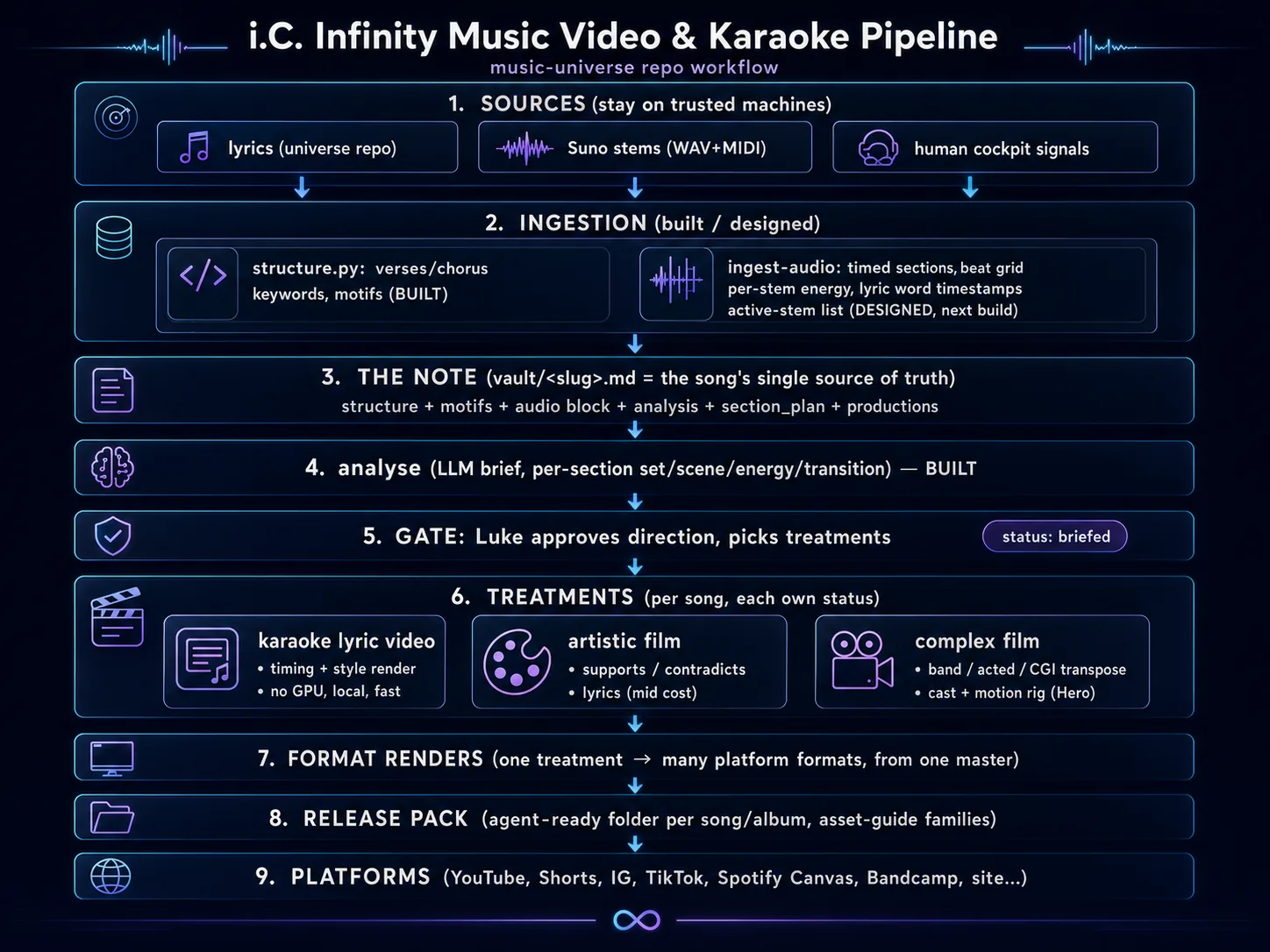
The diagram at the top of this page is the whole pipeline: sources stay on trusted machines, feed ingestion, land in the note, pass Luke's gate, branch into treatments, render to every platform format, assemble into release packs, ship.
Rule that never changes: sources and the vault stay local; only small derived data (JSON, timings) and approved renders move. Stems are ~470 MB a song; their feature block is a few KB. Same privacy rule as the lyrics.
3. Ingestion (the nuance layer)
Three inputs, one note:
1. Lyric structure (BUILT): marker-aware parsing (Verse/Chorus/Bridge labels when present, hook-line detection when not), per-section keywords, song-wide motifs. 2. Audio (BUILT core; ML layer next): from the Suno stem export per song. Verified from a real export: WAV 32-bit float / 48 kHz stereo (not 24-bit/44.1k), track 0 is the full mix, the rest are per-instrument stems with silent placeholder tracks (~-91 dBFS). engine ingest-audio PATH --slug S --bpm N (BUILT, stdlib-only, reads WAVs straight from the folder or the zip so nothing bloats disk): parses the float WAV headers, maps roles by track name, RMS-detects and skips silent stems, records the active-stem list and arrangement density (sparse/medium/full = a visual signal), writes an audio block to the note. Proven on Be The Legend: 167 BPM, 209s, 6/12 active (drums, backing vocals, vocals, synth, percussion, bass). NEXT layer (needs installs): All-In-One (timed sections, beats, downbeats), WhisperX on the Vocals stem against the known lyrics (word timestamps; never ASR guessing, which kills the CapCut problem at the root), Essentia energy curves. Output grows into timing.json per song. 3. Human cockpit (DESIGNED): the 001 Human Listen page's signals (quick notes, pads, per-timestamp feelings) finally get a home as a human_signals block on the note. Objective + subjective, one source of truth.
Reconciliation: parsed lyric sections + timed audio sections + energy = a timestamped, energy-aware section_plan. That is the spine every treatment reads.
4. Treatments
A song has one spine status (ingested → analysed → briefed) and then one status per treatment in a productions: list on the note:
productions:
  - lane: karaoke          # karaoke | artistic | complex | comic | course | micro-drama
    tier: release          # recon | release | hero
    relationship: support  # support | counterpoint | tangent (artistic/complex)
    status: rendered       # planned | briefed | panels | shots | assembled | rendered | released
formats: {yt: released, shorts: rendered, ig-feed: queued, canvas: planned}- Karaoke lyric video (first rung): timing.json + a style skin → ASS subtitles (native per-syllable wipe) → ffmpeg render. Guitar-hero flow rules: fixed focal anchor, progressive fill, ~120ms anticipation lead, beat-coupled pulses, 2-line max, safe areas. Restyle = swap skin, re-render in seconds. Every song can have one with zero GPU spend. Existing CapCut-era YouTube videos get recorded as legacy releases.
- Artistic film: generated imagery in a stated relationship to the lyrics (
support/counterpoint/tangent, a one-word directorial decision that changes every image). - Complex film: performance/acted/CGI-transposed, drawing on the cast LoRAs, motion capture and control rig. Hero lane.
- Comic, course video, micro-drama and album aggregates remain lanes on the same spine (pattern library already covers them).
5. Formats and platforms (the new layer)
One treatment renders to many formats. The format matrix comes straight from the asset guide (ai-native-indie-distribution/asset-guide.html) and lives in the repo as formats.yaml so it is data, not prose:
| Key | Size | Platform / use | Notes |
|---|---|---|---|
yt | 1920x1080 16:9 | YouTube main | H.264/AAC, thumbnail 1280x720 |
shorts | 1080x1920 9:16 | Shorts / Reels / TikTok shared master | captions safe, hook timestamp, loop point |
ig-feed | 1080x1080 1:1 | Instagram feed | still or video |
ig-portrait | 1080x1350 4:5 | Instagram portrait | |
canvas | 9:16, 3-8s loop | Spotify Canvas | 720-1080px tall, MP4 |
story | 1080x1920 | story frame still | |
cover | 3000x3000 | DSP cover master | + 1080 square, WebP web copies |
site | responsive | release page embed | + compressed poster frame |
Per-format rules a skin must respect (safe zones, caption areas, hook-first cutdown for vertical) are fields in formats.yaml. One master render per treatment, then automated crops/cutdowns per format, vertical is reframed, not squashed.
Status icons + priority. Each production's formats: map drives the site: a compact icon strip per song/treatment (done / rendering / queued / planned per format). Priority is config, not vibes: a default platform order per lane in formats.yaml (karaoke default: yt → shorts → canvas → ig-feed), and the site computes "next up": the highest-priority undone format across the catalogue. That answers "what do I render next, for which platform" at a glance.
6. Release packs and distribution
Every song (and album) accumulates an agent-ready release folder matching the asset guide's structure: /audio /artwork /video /copy /metadata /licensing /public /private + manifest.md. The engine fills what it produces (video formats, captions SRT, timing-derived metadata like BPM/key/hook timestamp, lyric sheet); Luke and other tools fill the rest (cover art, credits, ISRC/UPC). engine release <slug> (designed) assembles the folder and writes the manifest with per-asset status and the asset-guide checklist. The release pack is the handoff point to distribution workflows (ai-native-indie-distribution builders) and to the paid packages on strange-but-true / right-place-right-time, including the fan-custom karaoke render perk (pick song + skin, rendered in seconds, near-zero marginal cost).
7. Progress, authority and the site
One tree, rolled up everywhere:
Catalogue → Album → Song → Treatment → Format
Collections (course, short film, series) → reference treatments across albums- Progress bars per album exist today; they extend to treatment bars and format icon strips. Collections get their own rollup pages.
- Gates carry authority: each stage is
auto,review(machine proposes, Luke approves) orluke(only Luke: the briefed gate, hero shots). Site shows gold gates (Luke's) vs teal (automated). The trust dial = flipping a gate in config as a pattern proves out. - Error correction is structural: stages write to the note, git is history, re-running a stage resets downstream statuses for that treatment; the site marks
stalewhen upstream changed. - Per-song page (designed): spine timeline, treatments side by side, format strip, gates coloured, artefacts as they appear.
8. Registries and the recon loop (built)
Patterns, Cast (41), LoRA plan, open Models (44 incl. audio + worlds), Frontier (46 with verified affiliates), Compute (AUD), Sources, and the watcher → recon queue → vet → promote loop. Content notes (unfiltered/filtered/strict) on every model. These stay current via the watcher plus dated research passes; nothing enters Hero without earning it on our own footage.
9. Build order (revised)
| # | Piece | State | Exit test |
|---|---|---|---|
| 1 | ingest-audio (timing.json + audio block) | next | Be The Legend's map matches ears + Suno screenshot; word timing is karaoke-tight |
| 2 | Karaoke renderer (ASS + skins + format renders) | designed | one song, two skins, yt+shorts out; restyle in seconds |
| 3 | productions/formats data model + site icons, next-up queue | designed | site shows per-treatment/per-format truth |
| 4 | engine release pack assembler | designed | one complete agent-ready folder from real artefacts |
| 5 | Human cockpit → human_signals | designed | cockpit saves into a note |
| 6 | Comic pre-viz worker (panels from section_plan) | designed | first panel set on the production box |
| 7 | Remote video worker (Wan 2.2 on rented GPU) | designed | first artistic-film shots, cost logged in A$ |
| 8 | Cast LoRA foundry | designed | first validated character LoRA |
| 9 | Control rig (pose/motion, shot unit) | horizon | first directed hero shot |
Full karaoke catalogue sweep (96 songs) becomes possible at step 2 and costs ~nothing but render time; that is the community-facing win while the generative lanes mature.
10. Cost picture (unchanged fundamentals)
Karaoke lane: A$0 GPU, local ffmpeg. Draft generative: Vast.ai 4090 ~A$0.45/hr. Hero: RunPod A100 ~A$2.00/hr / H100 ~A$4.30/hr. LoRA training ~A$2-7 per character. Full draft-clip sweep of the catalogue ~A$18-22. Stems stay local (~45 GB catalogue-wide); only KB-scale derived data moves.