
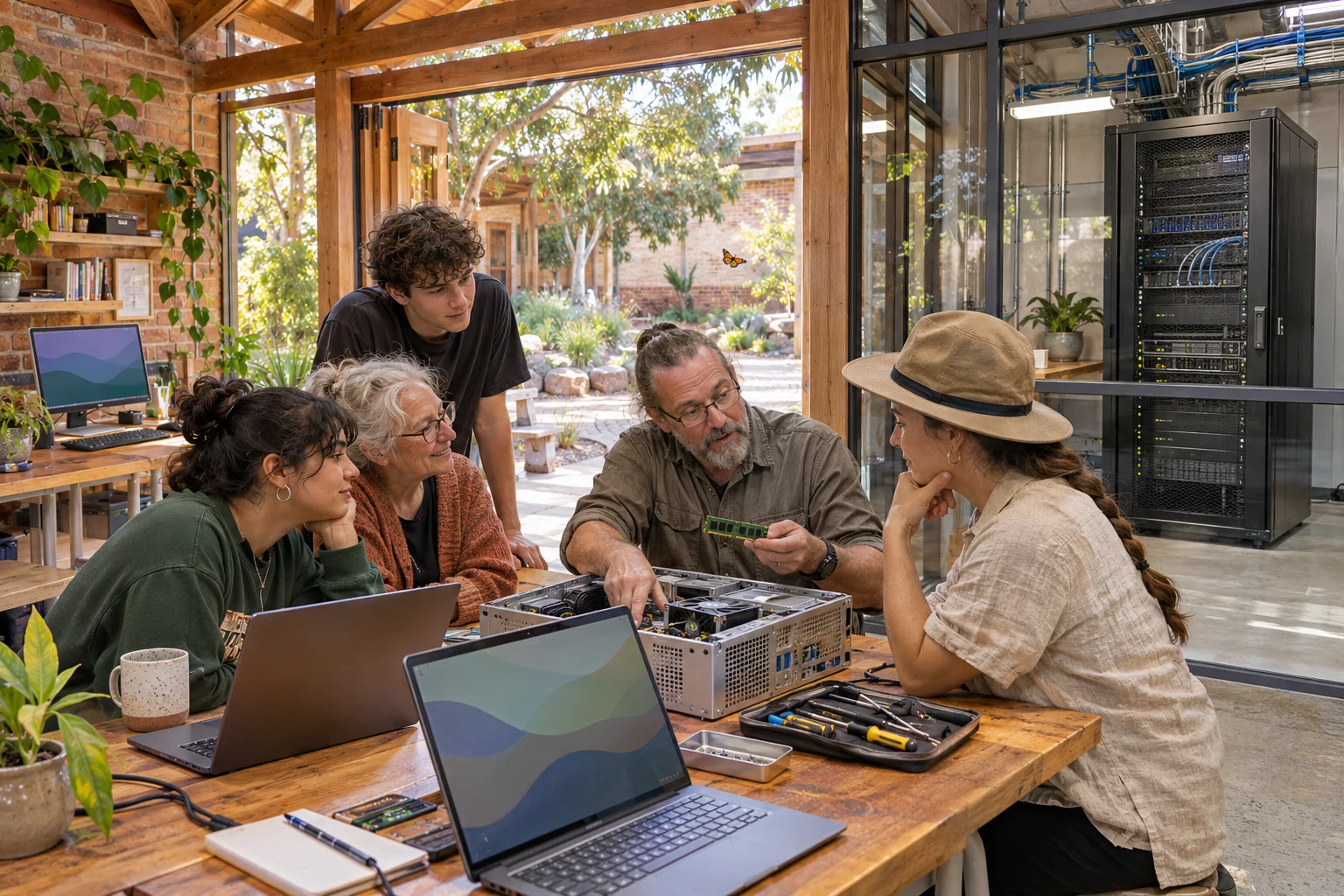
The conditions that let people take part
A resident who finishes a long shift, finds something for dinner and takes over caring for a family member still has a stake in the next council decision. How much room is left that evening to read the papers, talk with neighbours or make a submission? A system that depends on spare money, good health and a free evening will hear from people who already have those things more often.
Healthy De-Slop is the name for work that makes more room in ordinary life. The proposal brings together access to food, movement, rest, reflection and time with other people. A community might organise shared cooking, help people grow or preserve food, make a place to exercise easier to reach, or develop an affordable facility a local co-operative can help own. A co-operative is a business or organisation owned by its members for a shared purpose. Members have a say in what it offers and how it is run.
The Oceania project lets each place choose what would help. A town with a good pool and a shortage of meeting space will make different decisions from an island working to strengthen its food supply. The earlier Health-Tech Cooperative Business Plan, Oceania Health and AI Surge Plan and Queensland Heart-First AI Surge Plan connect this work to care, food waste and shared technology. Specialist facilities and research, including the proposed Geode, need their own professional oversight and evidence. Everyday activities such as sharing food or making time to recover can have their own place in the programme.
Household bills can also be de-slopped. Confusing charges, opaque terms and the work of chasing an explanation can take money and time people need elsewhere. Household Bill Check brings this principle to everyday contracts and bills, helping people organise the evidence, understand what they are paying for and pursue a clear answer. The chapter Reading a bill and finding the rule explains that process in more detail.
The same idea applies to information and institutions. A local group needs a way to find an original source, tell an observation from a conclusion and see what changed after a correction. It also needs time to hold that conversation. Better tools and better conditions reinforce one another. The aim is for more people to have the energy and time to take part in decisions about their lives and communities.
Keeping track of what a community gives and gets
Imagine a neighbourhood meal that uses food from several gardens. The organisers pay for hall access and ingredients. Some people cook or deliver meals as part of paid work. Others freely give an hour. People might gain a reliable meal, a new skill or a connection to someone who can help. A bank statement tells us what was spent. To understand whether the meal was worth repeating, we also need to know who made it possible and what changed.
The Incomplete Ledger is the gap between what ordinary accounts record and the work that sustains a community. The Braided Economy keeps three records alongside each other. A financial record shows wages, purchases, income and costs. A contribution record shows the time people freely gave and what they agreed could be shared. An outcomes record shows what happened, who benefited and what remains uncertain. The three accounts help people make a decision together.
A Community-Hour, or C-Hour, records one verified hour of voluntary human contribution. One person’s hour is counted once, even when it helps several projects. A description can record what they did, who it helped and what they learnt. The contributor can see and correct the record and decide what they wish to make public. A C-Hour has no cash value. Paid work keeps its wages, equipment keeps its funding, and acquiring a co-operative asset has its own terms.
People can use these records to ask better questions. A garden could track spending and volunteer time and then see whether it made fresh food easier to get. It might find that opening hours or transport shaped the result more than expected. Another community could use the same method without needing anyone’s private records.
That gives communities a better basis for deciding what to fund and who to train. It can also show when a service looks inexpensive because volunteers are carrying work that needs paid time and reliable support.
Sharing the gains from better tools
When a business can do more with better software or equipment, someone decides where the gains go. The business might improve services, train workers, pay better wages, fund leave or take a larger return. The choices people can make depend partly on who owns the business and who has a voice in those decisions.
Mutual Futures explores ways to widen ownership. An owner nearing retirement may want a fair price and to see the firm continue. Workers or a local co-operative may want to take it on and keep serving its customers. A staged purchase can give both sides a way to agree how ownership transfers. Paid mentoring can help the next crew learn how to quote a job, recognise an uncommon fault or maintain relationships that took years to build.
Ready SET Co-op proposes to bring together host workplaces, equipment, mentors and people ready to learn. Try Everything Once means supported, paid and supervised chances to try different work, with a stable base or a next step. Intermittent Retirement means funded time throughout life for care, study, travel, creative work or rest. Making that possible requires agreements about pay, who covers the work and how someone returns.
Universal Intelligence means useful access to AI and learning, with the ability to question how those tools work. Universal Adequate Income means having enough for a decent life through a mix that might include wages, public services, social protection and returns from shared ownership. Different places can use different arrangements.
500 Queens Venture Capital proposes a route for women to gain executive experience and direct investment. It combines mentoring, practical responsibility for customers, teams and budgets, and proposed AI advisers that offer different perspectives. An illustrative Australian five-year model allocates A$25 million to 500 grants and A$5 million to shared operations. Grants, leadership participation and appointments are distinct measures.
The common purpose is for productive capacity to make room for more choices. People can gain skills, build a stake in useful assets and have time for care, recovery and civic life.
Computing power that stays within reach
A laptop can edit a short film, run a spreadsheet and keep a copy of a local map. A larger film, a detailed flood simulation or an AI service used by a whole school can outgrow that machine. Compute means the capacity to carry out that work. It comes from physical equipment that processes and stores information, and needs power, cooling and network connections. The cloud is equipment elsewhere that people can use over a network.
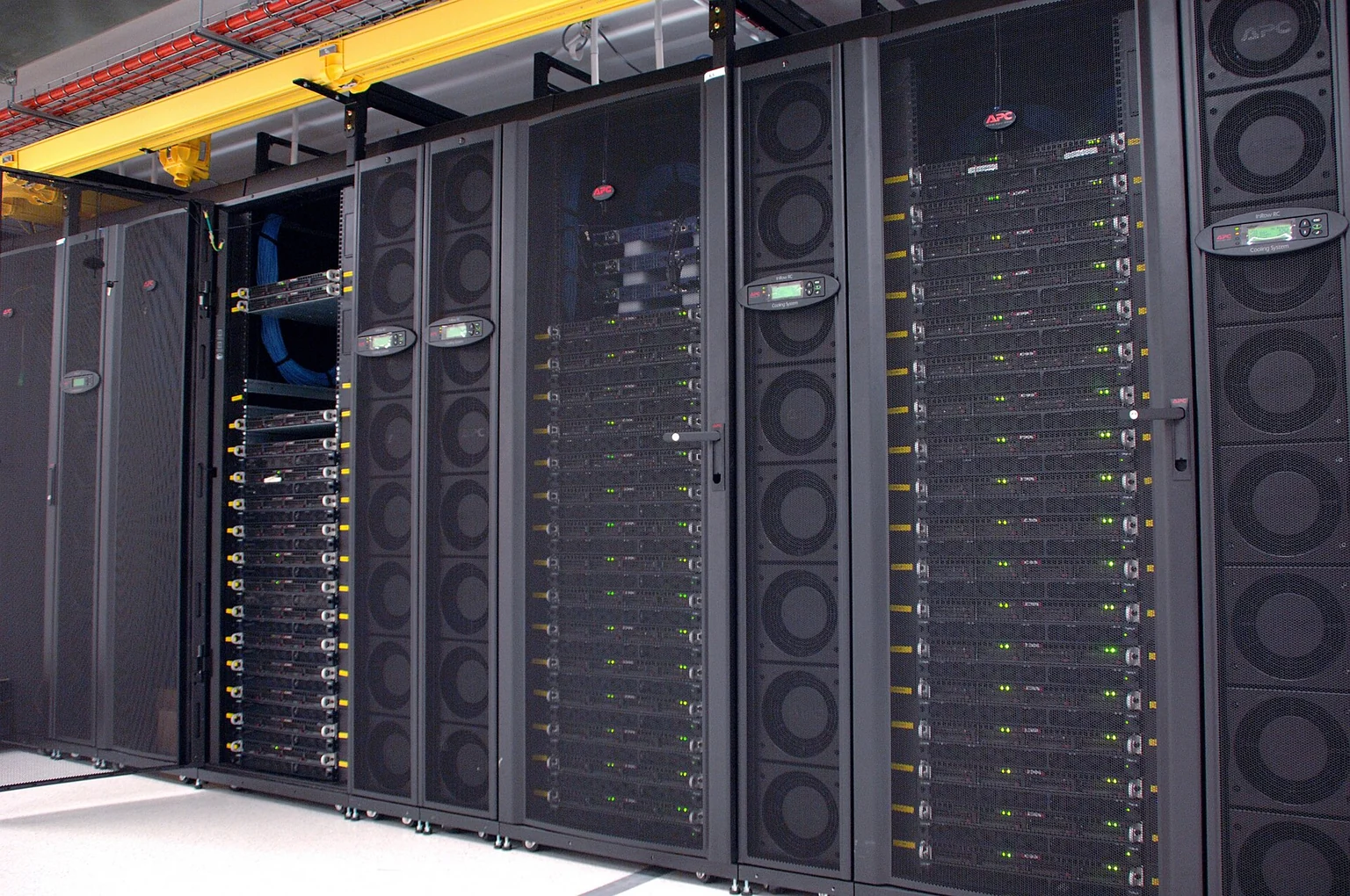
The Missing Middle would give communities access to substantial computing power between personal devices and large data centres. A node is one working installation in the network. A rack is the frame or cabinet that holds a stack of servers and the equipment that supports them. Servers are computers set up to do work for people using other devices. A school, library, hospital or training provider could share a node with other local organisations and draw on larger facilities for demanding jobs.
The Sovereignty Stack sets out how those levels fit together. Luke explains the design in Do Not Put All Our Eggs in One Basket. A phone or home computer can keep a chosen private record. Neighbourhood equipment can help people stay connected during an outage. A community node can handle larger tasks, and national and global facilities can take on jobs that need more machines. A public kiosk can show a stored map during a loss of internet connection if the site has suitable power and has tested the service.
Sovereign compute means having practical control over the choices. Who decides where the work runs? Who can use the information? Can a community move to different equipment or software and keep working? A local address helps when the people responsible for a service can exercise those choices. First Nations communities and other knowledge holders retain authority over what information can be used and where it can go.
A local library gives people a place to learn, share tools and get help while remaining connected to larger collections. The missing middle gives communities a similar place in the computing network. The next question is which AI models people can run on that equipment, and who can make or improve them.
Making and running our own AI models
Think of an AI service that helps people find a local organisation. It needs to recognise what someone is asking, find a reliable directory entry and give the person enough information to check it. If the source is out of date, or the service is missing, the tool should make that clear. A community needs a way to test those cases and improve the service when it gets them wrong.
An AI model is a system trained on examples to learn patterns. The numbers adjusted during training are called weights. Running a model means using those learned patterns for a new task. A local team can also give the model approved source documents to look up when answering. Updating a directory and training a new model are separate jobs.
The proposed Australian Open Model Commons would develop general-purpose models designed, trained and deployed in Australia. Local teams could build models or adapt open models from Australia and overseas. An open-weight release makes the learned numbers available under its licence. A broader open-source release would also provide the design, tools for training and running the model, tests and instructions that help others examine and reproduce the work. The proposal calls for that wider openness where law, privacy, cultural authority and security allow. The people responsible for sensitive or culturally restricted material govern what may be used and shared.
A team building the service finder could use approved examples of useful answers, then test the result on questions it held back during training. Does it send someone to the right place? Does it say when a source is old? Another region could run the same checks, add examples and show where a new version improves. A smaller model might run at a local node while more demanding training uses a larger Australian facility.
Australia can still use suitable commercial models and work with overseas partners. A commons gives communities and researchers models they can inspect, improve and run themselves, and practical ways to change services when their needs change.
Building and owning the Australian network
The Australian installation plan starts with 30 million people and one node per 10,000. That gives 3,000 Australian sites at around A$18–19 billion. The base calculation is A$18 billion at an initial A$6 million per site. That allowance includes equipment, power, cooling, connections, security, a public learning space, training and initial support. Electricity, staff, maintenance and future equipment replacement need ongoing budgets.
The AUKUS inquiry submission used the same allowance for a whole-world scenario of about 44,000 sites at A$264 billion. That is a comparison at global scale. The Australian installation plan sets out the separate domestic rollout.
The plan invites every Australian postcode to participate from the outset. Construction would proceed where people can bring together a host building, suitable power, users, staff and finance. A federation means organisations can work together under agreements while each retains its responsibilities. A host can provide space, a team can install the equipment, an operator can run the service and a local co-operative can acquire the agreed asset. Investors can receive a return with an end date. As co-operatives buy installations, some of that capital can finance further sites. Money to run and renew the equipment needs its own provision.
Computers give off heat while they run. If a nearby pool or building can use some of that heat, the installation can be designed to transfer and measure it. The equipment needs a way to cool when the building cannot use the heat. The building needs independent heating for times when the equipment is unavailable. Engineers would check demand, power and backup arrangements for the actual site.
Installations can also prepare the next crew. A 360-degree camera shows the layout and how the equipment connects. Camera-equipped glasses show selected tasks from the technician’s point of view. Trainers can combine that footage with drawings and safety checks to make short lessons or simulations. A learner can review how to do a task or identify a fault before practising under supervision. The network grows by building both useful assets and the local skills to keep them working.