
From an answer to an action
An AI assistant can help write a letter. Give the same software access to your calendar, files and booking service, and it can begin carrying out parts of the work. Connect it to a warehouse, a truck or a laboratory, and its instructions can change what happens in the physical world. The question becomes who may give those instructions, what the system is allowed to do, and how the people affected can challenge a mistake. A connected mine and authority to act · How remote instructions can travel
Artificial intelligence, or AI, is software that learns patterns and uses them to generate answers, make predictions or guide actions. A model is the learned software itself. An agent combines a model with access to tools and an arrangement for pursuing a task. Its practical agency comes from the actions that arrangement permits. Reading a document, sending a message and changing a machine each carry a different level of responsibility. AI and superintelligence · Authorised software agents
Superintelligence, shortened to SI, describes the ambition for systems that exceed human capability across many important activities. There is no agreed instrument that can tell everyone exactly when that threshold has been crossed. People also disagree about when it might arrive and how controllable it would be. The reviewed sovereignty paper therefore starts with things that can be examined today. It follows the money, equipment, electricity, industrial production and authority being assembled around that ambition. Its evidence cutoff is 5 November 2026. What superintelligence means · Musk’s stated expectations · The paper’s 5 November evidence cutoff
The machines behind the screen
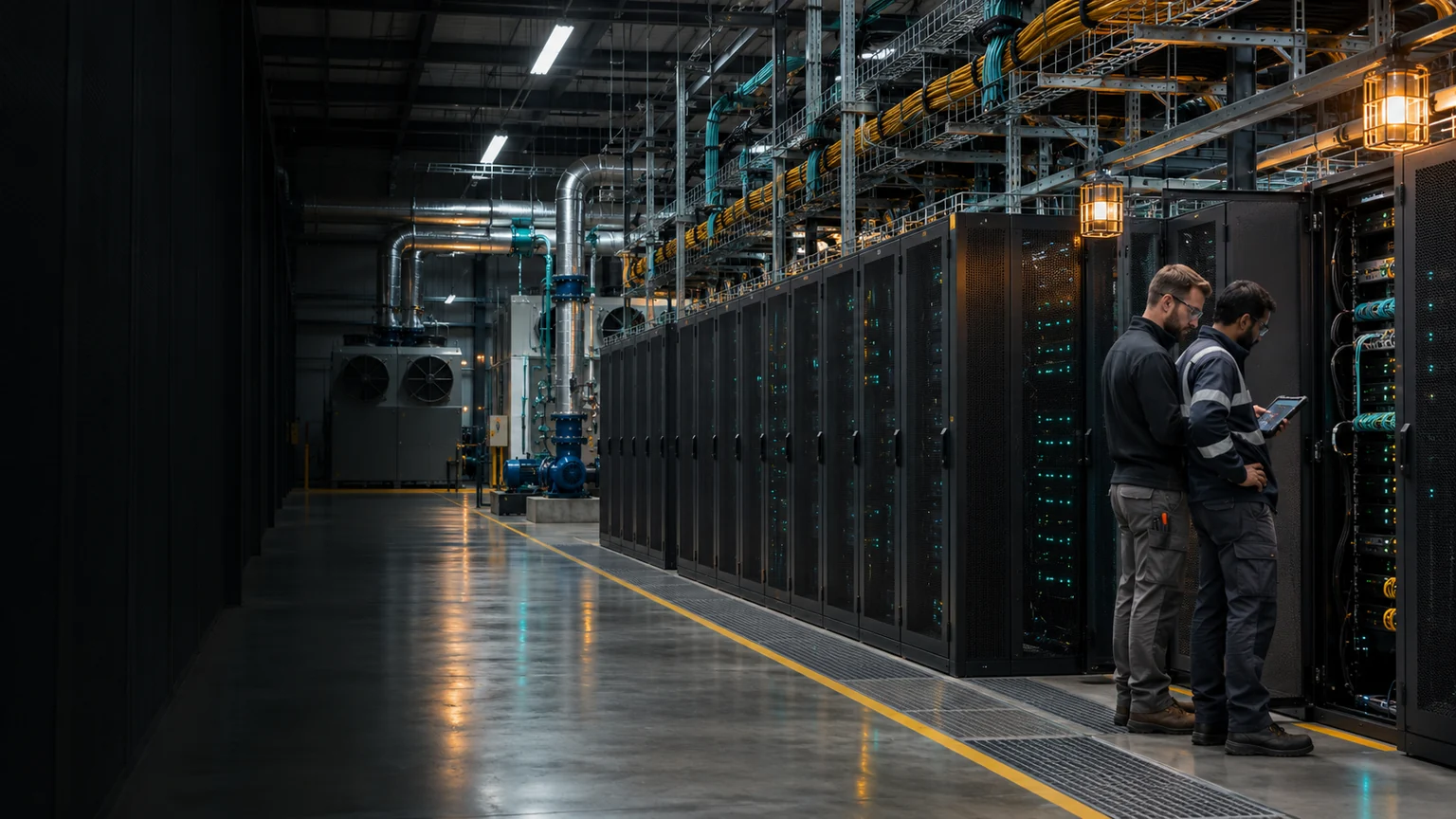
The physical side matters. Compute means the processing work a computer can do. Chips perform calculations, memory feeds them information, storage keeps records, and networks connect the parts. A rack holds a connected set of equipment. A data centre contains many machines with the power, cooling and communications needed to run them. The cloud is computing equipment you reach through a network, operated by a supplier somewhere else. Compute and the equipment · Cloud access and ownership
Renting that equipment can be useful. It lets a small organisation access facilities it could never sensibly build on its own. The relationship changes when it depends on that supplier for its records, daily procedures, staff expertise and ability to keep working. A price increase, policy change, outage or withdrawal can then affect the organisation's freedom to act. Sovereignty is meaningful authority over your own affairs, whether you are a person, community or country. Renting essential computing · Accumulated supplier dependence
Consider a mine buying its communications, dispatch software, battery storage and automated machinery from a closely connected group of suppliers. Every service may offer real benefits. Together, they also determine whether the mine can function and who can change its behaviour. Hospitals, farms and public agencies face related choices. Physical location is one part of the arrangement. Access rights, software updates, usable copies of records and workable alternatives matter as well. The connected mine example · Capability and control
Putting electricity into Australian terms
Electricity helps make the scale visible. Power measures the rate at which electricity is used, while energy measures how much is used over time. The paper uses Australia's calendar-2025 generation of 286.8 terawatt-hours as a fixed measuring stick, drawing on the Australian Government's 2026 statistics release. A fleet drawing 13 gigawatts continuously for a year would use about 40 per cent of that amount. At 100 gigawatts it would use roughly three such Australian totals. These comparisons describe an assumed continuous electrical load, rather than intelligence or useful work. Power and energy explained · The Australian annual generation baseline · The paper’s continuous-power calculation · Australian electricity generation statistics
Capability and choice grow together
The central possibility is that the industries reinforce one another. Better computing can improve designs and factory operations. Robots can help make and maintain more equipment. Improvements in mining, materials and energy can support further expansion. A machine becomes more consequential when it helps enlarge the production system that makes the next machine. The industrial feedback hypothesis · Computing and production reinforcing one another
That possibility can produce worthwhile gains in medicine, safety, creative work and disaster preparation. It can also concentrate influence over the systems people need to live. The practical issue is whether human capability and authority grow alongside machine capability. Following who supplies the equipment, who funds it and who holds the deciding votes makes that question much more concrete. Benefits authority and challenge · People gaining capability