
Following the money
The businesses in the AI race occupy different positions. Some build models, some rent out computing, some make processors, and some own several parts of the chain. A cloud provider can also be an investor in a model company and a competitor selling its own AI. Understanding these relationships is more useful than imagining a single firm doing everything on its own. The roles in the industrial network · Overlapping commercial relationships
The reviewed paper keeps several kinds of financial claim apart. Capital spending buys or builds equipment and facilities. A purchase commitment sets out future obligations. A financing announcement describes investment arrangements. A valuation is what investors think a company is worth. A contract ceiling is the maximum that can be ordered under an agreement. Adding all those headlines together would count different things, sometimes counting the same infrastructure more than once. Corporate amounts in this chapter are US dollars. Funding valuation and secured capacity · Overlapping supply announcements · How the paper treats financial categories
Who holds the deciding votes?
OpenAI, the company behind ChatGPT, illustrates the connections. The paper records its March 2026 announcement of US$122 billion in committed funding and its April statement that it had secured more than 10 gigawatts of infrastructure capacity. Secured capacity can include equipment and buildings still to be delivered. Its agreements connect it with NVIDIA, Broadcom, Amazon, Oracle and other participants. A single supply arrangement can appear in announcements from several of them. OpenAI’s disclosed funding and capacity · The connected supply agreements · OpenAI funding announcement · OpenAI infrastructure statement
The paper describes OpenAI's formal control through the OpenAI Foundation, using its structure page checked on 5 November 2026. It separately records chief executive Sam Altman's personal investments. Those interests can raise questions about conflicts where businesses deal with one another, while formal authority still needs to be traced through the actual boards, ownership rights and agreements. OpenAI’s formal control · Altman’s separate investments · OpenAI governance structure · Reuters on Altman’s disclosed investments
Anthropic, the developer of Claude, presents another structure. Its 2 November 2026 filing disclosed about US$895.4 billion of computing and infrastructure commitments, with obligations reaching as far as 2045. About US$447.5 billion fell before the end of 2030. That long schedule matters when interpreting the headline. At the paper's cutoff, Anthropic was private with an offering in preparation. Its proposed founder voting arrangements and the Long-Term Benefit Trust's board appointment rights sat alongside substantial commitments to commercial suppliers. Anthropic’s commitments and timetable · Its financing and proposed control rights · Anthropic’s amended registration filing · Anthropic financing announcement
Publicly traded companies can also concentrate decisions. The paper records combined voting power of 52.7 per cent for Alphabet founders Larry Page and Sergey Brin in the relevant 2026 disclosure. A Meta disclosure put Mark Zuckerberg's voting power at 60.6 per cent against a 13.4 per cent economic interest. Different share classes let people hold a relatively small share of the financial interest and a much larger share of the votes. The rights attached to ownership therefore matter as much as the number of outside shareholders. Alphabet’s voting disclosure · Meta’s voting and economic interests · Alphabet voting-control disclosure · Meta voting-control disclosure
A factory has several stages
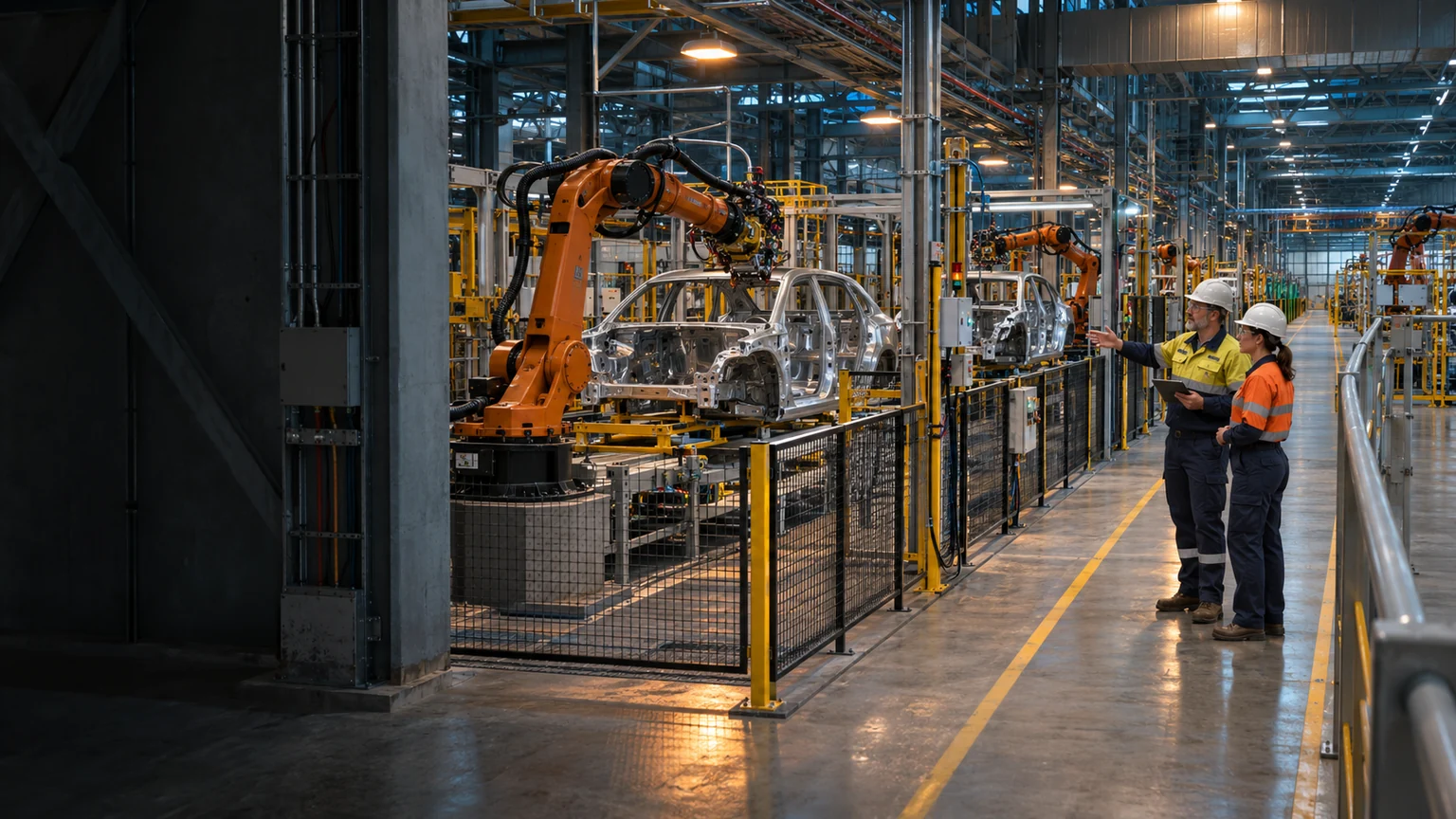
The machinery has its own chain of dependence. A semiconductor fabrication plant, usually called a fab, makes circuits on wafers. The chips then need memory, packaging, connections and suitable systems around them. The industry association SEMI projected equipment spending for 300-millimetre wafer factories to rise from US$149 billion in 2026 to US$227 billion in 2029. Its public outlook supported roughly 8 per cent annual growth in installed capacity from 2027 through 2029. On that basis, an index of 100 in 2026 becomes about 126 in 2029. Fabs wafers and packaging · SEMI’s spending outlook · The paper’s wafer-capacity index · SEMI fab equipment outlook · SEMI installed-capacity outlook
Construction, installed equipment and useful output occur at different stages. A factory may have a building before it has its tools. It may make initial wafers before it reaches reliable production. Processors can wait for memory or packaging, then wait again for power and commissioning. The paper follows those stages across TSMC, Intel, Samsung, Micron and other suppliers rather than converting construction spending straight into working AI. TSMC’s production timetable · Samsung and Micron milestones · Memory and production limits · How factory stages enter the scenarios
China and Australia’s room to act
China is building across this chain too. Its September 2026 national plan targeted 9,800 exaFLOPS of intelligent computing by 2030, compared with 1,882 reported for March 2026 on that plan's measurement basis. An exaFLOP means a billion billion arithmetic operations a second. The accuracy used in a calculation, the hardware counted and whether a figure describes theoretical or delivered performance all affect comparisons. That national total cannot simply be placed beside an estimate based on imported US-designed processors. China’s national target and baseline · How measurement affects comparison · Coverage of the chip-import estimate · China’s information-infrastructure plan · Chinese computing-capacity briefing
Huawei, Alibaba, Tencent, state telecommunications groups and Chinese chip and memory manufacturers have different roles and owners. Their programmes add domestic production and commercial deployment to national policy. For Australia, the question is how to benefit from both international systems while retaining skills, records and operating choices it can control locally. Several suppliers help. Practical authority also needs people who understand the machinery and can keep essential work going. China’s range of owners and roles · Huawei’s hardware and ownership · Alibaba and Tencent programmes · Australia’s room to act · Huawei processor roadmap · Alibaba infrastructure roadmap