
Australian C-Hour Legislative Strategy
Read the complete supplied reference online, or download the original file.
Original source material, including its historical dates and proposals.
Page 1 of 30
Read selectable text for page 1
Text extracted from this page. Use the page image for its original layout, tables and figures.
Framework
for
Integrating
Regenerative
Assets
into
Australian
Law
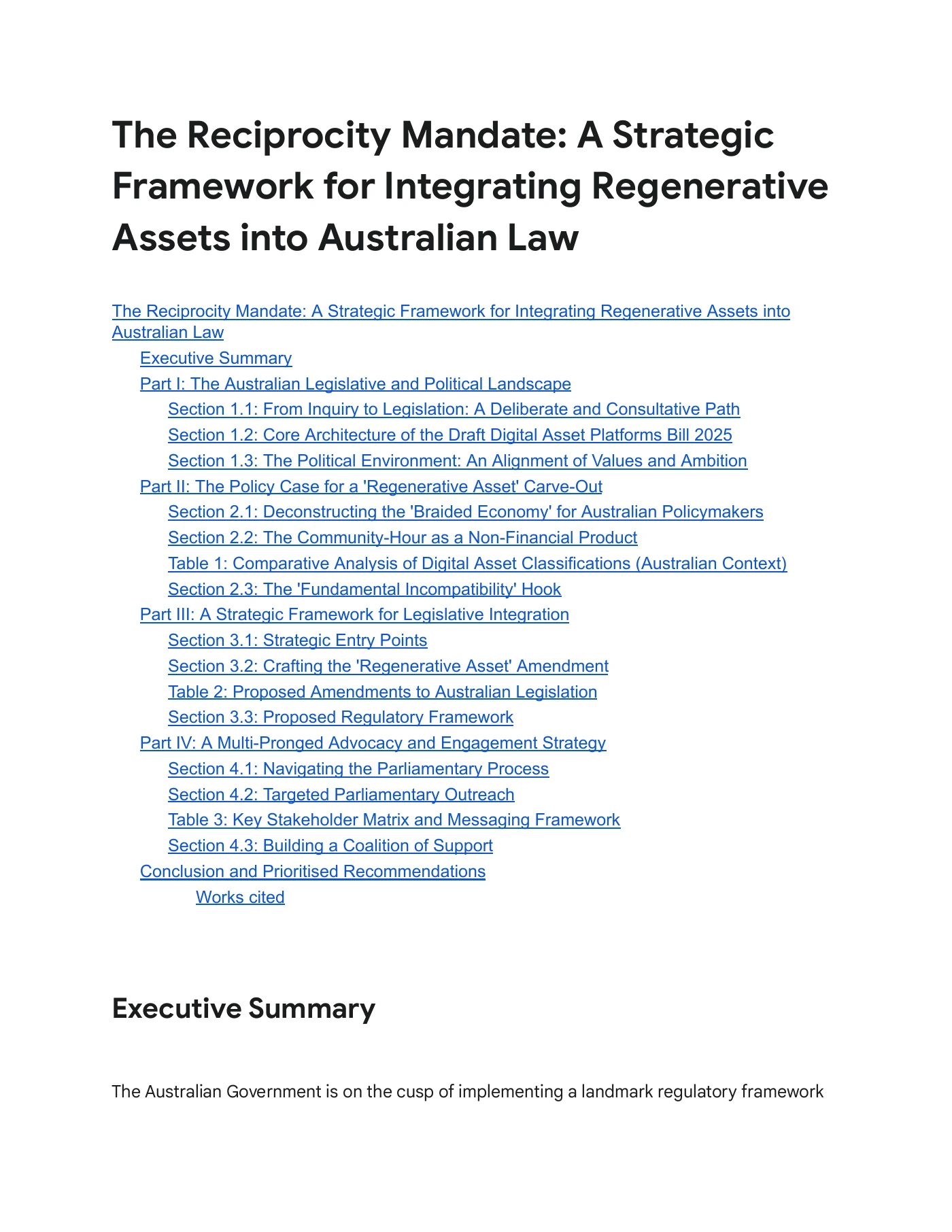
The Reciprocity Mandate: A Strategic Framework for Integrating Regenerative Assets into Australian Law Executive Summary Part I: The Australian Legislative and Political Landscape Section 1.1: From Inquiry to Legislation: A Deliberate and Consultative Path Section 1.2: Core Architecture of the Draft Digital Asset Platforms Bill 2025 Section 1.3: The Political Environment: An Alignment of Values and Ambition Part II: The Policy Case for a 'Regenerative Asset' Carve-Out Section 2.1: Deconstructing the 'Braided Economy' for Australian Policymakers Section 2.2: The Community-Hour as a Non-Financial Product Table 1: Comparative Analysis of Digital Asset Classifications (Australian Context) Section 2.3: The 'Fundamental Incompatibility' Hook Part III: A Strategic Framework for Legislative Integration Section 3.1: Strategic Entry Points Section 3.2: Crafting the 'Regenerative Asset' Amendment Table 2: Proposed Amendments to Australian Legislation Section 3.3: Proposed Regulatory Framework Part IV: A Multi-Pronged Advocacy and Engagement Strategy Section 4.1: Navigating the Parliamentary Process Section 4.2: Targeted Parliamentary Outreach Table 3: Key Stakeholder Matrix and Messaging Framework Section 4.3: Building a Coalition of Support Conclusion and Prioritised Recommendations Works cited
Executive Summary
The Australian Government is on the cusp of implementing a landmark regulatory framework
Page 2 of 30
Read selectable text for page 2
Text extracted from this page. Use the page image for its original layout, tables and figures.
Asset,
And
Tokenised
Custody,
Platforms)
Bill
2025
represents
a
considered,
principles-based
approach
to
mitigating
consumer
harm
and
providing
market
certainty
by
bringing
custodial
intermediaries
under
the
established
Australian
Financial
Services
Licence
(AFSL)
regime.
1
While
this
platform-centric
model
is
a
pragmatic
and
necessary
step,
its
focus
on
financial
intermediaries
and
custodial
risk
creates
a
strategic
blind
spot.
It
fails
to
adequately
provide
for
a
new
generation
of
digital
assets
designed
not
for
financial
speculation,
but
for
social
and
ecological
regeneration.
This
omission
risks
stifling
a
uniquely
powerful
form
of
pro-social
innovation
that
aligns
directly
with
Australia's
national
interests.
This report presents a comprehensive legal and political strategy to address this gap by
establishing
a
legislative
'carve-out'
for
a
novel
asset
class:
the
'Regenerative
Asset'.
The
archetype
for
this
class
is
the
Community-Hour
(C-hour),
a
non-speculative
digital
receipt
for
one
hour
of
verified
contribution
to
community
well-being,
ecological
stewardship,
or
the
care
economy.
3
The C-hour is the cornerstone of a 'Braided Economy' model, designed to formally
measure,
value,
and
reward
the
foundational,
non-market
work
that
underpins
a
resilient
society
and
a
healthy
environment.
The central recommendation of this report is to amend the forthcoming Digital Asset
Platforms
Bill
2025
and
the
Corporations
Act
2001
to
create
a
distinct
and
appropriate
regulatory
pathway
for
Regenerative
Assets.
This
strategy
does
not
oppose
the
Government's
current
direction
but
seeks
to
enhance
it.
The
policy
justification
for
this
carve-out
is
derived
directly
from
the
Australian
Treasury's
own
'Token
Mapping'
exercise,
which
concluded
that
certain
non-intermediated,
community-governed
token
systems
may
be
"fundamentally
incompatible"
with
the
existing
financial
services
framework.
4
The C-hour system is a
quintessential
example
of
such
a
system.
By creating this clear legal lane, Australia can position itself as a global leader in fostering
technology
that
generates
tangible
social
dividends.
This
initiative
strengthens
the
proposed
Bill
by
promoting
genuine,
non-speculative
innovation,
enhancing
consumer
protection
through
an
asset
class
that
is
pro-social
by
design,
and
providing
a
powerful,
market-based
tool
to
achieve
the
Albanese
Government's
stated
ambition
for
a
more
inclusive,
purposeful,
and
"values-based
economy".
5
This report provides the specific legislative language, the
detailed
political
engagement
plan,
and
the
compelling
policy
narrative
required
to
turn
this
vision
into
a
legal
reality,
securing
profound
benefits
for
the
Australian
community
and
environment.
Part I: The Australian Legislative and Political
Landscape
Page 3 of 30
Read selectable text for page 3
Text extracted from this page. Use the page image for its original layout, tables and figures.
Section 1.1: From Inquiry to Legislation: A Deliberate and Consultative
Path
Australia's approach to regulating digital assets has been characterized by a deliberate,
consultative,
and
evidence-led
methodology.
Unlike
jurisdictions
that
have
pursued
reactive
or
enforcement-centric
strategies,
the
Australian
policy
trajectory
reveals
a
commitment
to
understanding
the
underlying
technology
and
its
economic
functions
before
prescribing
regulation.
This
methodical
process,
from
parliamentary
inquiry
to
detailed
policy
consultation,
has
created
a
sophisticated
and
well-reasoned
foundation
for
the
current
legislative
reforms.
It
is
this
very
process
that
provides
the
critical
entry
points
for
a
nuanced
proposal
to
recognise
Regenerative
Assets.
The
government
has
demonstrated
a
clear
willingness
to
engage
with
complex
arguments
and
adapt
its
approach
based
on
evidence,
creating
a
favourable
environment
for
a
proposal
that
builds
upon,
rather
than
contradicts,
its
existing
work.
The genesis of the current reform agenda can be traced to the landmark Final Report of the
Senate
Select
Committee
on
Australia
as
a
Technology
and
Financial
Centre,
tabled
in
October
2021.
7
Chaired by then-Senator Andrew Bragg, this comprehensive inquiry engaged
deeply
with
industry,
academia,
and
regulators
to
map
the
opportunities
and
risks
of
the
burgeoning
digital
asset
sector.
10
The Committee's report was pivotal, moving the policy
debate
beyond
simplistic
narratives
and
toward
a
sophisticated
understanding
of
the
technology's
potential.
It
made
twelve
key
recommendations,
forming
a
coherent
roadmap
for
reform.
Central
among
these
were
proposals
to
establish
a
market
licensing
regime
for
digital
currency
exchanges,
introduce
minimum
standards
for
the
custody
of
digital
assets,
and,
most
critically
for
this
strategy,
a
recommendation
that
the
Australian
Government,
through
Treasury,
conduct
a
'token
mapping'
exercise
to
determine
the
best
way
to
characterise
the
various
types
of
digital
assets
in
Australia.
8
The then-Coalition Government's response in December 2021, titled "Transforming Australia's
Payment
System,"
signalled
a
broad,
bipartisan
consensus
on
the
need
for
action
by
agreeing
in
principle
to
the
core
recommendations,
including
the
token
mapping
exercise.
14
This
commitment
was
subsequently
carried
forward
by
the
incoming
Albanese
Labor
Government,
demonstrating
a
shared
understanding
across
the
political
spectrum
that
regulatory
clarity
was
essential
for
both
consumer
protection
and
innovation.
This commitment culminated in the release of Treasury's 'Token Mapping Consultation Paper'
in
February
2023,
a
foundational
document
in
Australia's
digital
asset
policy
development.
4
Page 4 of 30
Read selectable text for page 4
Text extracted from this page. Use the page image for its original layout, tables and figures.
established
regulatory
principles
to
the
novel
crypto
ecosystem.
Its
methodology
was
explicitly
guided
by
two
long-standing
pillars
of
Australian
financial
regulation:
technology
neutrality
and
a
'functional
approach'.
17
Rather than creating bespoke rules for specific
technologies,
the
paper
sought
to
identify
the
economic
'function'
of
a
given
crypto
asset
or
service
and
assess
whether
that
function
fell
within
the
existing
regulatory
'perimeter'
of
a
'financial
product'
as
defined
in
the
Corporations
Act
2001
.
4
To achieve this, the paper proposed a framework for classifying crypto arrangements into
three
components:
the
'token'
(the
digital
record-keeping
unit),
the
'token
system'
(the
protocol
or
arrangement
governing
the
token),
and
the
'function'
(the
product
or
benefit
provided).
4
It is this analytical framework that produced the most significant conclusion for
the
purposes
of
this
strategy.
The
paper
drew
a
clear
distinction
between
two
types
of
token
systems:
1. Intermediated Token Systems: Where an intermediary (such as an exchange or a
custodian)
makes
promises
and
provides
services
to
a
consumer.
A
large
portion
of
the
crypto
ecosystem
falls
into
this
category,
and
the
risks
are
analogous
to
traditional
financial
services.
4
2. Public Token Systems: Where users form transactional relationships directly on a public
network,
often
governed
by
smart
contracts,
in
the
absence
of
a
traditional
intermediary.
The paper's critical finding, which forms the lynchpin of the policy case for a Regenerative
Asset
carve-out,
was
its
conclusion
regarding
this
second
category.
Treasury
acknowledged
that
products
in
this
category,
which
operate
without
the
intermediaries
that
financial
services
law
is
designed
to
regulate,
"may
be
fundamentally
incompatible
with
the
existing
financial
services
regulatory
framework".
4
This official recognition of a potential regulatory mismatch is
not
a
flaw
in
the
government's
analysis
but
a
sophisticated
observation
that
provides
the
explicit
policy
justification
for
creating
a
new,
more
appropriate
regulatory
pathway
for
assets
that
fit
this
description.
Section 1.2: Core Architecture of the Draft Digital Asset Platforms Bill
2025
The intellectual work of the Token Mapping exercise directly informs the architecture of the
Government's
proposed
legislative
solution:
the
exposure
draft
of
the
Treasury
Laws
Amendment
(Regulating
Digital
Asset,
And
Tokenised
Custody,
Platforms)
Bill
2025
,
released
for
consultation
in
September
2025.
1
The Bill is a direct and logical consequence of the token
mapping
findings.
Having
identified
that
the
primary
source
of
unmitigated
consumer
risk
resides
in
'intermediated'
platforms
that
take
custody
of
client
assets,
the
Bill
is
precisely
Page 5 of 30
Read selectable text for page 5
Text extracted from this page. Use the page image for its original layout, tables and figures.
20
Its core logic is to regulate the activity of providing a
custodial
digital
asset
facility,
rather
than
attempting
to
define
the
legal
nature
of
every
underlying
asset
itself.
This is achieved through a significant amendment to the Corporations Act 2001 , which
introduces
two
new
categories
of
'financial
product'.
1
The creation of these new product
categories
brings
the
providers
of
these
facilities
squarely
within
the
existing
and
well-understood
AFSL
regime.
The
two
new
products
are:
● Digital Asset Platform (DAP): Defined as a facility where an operator holds digital
tokens
on
behalf
of
clients.
This
definition
is
broad,
intended
to
capture
a
wide
range
of
business
models,
including
cryptocurrency
exchanges,
custodial
wallet
providers,
and
staking
services
where
the
provider
takes
control
of
the
client's
tokens.
20
● Tokenised Custody Platform (TCP): Defined as a facility where an operator holds an
underlying
asset
(which
can
be
physical,
like
gold,
or
intangible,
like
shares)
and
creates
a
unique
digital
token
that
represents
the
client's
right
to
redeem
or
direct
that
underlying
asset.
This
covers
services
that
'tokenise'
real-world
assets.
20
Under the proposed legislation, any entity providing these DAP or TCP facilities, or providing
financial
services
such
as
advice
in
relation
to
them,
will
be
required
to
hold
an
AFSL
issued
by
the
Australian
Securities
and
Investments
Commission
(ASIC).
1
This triggers a comprehensive
suite
of
regulatory
obligations
designed
to
protect
consumers
and
ensure
market
integrity.
These
obligations
include
meeting
standards
for
capital
adequacy,
having
robust
risk
management
systems,
ensuring
key
personnel
are
competent,
providing
adequate
disclosure
to
clients
via
a
new
'Platform
Guide',
and
having
internal
and
external
dispute
resolution
mechanisms.
2
A key feature of the Bill's architecture is its deliberate technology-neutral language. The draft
legislation
avoids
using
specific,
and
potentially
transient,
technological
terms
like
'blockchain',
'cryptocurrency',
or
'distributed
ledger
technology'.
1
Instead, it uses broader
concepts
like
'digital
token'
and
'digital
object'.
This
approach
is
designed
for
longevity,
ensuring
the
framework
can
adapt
to
future
technological
developments
without
requiring
constant
legislative
amendment.
This
principle
of
technology
neutrality
is
a
strategic
advantage
that
can
be
leveraged,
as
it
allows
for
a
focus
on
the
economic
substance
and
purpose
of
an
asset,
rather
than
its
underlying
technical
implementation.
The Bill also includes a low-value exemption. Platforms that hold less than $5,000 per
customer
and
facilitate
less
than
$10
million
in
total
transactions
per
year
will
be
exempt
from
the
AFSL
requirement.
1
While this may provide a pathway for small-scale or early-stage
projects,
it
is
fundamentally
unsuitable
for
the
C-hour
protocol,
which
is
designed
for
national
and
global
scale
and
would
quickly
exceed
these
thresholds.
Therefore,
relying
on
this
exemption
is
not
a
viable
long-term
strategy.
The
C-hour
requires
a
dedicated,
purpose-built
regulatory
classification
that
recognises
its
unique
nature,
rather
than
an
exemption
based
on
Page 6 of 30
Read selectable text for page 6
Text extracted from this page. Use the page image for its original layout, tables and figures.
Section 1.3: The Political Environment: An Alignment of Values and
Ambition
The success of any legislative reform strategy depends critically on its alignment with the
prevailing
political
environment
and
the
priorities
of
key
decision-makers.
In
the
context
of
the
C-hour
proposal,
the
current
Australian
political
landscape
presents
a
uniquely
receptive
and
favourable
climate.
The
Albanese
Labor
Government's
core
economic
and
social
narrative,
the
specific
policy
interests
of
the
ministers
responsible
for
the
legislation,
and
the
backgrounds
and
public
statements
of
influential
committee
members
and
crossbenchers
all
indicate
a
powerful
alignment
of
values
and
ambition
with
the
foundational
principles
of
the
Regenerative
Asset
class.
This
proposal
does
not
need
to
create
a
new
political
conversation;
it
can
join
and
amplify
an
existing
one
about
how
to
build
a
more
purposeful,
inclusive,
and
sustainable
Australian
economy.
Government Leadership:
At the apex of economic policymaking, The Hon Dr Jim Chalmers MP , the Treasurer, has
embarked
on
a
significant
public
intellectual
project
to
redefine
the
goals
of
economic
policy
in
Australia.
24
In a widely discussed essay and numerous speeches, he has called for a move
towards
a
"values-based
capitalism"
or
a
"social
purpose
economy".
5
He argues that
economic
policy
must
look
beyond
traditional
metrics
like
GDP
to
measure
well-being
and
social
cohesion,
and
that
markets
should
be
designed
to
deliver
a
"social
dividend".
6
He has
explicitly
championed
the
expansion
of
social
impact
investing
and
the
need
to
find
new
models
to
fund
solutions
in
areas
like
aged
care
and
disability
services,
where
markets
have
traditionally
failed.
6
This overarching philosophy provides the premier political and intellectual
anchor
for
the
C-hour
proposal.
The
C-hour
is
a
tangible,
scalable
mechanism
to
build
the
very
"social
purpose
economy"
the
Treasurer
has
described.
Directly responsible for the legislation is The Hon Dr Daniel Mulino MP , the Assistant
Treasurer
and
Minister
for
Financial
Services.
30
As the minister steering the digital asset
reforms,
his
public
framing
is
crucial.
He
has
consistently
described
the
Bill's
purpose
as
"legitimising
the
good
actors
and
shutting
out
the
bad,"
and
providing
"certainty
for
business
and
confidence
for
consumers".
20
This framing creates a clear strategic imperative: to position
the
C-hour
not
as
a
fringe
crypto-asset
seeking
to
evade
regulation,
but
as
the
archetypal
"good
actor"
asset—one
that
is
non-speculative,
transparent,
and
pro-social
by
its
very
design.
The
advocacy
strategy
must
present
the
proposal
as
an
enhancement
that
helps
the
Minister
achieve
his
stated
goals.
Page 7 of 30
Read selectable text for page 7
Text extracted from this page. Use the page image for its original layout, tables and figures.
36
His portfolio
focus
on
building
sovereign
capability,
backing
Australian-led
innovation,
and
creating
a
"Future
Made
in
Australia"
provides
a
powerful
industrial
policy
lens.
38
The Regenerative
Civilization
Protocol,
as
a
homegrown,
globally
significant
innovation,
can
be
framed
as
a
key
contributor
to
this
agenda,
positioning
Australia
at
the
forefront
of
a
new,
more
ethical
model
of
technological
and
social
development.
Key Parliamentary Committees:
The legislative journey of the Bill will be critically shaped by parliamentary committees,
particularly
in
the
Senate.
The
Senate
Economics
Legislation
Committee
is
the
primary
body
responsible
for
scrutinizing
Treasury
legislation.
Its
current
Chair
is
Senator
Lisa
Darmanin
(ALP,
VIC)
.
42
Senator Darmanin's career prior to entering parliament was with the
Australian
Services
Union,
where
she
was
a
lifelong
advocate
for
workers
in
the
community
and
care
sectors,
leading
landmark
campaigns
for
equal
pay
and
the
recognition
of
undervalued
work.
44
Her public statements and career history demonstrate a deep, personal
understanding
of
the
very
issues
the
C-hour
is
designed
to
address.
Her
position
as
chair
of
the
key
committee
represents
an
extraordinary
alignment,
making
her
a
pivotal
and
potentially
highly
receptive
audience
for
this
proposal.
In the House of Representatives, the Standing Committee on Economics , chaired by
Minister
Husic,
plays
a
vital
role
in
shaping
economic
debate.
Its
membership
includes
influential
voices
such
as
the
independent
Member
for
Wentworth,
Ms
Allegra
Spender
MP
.
36
A
former
business
leader,
Ms
Spender
is
deeply
focused
on
Australia's
productivity
challenges,
intergenerational
fairness,
and
the
need
for
ambitious
economic
reform.
47
The
C-hour's
potential
to
unlock
the
productivity
of
the
non-market
economy
and
create
new
forms
of
value
for
community
contribution
speaks
directly
to
her
stated
policy
concerns.
Opposition and Crossbench:
Building bipartisan support is essential for the long-term success and stability of any
legislative
reform.
Senator
the
Hon
Andrew
Bragg
(Liberal,
NSW)
is
a
key
figure
in
this
regard.
51
As the architect of the 2021 Senate inquiry, he has a deep understanding of the
issues
and
is
a
vocal
advocate
for
a
clear,
pro-innovation
regulatory
framework.
10
His
frustration
with
the
current
government's
pace
of
reform
led
him
to
introduce
his
own
Private
Senator's
Bill,
the
Digital
Assets
(Market
Regulation)
Bill
2023
,
demonstrating
his
willingness
to
lead
on
the
issue.
11
Engaging him constructively and positioning the Regenerative Asset
carve-out
as
a
logical
extension
of
his
own
committee's
work
will
be
critical.
Similarly, Senator the Hon Jane Hume (Liberal, VIC) , a former Minister for Superannuation,
Financial
Services
and
the
Digital
Economy,
is
a
highly
experienced
and
respected
voice
on
financial
technology
and
innovation.
42
Her support would lend significant credibility to the
Page 8 of 30
Read selectable text for page 8
Text extracted from this page. Use the page image for its original layout, tables and figures.
Finally, The Australian Greens are natural allies for this initiative. Their core platform is built
on
principles
of
ecological
sustainability,
social
justice,
and
challenging
economic
models
that
externalize
costs
onto
the
community
and
the
environment.
59
The C-hour's function of
rewarding
environmental
regeneration
and
community
work
aligns
perfectly
with
their
policy
objectives,
making
them
strong
potential
champions
for
the
amendment
in
the
Senate,
where
they
frequently
hold
the
balance
of
power.
61
Part II: The Policy Case for a 'Regenerative Asset'
Carve-Out
Section 2.1: Deconstructing the 'Braided Economy' for Australian
Policymakers
To secure a legislative carve-out, the conceptual framework of the 'Braided Economy' and the
Community-Hour
must
be
translated
from
a
global
protocol
into
the
specific
language
and
context
of
Australian
public
policy.
The
core
argument—that
modern
capitalism
operates
on
an
"incomplete
ledger"
by
failing
to
value
foundational
work—must
be
grounded
in
tangible
Australian
challenges
and
data.
3
By doing so, the C-hour is no longer presented as an
abstract
technological
novelty,
but
as
a
pragmatic,
market-based
tool
designed
to
solve
well-documented,
pressing
national
problems.
The concept of the "incomplete ledger" resonates powerfully with Australia's widely discussed
"productivity
puzzle."
While
productivity
in
traditional
sectors
is
a
constant
focus
of
economic
debate,
the
vast
and
growing
'foundational
economy'—comprising
care,
community
services,
and
environmental
stewardship—is
often
overlooked
in
these
discussions.
Yet,
this
sector
is
critical
to
national
well-being
and
economic
resilience.
The
C-hour
offers
a
mechanism
to
make
the
value
of
this
work
visible
on
a
national
scale.
For
instance,
volunteering
in
Australia
contributes
an
estimated
$290
billion
to
the
economy
annually—a
staggering
figure
that
remains
largely
invisible
in
conventional
economic
accounts.
Similarly,
the
work
of
over
2.65
million
informal
caregivers,
who
provide
essential
support
to
the
elderly
and
people
with
disabilities,
represents
an
enormous
economic
subsidy
to
the
formal
healthcare
and
social
services
systems.
The
C-hour
system,
through
mechanisms
like
a
'Caregiver's
Dividend',
would
provide
a
formal,
non-welfare-based
recognition
and
reward
for
this
essential
labour,
Page 9 of 30
Read selectable text for page 9
Text extracted from this page. Use the page image for its original layout, tables and figures.
dividend".
3
Furthermore, the C-hour can be framed as a powerful tool for achieving specific government
policy
objectives.
In
the
environmental
sphere,
it
can
create
direct
incentives
for
participation
in
regeneration
and
conservation
activities,
supporting
the
work
of
community
groups
like
Landcare
and
local
conservation
volunteers.
In
social
policy,
it
can
foster
community
cohesion
and
combat
loneliness
by
rewarding
mentorship,
neighbourhood
support,
and
civic
engagement.
This
reframes
the
C-hour
from
a
'cryptocurrency'
into
a
versatile
public
policy
instrument.
It
is
a
market-based,
non-bureaucratic
mechanism
for
directing
human
capital
towards
areas
of
national
priority
that
are
currently
underserved
by
the
traditional
financial
economy.
This
narrative
aligns
with
the
principles
of
both
major
parties:
it
offers
a
market-oriented
solution
that
empowers
individuals
and
communities,
consistent
with
conservative
principles,
while
also
achieving
progressive
goals
of
valuing
care
work
and
strengthening
the
social
safety
net.
Section 2.2: The Community-Hour as a Non-Financial Product
The legal cornerstone of the strategy is to establish that the Community-Hour (C-hour)
system,
as
designed,
falls
outside
the
existing
regulatory
perimeter
of
the
Corporations
Act
2001
.
It
is
not
a
'financial
product'
and
the
protocol
governing
it
is
not
a
'Digital
Asset
Platform'
(DAP)
or
a
'Tokenised
Custody
Platform'
(TCP)
as
defined
in
the
proposed
2025
Bill.
This
argument
is
not
based
on
a
technical
loophole,
but
on
the
fundamental
purpose
and
structure
of
the
asset,
which
is
intentionally
designed
to
be
non-financial.
A systematic analysis against the definitions in Chapter 7 of the Corporations Act and ASIC's
guidance
demonstrates
this
distinction.
62
The C-hour is not: ● A Security: The C-hour fails the established legal test for an investment contract (known
in
the
US
as
the
Howey
Test
and
applied
similarly
in
Australian
jurisprudence).
There
is
no
"investment
of
money"
with
an
"expectation
of
profits
arising
from
the
efforts
of
a
third
party".
3
Users earn C-hours through their own personal contributions of time and effort.
The
value
they
receive
is
a
direct
result
of
their
own
work,
not
the
managerial
efforts
of
a
promoter
or
a
centralised
entity
seeking
to
generate
a
financial
return
for
investors.
3
● An Interest in a Managed Investment Scheme (MIS): An MIS involves people
contributing
money
or
assets
to
a
common
pool,
which
is
then
used
by
a
'responsible
entity'
to
generate
financial
benefits
that
are
distributed
back
to
the
members.
62
The
C-hour
system
operates
differently.
There
is
no
common
pool
of
invested
capital.
The
governing
body,
a
Decentralized
Autonomous
Organisation
(DAO),
is
not
a
responsible
entity
managing
investments
for
profit;
it
is
a
community-governed
protocol
for
verifying
Page 10 of 30
Read selectable text for page 10
Text extracted from this page. Use the page image for its original layout, tables and figures.
participants
for
their
own
work.
3
● A Derivative or a Non-Cash Payment Facility: The C-hour's value is not derived from
another
financial
instrument,
nor
is
it
designed
as
a
general-purpose
facility
for
making
payments
across
the
economy.
Its
utility
is
primarily
within
the
'Reciprocity
Economy'
for
redeeming
specific
community-backed
goods
and
services.
3
Crucially, the C-hour protocol is also not a DAP or a TCP under the proposed 2025 Bill. The
defining
characteristic
of
both
a
DAP
and
a
TCP
is
the
presence
of
a
custodial
'operator'—an
intermediary
that
holds
assets
on
behalf
of
clients.
20
This custodial relationship is the specific
risk
the
Bill
is
designed
to
regulate.
The
C-hour
system
is
architected
to
eliminate
this
risk.
C-hours
are
earned
directly
into
a
user's
self-custodied
digital
wallet.
The
user
has
exclusive
control
of
their
private
keys
and,
therefore,
their
assets.
The
protocol's
software
and
the
governing
DAO
facilitate
the
verification
and
issuance
of
C-hours,
but
they
do
not
take
custody
of
them.
The
'operator'
is
the
decentralised
community
itself,
not
a
corporate
intermediary.
This
fundamental
structural
difference
means
the
C-hour
system
does
not
create
the
custodial
risks
that
the
AFSL
regime
for
DAPs
and
TCPs
is
designed
to
mitigate,
making
that
regulatory
framework
both
unnecessary
and
inappropriate.
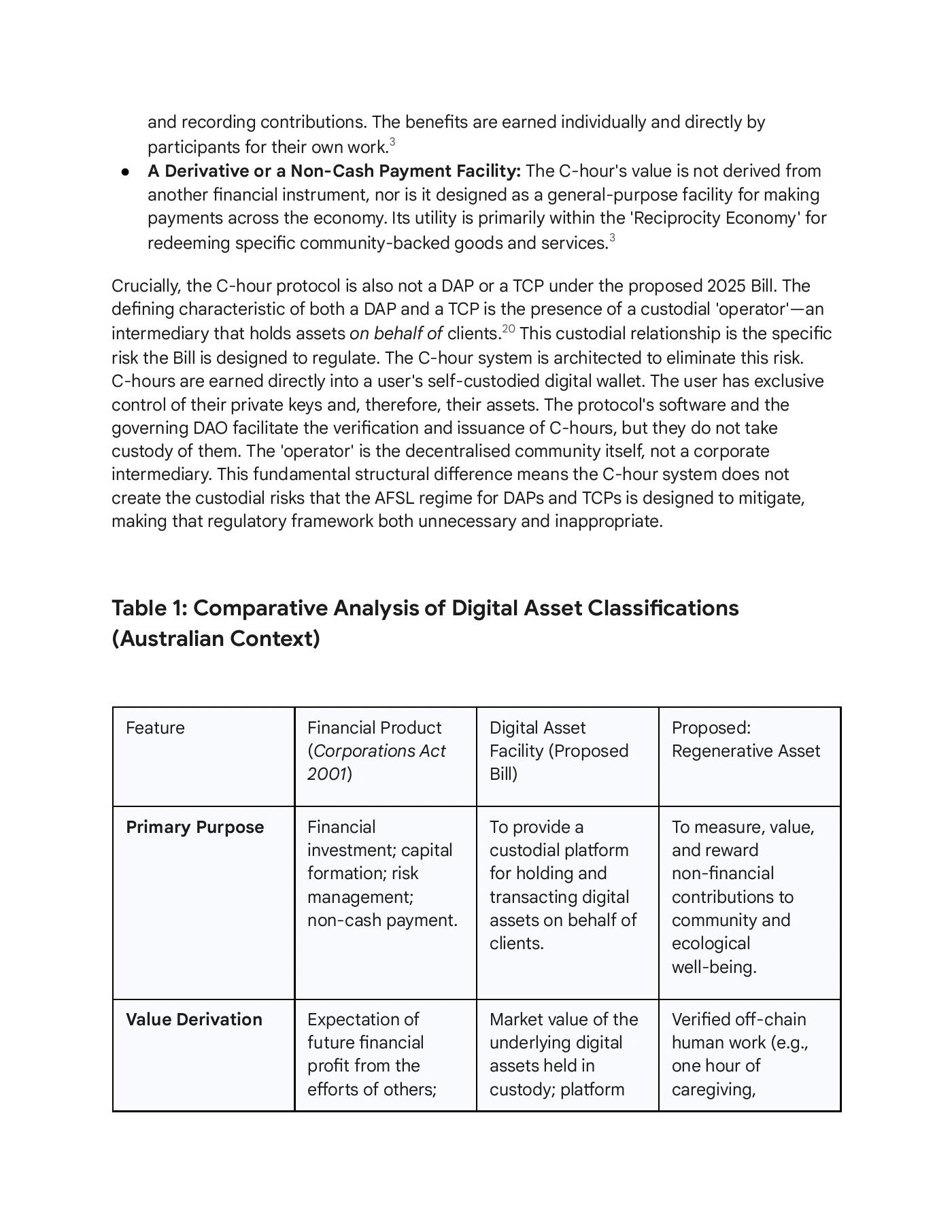
Table 1: Comparative Analysis of Digital Asset Classifications
(Australian
Context)
Feature Financial Product ( Corporations Act 2001 )
Digital Asset Facility (Proposed Bill)
Proposed: Regenerative Asset
Primary Purpose Financial investment; capital formation; risk management; non-cash payment.
To provide a custodial platform for holding and transacting digital assets on behalf of clients.
To measure, value, and reward non-financial contributions to community and ecological well-being.
Value Derivation Expectation of future financial profit from the efforts of others;
Market value of the underlying digital assets held in custody; platform
Verified off-chain human work (e.g., one hour of caregiving,
Page 11 of 30
Read selectable text for page 11
Text extracted from this page. Use the page image for its original layout, tables and figures.
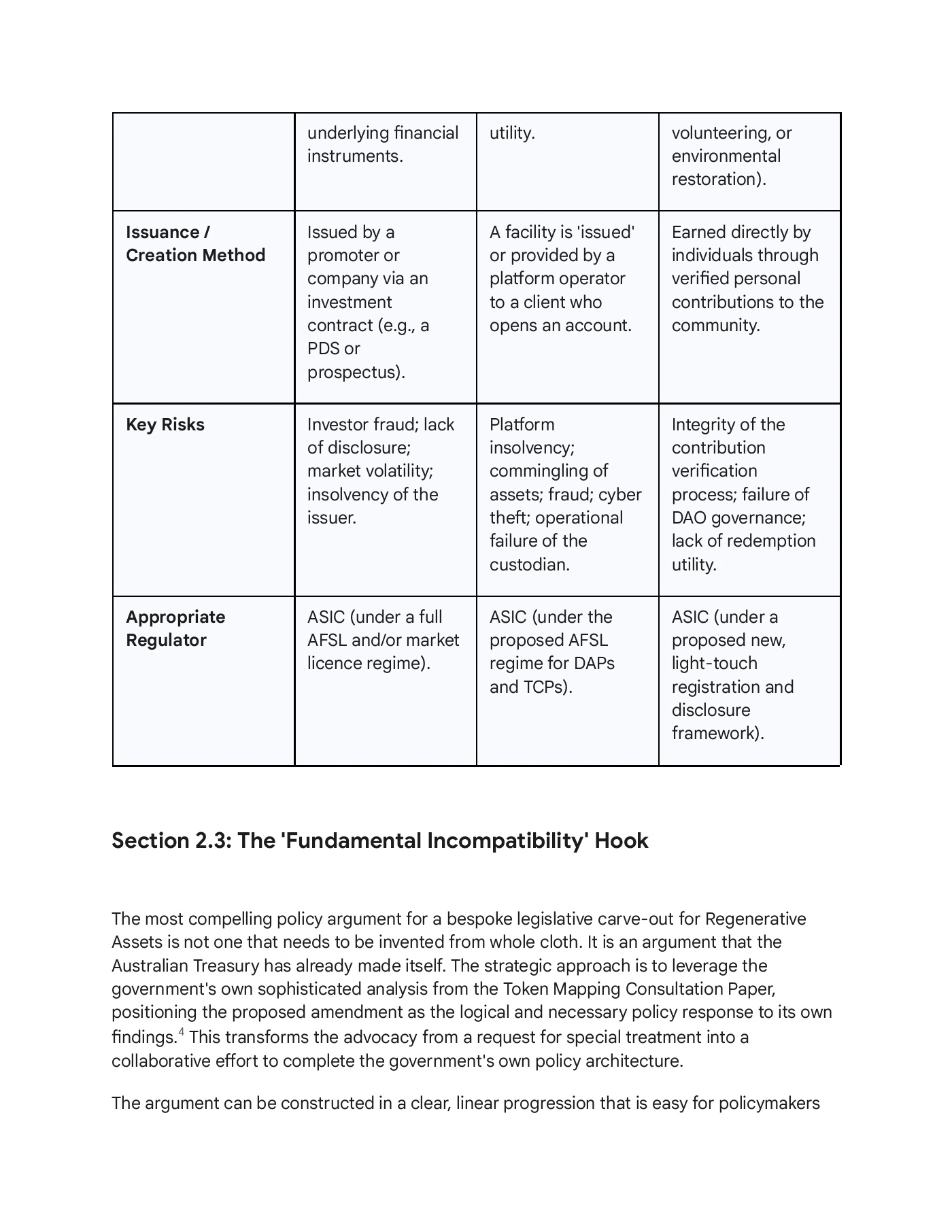
utility. volunteering, or environmental restoration).
Issuance / Creation Method
Issued by a promoter or company via an investment contract (e.g., a PDS or prospectus).
A facility is 'issued' or provided by a platform operator to a client who opens an account.
Earned directly by individuals through verified personal contributions to the community.
Key Risks Investor fraud; lack of disclosure; market volatility; insolvency of the issuer.
Platform insolvency; commingling of assets; fraud; cyber theft; operational failure of the custodian.
Integrity of the contribution verification process; failure of DAO governance; lack of redemption utility.
Appropriate Regulator
ASIC (under a full AFSL and/or market licence regime).
ASIC (under the proposed AFSL regime for DAPs and TCPs).
ASIC (under a proposed new, light-touch registration and disclosure framework).
Section 2.3: The 'Fundamental Incompatibility' Hook
The most compelling policy argument for a bespoke legislative carve-out for Regenerative
Assets
is
not
one
that
needs
to
be
invented
from
whole
cloth.
It
is
an
argument
that
the
Australian
Treasury
has
already
made
itself.
The
strategic
approach
is
to
leverage
the
government's
own
sophisticated
analysis
from
the
Token
Mapping
Consultation
Paper,
positioning
the
proposed
amendment
as
the
logical
and
necessary
policy
response
to
its
own
findings.
4
This transforms the advocacy from a request for special treatment into a
collaborative
effort
to
complete
the
government's
own
policy
architecture.
The argument can be constructed in a clear, linear progression that is easy for policymakers
Page 12 of 30
Read selectable text for page 12
Text extracted from this page. Use the page image for its original layout, tables and figures.
for
its
nuanced
and
insightful
analysis
in
the
Token
Mapping
paper.
Specifically,
its
distinction
between
'intermediated
token
systems'
and
'public
token
systems'
is
a
crucial
and
accurate
observation
of
the
crypto
ecosystem's
structure.
4
2. Affirm the Appropriateness of the Draft Bill for Intermediated Systems: The second
step
is
to
affirm
that
the
Digital
Asset
Platforms
Bill
2025
is
an
excellent,
well-designed,
and
appropriate
regulatory
framework
for
the
risks
associated
with
'intermediated'
systems.
By
focusing
on
custodial
platforms,
the
Bill
correctly
targets
the
primary
source
of
consumer
harm
seen
in
recent
market
failures,
such
as
platform
insolvency
and
the
misuse
of
client
funds.
20
This demonstrates that the proposal is not anti-regulation, but
pro-
appropriate
-regulation.
3. Classify the C-hour as a 'Public Token System': The third step is to clearly
demonstrate
that
the
C-hour
and
the
Regenerative
Civilization
Protocol
are
a
quintessential
example
of
a
'public
token
system'.
It
is
a
system
designed
to
enable
a
community
to
form
transactional
relationships
(the
earning
and
redemption
of
C-hours)
directly,
governed
by
a
transparent
protocol
and
a
DAO,
specifically
without
the
need
for
a
traditional,
custodial
intermediary.
3
4. Invoke Treasury's Own Conclusion: The final and most powerful step is to directly
quote
or
paraphrase
Treasury's
own
conclusion
from
the
Token
Mapping
paper:
that
such
public,
non-intermediated
systems
"may
be
fundamentally
incompatible
with
the
existing
financial
services
regulatory
framework".
4
This line of reasoning leads to an unavoidable conclusion. If the government's own expert
analysis
has
identified
a
class
of
systems
that
do
not
fit
the
existing
regulatory
model,
and
the
C-hour
is
a
prime
example
of
such
a
system,
then
attempting
to
force
it
into
the
legislative
framework
designed
for
'intermediated'
systems
would
be
a
policy
error.
It
would
create
a
regulatory
mismatch,
imposing
inappropriate
and
burdensome
obligations
designed
for
risks
that
do
not
exist
in
the
C-hour
model,
while
failing
to
address
the
unique
risks
that
do
(such
as
governance
and
verification
integrity).
Therefore,
the
creation
of
a
separate,
bespoke
'carve-out'
is
not
a
special
favour
or
an
exemption
from
the
rules.
It
is
the
direct,
logical,
and
responsible
policy
action
required
to
address
the
"fundamental
incompatibility"
that
Treasury
itself
has
identified.
This
approach
allows
advocates
to
present
themselves
as
helpful
partners
in
the
policy-making
process,
assisting
the
government
in
completing
the
important
work
it
has
already
started.
Part III: A Strategic Framework for Legislative
Integration
Page 13 of 30
Read selectable text for page 13
Text extracted from this page. Use the page image for its original layout, tables and figures.
Section 3.1: Strategic Entry Points
A coherent policy case must be matched with a precise and actionable legislative strategy.
The
primary
and
most
immediate
legislative
vehicle
for
creating
a
legal
carve-out
for
Regenerative
Assets
is
the
Treasury
Laws
Amendment
(Regulating
Digital
Asset,
And
Tokenised
Custody,
Platforms)
Bill
2025
.
1
The strategy is to propose amendments directly to
this
Bill
as
it
moves
through
the
policy
development
and
parliamentary
process.
This
is
the
most
efficient
pathway,
as
it
leverages
the
existing
political
momentum
and
legislative
timetable
for
digital
asset
reform.
The secondary but essential legislative target is the parent act, the Corporations Act 2001 ,
specifically
Chapter
7,
which
contains
the
foundational
definitions
of
'financial
product'
and
'financial
service'.
21
Any amendment to the new Bill to create a carve-out must be supported
by
a
corresponding
definitional
amendment
to
the
principal
Act
to
ensure
legal
consistency
and
clarity.
The
proposed
amendments
are
designed
to
work
in
tandem:
one
creates
the
positive
legal
definition
of
a
'Regenerative
Asset',
and
the
other
explicitly
excludes
it
from
the
new
custodial
platform
regime.
The timing of this intervention is critical. The most effective entry point is the current public
consultation
phase
on
the
exposure
draft
of
the
Bill.
By
lodging
a
comprehensive
submission
with
Treasury
that
includes
the
detailed
legal
arguments
from
Part
II
and
the
specific
draft
legislative
text
from
Section
3.2,
the
proposal
can
be
considered
by
departmental
officials
and
the
Minister's
office
before
the
Bill
is
finalised
and
introduced
to
Parliament.
This
provides
the
greatest
opportunity
for
the
amendments
to
be
adopted
into
the
government's
own
version
of
the
Bill,
which
is
a
far
more
effective
strategy
than
attempting
to
force
amendments
later
in
the
parliamentary
process.
Should
this
initial
approach
be
unsuccessful,
the
secondary
strategy
would
be
to
work
with
supportive
parliamentarians
to
move
the
amendments
during
the
committee
stage
of
the
Bill's
review
in
the
Senate.
Section 3.2: Crafting the 'Regenerative Asset' Amendment
To move from a policy concept to a legal reality, it is essential to provide policymakers with
concrete,
professionally
drafted
legislative
language.
This
significantly
lowers
the
barrier
to
adoption
and
demonstrates
a
high
level
of
sophistication
and
seriousness.
The
proposed
amendment
package
consists
of
two
core
components
designed
to
be
inserted
into
the
Page 14 of 30
Read selectable text for page 14
Text extracted from this page. Use the page image for its original layout, tables and figures.
Part 1: New Definition in the Corporations Act 2001
The first component is the creation of a positive legal definition for the new asset class. This
would
involve
proposing
a
new
definition
for
insertion
into
the
primary
definitions
section
of
the
Corporations
Act
2001
(section
9
or
761A).
The
proposed
wording
is:
regenerative asset means a digital representation of value that:
(a) serves as a digital receipt for a verified, non-financial contribution of time,
effort,
or
resources
to
community,
ecological,
or
social
well-being;
and
(b) is earned by a person through such a verified contribution and is not offered
to
the
public
primarily
for
the
purpose
of
a
passive
financial
investment
or
with
the
expectation
of
profit
derived
from
the
managerial
efforts
of
a
promoter
or
third
party;
and
(c) is not a non-cash payment facility within the meaning of section 763D.
This definition is carefully crafted to be both precise and principles-based. It anchors the
asset
in
its
pro-social
purpose
(subsection
a),
distinguishes
its
issuance
method
from
that
of
a
security
or
investment
product
(subsection
b),
and
explicitly
separates
it
from
payment
systems
(subsection
c).
Part 2: Exclusionary Clause in the Draft Digital Asset Platforms Bill 2025
The second component is an exclusionary clause to be inserted into the section of the new
Bill
that
defines
a
'digital
asset
platform'.
This
ensures
that
while
Regenerative
Assets
are
legally
recognised,
the
protocols
that
facilitate
them
are
not
captured
by
the
custodial
AFSL
regime.
The
proposed
wording
is:
A facility is not a digital asset platform to the extent that it is a facility for
holding,
or
facilitating
the
use
of,
a
regenerative
asset.
This dual-pronged approach is legally robust. It first establishes 'Regenerative Asset' as a
distinct
legal
concept
within
the
foundational
law
of
Australian
financial
services.
It
then
uses
that
new
definition
to
explicitly
and
cleanly
carve
it
out
from
the
specific
custodial
regime
being
created
by
the
new
Bill.
This
creates
the
necessary
legal
space
for
a
separate,
more
appropriate
regulatory
framework
to
be
developed
for
this
unique
asset
class.
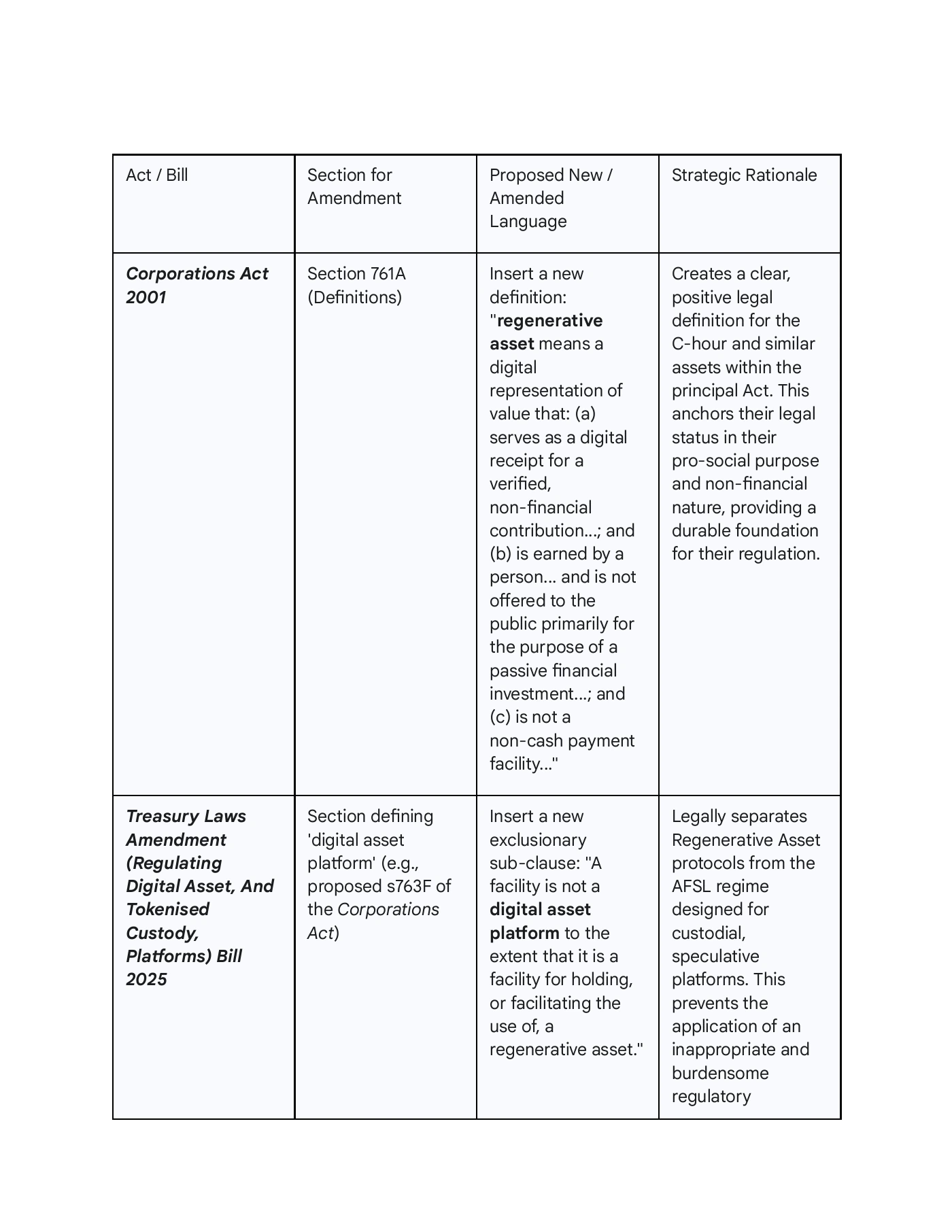
Table 2: Proposed Amendments to Australian Legislation
Page 15 of 30
Read selectable text for page 15
Text extracted from this page. Use the page image for its original layout, tables and figures.
Act / Bill Section for Amendment
Proposed New / Amended Language
Strategic Rationale
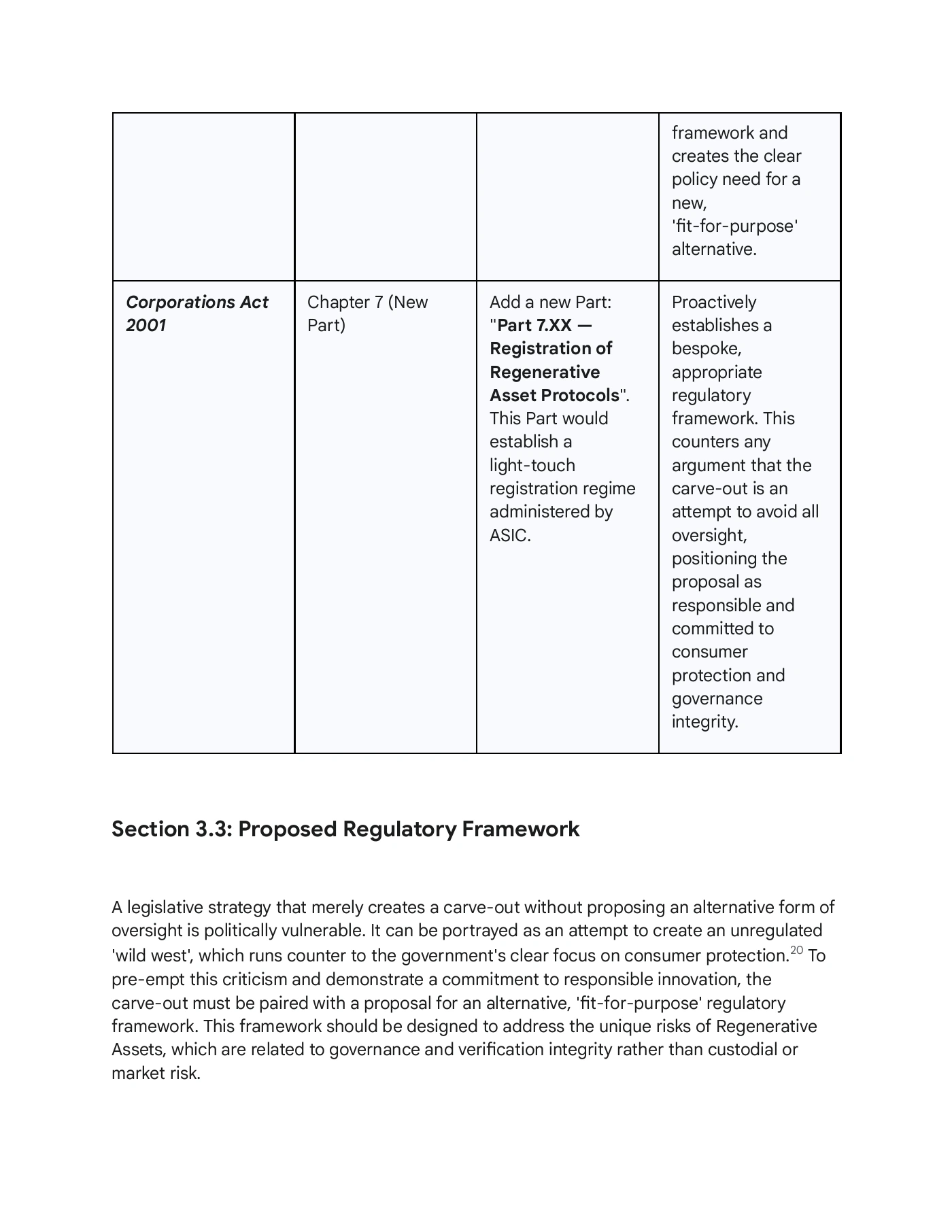
Corporations Act 2001
Section 761A (Definitions)
Insert a new definition: " regenerative asset means a digital representation of value that: (a) serves as a digital receipt for a verified, non-financial contribution...; and (b) is earned by a person... and is not offered to the public primarily for the purpose of a passive financial investment...; and (c) is not a non-cash payment facility..."
Creates a clear, positive legal definition for the C-hour and similar assets within the principal Act. This anchors their legal status in their pro-social purpose and non-financial nature, providing a durable foundation for their regulation.
Treasury Laws Amendment (Regulating Digital Asset, And Tokenised Custody, Platforms) Bill 2025
Section defining 'digital asset platform' (e.g., proposed s763F of the Corporations Act )
Insert a new exclusionary sub-clause: "A facility is not a digital asset platform to the extent that it is a facility for holding, or facilitating the use of, a regenerative asset."
Legally separates Regenerative Asset protocols from the AFSL regime designed for custodial, speculative platforms. This prevents the application of an inappropriate and burdensome regulatory
Page 16 of 30
Read selectable text for page 16
Text extracted from this page. Use the page image for its original layout, tables and figures.
Corporations Act 2001
Chapter 7 (New Part)
Add a new Part: " Part 7.XX — Registration of Regenerative Asset Protocols ". This Part would establish a light-touch registration regime administered by ASIC.
Proactively establishes a bespoke, appropriate regulatory framework. This counters any argument that the carve-out is an attempt to avoid all oversight, positioning the proposal as responsible and committed to consumer protection and governance integrity.
Section 3.3: Proposed Regulatory Framework
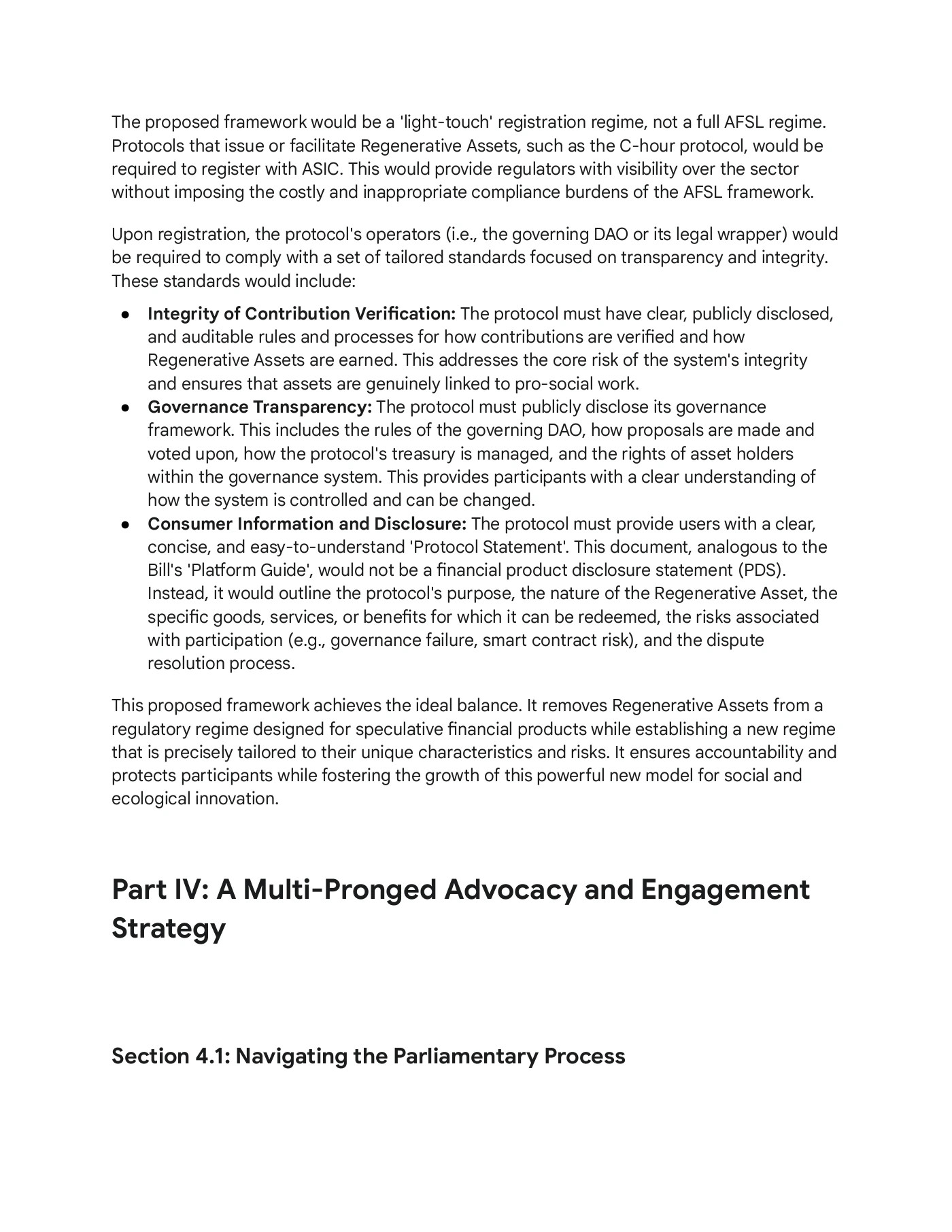
A legislative strategy that merely creates a carve-out without proposing an alternative form of
oversight
is
politically
vulnerable.
It
can
be
portrayed
as
an
attempt
to
create
an
unregulated
'wild
west',
which
runs
counter
to
the
government's
clear
focus
on
consumer
protection.
20
To
pre-empt
this
criticism
and
demonstrate
a
commitment
to
responsible
innovation,
the
carve-out
must
be
paired
with
a
proposal
for
an
alternative,
'fit-for-purpose'
regulatory
framework.
This
framework
should
be
designed
to
address
the
unique
risks
of
Regenerative
Assets,
which
are
related
to
governance
and
verification
integrity
rather
than
custodial
or
market
risk.
Page 17 of 30
Read selectable text for page 17
Text extracted from this page. Use the page image for its original layout, tables and figures.
Protocols
that
issue
or
facilitate
Regenerative
Assets,
such
as
the
C-hour
protocol,
would
be
required
to
register
with
ASIC.
This
would
provide
regulators
with
visibility
over
the
sector
without
imposing
the
costly
and
inappropriate
compliance
burdens
of
the
AFSL
framework.
Upon registration, the protocol's operators (i.e., the governing DAO or its legal wrapper) would
be
required
to
comply
with
a
set
of
tailored
standards
focused
on
transparency
and
integrity.
These
standards
would
include:
● Integrity of Contribution Verification: The protocol must have clear, publicly disclosed,
and
auditable
rules
and
processes
for
how
contributions
are
verified
and
how
Regenerative
Assets
are
earned.
This
addresses
the
core
risk
of
the
system's
integrity
and
ensures
that
assets
are
genuinely
linked
to
pro-social
work.
● Governance Transparency: The protocol must publicly disclose its governance
framework.
This
includes
the
rules
of
the
governing
DAO,
how
proposals
are
made
and
voted
upon,
how
the
protocol's
treasury
is
managed,
and
the
rights
of
asset
holders
within
the
governance
system.
This
provides
participants
with
a
clear
understanding
of
how
the
system
is
controlled
and
can
be
changed.
● Consumer Information and Disclosure: The protocol must provide users with a clear,
concise,
and
easy-to-understand
'Protocol
Statement'.
This
document,
analogous
to
the
Bill's
'Platform
Guide',
would
not
be
a
financial
product
disclosure
statement
(PDS).
Instead,
it
would
outline
the
protocol's
purpose,
the
nature
of
the
Regenerative
Asset,
the
specific
goods,
services,
or
benefits
for
which
it
can
be
redeemed,
the
risks
associated
with
participation
(e.g.,
governance
failure,
smart
contract
risk),
and
the
dispute
resolution
process.
This proposed framework achieves the ideal balance. It removes Regenerative Assets from a
regulatory
regime
designed
for
speculative
financial
products
while
establishing
a
new
regime
that
is
precisely
tailored
to
their
unique
characteristics
and
risks.
It
ensures
accountability
and
protects
participants
while
fostering
the
growth
of
this
powerful
new
model
for
social
and
ecological
innovation.
Part IV: A Multi-Pronged Advocacy and Engagement
Strategy
Section 4.1: Navigating the Parliamentary Process
Page 18 of 30
Read selectable text for page 18
Text extracted from this page. Use the page image for its original layout, tables and figures.
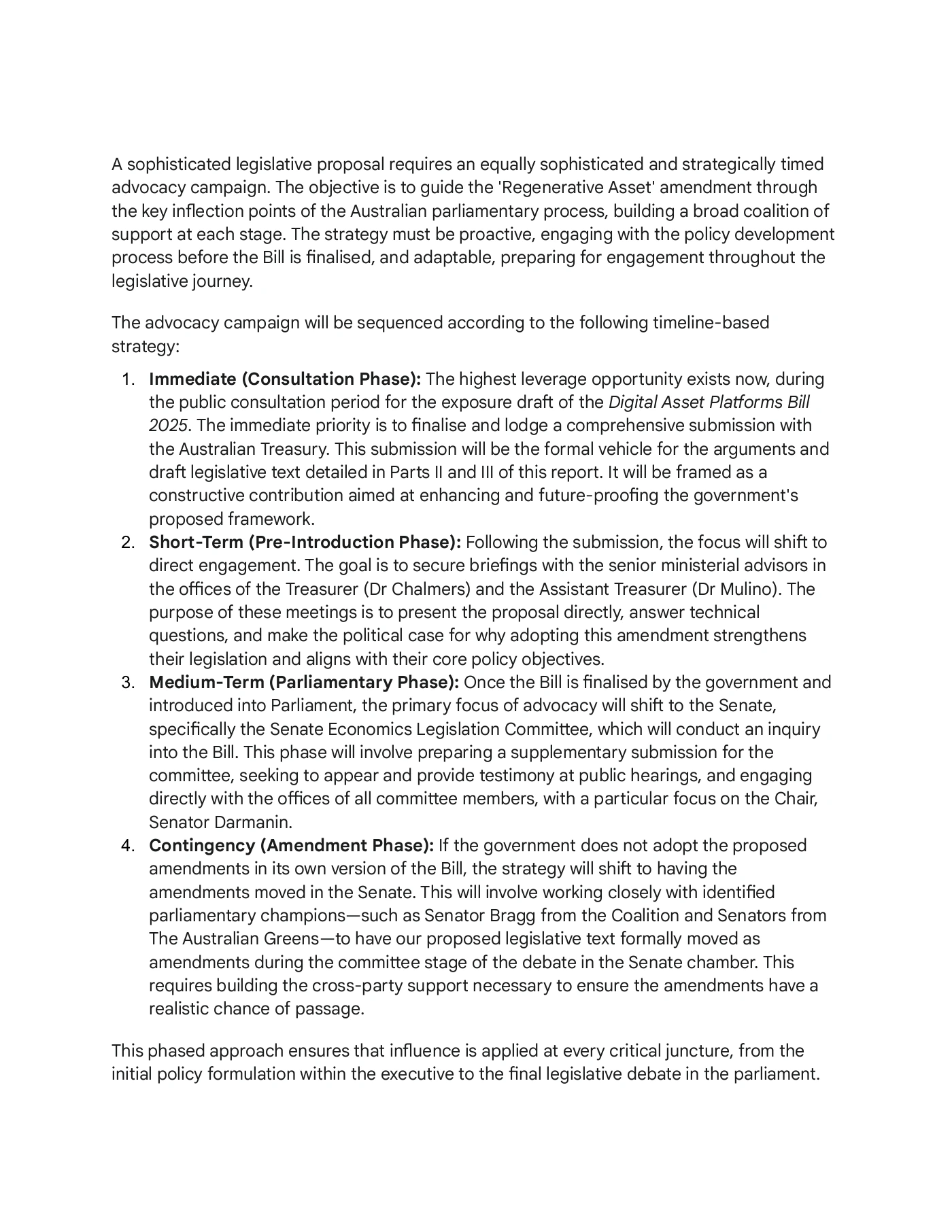
A sophisticated legislative proposal requires an equally sophisticated and strategically timed
advocacy
campaign.
The
objective
is
to
guide
the
'Regenerative
Asset'
amendment
through
the
key
inflection
points
of
the
Australian
parliamentary
process,
building
a
broad
coalition
of
support
at
each
stage.
The
strategy
must
be
proactive,
engaging
with
the
policy
development
process
before
the
Bill
is
finalised,
and
adaptable,
preparing
for
engagement
throughout
the
legislative
journey.
The advocacy campaign will be sequenced according to the following timeline-based
strategy:
1. Immediate (Consultation Phase): The highest leverage opportunity exists now, during
the
public
consultation
period
for
the
exposure
draft
of
the
Digital
Asset
Platforms
Bill
2025
.
The
immediate
priority
is
to
finalise
and
lodge
a
comprehensive
submission
with
the
Australian
Treasury.
This
submission
will
be
the
formal
vehicle
for
the
arguments
and
draft
legislative
text
detailed
in
Parts
II
and
III
of
this
report.
It
will
be
framed
as
a
constructive
contribution
aimed
at
enhancing
and
future-proofing
the
government's
proposed
framework.
2. Short-Term (Pre-Introduction Phase): Following the submission, the focus will shift to
direct
engagement.
The
goal
is
to
secure
briefings
with
the
senior
ministerial
advisors
in
the
offices
of
the
Treasurer
(Dr
Chalmers)
and
the
Assistant
Treasurer
(Dr
Mulino).
The
purpose
of
these
meetings
is
to
present
the
proposal
directly,
answer
technical
questions,
and
make
the
political
case
for
why
adopting
this
amendment
strengthens
their
legislation
and
aligns
with
their
core
policy
objectives.
3. Medium-Term (Parliamentary Phase): Once the Bill is finalised by the government and
introduced
into
Parliament,
the
primary
focus
of
advocacy
will
shift
to
the
Senate,
specifically
the
Senate
Economics
Legislation
Committee,
which
will
conduct
an
inquiry
into
the
Bill.
This
phase
will
involve
preparing
a
supplementary
submission
for
the
committee,
seeking
to
appear
and
provide
testimony
at
public
hearings,
and
engaging
directly
with
the
offices
of
all
committee
members,
with
a
particular
focus
on
the
Chair,
Senator
Darmanin.
4. Contingency (Amendment Phase): If the government does not adopt the proposed
amendments
in
its
own
version
of
the
Bill,
the
strategy
will
shift
to
having
the
amendments
moved
in
the
Senate.
This
will
involve
working
closely
with
identified
parliamentary
champions—such
as
Senator
Bragg
from
the
Coalition
and
Senators
from
The
Australian
Greens—to
have
our
proposed
legislative
text
formally
moved
as
amendments
during
the
committee
stage
of
the
debate
in
the
Senate
chamber.
This
requires
building
the
cross-party
support
necessary
to
ensure
the
amendments
have
a
realistic
chance
of
passage.
This phased approach ensures that influence is applied at every critical juncture, from the
initial
policy
formulation
within
the
executive
to
the
final
legislative
debate
in
the
parliament.
Page 19 of 30
Read selectable text for page 19
Text extracted from this page. Use the page image for its original layout, tables and figures.
Section 4.2: Targeted Parliamentary Outreach
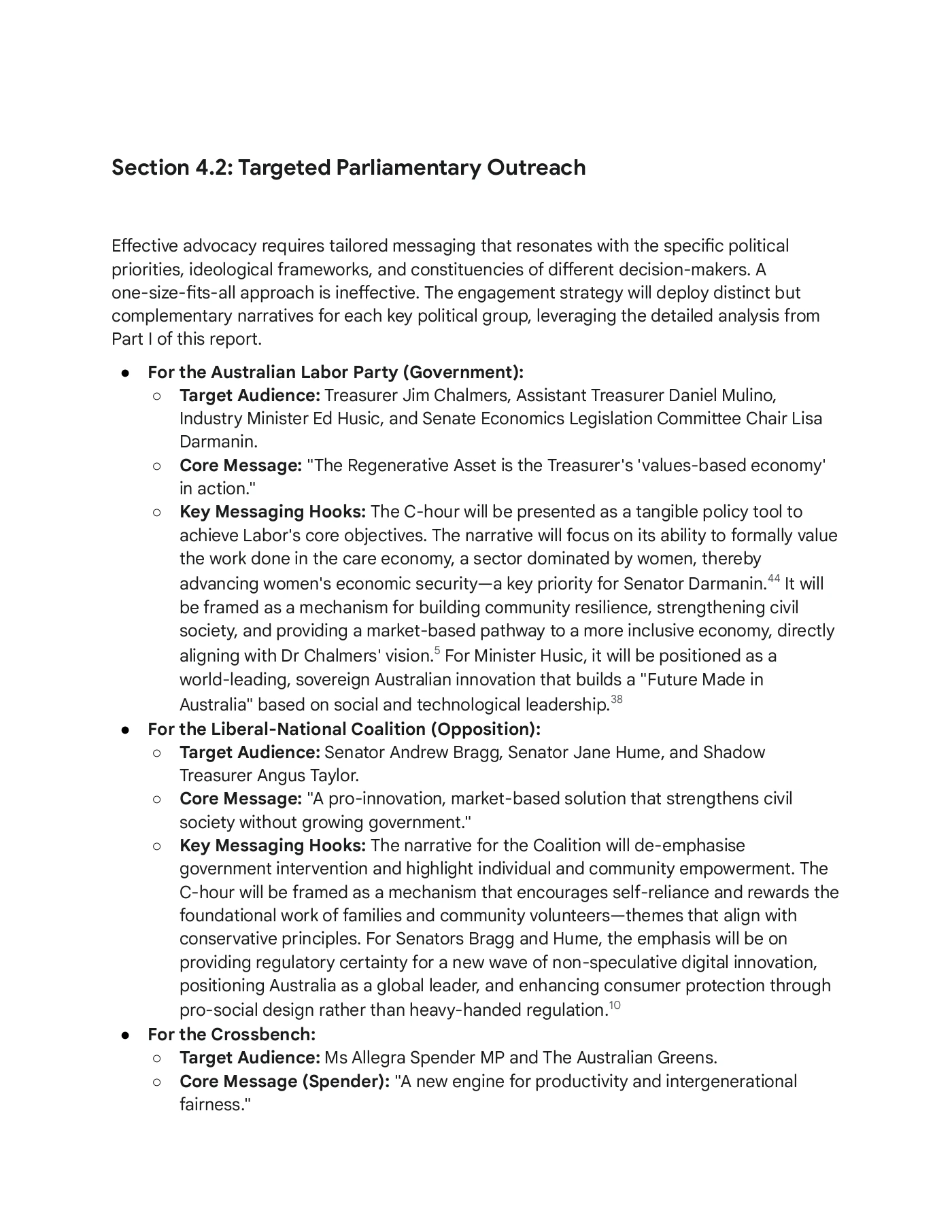
Effective advocacy requires tailored messaging that resonates with the specific political
priorities,
ideological
frameworks,
and
constituencies
of
different
decision-makers.
A
one-size-fits-all
approach
is
ineffective.
The
engagement
strategy
will
deploy
distinct
but
complementary
narratives
for
each
key
political
group,
leveraging
the
detailed
analysis
from
Part
I
of
this
report.
● For the Australian Labor Party (Government): ○ Target Audience: Treasurer Jim Chalmers, Assistant Treasurer Daniel Mulino,
Industry
Minister
Ed
Husic,
and
Senate
Economics
Legislation
Committee
Chair
Lisa
Darmanin.
○ Core Message: "The Regenerative Asset is the Treasurer's 'values-based economy'
in
action."
○ Key Messaging Hooks: The C-hour will be presented as a tangible policy tool to
achieve
Labor's
core
objectives.
The
narrative
will
focus
on
its
ability
to
formally
value
the
work
done
in
the
care
economy,
a
sector
dominated
by
women,
thereby
advancing
women's
economic
security—a
key
priority
for
Senator
Darmanin.
44
It will
be
framed
as
a
mechanism
for
building
community
resilience,
strengthening
civil
society,
and
providing
a
market-based
pathway
to
a
more
inclusive
economy,
directly
aligning
with
Dr
Chalmers'
vision.
5
For Minister Husic, it will be positioned as a
world-leading,
sovereign
Australian
innovation
that
builds
a
"Future
Made
in
Australia"
based
on
social
and
technological
leadership.
38
● For the Liberal-National Coalition (Opposition): ○ Target Audience: Senator Andrew Bragg, Senator Jane Hume, and Shadow
Treasurer
Angus
Taylor.
○ Core Message: "A pro-innovation, market-based solution that strengthens civil
society
without
growing
government."
○ Key Messaging Hooks: The narrative for the Coalition will de-emphasise
government
intervention
and
highlight
individual
and
community
empowerment.
The
C-hour
will
be
framed
as
a
mechanism
that
encourages
self-reliance
and
rewards
the
foundational
work
of
families
and
community
volunteers—themes
that
align
with
conservative
principles.
For
Senators
Bragg
and
Hume,
the
emphasis
will
be
on
providing
regulatory
certainty
for
a
new
wave
of
non-speculative
digital
innovation,
positioning
Australia
as
a
global
leader,
and
enhancing
consumer
protection
through
pro-social
design
rather
than
heavy-handed
regulation.
10
● For the Crossbench: ○ Target Audience: Ms Allegra Spender MP and The Australian Greens. ○ Core Message (Spender): "A new engine for productivity and intergenerational
fairness."
Page 20 of 30
Read selectable text for page 20
Text extracted from this page. Use the page image for its original layout, tables and figures.
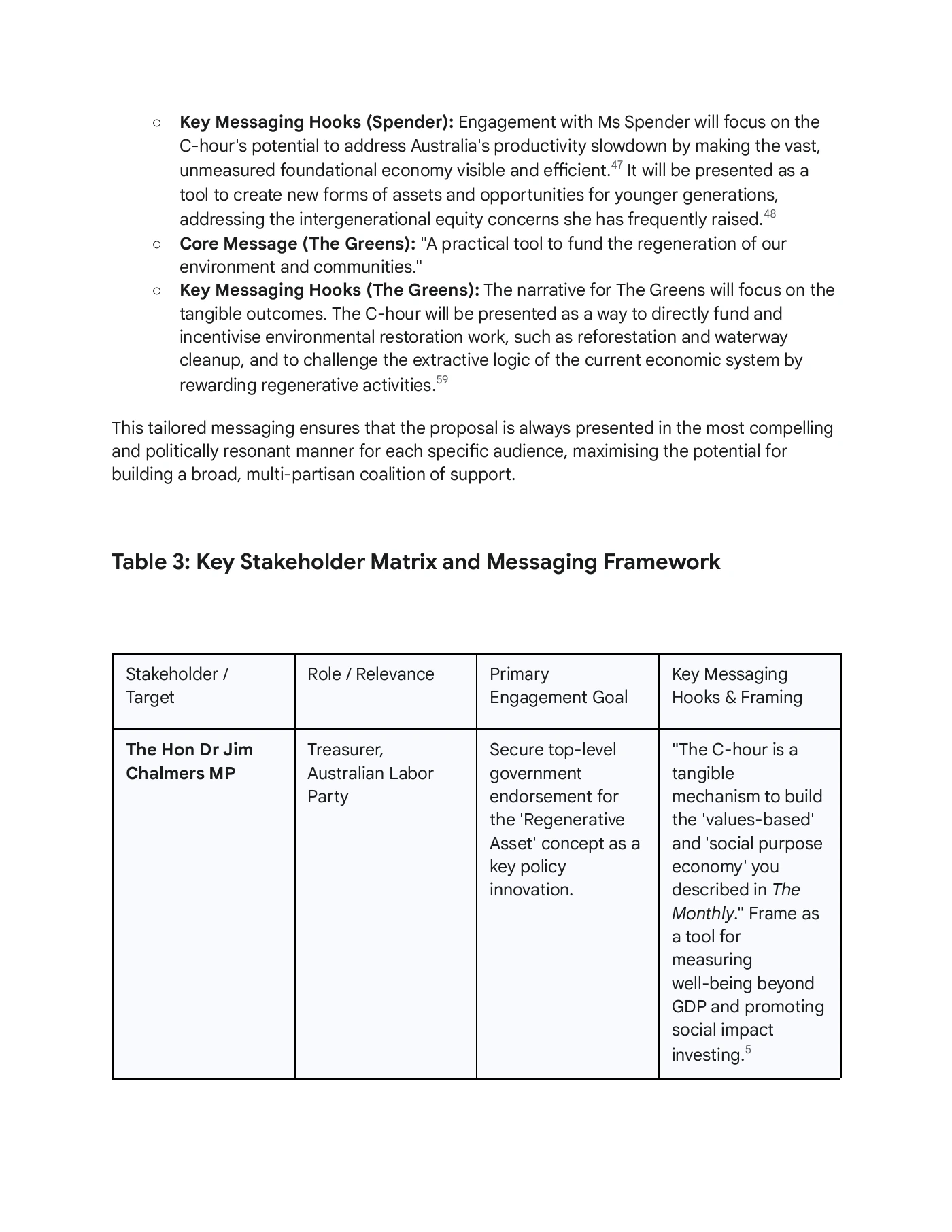
C-hour's
potential
to
address
Australia's
productivity
slowdown
by
making
the
vast,
unmeasured
foundational
economy
visible
and
efficient.
47
It will be presented as a
tool
to
create
new
forms
of
assets
and
opportunities
for
younger
generations,
addressing
the
intergenerational
equity
concerns
she
has
frequently
raised.
48
○ Core Message (The Greens): "A practical tool to fund the regeneration of our
environment
and
communities."
○ Key Messaging Hooks (The Greens): The narrative for The Greens will focus on the
tangible
outcomes.
The
C-hour
will
be
presented
as
a
way
to
directly
fund
and
incentivise
environmental
restoration
work,
such
as
reforestation
and
waterway
cleanup,
and
to
challenge
the
extractive
logic
of
the
current
economic
system
by
rewarding
regenerative
activities.
59
This tailored messaging ensures that the proposal is always presented in the most compelling
and
politically
resonant
manner
for
each
specific
audience,
maximising
the
potential
for
building
a
broad,
multi-partisan
coalition
of
support.
Table 3: Key Stakeholder Matrix and Messaging Framework
Stakeholder / Target
Role / Relevance Primary Engagement Goal
Key Messaging Hooks & Framing
The Hon Dr Jim Chalmers MP
Treasurer, Australian Labor Party
Secure top-level government endorsement for the 'Regenerative Asset' concept as a key policy innovation.
"The C-hour is a tangible mechanism to build the 'values-based' and 'social purpose economy' you described in The Monthly ." Frame as a tool for measuring well-being beyond GDP and promoting social impact investing.
5
Page 21 of 30
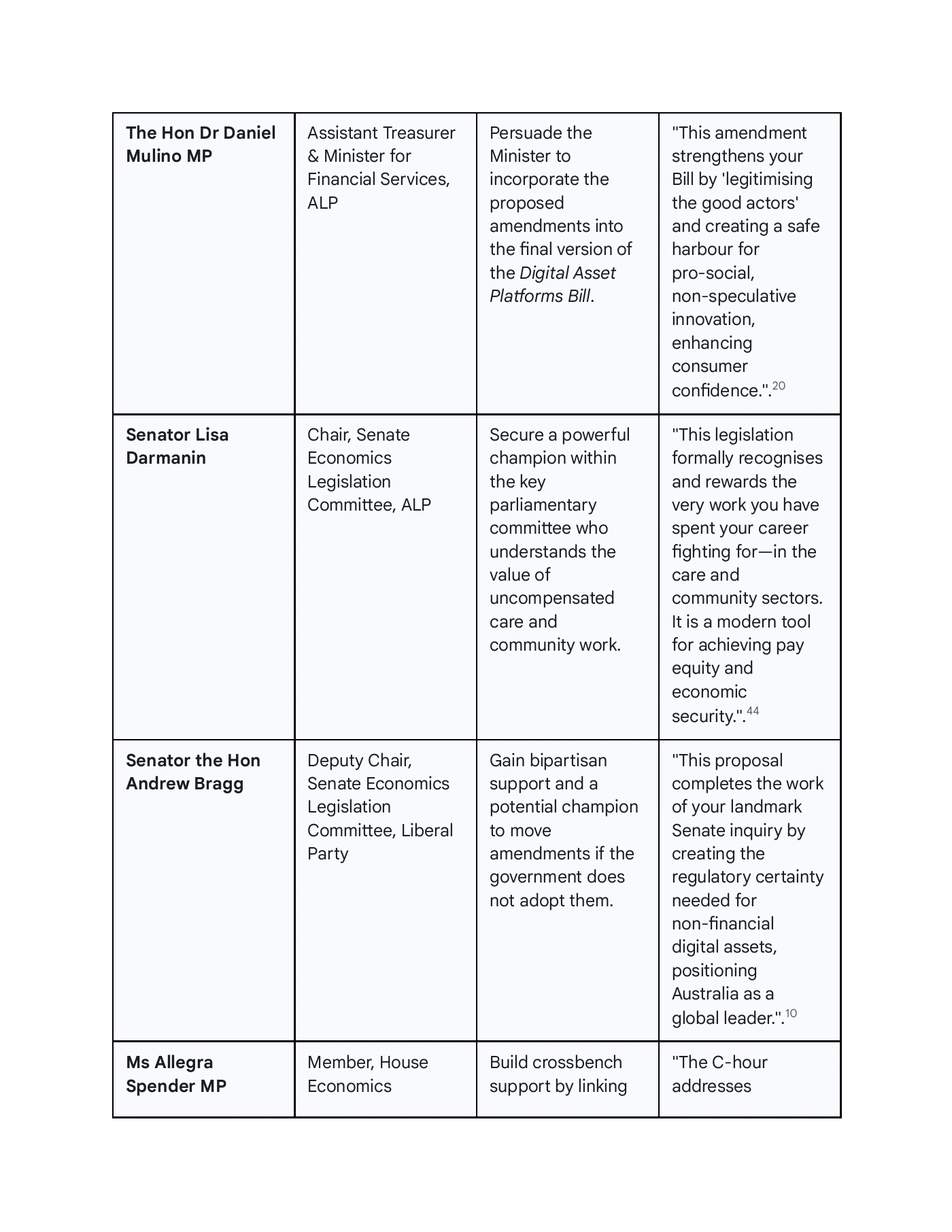
Read selectable text for page 21
Text extracted from this page. Use the page image for its original layout, tables and figures.
Assistant Treasurer & Minister for Financial Services, ALP
Persuade the Minister to incorporate the proposed amendments into the final version of the Digital Asset Platforms Bill .
"This amendment strengthens your Bill by 'legitimising the good actors' and creating a safe harbour for pro-social, non-speculative innovation, enhancing consumer confidence.".
20
Senator Lisa Darmanin
Chair, Senate Economics Legislation Committee, ALP
Secure a powerful champion within the key parliamentary committee who understands the value of uncompensated care and community work.
"This legislation formally recognises and rewards the very work you have spent your career fighting for—in the care and community sectors. It is a modern tool for achieving pay equity and economic security.".
44
Senator the Hon Andrew Bragg
Deputy Chair, Senate Economics Legislation Committee, Liberal Party
Gain bipartisan support and a potential champion to move amendments if the government does not adopt them.
"This proposal completes the work of your landmark Senate inquiry by creating the regulatory certainty needed for non-financial digital assets, positioning Australia as a global leader.".
10
Ms Allegra Spender MP
Member, House Economics
Build crossbench support by linking
"The C-hour addresses
Page 22 of 30
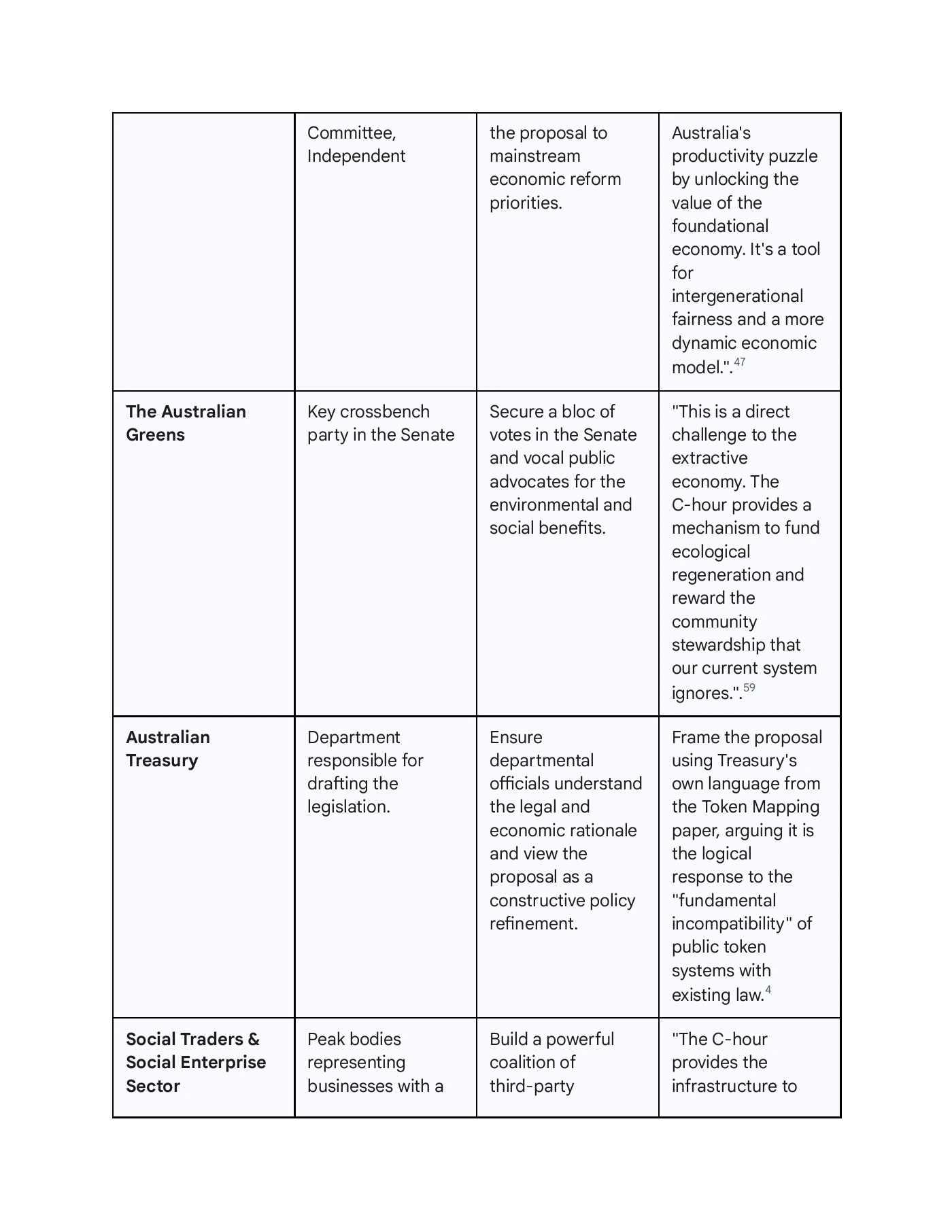
Read selectable text for page 22
Text extracted from this page. Use the page image for its original layout, tables and figures.
the proposal to mainstream economic reform priorities.
Australia's productivity puzzle by unlocking the value of the foundational economy. It's a tool for intergenerational fairness and a more dynamic economic model.".
47
The Australian Greens
Key crossbench party in the Senate
Secure a bloc of votes in the Senate and vocal public advocates for the environmental and social benefits.
"This is a direct challenge to the extractive economy. The C-hour provides a mechanism to fund ecological regeneration and reward the community stewardship that our current system ignores.".
59
Australian Treasury
Department responsible for drafting the legislation.
Ensure departmental officials understand the legal and economic rationale and view the proposal as a constructive policy refinement.
Frame the proposal using Treasury's own language from the Token Mapping paper, arguing it is the logical response to the "fundamental incompatibility" of public token systems with existing law.
4
Social Traders & Social Enterprise Sector
Peak bodies representing businesses with a
Build a powerful coalition of third-party
"The C-hour provides the infrastructure to
Page 23 of 30
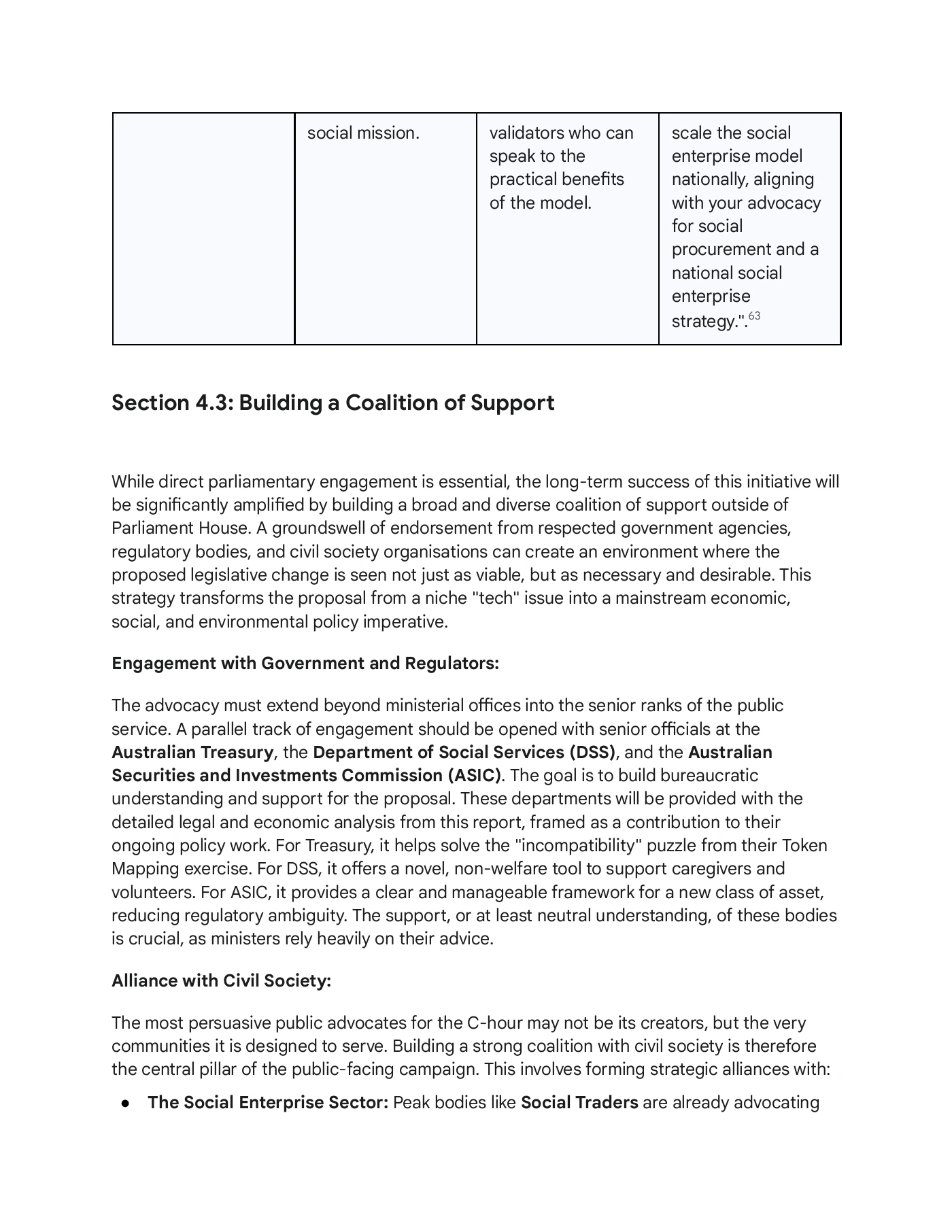
Read selectable text for page 23
Text extracted from this page. Use the page image for its original layout, tables and figures.
scale the social enterprise model nationally, aligning with your advocacy for social procurement and a national social enterprise strategy.".
63
Section 4.3: Building a Coalition of Support
While direct parliamentary engagement is essential, the long-term success of this initiative will
be
significantly
amplified
by
building
a
broad
and
diverse
coalition
of
support
outside
of
Parliament
House.
A
groundswell
of
endorsement
from
respected
government
agencies,
regulatory
bodies,
and
civil
society
organisations
can
create
an
environment
where
the
proposed
legislative
change
is
seen
not
just
as
viable,
but
as
necessary
and
desirable.
This
strategy
transforms
the
proposal
from
a
niche
"tech"
issue
into
a
mainstream
economic,
social,
and
environmental
policy
imperative.
Engagement with Government and Regulators:
The advocacy must extend beyond ministerial offices into the senior ranks of the public
service.
A
parallel
track
of
engagement
should
be
opened
with
senior
officials
at
the
Australian
Treasury
,
the
Department
of
Social
Services
(DSS)
,
and
the
Australian
Securities
and
Investments
Commission
(ASIC)
.
The
goal
is
to
build
bureaucratic
understanding
and
support
for
the
proposal.
These
departments
will
be
provided
with
the
detailed
legal
and
economic
analysis
from
this
report,
framed
as
a
contribution
to
their
ongoing
policy
work.
For
Treasury,
it
helps
solve
the
"incompatibility"
puzzle
from
their
Token
Mapping
exercise.
For
DSS,
it
offers
a
novel,
non-welfare
tool
to
support
caregivers
and
volunteers.
For
ASIC,
it
provides
a
clear
and
manageable
framework
for
a
new
class
of
asset,
reducing
regulatory
ambiguity.
The
support,
or
at
least
neutral
understanding,
of
these
bodies
is
crucial,
as
ministers
rely
heavily
on
their
advice.
Alliance with Civil Society:
The most persuasive public advocates for the C-hour may not be its creators, but the very
communities
it
is
designed
to
serve.
Building
a
strong
coalition
with
civil
society
is
therefore
the
central
pillar
of
the
public-facing
campaign.
This
involves
forming
strategic
alliances
with:
● The Social Enterprise Sector: Peak bodies like Social Traders are already advocating
Page 24 of 30
Read selectable text for page 24
Text extracted from this page. Use the page image for its original layout, tables and figures.
enterprise
strategy.
63
The C-hour provides a powerful piece of infrastructure to help
achieve
their
goals.
A
joint
submission
or
public
statement
with
these
groups
would
provide
powerful
validation.
● The Environmental Movement: Organisations such as the Australian Conservation
Foundation
(ACF),
The
Wilderness
Society,
and
Landcare
Australia
are
natural
partners.
60
The
C-hour
can
be
presented
to
them
as
a
new,
scalable
funding
and
incentive
mechanism
for
on-the-ground
conservation
and
regeneration
efforts,
empowering
their
volunteer
networks
and
creating
a
direct
economic
case
for
environmental
stewardship.
● The Care Sector: Engaging with unions representing community and care workers (such
as
the
Australian
Services
Union),
as
well
as
peak
bodies
for
caregivers
(e.g.,
Carers
Australia),
is
vital.
These
groups
can
speak
with
immense
moral
authority
on
the
importance
of
valuing
the
work
the
C-hour
measures.
Their
endorsement
would
powerfully
resonate
with
the
government
and
key
parliamentarians
like
Senator
Darmanin.
Engagement with Industry:
Finally, support should be cultivated within the innovative segments of the business and
finance
community.
This
includes
engaging
with
impact
investors
,
who
are
philosophically
aligned
with
the
goal
of
generating
a
social
dividend
alongside
financial
returns,
and
forward-thinking
fintech
companies
that
can
appreciate
the
technological
elegance
and
potential
of
the
protocol.
Their
support
will
demonstrate
that
the
proposal
is
not
anti-business,
but
represents
the
future
of
a
more
responsible
and
innovative
economy.
This
diverse
coalition
provides
a
powerful
political
buffer,
demonstrating
that
support
for
the
Regenerative
Asset
class
transcends
traditional
ideological
divides
and
is
rooted
in
a
shared
desire
for
a
more
prosperous,
equitable,
and
sustainable
Australia.
Conclusion and Prioritised Recommendations
Australia stands at a critical juncture in the development of its digital economy. The Digital
Asset
Platforms
Bill
2025
is
a
testament
to
a
thoughtful,
evidence-based
approach
to
regulation
that
rightly
prioritises
consumer
protection
and
market
integrity.
However,
in
its
current
form,
it
is
an
incomplete
architecture.
By
focusing
exclusively
on
the
risks
of
financialised,
custodial
platforms,
it
overlooks
the
immense
opportunity
presented
by
a
new
class
of
digital
assets
designed
for
social
and
ecological
regeneration.
This
omission,
if
uncorrected,
would
inadvertently
stifle
a
powerful
form
of
Australian
innovation
that
aligns
directly
with
the
government's
highest
aspirations
for
a
more
purposeful
and
inclusive
economy.
Page 25 of 30
Read selectable text for page 25
Text extracted from this page. Use the page image for its original layout, tables and figures.
exists
to
correct
this.
The
proposal
to
create
a
legislative
'carve-out'
for
'Regenerative
Assets'
is
not
a
radical
departure
from
the
government's
agenda
but
a
logical
and
necessary
refinement.
It
leverages
the
Treasury's
own
expert
findings
from
the
Token
Mapping
exercise,
which
acknowledged
the
"fundamental
incompatibility"
of
non-intermediated
systems
with
the
existing
financial
services
framework.
The
Community-Hour
is
the
archetype
of
such
a
system—one
that
is
earned
through
contribution,
governed
by
its
community,
and
dedicated
to
making
the
foundational
work
of
our
society
visible
and
valued.
Integrating this concept into law is both politically feasible and strategically advantageous. It
strengthens
the
bipartisan
consensus
for
digital
asset
reform
by
appealing
to
the
core
principles
of
both
major
parties.
For
the
government,
it
provides
a
powerful
tool
to
build
its
envisioned
"values-based
economy."
For
the
opposition,
it
offers
a
market-based,
pro-innovation
solution
that
empowers
civil
society.
The
path
forward
requires
a
disciplined,
multi-faceted
effort
that
combines
precise
legal
drafting
with
targeted
political
advocacy
and
the
construction
of
a
broad
coalition
of
support.
By
embracing
this
opportunity,
Australia
can
move
beyond
simply
regulating
the
digital
economy
as
it
is,
and
begin
to
actively
shape
it
into
what
it
ought
to
be:
an
engine
for
shared
prosperity
and
national
well-being.
The following prioritised recommendations provide an actionable roadmap for achieving this
strategic
objective
over
the
next
6-12
months:
1. Finalise and Lodge Treasury Submission: The immediate priority is to prepare and
lodge
a
formal
submission
with
the
Australian
Treasury
in
response
to
the
exposure
draft
of
the
Digital
Asset
Platforms
Bill
2025
.
This
submission
must
incorporate
the
detailed
legal
arguments,
policy
rationale,
and
specific
draft
legislative
amendments
contained
in
Parts
II
and
III
of
this
report.
This
is
the
single
most
effective
action
for
influencing
the
final
shape
of
the
legislation.
2. Secure Ministerial and Departmental Briefings: Immediately following the submission,
formally
request
meetings
with
the
senior
advisors
in
the
offices
of
the
Assistant
Treasurer
(Dr
Mulino)
and
the
Treasurer
(Dr
Chalmers).
Concurrently,
seek
technical
briefings
with
senior
officials
in
the
relevant
divisions
of
Treasury
and
ASIC
to
present
the
proposal
as
a
constructive
and
well-reasoned
enhancement
to
their
Bill.
3. Initiate Coalition Building with Civil Society: Commence a targeted outreach
campaign
to
the
leadership
of
key
civil
society
stakeholders
identified
in
Section
4.3.
The
initial
focus
should
be
on
securing
the
endorsement
of
Social
Traders,
Carers
Australia,
and
a
leading
national
environmental
organisation
(e.g.,
the
Australian
Conservation
Foundation).
The
goal
is
to
establish
a
powerful
group
of
third-party
validators
who
can
advocate
for
the
proposal
from
a
non-tech
perspective.
4. Prepare a Senate Committee Engagement Package: In anticipation of the Bill's
introduction
to
Parliament,
compile
a
tailored
package
of
materials
for
the
members
of
the
Senate
Economics
Legislation
Committee.
This
package
should
include
a
concise
one-page
summary
of
the
proposal,
the
detailed
legal
analysis,
the
draft
amendments,
and
letters
of
support
from
coalition
partners.
This
ensures
the
committee
is
fully
briefed
Page 26 of 30
Read selectable text for page 26
Text extracted from this page. Use the page image for its original layout, tables and figures.
Works cited
1. Treasury: Regulating digital asset platforms – exposure draft ..., accessed October
7,
2025,
https://www.regulationtomorrow.com/au/treasury-regulating-digital-asset-platforms-exposure-draft-legislation/ 2. More than meets the eye: navigating Australia's proposed regime for ..., accessed
October
7,
2025,
https://www.kwm.com/au/en/insights/latest-thinking/more-than-meets-the-eye-navigating-australias-proposed-regime-for-digital-asset-and-tokenised-custody-platforms.html 3. The Braided Economy Mandate_ Integrating Regenerative Principles into U.S.
Digital
Asset
Legislation.pdf
4. Token mapping | Treasury.gov.au, accessed October 7, 2025, https://treasury.gov.au/consultation/c2023-341659 5. Our position | A social purpose economy - now there's an idea, accessed
October
7,
2025,
https://www.socialtraders.com.au/news/our-position-a-social-purpose-economy-now-theres-an-idea/ 6. Capitalism after the crises - FPIP, accessed October 7, 2025, https://www.fpinvest.com.au/blog-article/capitalism-after-the-crises 7. Senate Select Committee on Australia as a Technology and Financial Centre | APO, accessed October 7, 2025, https://apo.org.au/organisation/314356 8. Final report – Parliament of Australia, accessed October 7, 2025, https://www.aph.gov.au/Parliamentary_Business/Committees/Senate/Financial_Technology_and_Regulatory_Technology/AusTechFinCentre/Final_report 9. Select Committee on Australia as a Technology and Financial Centre, accessed
October
7,
2025,
https://www.aph.gov.au/Parliamentary_Business/Committees/Senate/Financial_Technology_and_Regulatory_Technology 10. Cryptocurrency Is Here To Stay! - Senator Andrew Bragg, accessed October 7, 2025, https://www.andrewbragg.com/policy/the-new-economy 11. Senator Bragg proposes Digital Assets Bill to parliament - SW Accountants &
Advisors,
accessed
October
7,
2025,
https://www.sw-au.com/insights/article/senator-bragg-proposes-digital-assets-bill-to-parliament/ 12. Senate report on Australia as a technology and financial centre - Lander & Rogers,
accessed
October
7,
2025,
https://www.landers.com.au/legal-insights-news/senate-report-on-australia-as-technology-and-financial-centre 13. Australia as a Technology and Financial Centre: Report - Dwyer Harris business
lawyers,
accessed
October
7,
2025,
https://www.dwyerharris.com/blog/australia-as-a-technology-and-financial-centr
Page 27 of 30
Read selectable text for page 27
Text extracted from this page. Use the page image for its original layout, tables and figures.
October
7,
2025,
https://www.pwc.com.au/banking-capital-markets/pwc-perspectives-australia-as-a-technology-and-financial-centre.pdf 15. Overview of digital assets markets and regulation - Parliament of Australia,
accessed
October
7,
2025,
https://www.aph.gov.au/Parliamentary_Business/Committees/Senate/Financial_Technology_and_Regulatory_Technology/AusTechFinCentre/Final_report/Section?id=committees%2Freportsen%2F024747%2F78067 16. Crypto consultation: The Australian token mapping exercise | Russell Kennedy,
accessed
October
7,
2025,
https://www.russellkennedy.com.au/insights-events/insights/crypto-consultation-the-australian-token-mapping-exercise 17. Not by the same token - Treasury releases its Token Mapping consultation -
KWM,
accessed
October
7,
2025,
https://www.kwm.com/au/en/insights/latest-thinking/not-by-the-same-token-treasury-releases-its-token-mapping-consultation.html 18. Navigating the Australian Token Mapping Consultation - Bits of Blocks, accessed
October
7,
2025,
https://www.bitsofblocks.io/post/navigating-the-australian-token-mapping-consultation 19. Token Mapping in Australia - Ally Law, accessed October 7, 2025, https://ally-law.com/crypto-consultation-the-australian-token-mapping-exercise/ 20. Australia tightens crypto rules to protect investors - Information Age | ACS,
accessed
October
7,
2025,
https://ia.acs.org.au/article/2025/australia-tightens-crypto-rules-to-protect-investors.html 21. Australian Treasury consults on AFSL obligations for crypto-asset platforms,
accessed
October
7,
2025,
https://www.claytonutz.com/insights/2023/october/australian-treasury-consults-on-afsl-obligations-for-crypto-asset-platforms 22. Practically unpacking Treasury's proposed digital assets legislation | Financial
Services,
accessed
October
7,
2025,
https://www.tglaw.com.au/insights/practically-unpacking-treasurys-proposed-digital-assets-legislation 23. Australia: Australian Government moves to regulate digital asset and ..., accessed
October
7,
2025,
https://insightplus.bakermckenzie.com/bm/banking-finance_1/australia-australian-government-moves-to-regulate-digital-asset-and-tokenised-custody-platforms 24. Ministers | Treasury.gov.au, accessed October 7, 2025, https://treasury.gov.au/the-department/about-treasury/our-ministers 25. Jim Chalmers | Member for Rankin - Australian Labor Party, accessed October 7, 2025, https://www.alp.org.au/our-people/our-people/jim-chalmers/
Page 28 of 30
Read selectable text for page 28
Text extracted from this page. Use the page image for its original layout, tables and figures.
tossed
around
his
economic
roundtable
-
Startup
Daily,
accessed
October
7,
2025,
https://www.startupdaily.net/topic/politics-news-analysis/treasurer-jim-chalmers-evokes-hawke-era-consensus-as-political-footballs-are-tossed-around-his-economic-roundtable/ 29. Keynote address to the Economic and Social Outlook Conference, Melbourne |
Treasury
Ministers,
accessed
October
7,
2025,
https://ministers.treasury.gov.au/ministers/jim-chalmers-2022/speeches/keynote-address-economic-and-social-outlook-conference 30. The Hon Dr Daniel Mulino MP | Treasury Ministers, accessed October 7, 2025, https://ministers.treasury.gov.au/ministers/daniel-mulino-2025 31. Minister for Financial Services - Wikipedia, accessed October 7, 2025, https://en.wikipedia.org/wiki/Minister_for_Financial_Services 32. Hon Dr Daniel Mulino MP - Parliament of Australia, accessed October 7, 2025, https://www.aph.gov.au/Senators_and_Members/Parliamentarian?MPID=132880 33. Australian Government Address - Assistant Treasurer Dr Daniel Mulino - YouTube, accessed October 7, 2025, https://www.youtube.com/watch?v=j80e_8rbdI0 34. Australia Proposes Digital Asset Platform Regulations | Phemex News, accessed
October
7,
2025,
https://phemex.com/news/article/australia-proposes-regulatory-framework-for-digital-asset-platforms-21077 35. Australia Drafts Law to Tighten Oversight of Digital Asset Platforms - Decrypt,
accessed
October
7,
2025,
https://decrypt.co/341217/australia-drafts-law-tighten-oversight-digital-asset-platforms 36. Committee Membership - Parliament of Australia, accessed October 7, 2025, https://www.aph.gov.au/Parliamentary_Business/Committees/House/Economics/Committee_Membership 37. Hon Ed Husic MP - Parliament of Australia, accessed October 7, 2025, https://www.aph.gov.au/e_husic_mp 38. Industry, science and technology powering a Future Made in Australia, accessed
October
7,
2025,
https://www.minister.industry.gov.au/ministers/husic/media-releases/industry-science-and-technology-powering-future-made-australia 39. Unlocking the potential of AI for Australian industry, accessed October 7, 2025, https://www.minister.industry.gov.au/ministers/husic/speeches/unlocking-potential-ai-australian-industry 40. Industry and Science Minister Ed Husic's National Press Club address – Science
Meets
Parliament
2023,
accessed
October
7,
2025,
https://scienceandtechnologyaustralia.org.au/industry-and-science-minister-ed-
Page 29 of 30
Read selectable text for page 29
Text extracted from this page. Use the page image for its original layout, tables and figures.
Nightly,
accessed
October
7,
2025,
https://thenightly.com.au/society/technology/industry-minister-ed-husic-flags-crackdown-on-risky-artificial-intelligence-c-15944970 42. Legislation Committee Membership - Parliament of Australia, accessed October
7,
2025,
https://www.aph.gov.au/Parliamentary_Business/Committees/Senate/Economics/Legislation_Committee_Membership 43. Economics Legislation Committee, accessed October 7, 2025, http://navigatesenatecommittees.senate.gov.au/committees/c028--economics 44. Lisa Darmanin | Senator for Victoria - Australian Labor Party, accessed October 7, 2025, https://www.alp.org.au/our-people/our-people/lisa-darmanin/ 45. Lisa Darmanin: Home, accessed October 7, 2025, https://lisadarmanin.com.au/ 46. Senator Lisa Darmanin's first speech, accessed October 7, 2025, https://lisadarmanin.client.trfg.au/media/senator-lisa-darmanins-first-speech/ 47. Economic reform - Allegra Spender, accessed October 7, 2025, https://www.allegraspender.com.au/4821/economic_reform 48. 834b productivity roundtable, tax, housing, intergenerational wealth + more with
Allegra
Spender
-
YouTube,
accessed
October
7,
2025,
https://www.youtube.com/watch?v=dsw-wj-0zSU 49. Allegra Spender MP urges reform to address skills shortage and boost Australian
economy,
accessed
October
7,
2025,
https://activateaustralia.org.au/allegra-spender-mp-urges-reform-to-address-skills-shortage-and-boost-australian-economy/ 50. Additional Comments from Ms Allegra Spender MP - Parliament of Australia,
accessed
October
7,
2025,
https://www.aph.gov.au/Parliamentary_Business/Committees/House/Economics/Economicdynamism/Report/Additional_Comments_from_Ms_Allegra_Spender_MP 51. Advocacy | Digital Economy Council of Australia, accessed October 7, 2025, https://deca.org.au/advocacy/ 52. Crypto advocate Senator Andrew Bragg has launched his own digital assets
legislation
to
Parliament
-
Startup
Daily,
accessed
October
7,
2025,
https://www.startupdaily.net/topic/cryptocurrency/crypto-senator-andrew-bragg-digital-assets-legislation/ 53. Senator Bragg releases draft bill on Digital Assets regulation - Bits of Blocks,
accessed
October
7,
2025,
https://www.bitsofblocks.io/post/senator-bragg-releases-draft-bill-on-digital-assets-regulation 54. Senator the Hon Jane Hume - Parliament of Australia, accessed October 7, 2025, https://www.aph.gov.au/Senators_and_Members/Parliamentarian?MPID=266499 55. Supporting Australia's FinTech sector | Minister for Trade and Tourism, accessed
October
7,
2025,
https://www.trademinister.gov.au/minister/dan-tehan/media-release/supporting-australias-fintech-sector
Page 30 of 30
Read selectable text for page 30
Text extracted from this page. Use the page image for its original layout, tables and figures.
the
Digital
Economy,
Australian
Government
-
Innovate
Finance,
accessed
October
7,
2025,
https://www.innovatefinance.com/profiles/senator-the-hon-jane-hume/ 58. Jane Hume | Money Management, accessed October 7, 2025, https://www.moneymanagement.com.au/topics/jane-hume?page=4 59. Environment | Policy Portfolio - The Australian Greens, accessed October 7, 2025, https://greens.org.au/portfolios/environment 60. Revealed: The 10 Most Influential Sustainability Voices in Australia | Ecobin
Australia,
accessed
October
7,
2025,
https://www.ecobin.com.au/blogs/blog/revealed-10-influential-sustainability-voices-australia 61. Removing the Fossil Fuel Industry's Influence on Politics and Parliament | Senator
Larissa
Waters
-
The
Australia
Institute,
accessed
October
7,
2025,
https://australiainstitute.org.au/post/removing-the-fossil-fuel-industrys-influence-on-politics-and-parliament-senator-larissa-waters/ 62. Crypto-assets | ASIC, accessed October 7, 2025, https://www.asic.gov.au/regulatory-resources/digital-transformation/crypto-assets/ 63. Social Traders advocates for social enterprise to be part of the productivity
agenda
|
Unlocking
business
for
good,
accessed
October
7,
2025,
https://www.socialtraders.com.au/news/social-traders-advocates-for-economic-reform-through-social-enterprise/ 64. Australian Government backing social enterprise to deliver multiple policy
agendas,
accessed
October
7,
2025,
https://www.socialtraders.com.au/news/australian-government-backing-social-enterprise-to-deliver-multiple-policy-agendas/