
Web3 Sensorium for Science Debate
Read the complete supplied reference online, or download the original file.
Original source material, including its historical dates and proposals.
Page 1 of 37
Read selectable text for page 1
Text extracted from this page. Use the page image for its original layout, tables and figures.
Sensorium:
Collaborative
Modeling
of
Known
and
Fringe
Science
via
Web3
and
Digital
Twin
Simulation
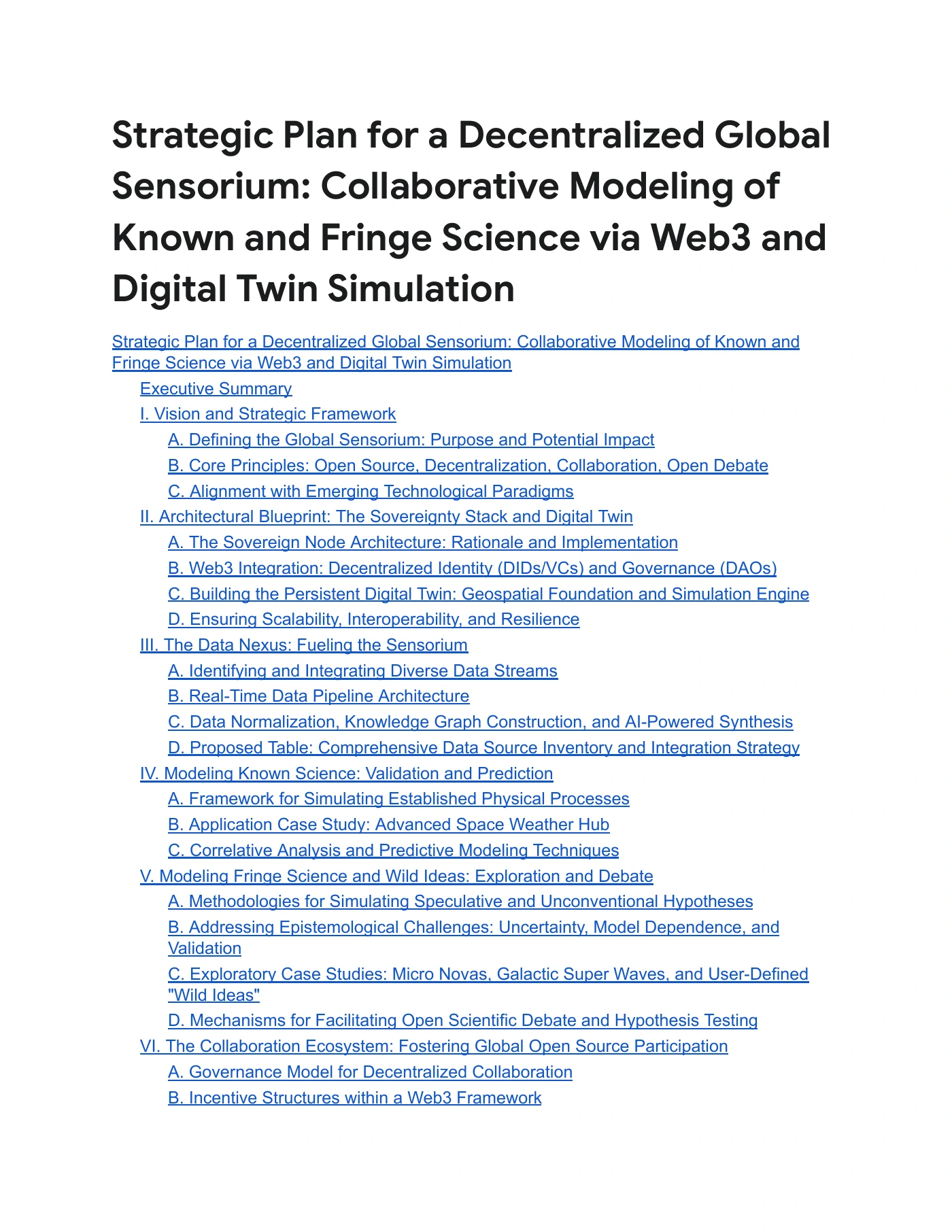
Strategic Plan for a Decentralized Global Sensorium: Collaborative Modeling of Known and Fringe Science via Web3 and Digital Twin Simulation Executive Summary I. Vision and Strategic Framework A. Defining the Global Sensorium: Purpose and Potential Impact B. Core Principles: Open Source, Decentralization, Collaboration, Open Debate C. Alignment with Emerging Technological Paradigms II. Architectural Blueprint: The Sovereignty Stack and Digital Twin A. The Sovereign Node Architecture: Rationale and Implementation B. Web3 Integration: Decentralized Identity (DIDs/VCs) and Governance (DAOs) C. Building the Persistent Digital Twin: Geospatial Foundation and Simulation Engine D. Ensuring Scalability, Interoperability, and Resilience III. The Data Nexus: Fueling the Sensorium A. Identifying and Integrating Diverse Data Streams B. Real-Time Data Pipeline Architecture C. Data Normalization, Knowledge Graph Construction, and AI-Powered Synthesis D. Proposed Table: Comprehensive Data Source Inventory and Integration Strategy IV. Modeling Known Science: Validation and Prediction A. Framework for Simulating Established Physical Processes B. Application Case Study: Advanced Space Weather Hub C. Correlative Analysis and Predictive Modeling Techniques V. Modeling Fringe Science and Wild Ideas: Exploration and Debate A. Methodologies for Simulating Speculative and Unconventional Hypotheses B. Addressing Epistemological Challenges: Uncertainty, Model Dependence, and Validation C. Exploratory Case Studies: Micro Novas, Galactic Super Waves, and User-Defined "Wild Ideas" D. Mechanisms for Facilitating Open Scientific Debate and Hypothesis Testing VI. The Collaboration Ecosystem: Fostering Global Open Source Participation A. Governance Model for Decentralized Collaboration B. Incentive Structures within a Web3 Framework
Page 2 of 37
Read selectable text for page 2
Text extracted from this page. Use the page image for its original layout, tables and figures.
Executive Summary
(To be drafted in the final step, summarizing key findings and recommendations)
I. Vision and Strategic Framework
A. Defining the Global Sensorium: Purpose and Potential Impact
The proposed "Global Sensorium" represents a paradigm shift in how humanity observes,
models,
and
understands
its
planet
and
the
surrounding
cosmic
environment.
It
is
envisioned
as
a
dynamic,
persistent,
1:1
scale
digital
twin
encompassing
Earth
and
its
local
space,
built
upon
a
foundation
of
integrated,
real-time
data
feeds
from
a
multitude
of
sensors
and
sources.
This
platform
transcends
the
limitations
of
traditional,
siloed
scientific
research
by
creating
a
unified,
multi-scale,
multi-domain
virtual
environment
for
collaborative
exploration,
simulation,
and
prediction
[User
Query].
The core purpose is to democratize access to complex Earth-space system data and
Page 3 of 37
Read selectable text for page 3
Text extracted from this page. Use the page image for its original layout, tables and figures.
accelerate
scientific
discovery
through
enhanced
collaboration
and
the
ability
to
test
hypotheses
within
a
comprehensive,
data-grounded
virtual
world
[User
Query].
Potential
impacts
are
far-reaching.
It
can
significantly
enhance
our
understanding
of
intricate
interactions
between
solar
activity,
the
magnetosphere,
atmosphere,
and
terrestrial
systems
(geophysical
and
biological).
This
improved
understanding
can
lead
to
more
accurate
and
timely
prediction
capabilities
for
a
range
of
natural
hazards,
including
space
weather
events
impacting
technology
and
infrastructure
1
, earthquakes
1
, volcanic activity
1
, and climate
anomalies.
1
Furthermore, the platform serves as a powerful tool for global scientific literacy,
allowing
students,
educators,
and
the
public
to
engage
directly
with
complex
scientific
concepts
and
data
visualizations.
1
Crucially, it provides a unique testbed for rigorously
evaluating
novel
scientific
hypotheses,
including
those
currently
considered
"fringe
science"
or
"wild
ideas,"
fostering
innovation
and
challenging
established
paradigms
within
a
data-driven
framework.
1
B. Core Principles: Open Source, Decentralization, Collaboration,
Open
Debate
The success and integrity of the Global Sensorium hinge on adhering to four foundational
principles:
1. Open Source: All core components of the platform, from the data ingestion pipelines
and
simulation
engines
to
the
visualization
frameworks
and
governance
protocols,
will
be
developed
under
open-source
licenses
[User
Query].
This
promotes
transparency,
allowing
anyone
to
inspect,
validate,
and
contribute
to
the
codebase.
It
maximizes
accessibility,
removing
barriers
to
participation
for
researchers,
developers,
and
institutions
globally.
Most
importantly,
it
fosters
a
collaborative
ecosystem
where
innovation
can
flourish
through
shared
effort
and
peer
review.
1
2. Decentralization: The platform will be built upon a fundamentally decentralized
architecture,
rejecting
traditional
client-server
models.
1
This architectural choice,
detailed
in
Section
II,
is
not
merely
for
technical
resilience
against
single
points
of
failure.
It
is
essential
for
underpinning
the
platform's
commitment
to
open
collaboration,
data
sovereignty,
and
censorship
resistance.
A
decentralized
structure
prevents
any
single
entity
from
controlling
the
platform,
its
data,
or
the
scientific
discourse
conducted
upon
it,
which
is
particularly
vital
for
hosting
potentially
controversial
debates
surrounding
fringe
science.
1
3. Global Collaboration: The Sensorium is envisioned as a truly global initiative,
transcending
institutional
silos
and
geographical
boundaries
[User
Query].
The
open-source
and
decentralized
framework
provides
the
technical
substrate
for
this
Page 4 of 37
Read selectable text for page 4
Text extracted from this page. Use the page image for its original layout, tables and figures.
worldwide
to
contribute
data,
develop
models,
validate
findings,
and
participate
in
governance.
1
4. Open Debate: The platform will serve as a neutral, data-driven arena for rigorous
scientific
debate
[User
Query].
It
will
provide
tools
for
diverse
scientific
perspectives
and
hypotheses—both
mainstream
and
unconventional—to
be
implemented
as
simulation
models,
tested
against
the
integrated
real-world
data
feeds,
visualized
comparatively,
and
discussed
openly
within
the
community.
The
emphasis
is
on
empirical
grounding
and
transparent
methodology,
allowing
ideas
to
be
evaluated
based
on
their
ability
to
explain
observations
and
make
verifiable
predictions.
C. Alignment with Emerging Technological Paradigms
The Global Sensorium concept is strategically positioned at the confluence of several key
technological
trends,
leveraging
their
convergence
to
create
a
unique
and
powerful
platform:
● Web3: The project embraces Web3 principles by incorporating decentralized identity
(DIDs/VCs)
for
user
sovereignty,
distributed
governance
mechanisms
(DAOs)
for
community
control,
and
potentially
novel
tokenomic
or
reputation
systems
to
incentivize
participation
and
contribution.
1
This aligns with the broader shift towards a more
user-centric,
decentralized
internet.
● Metaverse/Spatial Computing: While distinct from purely social or
entertainment-focused
metaverses,
the
Sensorium
utilizes
the
core
technologies
of
spatial
computing
and
immersive
visualization
(VR/AR/XR).
1
It positions itself as a
scientifically
grounded,
data-driven
virtual
world—a
high-fidelity
digital
twin
used
for
exploration,
analysis,
and
collaboration,
offering
a
purpose-driven
application
of
metaverse
technologies.
1
● Decentralized Science (DeSci): The platform directly supports and potentially provides
core
infrastructure
for
the
burgeoning
DeSci
movement.
1
Its open-source nature,
decentralized
architecture,
emphasis
on
data
sovereignty
(via
DIDs/VCs),
and
potential
for
community-governed
funding
and
validation
mechanisms
align
perfectly
with
DeSci's
goals
of
making
science
more
open,
transparent,
collaborative,
and
equitable.
1
The integration of these paradigms creates a powerful synergy. The Sensorium leverages
Web3
technologies
(DIDs,
DAOs,
CRDTs)
to
build
a
resilient,
sovereign,
and
collaborative
foundation.
1
It employs Metaverse/XR technologies to create an intuitive and immersive
interface
for
exploring
the
complex,
multi-dimensional
data
within
the
digital
twin.
1
Furthermore,
it
embodies
DeSci
principles
by
providing
an
open
platform
for
data
sharing,
model
validation,
peer
review,
and
community
governance.
1
This convergence allows the
Global
Sensorium
to
serve
as
a
potential
flagship
application,
demonstrating
how
these
Page 5 of 37
Read selectable text for page 5
Text extracted from this page. Use the page image for its original layout, tables and figures.
understanding
and
address
global
challenges.
II. Architectural Blueprint: The Sovereignty Stack and
Digital
Twin
A. The Sovereign Node Architecture: Rationale and Implementation
The architectural foundation of the Global Sensorium must embody its core principles of
decentralization,
resilience,
and
user
sovereignty.
Traditional
client-server
architectures,
common
in
large-scale
simulations
and
online
games,
are
fundamentally
unsuitable.
1
They rely
on
a
central
server
as
the
single
source
of
truth
and
authority,
creating
inherent
vulnerabilities:
single
points
of
failure
that
can
disable
the
entire
system,
bottlenecks
that
limit
scalability,
and
centralized
control
points
susceptible
to
censorship
or
manipulation.
1
Such a
model
directly
contradicts
the
requirement
for
a
resilient,
open,
and
user-controlled
platform
capable
of
hosting
diverse
and
potentially
controversial
scientific
discourse.
1
Therefore, the proposed architecture adopts the "Sovereign Node" concept.
1
Each instance of
the
Global
Sensorium
application,
whether
running
on
a
user's
local
machine
or
potentially
a
personal
cloud
instance,
functions
as
a
complete,
self-contained
software
stack.
It
maintains
its
own
replica
of
the
relevant
world
state
and
simulation
logic,
capable
of
operating
fully
offline.
1
This offline-first capability is crucial for resilience, ensuring continued operation even
during
network
disruptions—a
vital
feature
for
a
platform
potentially
used
in
crisis
monitoring
scenarios.
1
To achieve consistent synchronization of the shared world state across these independent,
potentially
offline
nodes
without
central
coordination,
the
architecture
leverages
peer-to-peer
(P2P)
networking
combined
with
Conflict-Free
Replicated
Data
Types
(CRDTs).
1
CRDTs are
data
structures
specifically
designed
for
distributed
systems,
possessing
mathematical
properties
that
guarantee
concurrent
updates
from
different
nodes
will
eventually
converge
to
the
same
state
without
conflicts
or
the
need
for
a
central
arbiter.
1
By modeling the shared
state
of
the
digital
twin
(e.g.,
sensor
readings,
object
positions,
simulation
parameters,
user
contributions)
using
CRDTs,
the
system
achieves
strong
eventual
consistency
in
a
fully
decentralized
manner.
1
When a node comes online, it synchronizes with peers, exchanging
CRDT
state
updates
(deltas)
which
are
merged
locally
according
to
mathematically
defined
Page 6 of 37
Read selectable text for page 6
Text extracted from this page. Use the page image for its original layout, tables and figures.
1
Implementing this within a high-fidelity simulation engine like Unreal Engine presents
challenges,
as
engines
often
assume
a
client-server
model.
1
The strategy involves integrating
robust,
open-source
C++
CRDT
libraries
(e.g.,
examining
candidates
like
miladghaznavi/crdts
or
similar,
subject
to
license
review)
and
building
a
custom
replication
layer
that
overrides
or
bypasses
the
engine's
native
networking.
1
Core data structures within the simulation will need
to
be
mapped
to
appropriate
CRDT
types
(e.g.,
Observed-Remove
Maps
for
collections,
Last-Writer-Wins
Registers
for
simple
values).
1
The P2P transport layer could utilize underlying
engine
capabilities
(like
Unreal's
EOS
P2P
Interface)
for
connection
management
and
NAT
traversal,
or
employ
standards
like
WebRTC
for
broader
platform
compatibility.
1
This
architectural
choice
is
fundamental;
the
CRDT-based
P2P
Sovereign
Node
model
provides
the
necessary
technical
foundation
for
resilience
(offline-first),
asynchronous
collaboration
(conflict-free
merging),
and
sovereignty
(no
central
dependency),
making
it
the
essential
enabler
for
the
project's
core
philosophical
and
functional
requirements.
1
B. Web3 Integration: Decentralized Identity (DIDs/VCs) and
Governance
(DAOs)
In a decentralized, P2P network lacking central authorities, establishing trust and verifying the
integrity
of
data
and
interactions
is
paramount.
The
architecture
integrates
core
Web3
components
to
address
this,
forming
the
"Sovereignty
Stack".
1
At the base layer is cryptographic identity, implemented using the W3C standards for
Decentralized
Identifiers
(DIDs)
and
Verifiable
Credentials
(VCs).
1
Each user (or potentially
each
sensor
feed
or
simulation
model)
generates
and
controls
their
own
DID,
a
globally
unique
identifier
independent
of
any
central
registry.
1
This DID serves as the root of their digital
identity
within
the
Sensorium.
VCs
are
tamper-proof,
digitally
signed
statements
issued
by
one
DID
about
another
(e.g.,
"Sensor
X
is
calibrated,"
"User
Y
contributed
model
Z,"
"Model
Z
passed
validation
test
W").
1
Users store these credentials in their local "Sovereign Skills
Wallet"
or
data
vault
(part
of
their
Sovereign
Node)
and
can
present
them
as
verifiable
proof
without
relying
on
the
original
issuer.
1
All significant actions and state changes within the
system
(e.g.,
submitting
data,
modifying
a
model,
casting
a
vote)
can
be
cryptographically
signed
using
the
user's
DID,
linking
actions
to
identity
and
ensuring
data
provenance
and
integrity.
1
Building upon trustworthy identity and data (signed CRDTs synchronized over P2P), the stack
incorporates
distributed
governance
mechanisms,
likely
implemented
as
Decentralized
Autonomous
Organizations
(DAOs).
1
Given the multi-scalar nature of the Global Sensorium, a
Page 7 of 37
Read selectable text for page 7
Text extracted from this page. Use the page image for its original layout, tables and figures.
managing
local
data
standards
or
specific
simulation
modules
to
overseeing
the
core
protocol
itself.
1
DAOs encode governance rules in smart contracts or verifiable code, enabling
transparent,
community-driven
decision-making
on
platform
evolution,
data
policies,
model
validation
criteria,
dispute
resolution,
and
potentially
the
allocation
of
resources
or
funding.
1
DIDs
and
VCs
can
underpin
participation
in
these
DAOs,
with
voting
rights
potentially
weighted
by
reputation,
contribution
history
(verified
by
VCs),
or
stake.
1
Furthermore, the integration of Web3 principles allows for exploring novel incentive
structures.
Concepts
like
the
"Braided
Economy"
and
the
"Community-Hour"
(C-Hour),
originally
proposed
in
a
different
context
for
rewarding
non-market
contributions
like
ecological
stewardship
or
community
care
1
, can be adapted. Within the Global Sensorium,
such
mechanisms
could
be
used
to
create
non-speculative
rewards
(represented
perhaps
by
VCs
or
reputation
tokens)
for
valuable
scientific
contributions
that
are
often
uncompensated
in
traditional
academia,
such
as
rigorous
peer
review,
data
curation,
model
replication,
or
educational
content
creation.
1
This creates a potential flywheel connecting contribution
(verified
by
VCs)
to
reputation
and
governance
power
within
the
DAO,
aligning
incentives
with
the
health
and
progress
of
the
collaborative
scientific
ecosystem.
1
The full Sovereignty Stack
thus
provides
a
logical
progression:
DIDs/VCs
establish
trust,
enabling
signed
CRDTs
for
reliable
data,
enabling
P2P
synchronization
for
resilience,
enabling
DAOs
and
incentive
mechanisms
for
collaborative
governance
and
growth.
1
C. Building the Persistent Digital Twin: Geospatial Foundation and
Simulation
Engine
The core visualization and interaction layer of the Global Sensorium is the persistent, 1:1 scale
digital
twin
of
Earth
and
its
relevant
space
environment.
Creating
this
requires
a
robust
pipeline
for
integrating
geospatial
data
and
a
powerful
simulation
engine
capable
of
rendering
a
dynamic,
large-scale
world.
The foundation begins with sourcing comprehensive geospatial data: Digital Elevation Models
(DEM)
for
topography,
high-resolution
satellite
and
aerial
imagery
for
surface
texturing,
and
vector
data
defining
features
like
coastlines,
hydrology,
vegetation
types,
and
infrastructure.
1
Official
open
data
portals
from
government
agencies
(e.g.,
NASA,
ESA,
USGS,
national
mapping
agencies)
are
primary
sources.
1
This raw data must be processed using Geographic
Information
System
(GIS)
software
like
the
open-source
QGIS.
1
Key steps include reprojecting
all
data
to
a
common
coordinate
system,
clipping
data
to
relevant
boundaries,
and
formatting
outputs
suitably
for
the
chosen
simulation
engine
(e.g.,
DEM
as
16-bit
GeoTIFF,
land
cover
Page 8 of 37
Read selectable text for page 8
Text extracted from this page. Use the page image for its original layout, tables and figures.
1
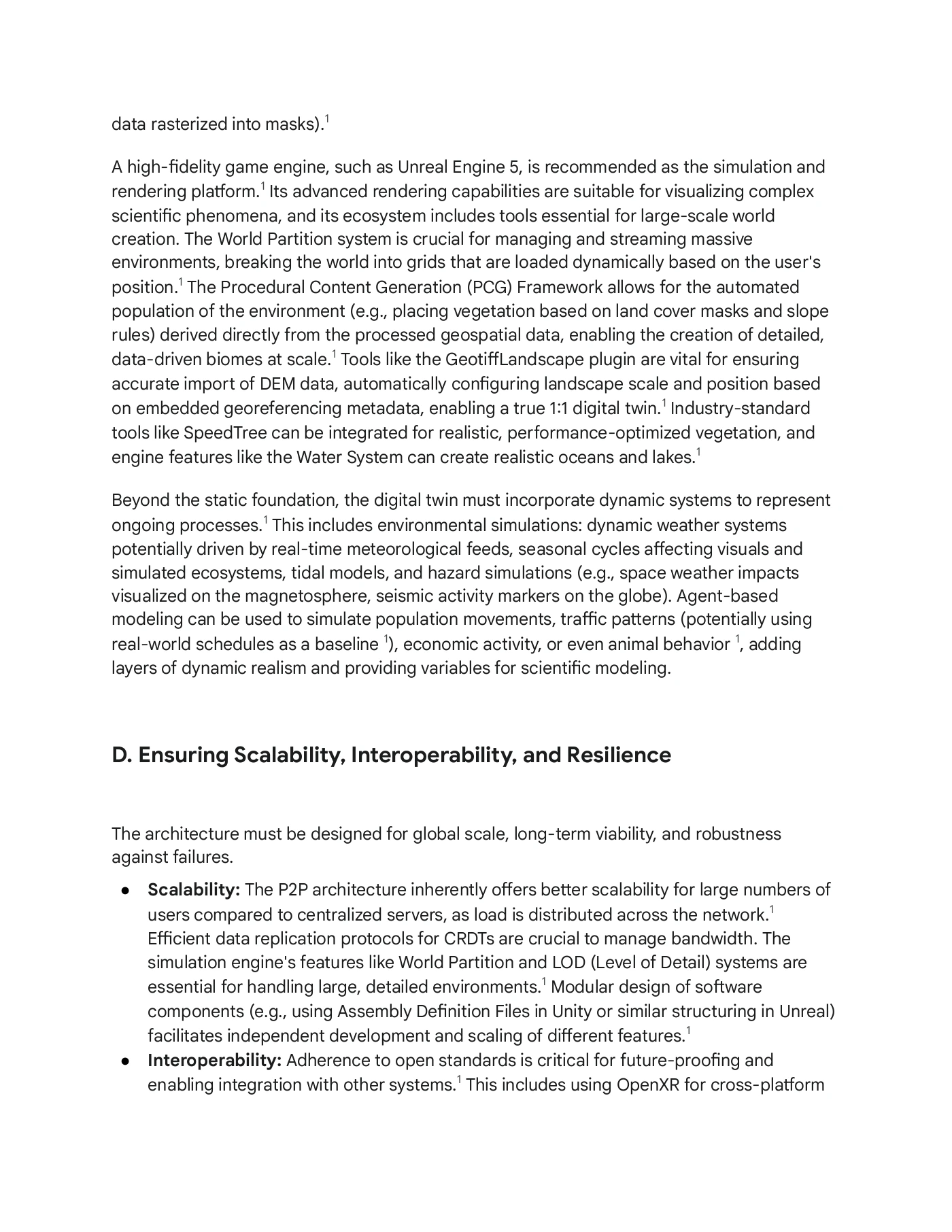
A high-fidelity game engine, such as Unreal Engine 5, is recommended as the simulation and
rendering
platform.
1
Its advanced rendering capabilities are suitable for visualizing complex
scientific
phenomena,
and
its
ecosystem
includes
tools
essential
for
large-scale
world
creation.
The
World
Partition
system
is
crucial
for
managing
and
streaming
massive
environments,
breaking
the
world
into
grids
that
are
loaded
dynamically
based
on
the
user's
position.
1
The Procedural Content Generation (PCG) Framework allows for the automated
population
of
the
environment
(e.g.,
placing
vegetation
based
on
land
cover
masks
and
slope
rules)
derived
directly
from
the
processed
geospatial
data,
enabling
the
creation
of
detailed,
data-driven
biomes
at
scale.
1
Tools like the GeotiffLandscape plugin are vital for ensuring
accurate
import
of
DEM
data,
automatically
configuring
landscape
scale
and
position
based
on
embedded
georeferencing
metadata,
enabling
a
true
1:1
digital
twin.
1
Industry-standard
tools
like
SpeedTree
can
be
integrated
for
realistic,
performance-optimized
vegetation,
and
engine
features
like
the
Water
System
can
create
realistic
oceans
and
lakes.
1
Beyond the static foundation, the digital twin must incorporate dynamic systems to represent
ongoing
processes.
1
This includes environmental simulations: dynamic weather systems
potentially
driven
by
real-time
meteorological
feeds,
seasonal
cycles
affecting
visuals
and
simulated
ecosystems,
tidal
models,
and
hazard
simulations
(e.g.,
space
weather
impacts
visualized
on
the
magnetosphere,
seismic
activity
markers
on
the
globe).
Agent-based
modeling
can
be
used
to
simulate
population
movements,
traffic
patterns
(potentially
using
real-world
schedules
as
a
baseline
1
), economic activity, or even animal behavior
1
, adding
layers
of
dynamic
realism
and
providing
variables
for
scientific
modeling.
D. Ensuring Scalability, Interoperability, and Resilience
The architecture must be designed for global scale, long-term viability, and robustness
against
failures.
● Scalability: The P2P architecture inherently offers better scalability for large numbers of
users
compared
to
centralized
servers,
as
load
is
distributed
across
the
network.
1
Efficient
data
replication
protocols
for
CRDTs
are
crucial
to
manage
bandwidth.
The
simulation
engine's
features
like
World
Partition
and
LOD
(Level
of
Detail)
systems
are
essential
for
handling
large,
detailed
environments.
1
Modular design of software
components
(e.g.,
using
Assembly
Definition
Files
in
Unity
or
similar
structuring
in
Unreal)
facilitates
independent
development
and
scaling
of
different
features.
1
● Interoperability: Adherence to open standards is critical for future-proofing and
enabling
integration
with
other
systems.
1
This includes using OpenXR for cross-platform
Page 9 of 37
Read selectable text for page 9
Text extracted from this page. Use the page image for its original layout, tables and figures.
1
, W3C standards for DIDs and VCs
1
, open formats for 3D assets (glTF,
USD)
1
, and standard web protocols (HTTP, WebSockets, WebRTC) for external
communication.
1
Core backend services (data pipeline, AI) should expose
well-documented
APIs
using
standard
formats
like
JSON
or
Protocol
Buffers,
making
them
engine-agnostic
and
accessible
to
other
potential
clients
(e.g.,
web
dashboards,
other
simulation
platforms).
1
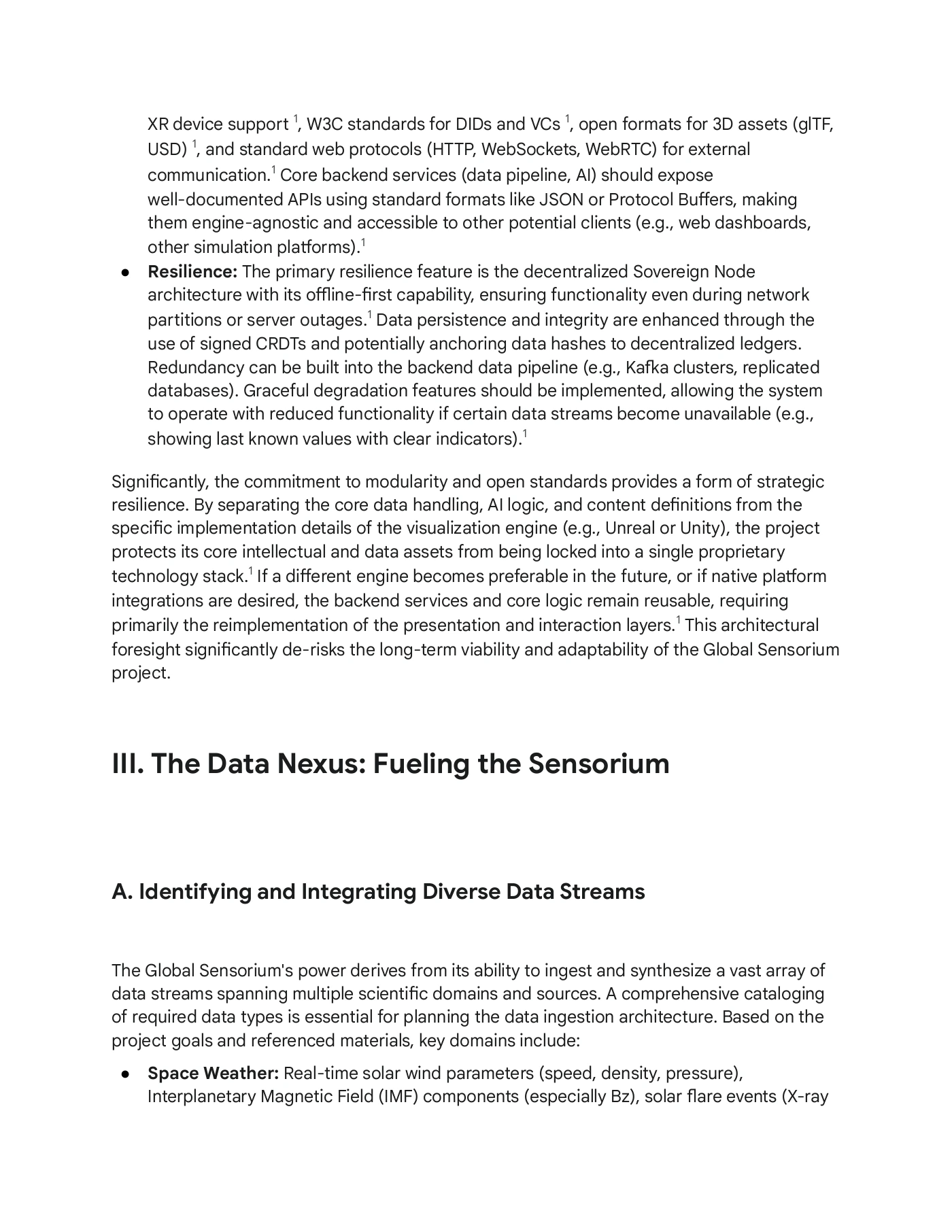
● Resilience: The primary resilience feature is the decentralized Sovereign Node
architecture
with
its
offline-first
capability,
ensuring
functionality
even
during
network
partitions
or
server
outages.
1
Data persistence and integrity are enhanced through the
use
of
signed
CRDTs
and
potentially
anchoring
data
hashes
to
decentralized
ledgers.
Redundancy
can
be
built
into
the
backend
data
pipeline
(e.g.,
Kafka
clusters,
replicated
databases).
Graceful
degradation
features
should
be
implemented,
allowing
the
system
to
operate
with
reduced
functionality
if
certain
data
streams
become
unavailable
(e.g.,
showing
last
known
values
with
clear
indicators).
1
Significantly, the commitment to modularity and open standards provides a form of strategic
resilience.
By
separating
the
core
data
handling,
AI
logic,
and
content
definitions
from
the
specific
implementation
details
of
the
visualization
engine
(e.g.,
Unreal
or
Unity),
the
project
protects
its
core
intellectual
and
data
assets
from
being
locked
into
a
single
proprietary
technology
stack.
1
If a different engine becomes preferable in the future, or if native platform
integrations
are
desired,
the
backend
services
and
core
logic
remain
reusable,
requiring
primarily
the
reimplementation
of
the
presentation
and
interaction
layers.
1
This architectural
foresight
significantly
de-risks
the
long-term
viability
and
adaptability
of
the
Global
Sensorium
project.
III. The Data Nexus: Fueling the Sensorium
A. Identifying and Integrating Diverse Data Streams
The Global Sensorium's power derives from its ability to ingest and synthesize a vast array of
data
streams
spanning
multiple
scientific
domains
and
sources.
A
comprehensive
cataloging
of
required
data
types
is
essential
for
planning
the
data
ingestion
architecture.
Based
on
the
project
goals
and
referenced
materials,
key
domains
include:
● Space Weather: Real-time solar wind parameters (speed, density, pressure),
Interplanetary
Magnetic
Field
(IMF)
components
(especially
Bz),
solar
flare
events
(X-ray
Page 10 of 37
Read selectable text for page 10
Text extracted from this page. Use the page image for its original layout, tables and figures.
high-energy
solar
proton
events
(SPEs),
sunspot
numbers,
solar
cycle
phase
data.
1
● Geophysical/Geological: Real-time seismograph data (ground motion, foreshocks),
historical
earthquake
records
(magnitude,
location,
depth),
tectonic
plate
boundaries
and
movement
data,
fault
line
information,
lithospheric
data,
radon
emissions,
core
sample
analyses
(e.g.,
olivine
concentration),
Low
Shear
Velocity
Zone
(LSVZ)
and
Large
Low
Shear
Velocity
Province
(LLSVP)
data,
thermal
infrared
anomalies,
acoustic
emissions
in
rock
media,
InSAR
ground
deformation
data,
Earth's
magnetic
field
measurements
(e.g.,
Kp
index).
1
● Atmospheric/Ionospheric: Total Electron Content (TEC), Outgoing Longwave Radiation
(OLR),
atmospheric
temperature,
pressure,
humidity,
wind
speed/direction,
cloud
cover,
precipitation,
UV
index,
visibility,
aerosol
optical
depth,
specific
gas
concentrations.
1
● Technological Infrastructure: GPS disruptions/anomalies, sensor data from critical
infrastructure
(power
lines,
bridges).
1
● Astronomical: Precise positions of the Sun and Moon relative to Earth for tidal force
calculations.
1
● Biological: Wildlife monitoring data (unusual animal behavior) as potential precursors.
1
● Societal/Human: Real-time public sentiment analysis (social media, news),
community-reported
observations,
public
health
data
potentially
correlated
with
space
weather
(e.g.,
hospital
admissions).
1
● Archival/Historical: Historical maps (cadastral, parish), government records, digitized
newspapers,
photographs,
oral
histories,
cultural
narratives
for
reconstructing
past
environments
and
events.
1
Sourcing strategies must be multi-pronged. Public APIs from government agencies like NOAA
(SWPC),
NASA
(SDO,
GOES,
ACE,
DSCOVR),
USGS,
ESA
are
crucial
primary
sources
for
real-time
and
historical
instrument
data.
1
Research networks and academic consortia can
provide
specialized
datasets
(e.g.,
ionospheric
monitoring,
global
seismograph
networks).
Partnerships
may
be
necessary
to
access
proprietary
data,
such
as
geological
survey
data
from
mining
companies
1
or detailed infrastructure sensor logs. Community contributions
through
citizen
science
initiatives
(e.g.,
aurora
sightings,
local
environmental
monitoring)
can
enrich
the
dataset.
Archival
data
requires
collaboration
with
institutions
like
libraries
and
archives
(e.g.,
State
Library
of
Queensland,
Queensland
State
Archives
as
examples).
1
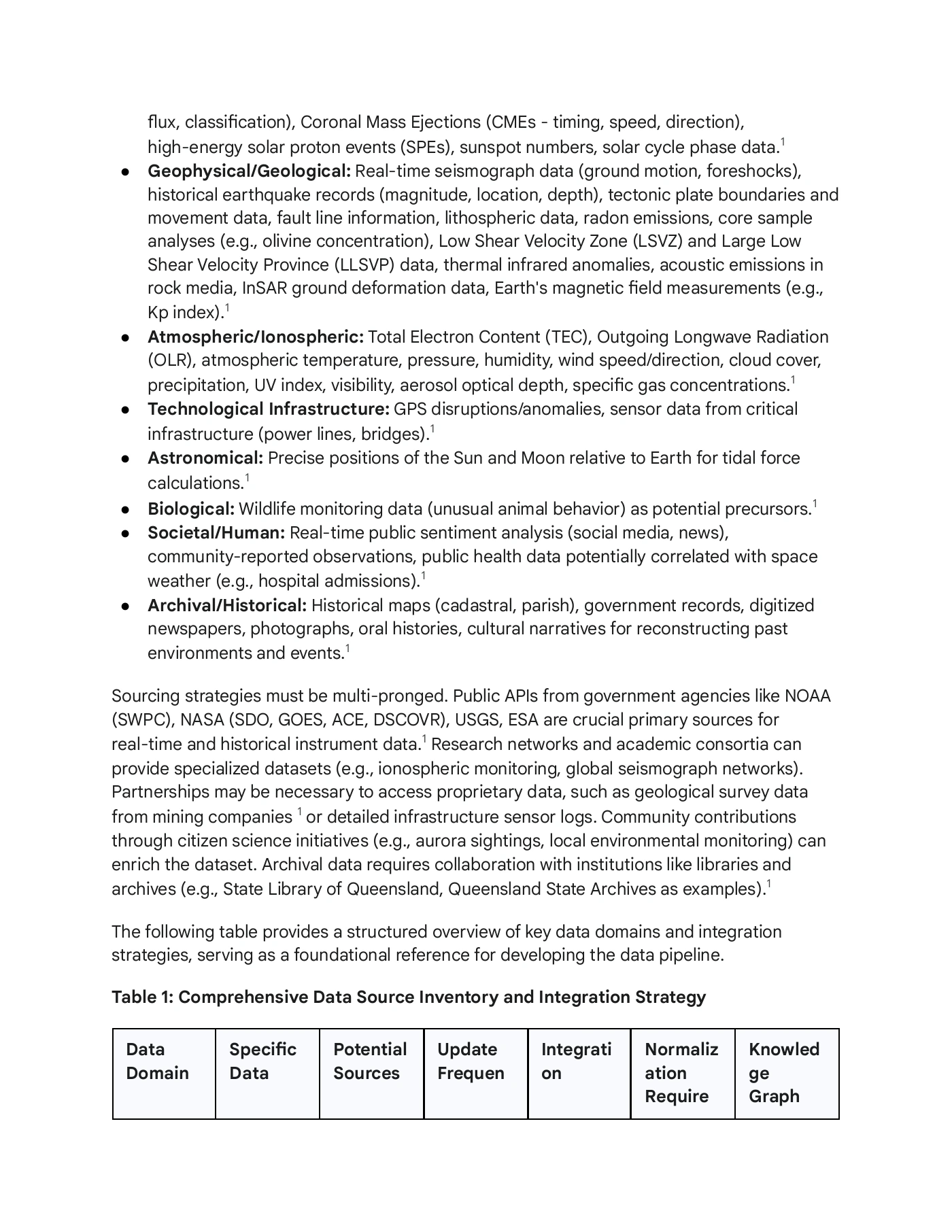
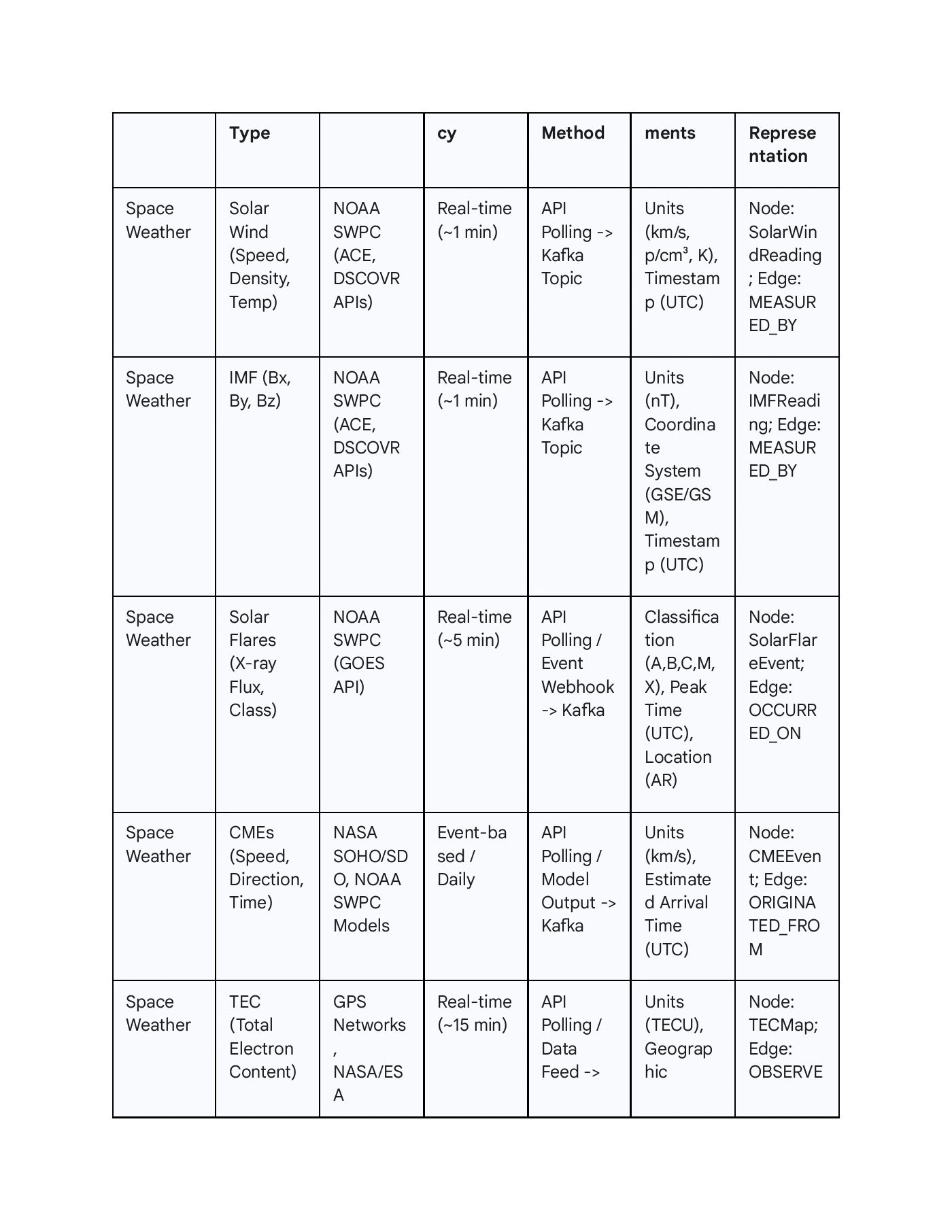
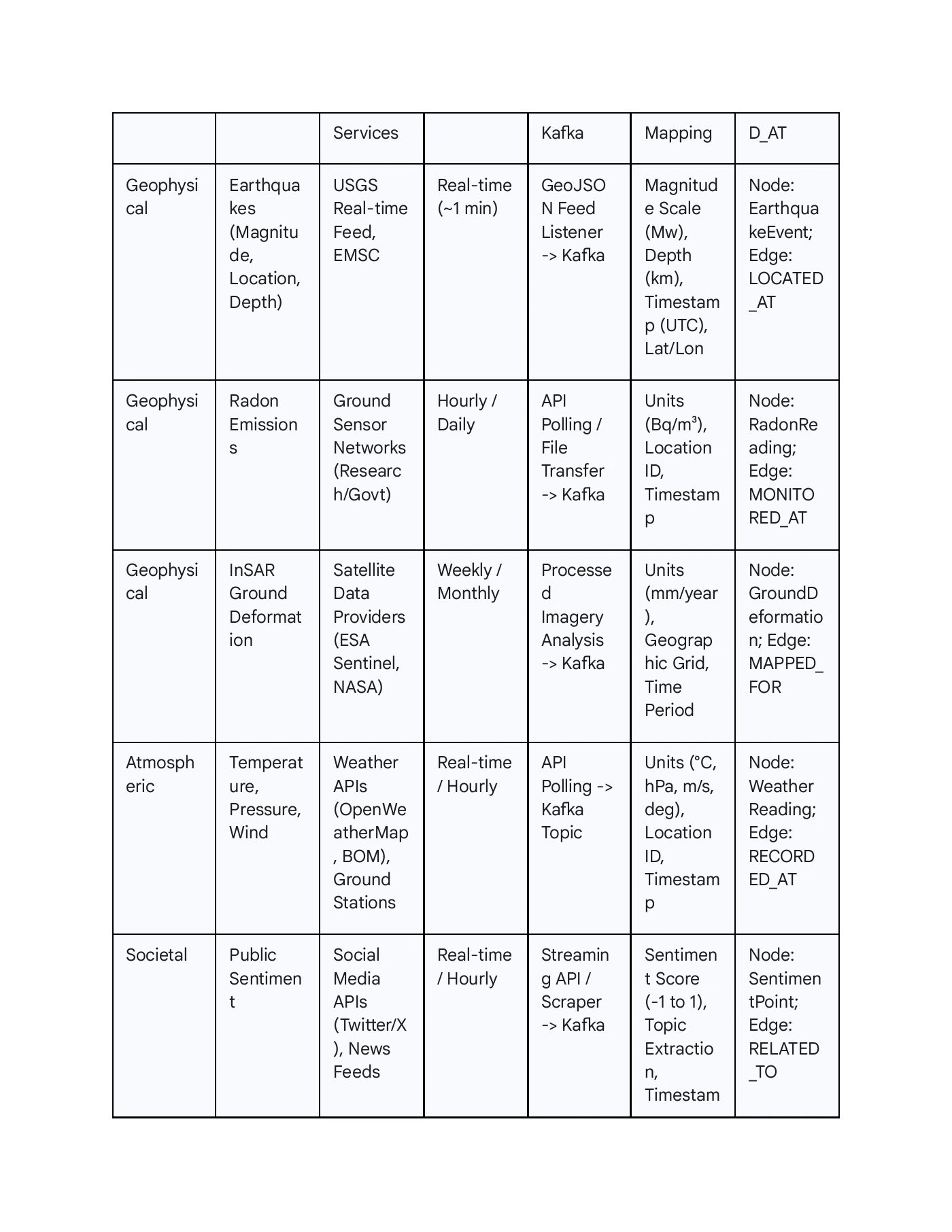
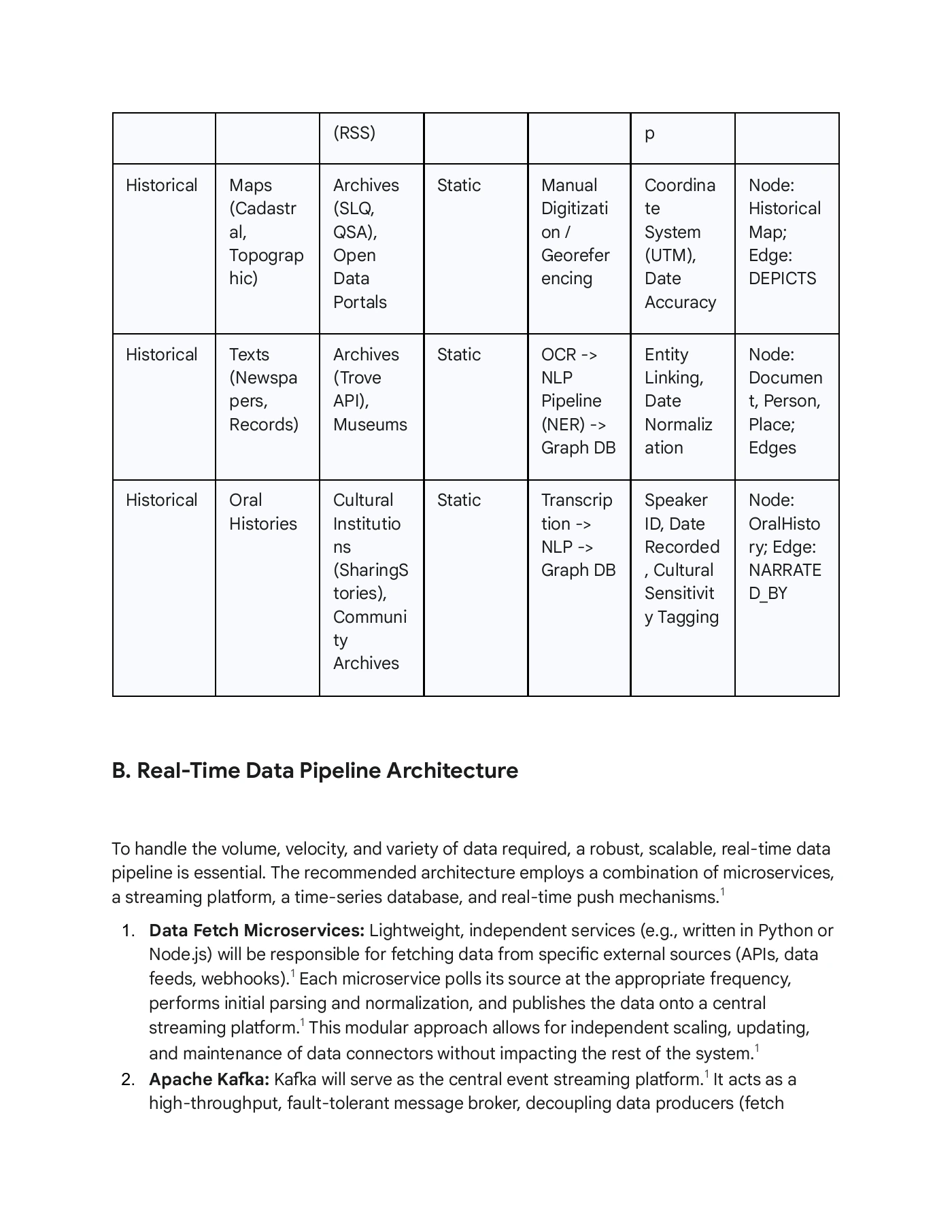
The following table provides a structured overview of key data domains and integration
strategies,
serving
as
a
foundational
reference
for
developing
the
data
pipeline.
Table 1: Comprehensive Data Source Inventory and Integration Strategy
Data Domain
Specific Data
Potential Sources
Update Frequen
Integration
Normalization Require
Knowledge Graph
Page 11 of 37
Read selectable text for page 11
Text extracted from this page. Use the page image for its original layout, tables and figures.
Space Weather
Solar Wind (Speed, Density, Temp)
NOAA SWPC (ACE, DSCOVR APIs)
Real-time (~1 min)
API Polling -> Kafka Topic
Units (km/s, p/cm³, K), Timestamp (UTC)
Node: SolarWindReading; Edge: MEASURED_BY
Space Weather
IMF (Bx, By, Bz)
NOAA SWPC (ACE, DSCOVR APIs)
Real-time (~1 min)
API Polling -> Kafka Topic
Units (nT), Coordinate System (GSE/GSM), Timestamp (UTC)
Node: IMFReading; Edge: MEASURED_BY
Space Weather
Solar Flares (X-ray Flux, Class)
NOAA SWPC (GOES API)
Real-time (~5 min)
API Polling / Event Webhook -> Kafka
Classification (A,B,C,M,X), Peak Time (UTC), Location (AR)
Node: SolarFlareEvent; Edge: OCCURRED_ON
Space Weather
CMEs (Speed, Direction, Time)
NASA SOHO/SDO, NOAA SWPC Models
Event-based / Daily
API Polling / Model Output -> Kafka
Units (km/s), Estimated Arrival Time (UTC)
Node: CMEEvent; Edge: ORIGINATED_FROM
Space Weather
TEC (Total Electron Content)
GPS Networks, NASA/ESA
Real-time (~15 min)
API Polling / Data Feed ->
Units (TECU), Geographic
Node: TECMap; Edge: OBSERVE
Page 12 of 37
Read selectable text for page 12
Text extracted from this page. Use the page image for its original layout, tables and figures.
Geophysical
Earthquakes (Magnitude, Location, Depth)
USGS Real-time Feed, EMSC
Real-time (~1 min)
GeoJSON Feed Listener -> Kafka
Magnitude Scale (Mw), Depth (km), Timestamp (UTC), Lat/Lon
Node: EarthquakeEvent; Edge: LOCATED_AT
Geophysical
Radon Emissions
Ground Sensor Networks (Research/Govt)
Hourly / Daily
API Polling / File Transfer -> Kafka
Units (Bq/m³), Location ID, Timestamp
Node: RadonReading; Edge: MONITORED_AT
Geophysical
InSAR Ground Deformation
Satellite Data Providers (ESA Sentinel, NASA)
Weekly / Monthly
Processed Imagery Analysis -> Kafka
Units (mm/year), Geographic Grid, Time Period
Node: GroundDeformation; Edge: MAPPED_FOR
Atmospheric
Temperature, Pressure, Wind
Weather APIs (OpenWeatherMap, BOM), Ground Stations
Real-time / Hourly
API Polling -> Kafka Topic
Units (°C, hPa, m/s, deg), Location ID, Timestamp
Node: WeatherReading; Edge: RECORDED_AT
Societal Public Sentiment
Social Media APIs (Twitter/X), News Feeds
Real-time / Hourly
Streaming API / Scraper -> Kafka
Sentiment Score (-1 to 1), Topic Extraction, Timestam
Node: SentimentPoint; Edge: RELATED_TO
Page 13 of 37
Read selectable text for page 13
Text extracted from this page. Use the page image for its original layout, tables and figures.
Historical Maps (Cadastral, Topographic)
Archives (SLQ, QSA), Open Data Portals
Static Manual Digitization / Georeferencing
Coordinate System (UTM), Date Accuracy
Node: HistoricalMap; Edge: DEPICTS
Historical Texts (Newspapers, Records)
Archives (Trove API), Museums
Static OCR -> NLP Pipeline (NER) -> Graph DB
Entity Linking, Date Normalization
Node: Document, Person, Place; Edges
Historical Oral Histories
Cultural Institutions (SharingStories), Community Archives
Static Transcription -> NLP -> Graph DB
Speaker ID, Date Recorded, Cultural Sensitivity Tagging
Node: OralHistory; Edge: NARRATED_BY
B. Real-Time Data Pipeline Architecture
To handle the volume, velocity, and variety of data required, a robust, scalable, real-time data
pipeline
is
essential.
The
recommended
architecture
employs
a
combination
of
microservices,
a
streaming
platform,
a
time-series
database,
and
real-time
push
mechanisms.
1
1. Data Fetch Microservices: Lightweight, independent services (e.g., written in Python or
Node.js)
will
be
responsible
for
fetching
data
from
specific
external
sources
(APIs,
data
feeds,
webhooks).
1
Each microservice polls its source at the appropriate frequency,
performs
initial
parsing
and
normalization,
and
publishes
the
data
onto
a
central
streaming
platform.
1
This modular approach allows for independent scaling, updating,
and
maintenance
of
data
connectors
without
impacting
the
rest
of
the
system.
1
2. Apache Kafka: Kafka will serve as the central event streaming platform.
1
It acts as a
high-throughput,
fault-tolerant
message
broker,
decoupling
data
producers
(fetch
Page 14 of 37
Read selectable text for page 14
Text extracted from this page. Use the page image for its original layout, tables and figures.
1
Data streams are
organized
into
topics
(e.g.,
solar_wind,
earthquakes,
tec_data).
1
Kafka buffers incoming
messages,
allowing
consumers
to
process
data
at
their
own
pace
and
enabling
multiple
consumers
to
subscribe
to
the
same
data
stream
independently.
1
3. InfluxDB: A time-series database like InfluxDB is recommended for persistent storage of
all
timestamped
data.
1
InfluxDB is optimized for high-volume ingestion and fast querying
of
time-indexed
data,
making
it
ideal
for
storing
sensor
readings
and
event
logs.
1
Data
can
be
fed
from
Kafka
to
InfluxDB
either
via
dedicated
connectors
(e.g.,
Kafka
Connect
sink)
or
by
having
the
fetch
microservices
write
directly
to
InfluxDB
in
parallel
with
publishing
to
Kafka.
1
InfluxDB enables historical analysis, trend generation, and provides
the
data
backend
for
populating
dashboards
and
timelines
within
the
Sensorium.
1
Data
should
be
organized
into
'measurements'
(e.g.,
SolarWind)
with
appropriate
'tags'
(e.g.,
satellite=DSCOVR)
and
'fields'
(e.g.,
speed,
density).
1
4. WebSocket Gateway: To provide low-latency, real-time updates to connected
Sensorium
clients
(e.g.,
users
in
VR),
a
WebSocket
gateway
service
is
proposed.
1
This
service
subscribes
to
relevant
Kafka
topics
and
pushes
new
messages
immediately
to
connected
clients
over
persistent
WebSocket
connections.
1
This push mechanism is more
efficient
and
provides
faster
updates
than
clients
repeatedly
polling
REST
APIs,
crucial
for
reacting
to
dynamic
events
like
solar
flares
or
displaying
rapidly
changing
sensor
data.
1
Clients
can
subscribe
to
specific
data
streams
based
on
their
current
focus
or
location
within
the
digital
twin.
1
On resource-constrained platforms like mobile VR, this push
mechanism
might
be
used
more
selectively
to
conserve
battery
and
bandwidth,
potentially
falling
back
to
polling
for
less
critical
data.
1
This pipeline provides a scalable, resilient, and flexible infrastructure for managing the diverse
data
flows
required
by
the
Global
Sensorium.
C. Data Normalization, Knowledge Graph Construction, and
AI-Powered
Synthesis
Raw data from disparate sources often arrives in inconsistent formats, units, or time
references.
A
critical,
often
underestimated,
step
is
rigorous
data
normalization
before
storage
or
analysis.
1
This involves converting all data points to standardized units (e.g., SI units),
consistent
timestamp
formats
(e.g.,
UTC
with
millisecond
precision),
canonical
entity
identifiers
(e.g.,
standardized
sensor
IDs,
location
names),
and
defined
coordinate
systems.
1
This
ensures
data
integrity
and
enables
meaningful
comparison
and
correlation
across
different
datasets.
Page 15 of 37
Read selectable text for page 15
Text extracted from this page. Use the page image for its original layout, tables and figures.
between
diverse
entities
within
the
Sensorium,
constructing
a
central
Knowledge
Graph
is
proposed.
1
Using a graph database like Neo4j, which is optimized for relationship-centric
queries,
allows
modeling
the
ecosystem
as
a
network
of
nodes
(representing
entities
like
sensors,
scientific
concepts,
historical
figures,
locations,
events,
documents)
and
edges
(representing
the
relationships
between
them,
e.g.,
MEASURES,
LOCATED_AT,
CAUSES,
MENTIONED_IN).
1
This structure facilitates the discovery of non-obvious connections, such as
correlating
specific
solar
events
with
patterns
in
geophysical
data
or
linking
historical
narratives
to
current
environmental
conditions.
1
Populating this knowledge graph, especially from unstructured sources like historical texts,
news
articles,
social
media,
or
even
transcribed
oral
histories,
requires
advanced
AI
techniques.
1
Natural Language Processing (NLP) models, including Named Entity Recognition
(NER)
tools
(e.g.,
spaCy,
potentially
fine-tuned
LLMs),
can
extract
key
entities
and
relationships
from
text,
even
handling
challenges
like
OCR
errors
or
archaic
language.
1
Computer
Vision
models
(e.g.,
using
OpenCV,
Scikit-Image)
can
analyze
images
and
videos
to
detect
objects,
classify
scenes,
and
potentially
identify
individuals
or
locations,
linking
visual
content
to
the
graph.
1
Sentiment analysis tools (e.g., VADER) can process social media and
review
data
to
add
layers
of
public
perception
and
emotional
context
to
events
or
locations
within
the
graph.
1
The primary mechanism for users to interact with and derive insights from this rich,
interconnected
data
structure
is
proposed
to
be
GraphRAG
(Retrieval-Augmented
Generation).
1
When a user poses a complex question (e.g., "Show me historical periods where
high
solar
activity
coincided
with
major
earthquakes
near
this
fault
line,
and
summarize
the
prevailing
scientific
theories
at
the
time"),
the
system
first
queries
the
Neo4j
knowledge
graph
to
retrieve
relevant
factual
context
(time-series
data,
earthquake
records,
links
to
relevant
scientific
papers
or
historical
documents
stored
in
the
graph).
1
This retrieved context is then
dynamically
injected
into
the
prompt
sent
to
a
Large
Language
Model
(LLM).
1
This crucial step
grounds
the
LLM's
generative
capabilities
in
the
verified,
factual
data
of
the
knowledge
graph,
enabling
it
to
synthesize
complex
information,
answer
nuanced
questions,
and
generate
summaries
or
explanations
while
significantly
reducing
the
risk
of
factual
errors
or
"hallucinations"
common
in
ungrounded
LLMs.
1
This combination of a structured knowledge
graph
and
AI-powered
synthesis
provides
the
core
engine
for
enabling
deep
exploration,
contextual
understanding,
and
informed
debate
within
the
Global
Sensorium.
1
D. Proposed Table: Comprehensive Data Source Inventory and
Integration
Strategy
Page 16 of 37
Read selectable text for page 16
Text extracted from this page. Use the page image for its original layout, tables and figures.
(Table 1 integrated into Section III.A above)
IV. Modeling Known Science: Validation and Prediction
A. Framework for Simulating Established Physical Processes
A core function of the Global Sensorium is to simulate known scientific processes based on
the
integrated
data
streams.
This
requires
a
flexible
and
robust
simulation
framework
capable
of
representing
physical
laws
and
interactions
accurately
across
diverse
domains
and
scales
–
from
particle
interactions
in
the
solar
wind
to
large-scale
atmospheric
circulation
and
tectonic
plate
movements.
The framework should support multiple approaches to simulation: ● Embedded Physics Solvers: For well-understood phenomena, established physics
solvers
(e.g.,
for
fluid
dynamics,
N-body
simulations,
electromagnetic
field
propagation)
can
be
integrated
directly
into
the
simulation
engine
or
run
as
external
modules
coupled
via
APIs.
● Data-Driven Models: Where fundamental physics is too complex to simulate directly or
computationally
prohibitive,
data-driven
models
(e.g.,
machine
learning
models
trained
on
historical
observations)
can
approximate
system
behavior.
These
models
learn
patterns
from
the
vast
datasets
within
the
Sensorium
to
predict
future
states.
● Agent-Based Modeling: For simulating systems involving numerous interacting entities
(e.g.,
ecosystems,
social
systems,
traffic
flow),
agent-based
modeling
provides
a
powerful
bottom-up
approach.
1
Regardless of the method, rigorous validation is paramount. Simulation outputs must be
continuously
compared
against
real-world
observational
data
ingested
by
the
Sensorium.
Discrepancies
between
simulation
and
reality
provide
crucial
feedback
for
refining
models,
adjusting
parameters,
or
identifying
areas
where
scientific
understanding
is
incomplete.
The
platform
should
include
tools
for
quantitative
comparison,
statistical
analysis
of
model
performance,
and
visualization
of
model
errors.
Furthermore,
simulations
should
be
benchmarked
against
established
scientific
models
and
community
standards
where
available.
Page 17 of 37
Read selectable text for page 17
Text extracted from this page. Use the page image for its original layout, tables and figures.
B. Application Case Study: Advanced Space Weather Hub
The user query specifically requests a space weather news hub, serving as an excellent case
study
for
applying
the
modeling
framework
[User
Query].
Building
upon
the
concepts
outlined
in
various
source
documents
1
, an advanced hub within the Global Sensorium would integrate
specific
data
streams:
real-time
solar
wind
data
(speed,
density,
temperature,
pressure),
IMF
components
(Bx,
By,
Bz),
solar
flare
reports
(X-ray
flux,
location,
class),
CME
tracking
(speed,
direction,
density
estimates
from
coronagraph
imagery
and
models),
Solar
Proton
Event
monitors,
TEC
maps,
and
ground-based
geomagnetic
indices
(Kp,
Dst).
1
Visualization within the immersive XR environment would be key to making this complex data
intuitive.
1
This includes: ● Interactive 3D models of the Sun and Earth, showing real-time activity like sunspots,
flares,
and
coronal
holes.
1
● Dynamic visualization of Earth's magnetosphere, potentially using particle systems or
shader
effects
to
show
its
compression
and
distortion
in
response
to
real-time
solar
wind
pressure
and
IMF
Bz
orientation.
1
Exaggerated scales might be employed for clarity.
1
● Aurora forecast visualizations overlaid on the 3D Earth globe, showing predicted intensity
and
geographic
extent
based
on
geomagnetic
activity
levels
(e.g.,
Kp
index).
1
● Animated CME trajectories showing predicted paths from the Sun towards Earth (or other
planets),
including
estimated
arrival
times.
1
● Data dashboards and panels displaying key numerical values and recent trends (e.g.,
solar
wind
speed
graphs,
X-ray
flux
charts)
within
the
virtual
environment.
1
● Adaptive Level-of-Detail (LoD) systems to ensure visualizations remain performant across
different
platforms.
1
Forecasting capabilities would integrate predictions from established agencies like NOAA
SWPC
1
while also providing a platform for developing and testing custom predictive models.
Machine
learning
algorithms
could
be
trained
on
the
Sensorium's
historical
data
archive
to
identify
complex
patterns
preceding
geomagnetic
storms
or
Solar
Proton
Events.
1
Event detection and alerting systems, potentially using "IF This Then That" (IFTTT) logic or
more
sophisticated
pattern
recognition,
would
provide
timely
warnings.
1
Examples include: IF
X-class
flare
detected
THEN
issue
radio
blackout
warning;
IF
IMF
Bz
turns
strongly
southward
AND
solar
wind
speed
>
500
km/s
THEN
predict
high
probability
of
G2+
geomagnetic
storm.
1
These
alerts
could
trigger
visual
and
auditory
cues
within
the
XR
environment
and
potentially
push
notifications
to
users.
1
Page 18 of 37
Read selectable text for page 18
Text extracted from this page. Use the page image for its original layout, tables and figures.
Weather
News
show
concepts
1
, using AI-driven narration and virtual anchors to deliver
updates
tailored
to
different
audiences
(e.g.,
general
public,
satellite
operators,
power
grid
managers)
within
the
immersive
Sensorium
environment.
1
C. Correlative Analysis and Predictive Modeling Techniques
The Global Sensorium's unique strength lies in its ability to bring together diverse,
time-synchronized
datasets
from
previously
siloed
domains,
enabling
powerful
correlative
analysis.
1
This is particularly relevant for investigating hypothesized connections, such as the
potential
influence
of
solar
activity
and
space
weather
on
terrestrial
phenomena
like
seismic
activity,
volcanic
eruptions,
or
even
atmospheric
patterns.
1
Initial exploration can employ statistical methods. Calculating Pearson correlation coefficients
between
time
series
(e.g.,
solar
wind
parameters
vs.
global
seismicity
rates,
IMF
variations
vs.
regional
earthquake
frequency)
can
reveal
potential
linear
relationships,
though
caution
must
be
exercised
regarding
spurious
correlations.
1
Linear regression models can quantify these
relationships
and
make
basic
predictions.
1
More sophisticated time series analysis techniques
(e.g.,
ARIMA,
cross-correlation
functions
with
time
lags)
can
uncover
more
complex
temporal
dependencies.
1
Machine Learning (ML) offers powerful tools for recognizing subtle, non-linear patterns within
the
high-dimensional
data
space
of
the
Sensorium.
1
Supervised learning models like Random
Forests
1
or Support Vector Machines can be trained on historical data to classify conditions
(e.g.,
predicting
the
likelihood
of
a
major
earthquake
based
on
a
combination
of
seismic
precursors,
ionospheric
disturbances,
and
solar/lunar
tidal
forces
1
). Recurrent Neural
Networks
(RNNs),
particularly
Long
Short-Term
Memory
(LSTM)
networks,
are
well-suited
for
modeling
complex
temporal
sequences
and
making
predictions
based
on
historical
patterns
in
multiple
data
streams.
1
However, it is crucial to acknowledge the inherent limitations and challenges, especially when
dealing
with
complex,
potentially
chaotic
systems
like
earthquake
generation.
1
Reliable,
high-precision
earthquake
prediction
(specifying
exact
time,
location,
and
magnitude)
remains
an
unsolved
scientific
problem.
1
While the Sensorium can facilitate research by
integrating
more
diverse
potential
precursor
data
(ULF
anomalies,
TEC
changes,
radon
emissions,
foreshocks,
animal
behavior,
tidal
forces,
solar
activity,
InSAR
deformation,
thermal
anomalies,
acoustic
emissions,
groundwater
changes)
1
, the focus should be on probabilistic
forecasting
and
risk
assessment
rather
than
deterministic
prediction.
1
Models must be
rigorously
validated
using
techniques
like
cross-validation
and
testing
on
unseen
data.
Page 19 of 37
Read selectable text for page 19
Text extracted from this page. Use the page image for its original layout, tables and figures.
associated
with
any
predictions
generated,
avoiding
false
certainty
and
ensuring
responsible
interpretation
of
model
outputs.
1
A significant advantage offered by the Sensorium's architecture is the integration of vast
historical
datasets,
potentially
extending
back
decades
or
centuries
through
the
archival
ingestion
and
reconstruction
methods
outlined.
1
This enables the analysis of long-cycle
phenomena,
such
as
the
correlation
between
solar
cycle
phases
(e.g.,
solar
maximum/minimum)
and
geophysical
activity
(e.g.,
earthquake
frequency/magnitude).
1
Analyzing
potential
correlations
across
these
longer
timescales,
which
may
involve
subtle
influences
or
lagged
responses,
requires
access
to
integrated
historical
data
that
traditional,
short-term
monitoring
datasets
often
lack.
1
The Sensorium's capacity to unify real-time
streams
with
deep
historical
context
therefore
provides
a
unique
and
powerful
capability
for
novel
discoveries
in
correlative
science.
V. Modeling Fringe Science and Wild Ideas: Exploration
and
Debate
A. Methodologies for Simulating Speculative and Unconventional
Hypotheses
A core objective of the Global Sensorium is to provide a platform for the exploration and open
debate
of
not
only
established
science
but
also
"fringe
science"
and
"wild
ideas"
[User
Query].
This
requires
methodologies
for
implementing,
simulating,
and
evaluating
speculative
hypotheses
within
the
platform's
data-driven
environment.
The process begins with translating a speculative concept into a formal, testable model. This
involves:
1. Hypothesis Definition: Clearly articulating the core claims of the fringe theory, its
proposed
mechanisms,
and
its
expected
observable
consequences.
2. Parameter Identification: Defining the key parameters and variables involved in the
hypothesis,
even
if
their
values
are
theoretical
or
poorly
constrained.
3. Model Implementation: Building a simulation module within the Sensorium framework
that
encodes
the
hypothetical
physics,
interactions,
or
processes
described
by
the
theory.
This
might
involve
writing
custom
physics
code,
developing
agent-based
models
Page 20 of 37
Read selectable text for page 20
Text extracted from this page. Use the page image for its original layout, tables and figures.
hypothetical
electromagnetic
force
term
to
Earth-Moon
orbital
mechanics
1
, or modeling
radon's
diamagnetic
interaction
with
crustal
EMF
1
). 4. Simulation Execution: Running the speculative model within the digital twin
environment,
potentially
driven
by
real-world
data
inputs
where
applicable.
5. Output Comparison: Comparing the simulation outputs against relevant observational
data
available
within
the
Sensorium.
Does
the
model
reproduce
known
phenomena?
Does
it
predict
observable
effects
that
can
be
searched
for
in
the
data?
The platform essentially functions as a "hypothesis sandbox," enabling researchers (or even
motivated
citizen
scientists)
to
rapidly
prototype,
visualize,
and
test
unconventional
ideas
[User
Query].
This
lowers
the
barrier
to
entry
for
exploring
hypotheses
that
might
struggle
to
gain
traction
or
funding
within
traditional
institutional
structures,
fostering
intellectual
diversity
and
potential
breakthroughs.
B. Addressing Epistemological Challenges: Uncertainty, Model
Dependence,
and
Validation
Modeling speculative science inherently involves significant epistemological challenges that
must
be
addressed
explicitly
and
transparently
within
the
platform.
1
● Uncertainty: Fringe theories often involve poorly constrained parameters or
mechanisms.
Simulations
based
on
them
must
incorporate
robust
uncertainty
quantification.
This
could
involve
running
ensemble
simulations
with
varying
parameter
ranges,
performing
sensitivity
analyses
to
identify
key
assumptions,
and
clearly
visualizing
the
range
of
possible
outcomes
rather
than
a
single
deterministic
prediction.
● Model Dependence: Conclusions drawn from simulations are inherently dependent on
the
assumptions
built
into
the
model.
The
platform
must
enforce
transparent
documentation
of
all
model
assumptions,
equations,
and
parameter
choices.
Version
control
systems
for
models
should
allow
users
to
track
changes
and
compare
different
model
versions
or
alternative
formulations
of
the
same
hypothesis.
● Validation and Falsification: Unlike established science, fringe theories often lack clear
empirical
validation.
The
Sensorium's
role
is
not
necessarily
to
"prove"
these
theories
but
to
provide
a
rigorous
environment
for
testing
their
consistency
with
observational
data
and
potentially
identifying
ways
to
falsify
them.
The
platform
should
facilitate
comparison
between
competing
models
(both
mainstream
and
fringe)
based
on
their
ability
to
explain
the
available
data
within
the
Sensorium.
Drawing parallels with the "epistemological fragility" inherent in even mainstream frontier
science
like
cosmology
1
, the platform must apply critical evaluation standards to all models,
Page 21 of 37
Read selectable text for page 21
Text extracted from this page. Use the page image for its original layout, tables and figures.
significant
asset
here.
By
making
the
implementation
of
a
fringe
hypothesis
explicit
and
runnable
as
a
simulation
model
1
, its underlying assumptions become transparent and open to
scrutiny.
1
Others can inspect the code, modify parameters, test sensitivities, or propose
alternative
models
directly
within
the
shared
environment.
This
interactive,
transparent,
and
data-grounded
approach
provides
a
more
rigorous
and
productive
environment
for
evaluating
unconventional
ideas
compared
to
purely
textual
or
rhetorical
debate,
potentially
accelerating
the
process
of
either
refuting
them
based
on
data
or
identifying
promising
avenues
for
further
investigation.
C. Exploratory Case Studies: Micro Novas, Galactic Super Waves, and
User-Defined
"Wild
Ideas"
The platform can be used to explore specific areas of fringe science mentioned by the user
[User
Query]:
● Micro Novas / Solar Cataclysms: This involves integrating theoretical models of
recurring
stellar
events,
possibly
drawing
on
interpretations
mentioned
in
sources
like.
11
Simulation
could
focus
on:
○ Modeling potential precursor signals: Are there hypothetical changes in solar
oscillations
(helioseismology),
magnetic
field
configurations,
or
particle
emissions
that
might
precede
such
an
event?
1
Can these be distinguished from normal solar
variability
in
the
Sensorium's
data
feeds?
○ Simulating the impact: Based on hypothetical energy release profiles (e.g., intense
bursts
of
particles,
electromagnetic
pulses),
model
the
interaction
with
Earth's
magnetosphere,
ionosphere,
atmosphere,
and
potentially
the
crust
(inducing
geomagnetic
effects
or
triggering
seismic
activity
as
speculated
in
some
theories).
Compare
simulated
effects
with
geological
records
or
historical
accounts
of
unexplained
phenomena.
● Galactic Super Waves: This involves modeling the propagation of hypothetical energy
waves
originating
from
the
galactic
center
or
other
cosmic
sources.
Simulation
could
focus
on:
○ Wave characteristics and propagation: Define wave properties (energy spectrum,
composition,
speed)
and
model
their
journey
through
the
interstellar
medium
to
the
heliosphere.
○ Heliospheric/Geomagnetic Interaction: Simulate the wave's impact on the heliopause,
modulation
of
cosmic
ray
influx
reaching
Earth,
and
potential
direct
effects
on
the
magnetosphere,
ionosphere
(e.g.,
changes
in
TEC
1
), and atmosphere.
1
Link to
existential
threat
mitigation
concepts
from
1
if relevant.
1
Page 22 of 37
Read selectable text for page 22
Text extracted from this page. Use the page image for its original layout, tables and figures.
and
APIs
allowing
users
to
define
and
implement
their
own
speculative
models
[User
Query].
This
could
range
from
alternative
cosmological
models
to
unconventional
theories
of
consciousness
interacting
with
physical
systems.
The
platform
provides
the
data
context
and
simulation
engine,
while
the
community
provides
the
diversity
of
ideas,
creating
a
dynamic
ecosystem
for
exploration
at
the
frontiers
of
thought.
D. Mechanisms for Facilitating Open Scientific Debate and Hypothesis
Testing
To fulfill the goal of enabling "open debate," the platform must incorporate specific features
designed
to
support
rigorous
scientific
discourse
around
both
known
and
fringe
science
[User
Query]:
● Integrated Communication Tools: Forums, chat channels, or annotation systems linked
directly
to
specific
datasets,
simulation
models,
or
visualizations
within
the
Sensorium.
This
allows
discussions
to
be
contextually
grounded
in
the
data
and
models
being
debated.
● Model Comparison and Validation Frameworks: Tools that allow users to easily run
multiple
simulation
models
(representing
competing
hypotheses)
side-by-side,
using
the
same
input
data,
and
compare
their
outputs
both
qualitatively
(visually
within
the
digital
twin)
and
quantitatively
(statistical
comparison
against
observational
data).
1
● Version Control and Provenance Tracking: Implementing version control (e.g., Git
integration)
for
simulation
models
allows
tracking
of
changes,
facilitates
replication,
and
ensures
clarity
about
which
version
of
a
model
produced
specific
results.
Linking
results
back
to
specific
model
versions
and
input
datasets
via
DIDs/VCs
enhances
provenance.
1
● Community-Based Review and Replication: Leveraging DeSci principles, the platform
could
host
workflows
for
community-based
peer
review
of
models
and
simulation
results,
potentially
incentivized
through
reputation
systems
or
tokens.
1
Tools could facilitate
independent
replication
of
simulation
runs
by
other
users.
● Visualization as a Debate Tool: The immersive and interactive visualization capabilities
are
central.
1
Allowing users to dynamically overlay simulation outputs from different
models
onto
the
real-world
data
represented
in
the
digital
twin
provides
an
intuitive
way
to
assess
model
fit,
identify
discrepancies,
and
communicate
arguments
visually
during
debates.
By providing these tools within an open, decentralized framework, the Global Sensorium can
foster
a
more
dynamic,
transparent,
and
evidence-based
approach
to
evaluating
all
scientific
ideas,
pushing
the
boundaries
of
knowledge
while
maintaining
scientific
rigor.
Page 23 of 37
Read selectable text for page 23
Text extracted from this page. Use the page image for its original layout, tables and figures.
VI. The Collaboration Ecosystem: Fostering Global
Open
Source
Participation
A. Governance Model for Decentralized Collaboration
A project of this scale and ambition requires a robust governance model that reflects its
open-source,
collaborative,
and
decentralized
nature.
A
hierarchical,
top-down
structure
would
stifle
innovation
and
contradict
the
core
principles.
Instead,
a
distributed
governance
model,
likely
based
on
Decentralized
Autonomous
Organizations
(DAOs),
is
proposed.
1
Given the diverse aspects of the platform (core protocol, data standards, specific simulation
domains
like
space
weather
or
seismology,
regional
data
initiatives),
a
"fractal"
DAO
structure
seems
appropriate.
1
This involves creating nested or interconnected DAOs, each with a
specific
scope
of
responsibility.
For
instance:
● Core Protocol DAO: Oversees the fundamental architecture, core Sovereignty Stack
components,
and
overall
platform
roadmap.
● Domain DAOs: Focused on specific scientific areas (e.g., Space Weather DAO,
Geophysics
DAO),
responsible
for
defining
data
standards,
validating
models,
and
curating
domain-specific
content
within
their
purview.
● Contributor DAOs/Guilds: Groups focused on specific technical contributions (e.g., XR
Interface
Guild,
Data
Pipeline
Guild),
managing
development
priorities
and
code
reviews
within
their
area.
Decision-making within these DAOs would occur through transparent proposal and voting
mechanisms,
likely
implemented
using
smart
contracts
on
a
suitable
blockchain
or
via
verifiable
off-chain
voting
systems
linked
to
the
platform's
identity
layer.
1
Participation and
voting
rights
could
be
based
on
various
factors,
leveraging
the
DID/VC
system:
proof
of
contribution
(e.g.,
code
commits,
validated
models),
demonstrated
expertise
(VCs
for
qualifications
or
peer
reviews),
reputation
scores
earned
through
participation,
or
potentially
token
holdings
representing
stake
in
the
ecosystem.
1
This allows for a flexible and meritocratic
governance
structure
where
influence
aligns
with
contribution
and
expertise.
Page 24 of 37
Read selectable text for page 24
Text extracted from this page. Use the page image for its original layout, tables and figures.
Sustaining a global open-source project requires effective mechanisms to incentivize
participation
and
contribution.
Web3
technologies
offer
potential
solutions
beyond
traditional
volunteer
models
or
grant
funding
[User
Query].
Exploring tokenomics is one avenue, where a native platform token could be used for
governance
voting,
staking,
accessing
premium
features
(if
any),
or
rewarding
contributions.
However,
designing
sustainable
and
non-speculative
tokenomics
is
complex.
An alternative or complementary approach involves adapting the principles of the "Braided
Economy"
and
the
"Community-Hour"
(C-Hour)
concept
described
in
related
strategy
documents.
1
The core idea is to create a system that formally values and rewards
contributions
that
benefit
the
ecosystem,
particularly
those
forms
of
scientific
labor
often
uncompensated
in
traditional
academia.
1
This could function as follows: 1. Verifiable Contributions: Users perform valuable actions (e.g., submit validated data,
contribute
code,
perform
a
rigorous
peer
review
of
a
model,
create
educational
content).
2. Verification and Credentialing: The contribution is verified (e.g., by automated tests,
domain
DAO
review),
and
the
user
receives
a
Verifiable
Credential
(VC)
attesting
to
their
contribution,
stored
in
their
Sovereign
Node.
1
3. Reputation/Reward: This VC translates into a non-speculative reward within the
ecosystem.
This
might
be
an
increase
in
their
reputation
score,
enhanced
voting
weight
in
relevant
DAOs,
access
privileges,
or
potentially
credits
(analogous
to
C-Hours)
redeemable
for
platform
resources
(e.g.,
compute
time
for
complex
simulations)
or
community
benefits.
1
This model directly addresses the critique of traditional academia's failure to adequately
incentivize
crucial
tasks
like
peer
review.
1
By creating a closed-loop system where verifiable
contributions
(proven
by
VCs)
lead
to
tangible
benefits
and
influence
(governance
power)
within
the
platform,
it
aligns
individual
incentives
with
the
collective
goal
of
advancing
scientific
knowledge
and
maintaining
a
high-quality,
trustworthy
Sensorium.
1
This
Web3-inspired,
contribution-focused
incentive
structure
can
foster
a
more
sustainable
and
engaged
global
open-source
community.
C. Tools and Platforms for Distributed Development and Knowledge
Sharing
Page 25 of 37
Read selectable text for page 25
Text extracted from this page. Use the page image for its original layout, tables and figures.
communication,
and
project
management.
1
● Version Control: Git is the standard for distributed version control. Given the potential
for
large
binary
assets
(3D
models,
textures,
large
datasets),
Git
LFS
(Large
File
Storage)
is
essential.
Alternatively,
solutions
optimized
for
game
development
assets
like
Unity's
Plastic
SCM
(now
Unity
DevOps)
might
be
considered
if
the
primary
engine
choice
solidifies,
as
they
offer
better
handling
of
scene
and
prefab
merging.
1
A clear branching
strategy
(e.g.,
GitFlow
or
trunk-based
development
with
feature
branches)
and
code
review
practices
are
crucial.
1
● Communication: Asynchronous communication platforms like Discord or Slack are
suitable
for
day-to-day
discussions,
Q&A,
and
community
building
among
globally
distributed
contributors.
1
Dedicated forums might be used for more structured,
long-form
discussions
around
specific
proposals
or
models.
● Project Management: Issue tracking and project management tools like GitHub Issues,
GitLab
Issues,
or
Jira
will
be
used
to
manage
the
development
backlog,
track
tasks,
assign
responsibilities,
and
plan
development
sprints
using
agile
methodologies.
1
● Knowledge Sharing: A dedicated Wiki or documentation platform (potentially integrated
with
the
code
repository)
is
needed
for
technical
documentation,
architectural
diagrams,
API
references,
and
user
guides.
1
Critically, the Global Sensorium platform itself—the
digital
twin
environment
and
the
underlying
knowledge
graph—can
serve
as
a
powerful
medium
for
knowledge
sharing.
Models,
datasets,
and
simulation
results
can
be
directly
explored,
annotated,
and
discussed
within
the
immersive
environment,
moving
beyond
static
documentation.
1
D. Integrating Decentralized Science (DeSci) Principles
The Global Sensorium's architecture and ethos provide a natural foundation for implementing
various
DeSci
practices,
aiming
to
make
the
scientific
process
more
open,
transparent,
reproducible,
and
community-driven.
1
Specific applications include: ● Open Peer Review: Moving beyond the limitations of traditional, opaque journal peer
review.
1
Proposals, models, datasets, and results published within the Sensorium could
undergo
open
peer
review
by
the
community.
Reviews
themselves
could
be
signed
contributions
(linked
to
reviewer
DIDs),
potentially
rewarded
via
the
incentive
system,
and
publicly
visible
alongside
the
work,
fostering
accountability
and
constructive
dialogue.
1
VCs
could
be
issued
for
completed
reviews,
building
reviewer
reputation.
1
● Decentralized Data/Model Storage: Utilizing decentralized storage solutions (e.g., IPFS,
Arweave)
to
host
datasets
and
simulation
models
referenced
within
the
Sensorium.
Content
identifiers
(CIDs)
can
be
linked
within
the
knowledge
graph
or
embedded
in
VCs,
Page 26 of 37
Read selectable text for page 26
Text extracted from this page. Use the page image for its original layout, tables and figures.
enhancing
reproducibility
[
1
(implicit)]. ● Reproducibility Workflows: Building tools within the Sensorium to facilitate the
replication
of
simulation
studies.
Users
could
potentially
clone
a
simulation
setup,
re-run
it
on
their
own
Sovereign
Node
or
cloud
compute,
and
compare
results,
with
the
platform
verifying
computational
equivalence.
1
VCs could attest to successful replication. ● Decentralized Funding: Domain DAOs or the Core Protocol DAO could potentially
manage
treasuries
(funded
by
grants,
donations,
or
future
revenue
streams)
and
allocate
funds
to
research
proposals
submitted
and
voted
upon
by
the
community,
creating
alternative
pathways
for
supporting
novel
or
underfunded
research
areas.
1
By embedding these DeSci principles and workflows directly into the platform, the Global
Sensorium
can
actively
promote
a
more
robust
and
collaborative
scientific
ecosystem.
VII. Visualization, Interaction, and Dissemination
A. Immersive XR Interface Design for Exploration and Analysis
The primary interface for the Global Sensorium will be an immersive Extended Reality (XR)
environment,
leveraging
Virtual
Reality
(VR)
and
potentially
Augmented/Mixed
Reality
(AR/MR)
for
intuitive
exploration
and
analysis
of
complex,
multi-dimensional
data.
1
The design philosophy adopts the "World-UI" or "Memory-Palace UX" concept: the
high-fidelity
digital
twin
of
Earth
and
space
is
the
interface.
1
Users navigate and interact
spatially,
rather
than
through
abstract
menus.
To
check
space
weather
effects,
they
might
"fly"
to
the
magnetosphere
visualization;
to
analyze
seismic
data,
they
might
zoom
into
the
Earth
globe
and
interact
with
data
points
overlaid
on
specific
regions.
1
Key visualization techniques include: ● Interactive 3D/4D Models: Real-time rendering of Earth, Sun, planets, satellites,
magnetosphere,
etc.,
dynamically
updated
by
data
feeds.
1
Time can be controlled (played
back,
sped
up)
to
visualize
processes
unfolding
over
hours,
days,
or
years
(4D
aspect).
1
● Data Overlays: Geospatial data (aurora forecasts, TEC maps, ground deformation,
earthquake
locations)
directly
textured
or
projected
onto
the
3D
Earth
model.
1
Temporal
data
(time
series
like
solar
wind
speed)
displayed
on
interactive
graphs
or
dashboards
Page 27 of 37
Read selectable text for page 27
Text extracted from this page. Use the page image for its original layout, tables and figures.
1
● Representation of Forces and Fields: Abstract concepts like magnetic fields, gravitational
forces,
or
energy
waves
visualized
using
particle
systems,
field
lines,
color
gradients,
or
shader
effects
to
make
the
invisible
tangible.
1
● Exaggerated Scales and Adaptive LoD: Employing non-linear scaling or visual
amplification
to
make
subtle
but
significant
phenomena
perceivable
(e.g.,
magnetopause
movements,
ground
uplift).
1
Implementing geometric and effect Level-of-Detail (LoD)
systems
ensures
visualizations
remain
clear
and
performant
across
scales
(zooming
from
global
view
down
to
local
detail)
and
on
different
hardware
capabilities.
1
User controls
allow
adjustment
of
exaggeration
levels
for
educational
vs.
scientific
accuracy
modes.
1
Interaction modalities must be intuitive and leverage the strengths of XR: ● Gaze-based interaction for selection in simpler VR/AR setups. ● Controller-based interaction (using ray interactor pointers, grab mechanics) for precise
manipulation
and
UI
interaction
in
standard
VR.
1
● Hand-tracking for natural, controller-free interaction on supported platforms (e.g., Quest,
Vision
Pro).
1
● Integration with established frameworks like Unity's XR Interaction Toolkit (XRI) provides
device-agnostic
components
for
common
interactions
(pointing,
grabbing,
teleporting),
reducing
platform-specific
coding.
1
● Spatial Audio is crucial for immersion and providing directional cues.
1
The overall design aims to create an intuitive, embodied experience where users feel present
within
the
data,
fostering
deeper
understanding
and
insight
compared
to
traditional
2D
interfaces.
Design
considerations
from
related
VR
projects,
such
as
the
cosmic-themed
studio
concept,
can
inform
the
aesthetic
and
functional
layout.
1
B. Multi-Platform Accessibility Strategy
To achieve global reach and cater to diverse users and resource levels, a multi-platform
deployment
strategy
is
essential.
1
The plan leverages a unified codebase
1
that targets
multiple
platforms
via
conditional
compilation
and
adaptive
quality
settings,
primarily
relying
on
the
OpenXR
standard
for
broad
XR
device
compatibility.
1
Supported Platforms include: ● Low-Cost Mobile VR/AR: ○ Google Cardboard / 3DoF Headsets: Android builds using split-screen stereo
rendering
and
phone
gyroscope
tracking,
potentially
via
OpenXR
extensions
or
Page 28 of 37
Read selectable text for page 28
Text extracted from this page. Use the page image for its original layout, tables and figures.
1
○ WebXR: Browser-based VR/AR via plugins like WebXR Export for Unity, enabling
access
without
app
installation,
albeit
with
performance
constraints
(simpler
visuals,
potentially
multi-pass
rendering).
1
○ Mobile AR: Using Unity's AR Foundation to deploy AR experiences on ARCore
(Android)
and
ARKit
(iOS)
compatible
smartphones/tablets,
allowing
users
to
overlay
visualizations
onto
their
real
environment.
1
● Standalone VR: High-fidelity builds for devices like Meta Quest 3, leveraging OpenXR for
native
deployment.
Utilizes
hardware
features
like
inside-out
tracking,
controllers,
hand-tracking,
and
potentially
passthrough
AR
for
Mixed
Reality
experiences.
1
Performance
optimized
using
techniques
like
foveated
rendering.
1
● PC VR: Targeting high-end experiences on Windows via OpenXR, compatible with
SteamVR
headsets
(Vive,
Index,
Oculus
Link
etc.).
Allows
for
maximum
graphical
fidelity
(volumetric
lighting,
high-poly
models,
complex
particle
effects).
1
● Mixed Reality (MR) Headsets: Supporting devices like Apple Vision Pro via Unity's
visionOS
support
(PolySpatial),
leveraging
passthrough
AR
for
blending
virtual
elements
(data
visualizations,
simulations)
into
the
user's
real
room.
Input
adapted
for
hand
gestures
and
eye
tracking.
1
Other OpenXR-compliant MR devices also potentially
supported.
1
Optimization for lower-end platforms is critical for accessibility, especially in educational
contexts.
1
Strategies include using Unity's Universal Render Pipeline (URP) with simplified
lighting
profiles,
implementing
multiple
quality
settings
tiers
(auto-detected
or
user-selected),
aggressive
use
of
LODs
for
geometry
and
effects,
texture
compression
(ETC2/ASTC),
and
potentially
streaming
or
downloading
heavier
assets
via
Addressables
to
minimize
initial
app
size.
1
Crucially, the application must handle intermittent or offline connectivity gracefully,
caching
essential
data
and
visualizations
to
remain
functional
even
without
a
live
internet
connection.
1
C. AI-Driven Narration and Educational Content Delivery
Generative AI and Large Language Models (LLMs) play a significant role in making the
complex
information
within
the
Sensorium
accessible
and
engaging.
1
● Automated Narration: LLMs can generate dynamic news scripts or explanatory
narrations
based
on
real-time
data
summaries
and
events
detected
within
the
Sensorium.
1
These scripts can be tailored in length (e.g., for 2-min vs. 30-min updates
1
)
and
tone.
1
● Text-to-Speech (TTS): High-quality TTS services (cloud-based like Google
Page 29 of 37
Read selectable text for page 29
Text extracted from this page. Use the page image for its original layout, tables and figures.
natural-sounding
audio
for
virtual
anchors
or
guides
within
the
XR
environment.
1
● Avatar Integration: 3D avatars representing news anchors or guides can be animated to
deliver
the
narration,
using
lip-sync
technologies
(e.g.,
Oculus
Lip
Sync,
Rhubarb)
driven
by
the
TTS
audio
output
to
enhance
presence
and
engagement.
1
Procedural animations
can
add
natural
gestures
and
expressions.
1
● Multi-Language Support: LLMs and TTS facilitate rapid localization, allowing narration
and
potentially
UI
text
to
be
generated
in
multiple
languages,
broadening
global
reach.
1
● Educational Customization: LLMs can adapt explanations based on user profiles or
explicit
requests,
adjusting
vocabulary,
complexity,
and
analogies
for
different
age
groups
(e.g.,
K-12
students
vs.
university
researchers)
or
levels
of
expertise.
1
An "Explain like I'm
10"
feature
could
dynamically
regenerate
a
simpler
explanation
of
a
complex
phenomenon.
1
● Sentiment Analysis Integration: AI can analyze external data (social media, news) for
public
sentiment
regarding
specific
events
(e.g.,
a
solar
storm
forecast).
1
This analysis
can
inform
the
tone
or
focus
of
AI-generated
communications,
helping
to
address
public
concerns,
counter
misinformation,
or
emphasize
the
significance
of
underestimated
events.
1
● Content Generation Workflow: The "Vibe-Coding" / Spec-Driven Development
workflow,
using
a
multi-agent
AI
pipeline,
can
be
employed
not
just
for
code
but
for
generating
structured
educational
modules,
interactive
tutorials,
or
narrative
scenarios
within
the
Sensorium
environment.
1
Accuracy and moderation are critical. AI-generated factual content (e.g., data summaries)
must
be
grounded
in
the
verified
data
from
the
Sensorium's
backend.
1
A human-in-the-loop
review
process
is
recommended
for
primary
news
scripts
or
critical
explanations
to
prevent
misinformation.
1
D. Public Engagement and Data Dissemination Strategies
Beyond the immersive XR interface, strategies are needed to engage a broader audience and
disseminate
the
Sensorium's
data
and
insights.
● Flagship Applications: The dedicated Space Weather News Hub, inspired by the
formats
in
1
, serves as a primary public-facing application built on the Sensorium
platform,
translating
complex
data
into
accessible
news
updates.
1
Similar curated
experiences
could
be
developed
for
other
domains
(e.g.,
earthquake
monitoring,
climate
change
visualization).
● Web Interfaces: Complementary web-based dashboards and data exploration tools can
Page 30 of 37
Read selectable text for page 30
Text extracted from this page. Use the page image for its original layout, tables and figures.
better
suited
to
2D
interfaces.
These
can
leverage
the
same
backend
APIs.
● APIs for Developers: Providing public APIs allows external developers to build
third-party
applications,
visualizations,
or
educational
tools
using
Sensorium
data,
fostering
a
broader
ecosystem.
● Educational Outreach: Developing specific modules and programs for K-12 and
university
education,
leveraging
the
interactive
and
immersive
nature
of
the
platform.
Partnerships
with
educational
institutions
are
key.
1
● Citizen Science Integration: Creating pathways for the public to contribute data (e.g.,
observations,
sensor
readings
from
personal
devices)
and
participate
in
analysis
or
model
validation
tasks.
● Ethical Considerations: When presenting simulations, especially those involving fringe
science
or
predictions
with
high
uncertainty,
clear
communication
is
essential.
The
platform
must
visually
and
narratively
distinguish
between
observational
data,
validated
model
outputs,
and
speculative
simulations.
Uncertainty
must
be
clearly
represented.
Moderation
policies
and
community
guidelines
will
be
needed
for
the
open
debate
features
to
ensure
discussions
remain
respectful
and
scientifically
grounded,
avoiding
the
spread
of
misinformation.
VIII. Strategic Roadmap and Recommendations
A. Phased Implementation Plan
A phased approach is crucial for managing the complexity and risks associated with building
the
Global
Sensorium.
The
following
phases
provide
a
logical
progression
from
foundational
development
to
full-scale
deployment:
● Phase 1: Foundational Architecture (Months 1-12): ○ Objectives: Establish the core technical infrastructure. ○ Key Activities: Develop and test the Sovereign Node architecture (P2P networking,
CRDT
integration).
Implement
the
DID/VC
identity
layer.
Build
the
initial
real-time
data
pipeline
infrastructure
(Kafka,
InfluxDB,
basic
fetch
microservices
for
key
data
like
solar
wind).
Set
up
the
core
Unreal/Unity
project
with
basic
geospatial
data
import
(e.g.,
global
DEM,
base
imagery)
using
World
Partition.
Establish
core
open-source
repositories
and
collaboration
tools.
Define
initial
DAO
governance
structure.
● Phase 2: Known Science Implementation & MVP (Months 13-24):
Page 31 of 37
Read selectable text for page 31
Text extracted from this page. Use the page image for its original layout, tables and figures.
deliver
a
Minimum
Viable
Product
(MVP).
○ Key Activities: Focus on the Space Weather Hub case study. Integrate required
real-time
space
weather
data
streams.
Develop
core
space
weather
simulation
models
(magnetosphere
interaction,
aurora
prediction).
Build
the
initial
XR
interface
for
visualizing
space
weather
phenomena.
Implement
basic
AI
narration
for
delivering
space
weather
updates.
Release
MVP
showcasing
live
space
weather
visualization
and
basic
forecasting.
Begin
integration
of
historical
data
into
InfluxDB.
● Phase 3: Collaboration, Community & DeSci Features (Months 25-36): ○ Objectives: Foster the open-source community and integrate collaborative science
features.
○ Key Activities: Refine and document APIs for external contribution. Launch
community
forums
and
contribution
guidelines.
Implement
core
DAO
voting
mechanisms.
Develop
initial
DeSci
features
(e.g.,
model
submission
workflow,
basic
open
review
tools,
VC
issuance
for
contributions).
Expand
data
integration
to
include
more
geophysical
and
atmospheric
datasets.
Enhance
simulation
framework
for
multi-domain
modeling.
● Phase 4: Fringe Science & Advanced Simulation (Months 37-48): ○ Objectives: Implement the "hypothesis sandbox" and tools for advanced modeling
and
debate.
○ Key Activities: Develop APIs and tools for users to integrate custom simulation
modules.
Implement
case
studies
for
modeling
fringe
science
(micro
novas,
super
waves).
Build
advanced
model
comparison
and
validation
tools.
Integrate
the
Knowledge
Graph
and
GraphRAG
system
for
contextual
data
exploration.
Develop
sophisticated
debate
and
annotation
features
within
the
platform.
● Phase 5: Scaling and Expansion (Month 49+): ○ Objectives: Integrate global sensor networks, enhance simulation fidelity, and
broaden
application
domains.
○ Key Activities: Scale data pipeline to handle significantly more diverse and
higher-volume
sensor
feeds.
Optimize
simulation
performance
for
higher
fidelity
and
complexity.
Expand
digital
twin
detail
and
dynamic
systems.
Develop
applications
beyond
space
weather
and
geophysics
(e.g.,
climate
modeling,
ecosystem
simulation,
urban
dynamics).
Foster
global
adoption
and
integration
with
educational
and
research
institutions.
This phased approach, drawing on agile methodologies
1
, allows for iterative development,
early
feedback,
risk
mitigation,
and
progressive
delivery
of
value.
B. Key Technological Choices and Trade-offs
Page 32 of 37
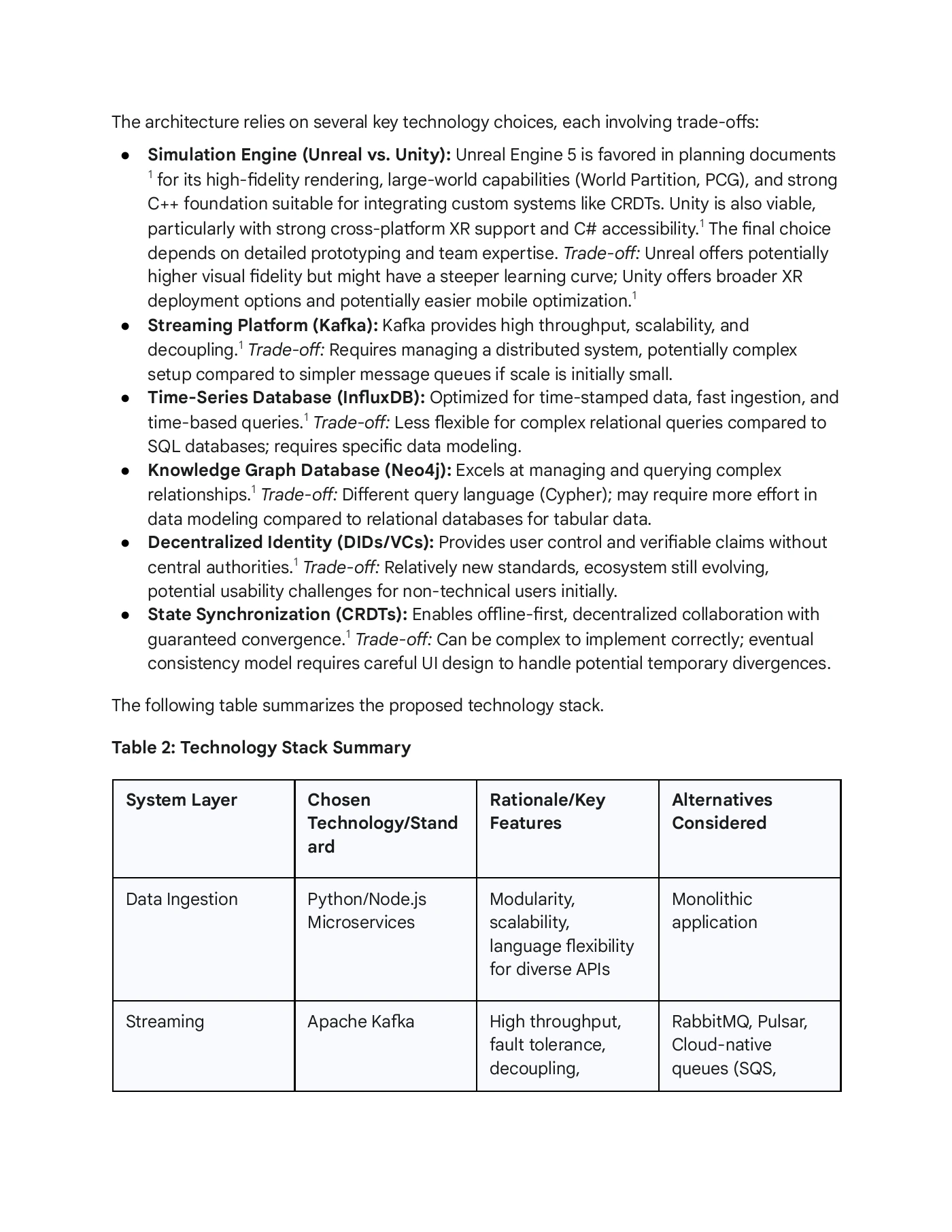
Read selectable text for page 32
Text extracted from this page. Use the page image for its original layout, tables and figures.
for its high-fidelity rendering, large-world capabilities (World Partition, PCG), and strong
C++
foundation
suitable
for
integrating
custom
systems
like
CRDTs.
Unity
is
also
viable,
particularly
with
strong
cross-platform
XR
support
and
C#
accessibility.
1
The final choice
depends
on
detailed
prototyping
and
team
expertise.
Trade-off:
Unreal
offers
potentially
higher
visual
fidelity
but
might
have
a
steeper
learning
curve;
Unity
offers
broader
XR
deployment
options
and
potentially
easier
mobile
optimization.
1
● Streaming Platform (Kafka): Kafka provides high throughput, scalability, and
decoupling.
1
Trade-off: Requires managing a distributed system, potentially complex
setup
compared
to
simpler
message
queues
if
scale
is
initially
small.
● Time-Series Database (InfluxDB): Optimized for time-stamped data, fast ingestion, and
time-based
queries.
1
Trade-off: Less flexible for complex relational queries compared to
SQL
databases;
requires
specific
data
modeling.
● Knowledge Graph Database (Neo4j): Excels at managing and querying complex
relationships.
1
Trade-off: Different query language (Cypher); may require more effort in
data
modeling
compared
to
relational
databases
for
tabular
data.
● Decentralized Identity (DIDs/VCs): Provides user control and verifiable claims without
central
authorities.
1
Trade-off: Relatively new standards, ecosystem still evolving,
potential
usability
challenges
for
non-technical
users
initially.
● State Synchronization (CRDTs): Enables offline-first, decentralized collaboration with
guaranteed
convergence.
1
Trade-off: Can be complex to implement correctly; eventual
consistency
model
requires
careful
UI
design
to
handle
potential
temporary
divergences.
The following table summarizes the proposed technology stack.
Table 2: Technology Stack Summary
System Layer Chosen Technology/Standard
Rationale/Key Features
Alternatives Considered
Data Ingestion Python/Node.js Microservices
Modularity, scalability, language flexibility for diverse APIs
Monolithic application
Streaming Apache Kafka High throughput, fault tolerance, decoupling,
RabbitMQ, Pulsar, Cloud-native queues (SQS,
Page 33 of 37
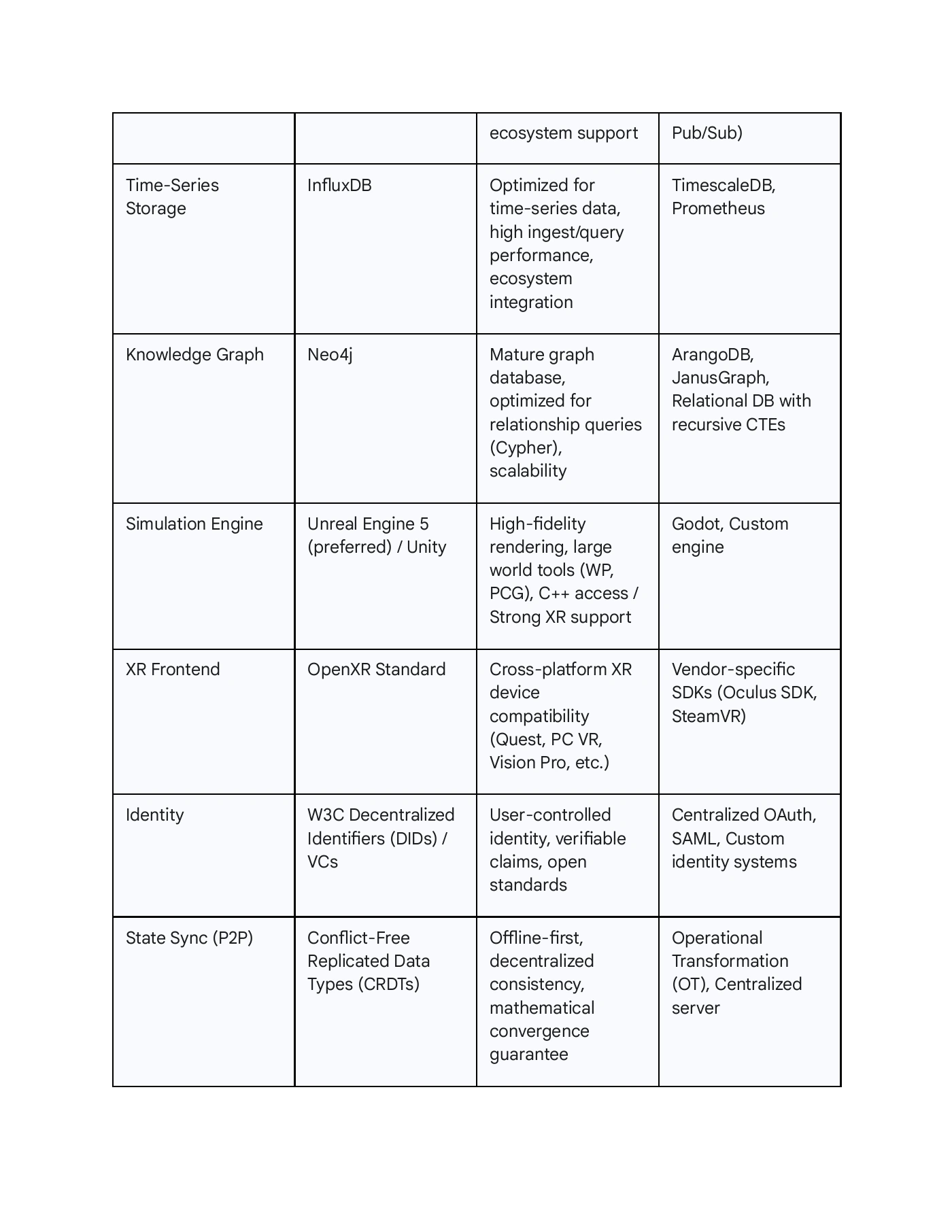
Read selectable text for page 33
Text extracted from this page. Use the page image for its original layout, tables and figures.
Time-Series Storage
InfluxDB Optimized for time-series data, high ingest/query performance, ecosystem integration
TimescaleDB, Prometheus
Knowledge Graph Neo4j Mature graph database, optimized for relationship queries (Cypher), scalability
ArangoDB, JanusGraph, Relational DB with recursive CTEs
Simulation Engine Unreal Engine 5 (preferred) / Unity
High-fidelity rendering, large world tools (WP, PCG), C++ access / Strong XR support
Godot, Custom engine
XR Frontend OpenXR Standard Cross-platform XR device compatibility (Quest, PC VR, Vision Pro, etc.)
Vendor-specific SDKs (Oculus SDK, SteamVR)
Identity W3C Decentralized Identifiers (DIDs) / VCs
User-controlled identity, verifiable claims, open standards
Centralized OAuth, SAML, Custom identity systems
State Sync (P2P) Conflict-Free Replicated Data Types (CRDTs)
Offline-first, decentralized consistency, mathematical convergence guarantee
Operational Transformation (OT), Centralized server
Page 34 of 37
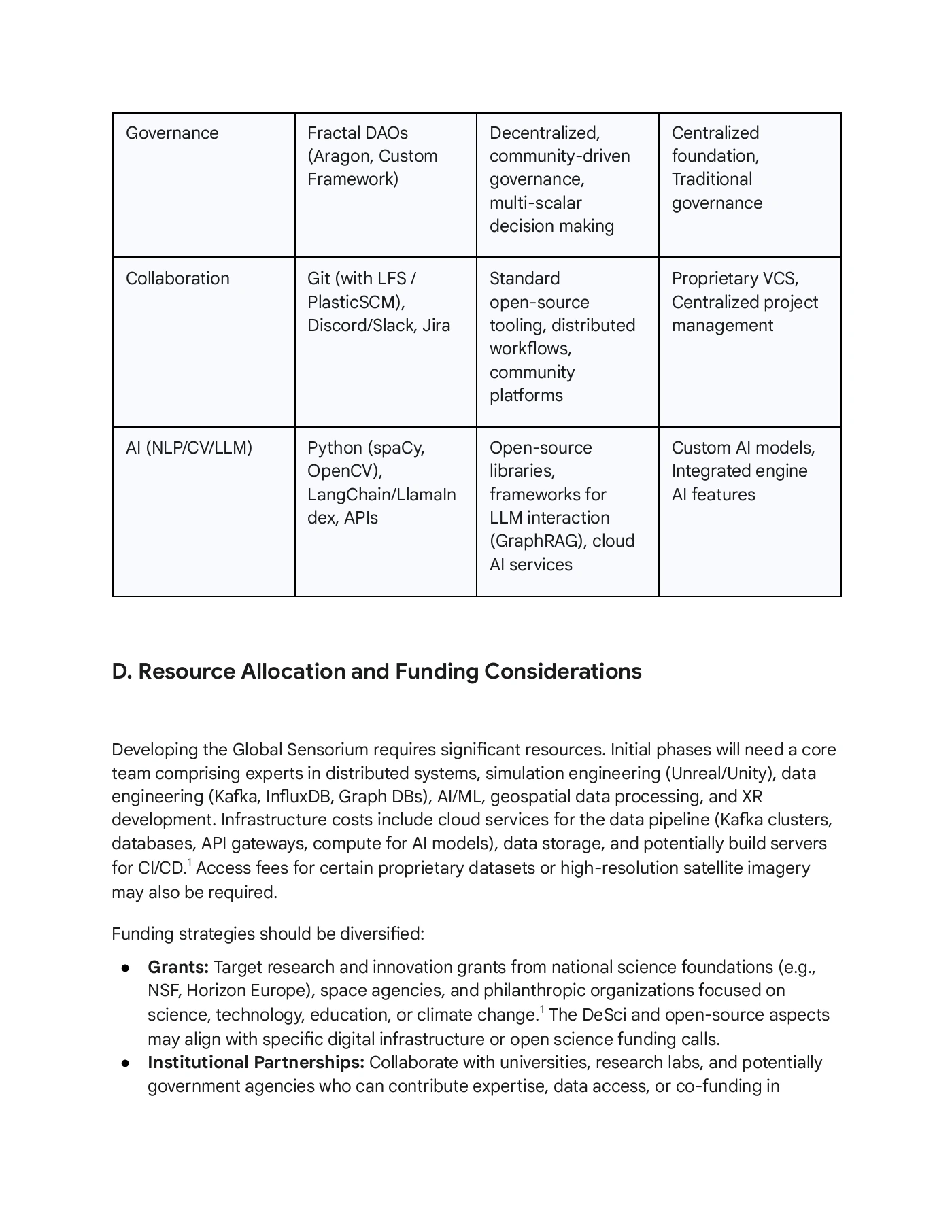
Read selectable text for page 34
Text extracted from this page. Use the page image for its original layout, tables and figures.
Decentralized, community-driven governance, multi-scalar decision making
Centralized foundation, Traditional governance
Collaboration Git (with LFS / PlasticSCM), Discord/Slack, Jira
Standard open-source tooling, distributed workflows, community platforms
Proprietary VCS, Centralized project management
AI (NLP/CV/LLM) Python (spaCy, OpenCV), LangChain/LlamaIndex, APIs
Open-source libraries, frameworks for LLM interaction (GraphRAG), cloud AI services
Custom AI models, Integrated engine AI features
D. Resource Allocation and Funding Considerations
Developing the Global Sensorium requires significant resources. Initial phases will need a core
team
comprising
experts
in
distributed
systems,
simulation
engineering
(Unreal/Unity),
data
engineering
(Kafka,
InfluxDB,
Graph
DBs),
AI/ML,
geospatial
data
processing,
and
XR
development.
Infrastructure
costs
include
cloud
services
for
the
data
pipeline
(Kafka
clusters,
databases,
API
gateways,
compute
for
AI
models),
data
storage,
and
potentially
build
servers
for
CI/CD.
1
Access fees for certain proprietary datasets or high-resolution satellite imagery
may
also
be
required.
Funding strategies should be diversified: ● Grants: Target research and innovation grants from national science foundations (e.g.,
NSF,
Horizon
Europe),
space
agencies,
and
philanthropic
organizations
focused
on
science,
technology,
education,
or
climate
change.
1
The DeSci and open-source aspects
may
align
with
specific
digital
infrastructure
or
open
science
funding
calls.
● Institutional Partnerships: Collaborate with universities, research labs, and potentially
government
agencies
who
can
contribute
expertise,
data
access,
or
co-funding
in
Page 35 of 37
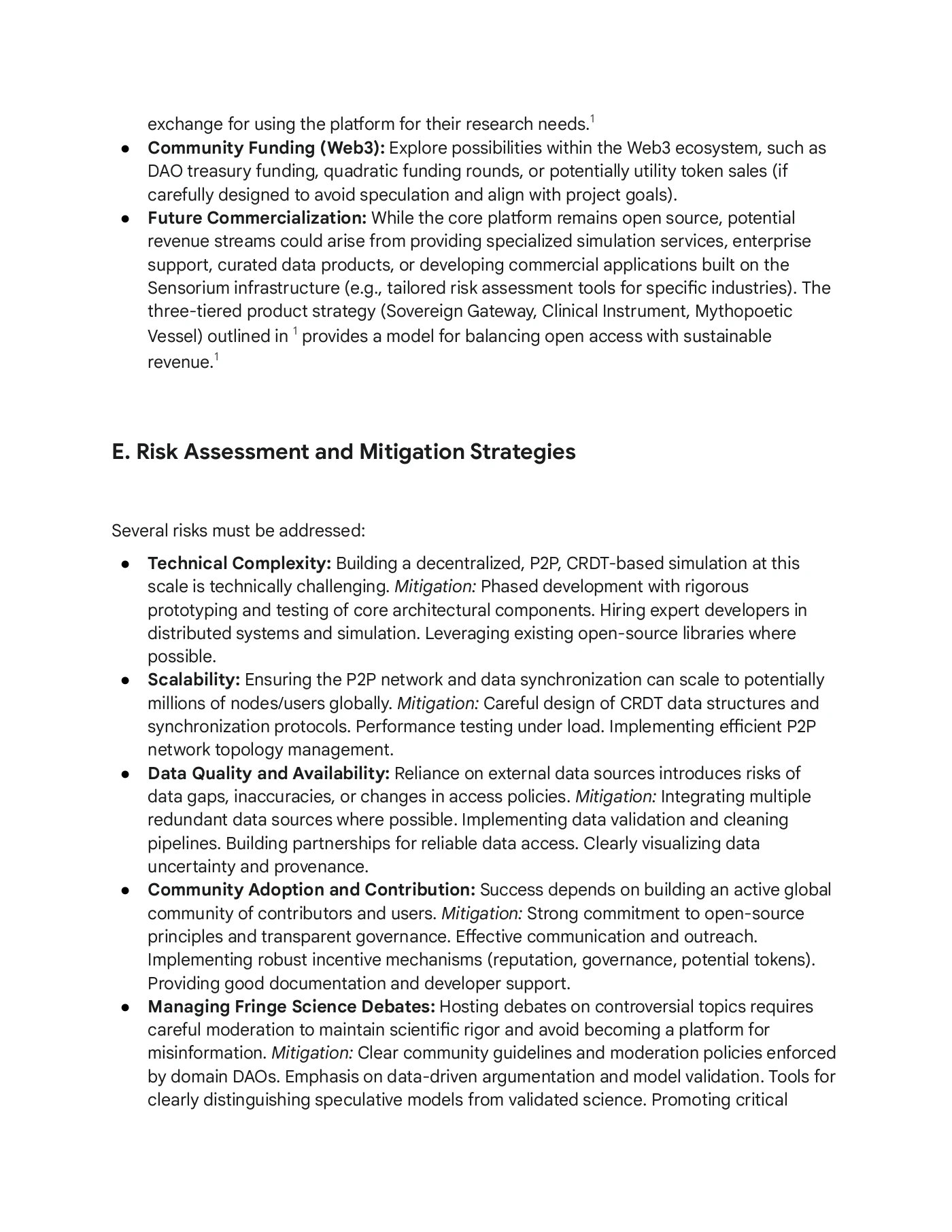
Read selectable text for page 35
Text extracted from this page. Use the page image for its original layout, tables and figures.
1
● Community Funding (Web3): Explore possibilities within the Web3 ecosystem, such as
DAO
treasury
funding,
quadratic
funding
rounds,
or
potentially
utility
token
sales
(if
carefully
designed
to
avoid
speculation
and
align
with
project
goals).
● Future Commercialization: While the core platform remains open source, potential
revenue
streams
could
arise
from
providing
specialized
simulation
services,
enterprise
support,
curated
data
products,
or
developing
commercial
applications
built
on
the
Sensorium
infrastructure
(e.g.,
tailored
risk
assessment
tools
for
specific
industries).
The
three-tiered
product
strategy
(Sovereign
Gateway,
Clinical
Instrument,
Mythopoetic
Vessel)
outlined
in
1
provides a model for balancing open access with sustainable
revenue.
1
E. Risk Assessment and Mitigation Strategies
Several risks must be addressed: ● Technical Complexity: Building a decentralized, P2P, CRDT-based simulation at this
scale
is
technically
challenging.
Mitigation:
Phased
development
with
rigorous
prototyping
and
testing
of
core
architectural
components.
Hiring
expert
developers
in
distributed
systems
and
simulation.
Leveraging
existing
open-source
libraries
where
possible.
● Scalability: Ensuring the P2P network and data synchronization can scale to potentially
millions
of
nodes/users
globally.
Mitigation:
Careful
design
of
CRDT
data
structures
and
synchronization
protocols.
Performance
testing
under
load.
Implementing
efficient
P2P
network
topology
management.
● Data Quality and Availability: Reliance on external data sources introduces risks of
data
gaps,
inaccuracies,
or
changes
in
access
policies.
Mitigation:
Integrating
multiple
redundant
data
sources
where
possible.
Implementing
data
validation
and
cleaning
pipelines.
Building
partnerships
for
reliable
data
access.
Clearly
visualizing
data
uncertainty
and
provenance.
● Community Adoption and Contribution: Success depends on building an active global
community
of
contributors
and
users.
Mitigation:
Strong
commitment
to
open-source
principles
and
transparent
governance.
Effective
communication
and
outreach.
Implementing
robust
incentive
mechanisms
(reputation,
governance,
potential
tokens).
Providing
good
documentation
and
developer
support.
● Managing Fringe Science Debates: Hosting debates on controversial topics requires
careful
moderation
to
maintain
scientific
rigor
and
avoid
becoming
a
platform
for
misinformation.
Mitigation:
Clear
community
guidelines
and
moderation
policies
enforced
by
domain
DAOs.
Emphasis
on
data-driven
argumentation
and
model
validation.
Tools
for
clearly
distinguishing
speculative
models
from
validated
science.
Promoting
critical
Page 36 of 37
Read selectable text for page 36
Text extracted from this page. Use the page image for its original layout, tables and figures.
maintenance,
and
infrastructure.
Mitigation:
Diversified
funding
strategy
(grants,
partnerships,
community,
potential
commercial).
Lean
development
practices.
Clear
demonstration
of
value
to
attract
ongoing
support.
● AI Misuse/Misinformation: AI-generated content (narration, summaries) could contain
inaccuracies
or
biases.
Mitigation:
Grounding
AI
outputs
in
verified
data
(GraphRAG).
Human-in-the-loop
review
for
critical
content.
Transparency
about
AI
usage.
Implementing
AI
safety
best
practices.
1
Framing the platform's purpose around
addressing
existential
risks
may
also
require
considering
broader
AI
safety
and
alignment
issues,
potentially
integrating
frameworks
like
the
proposed
"Ithaca
Protocol"
for
secure
global
dialogue
on
such
topics.
1
F. Concluding Remarks: Towards a New Era of Collaborative Scientific
Discovery
The Global Sensorium, as outlined in this strategic plan, represents more than just an
advanced
technological
platform;
it
embodies
a
potential
transformation
in
how
scientific
knowledge
is
created,
validated,
and
shared.
By
integrating
cutting-edge
technologies
from
Web3,
spatial
computing,
AI,
and
distributed
systems
within
an
open-source,
collaborative
framework,
it
offers
a
powerful
alternative
to
the
often
siloed,
centralized,
and
slow-moving
processes
of
traditional
science.
1
The platform's ability to synthesize vast, heterogeneous datasets into a unified, explorable
digital
twin
provides
an
unprecedented
tool
for
understanding
the
complex,
interconnected
systems
of
our
planet
and
its
cosmic
environment.
Its
capacity
to
host
simulations
of
both
established
and
speculative
science
within
a
data-grounded,
transparent
framework
offers
a
unique
environment
for
accelerating
discovery,
testing
hypotheses,
and
fostering
open,
evidence-based
debate.
1
The emphasis on decentralization, user sovereignty, and open
collaboration
aims
to
build
not
just
software,
but
a
resilient
global
community
dedicated
to
shared
understanding
and
collective
problem-solving.
1
The challenges are significant, spanning technical complexity, community building, and
navigating
the
sensitive
interface
between
mainstream
and
fringe
science.
However,
the
potential
rewards—a
leap
forward
in
predictive
capabilities,
a
more
open
and
equitable
scientific
ecosystem,
and
a
powerful
tool
for
global
education
and
resilience—justify
the
ambitious
undertaking.
This
strategic
plan
provides
the
architectural
blueprint
and
roadmap
to
begin
constructing
this
future,
inviting
global
participation
in
what
could
be
a
new
era
of
Page 37 of 37

Read selectable text for page 37
Text extracted from this page. Use the page image for its original layout, tables and figures.
Works cited
1. Space Weather News Development.pdf