The missing middle
An island brings the argument back to physical relationships quickly. A facility needs electricity and water. Its users need transport. Equipment needs care, and someone needs to know what to do when it fails. A building sits in a community with history, responsibilities and opinions about what belongs there.
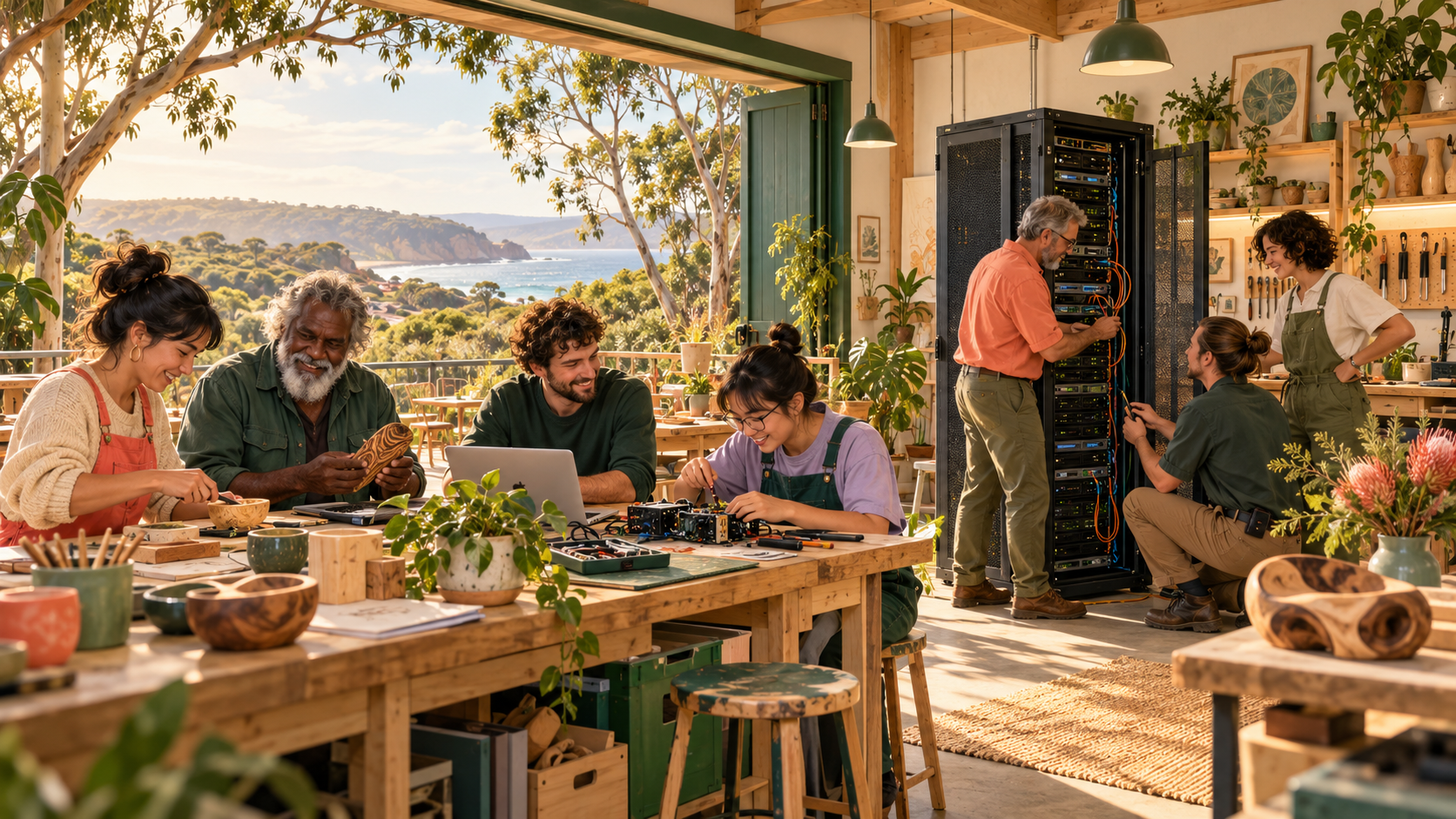
The proposed local intelligence infrastructure is therefore a learning institution as much as a machine. A school student encounters the hardware and sees that AI involves processors, memory, power, cooling and software chosen by people. A teacher builds a lesson around actual equipment. A developer learns to run a model. A local organisation works through how to keep sensitive information within its authority. A researcher needs a workload to run. The skills develop through useful purposes rather than through a distant promise that everyone will eventually become digital.14
Hayes's compute submission calls this the missing middle. Phones and personal computers are familiar at one end; hyperscale facilities dominate the other end of the public picture. Between them lie opportunities for serious computing operated through hospitals, libraries, universities, cooperatives and communities. The right scale follows the work. A small task stays close to a personal device; larger tasks draw on local, national or wider capacity.
There is an everyday democratic consequence. People who understand some of the system have more room to question a purchasing decision, change a tool or train the next person. Cultural knowledge has an operator answerable to its custodians. A local filmmaker has somewhere to render. A business shares technical help it could struggle to support alone. During a communications disruption, locally held maps, directories and selected information remain part of the community's resources.
The rack still needs a viable operating arrangement. Reliable power, cooling, security, software updates and skilled attention are continuing costs. The IEA's 2026 energy analysis describes the strain that rapid data-centre growth places on physical systems and local planning. Siting and electricity arrangements shape the consequences for a place. A distributed network deserves that same practical examination.41
Heat makes the physical relationships especially clear. Computing uses electricity and produces heat. Where a nearby activity needs useful heat at the right temperature and time, an installation might give that energy another job. Water heating, suitable agricultural processes or other local uses become design questions. Heat exchangers, pumps and pipework have costs, operators and maintenance. In Queensland, the relevant demand deserves local study rather than borrowing a cold-climate example unchanged.42
Whole systems thinking acquires a tangible scale here. The machine, the building, a nearby service and the people operating them begin affecting one another's economics. Measuring those relationships creates knowledge the next installation is able to use.
An hour that opens another door
A C-Hour begins with something ordinary: a person freely contributes an hour of useful human effort. The record recognises that contribution. Money continues to pay wages and bills. Outcomes describe what changed. One person's hour is counted once, even when the resulting benefits reach several projects. There is no monetary equivalent or conversion, and the recorded time creates no fixed claim on someone else's resources.13
The C-Hour plan describes participation as a choose-your-own-adventure. Someone helps prepare food, learns a preservation method and meets a person making a film. Later, they contribute editing from home. Another person follows the same beginning into garden sensors, a community event or an interest in hosting visitors. The contribution leaves knowledge, relationships and a reason to return.
That sequence is more interesting than a points balance. Communities choose their own recognition and reciprocal opportunities. A shared experience, an introduction, an invitation to learn or a public thank-you may mean different things to different people. Paid work develops alongside the voluntary activity where there is demand and a properly funded role. Care and reciprocity help hold relationships together while the ordinary economy continues its necessary work.
The software follows that experience. A conversation with an agent helps a person describe an activity, its date and duration, the people involved and who may see it. A proposed record passes through the agreed verification process. Corrections retain the person's explanation. The system earns its place by reducing the burden of participation. Someone with little time and a head full of other worries has reason to expect that much.
The first account of a community's wealth is often its finances. The additional records reveal activity that keeps the place functioning: care, repair, teaching, habitat work and support given before a formal service arrives. Recognising those contributions changes what an institution notices and what it is able to support. It also gives the next person more ways into useful work.
A city has purposes of its own
Council has a particular role among those relationships. Its responsibilities and decisions sit alongside those of state agencies, businesses, research institutions and community organisations. A mayor works through the existing council and administration. A proposal gains practical force through the people willing and authorised to carry its next part. The project network also has routes into useful work beyond the council's own budget.
That distinction matters in the election scenario. A city is neither a blank page nor an audience waiting for one person's system. It already contains knowledge, disputes, commitments and worthwhile activity. The architecture contributes through the relationships it helps those people develop and through the capability they retain.
A resident may enjoy the music, doubt the technology and still expect a clear answer about an ordinary council decision. Another may share the international ambition while preferring a different local priority. Anyone seeking public office joins people whose own purposes carry equal weight, including those with no interest in adopting an Aura.