Capability without domination
The United States has explicitly used global AI dominance as an objective of national policy. In 2025, official language also revived "Department of War" as a secondary title intended to signal a willingness to fight and win. Such words reveal an archetype: dominate, win, control, become indispensable and make others dependent first.
Countries have legitimate defence needs. Artificial intelligence also requires real safeguards. But if every powerful nation concludes that safety requires dominance, and every frontier company concludes that survival requires indispensability, humanity may become extraordinarily intelligent without becoming wise.
Australia offers another idea: a fair go. It does not promise identical outcomes. It means a genuine opportunity to participate, contribute, understand and benefit. Friendship does not require submission. Australia can value the United States, the United Kingdom and other partners while retaining the capacity to question them. We can work with China, India, Europe, the Pacific and others without turning every relationship into ideological conversion. A strong alliance should leave participants more capable, not quietly remove their alternatives.
This is why AUKUS Pillar II matters. It covers artificial intelligence, autonomy, quantum technologies, cyber, electronic warfare, hypersonics and undersea systems, with emphasis on near-term military advantage. My submission to the independent AUKUS Public Inquiry asked why technological advancement of that scale should be imagined primarily through military advantage. The same capabilities can serve civic, scientific, health, educational, creative and disaster-resilience purposes. Skills can be transferred rather than products merely delivered. Technicians can maintain systems. Researchers can gain meaningful access. Interfaces can remain open. Workloads can move between providers. Communities can retain authority over local information rather than becoming permanently dependent on one cloud, accelerator vendor, alliance or mission.
That is not anti-alliance. It is integration without ingestion.
The Pacific offers a complementary language of security. In 2026, Australia and Fiji signed the Ocean of Peace Alliance, also called the Veitacini Treaty, and the Fiji-Australia Vuvale Union. Together they connect mutual defence with sovereignty, peaceful settlement, the Pacific Way, health, education, economic development, people-to-people links and sport.
A submarine, hospital, language exchange, community research facility and trusted relationship between neighbours perform different security functions. Peace, health and understanding can be strategic infrastructure. Pacific partnerships can support locally chosen civic AI, health research, food resilience, community learning and shared science while every place keeps its own centre. Australia does not have to choose between defence and peace. It can invest in protection and in the conditions that make conflict less attractive.
A Protopian Gambit
During the global financial crisis and COVID, Australian governments mobilised interventions that had previously seemed impossible. The money had consequences, but political ideas of possibility changed when the danger became urgent.
The lesson is not to spend randomly or create projects that vanish with emergency funding. It is to prepare useful investments before the next shock: energy, food, housing, health, education, resilience, shared productive assets, local science and intelligence infrastructure people can actually use.
I call this a Protopian Gambit. Protopia means continual improvement instead of pretending to design a perfect final civilisation. A gambit is an opening move that changes what becomes possible next. Improve something real now, learn from it and leave more choices afterwards.
The missing middle of AI
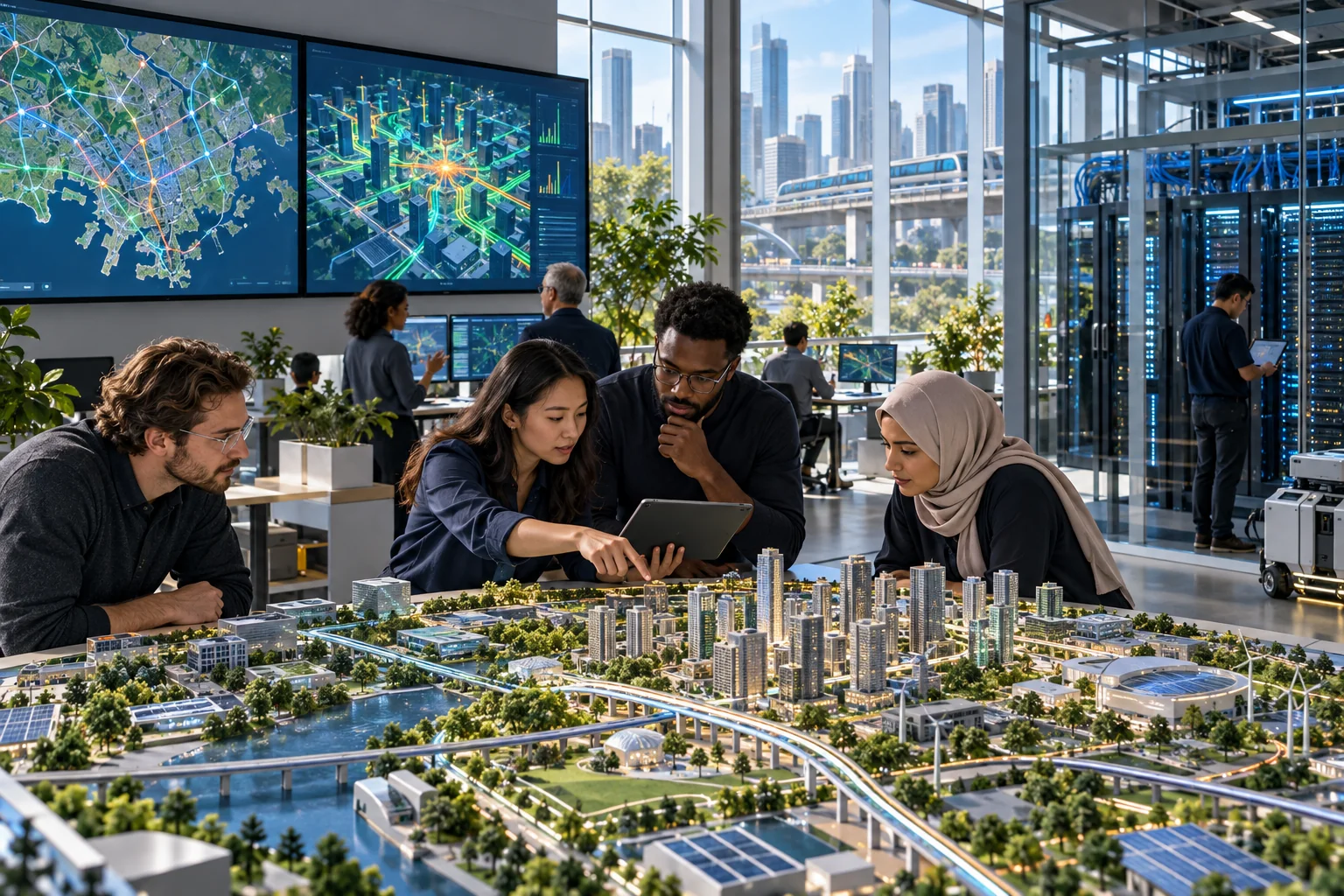
At one end of computing are phones, laptops, workstations and small servers. At the other are hyperscale data centres. Between them is too little serious computing under the control of towns, islands, libraries, universities, hospitals, cooperatives and communities.
Local AI nodes can fill that missing middle. A school can teach on real equipment. A hospital can run protected local models. Filmmakers can render. Small businesses can automate administration. Researchers can build digital twins of reefs, farms, transport and infrastructure. During cyclones, fires, cable failures, cyberattacks or communications outages, the same infrastructure can preserve maps, directories, resource information and coordination.
This is a continuum, not a miniature hyperscale centre in every suburb. Some work belongs on a personal device, some in a household or neighbourhood, some on a serious local rack, some on a national supercomputer, and some at hyperscale. The machine should follow the purpose. Global cloud services remain useful, but the architecture should preserve choice rather than assume that all intelligence flows upwards. That is sovereign intelligence: not isolation, but choice.
Use the heat twice
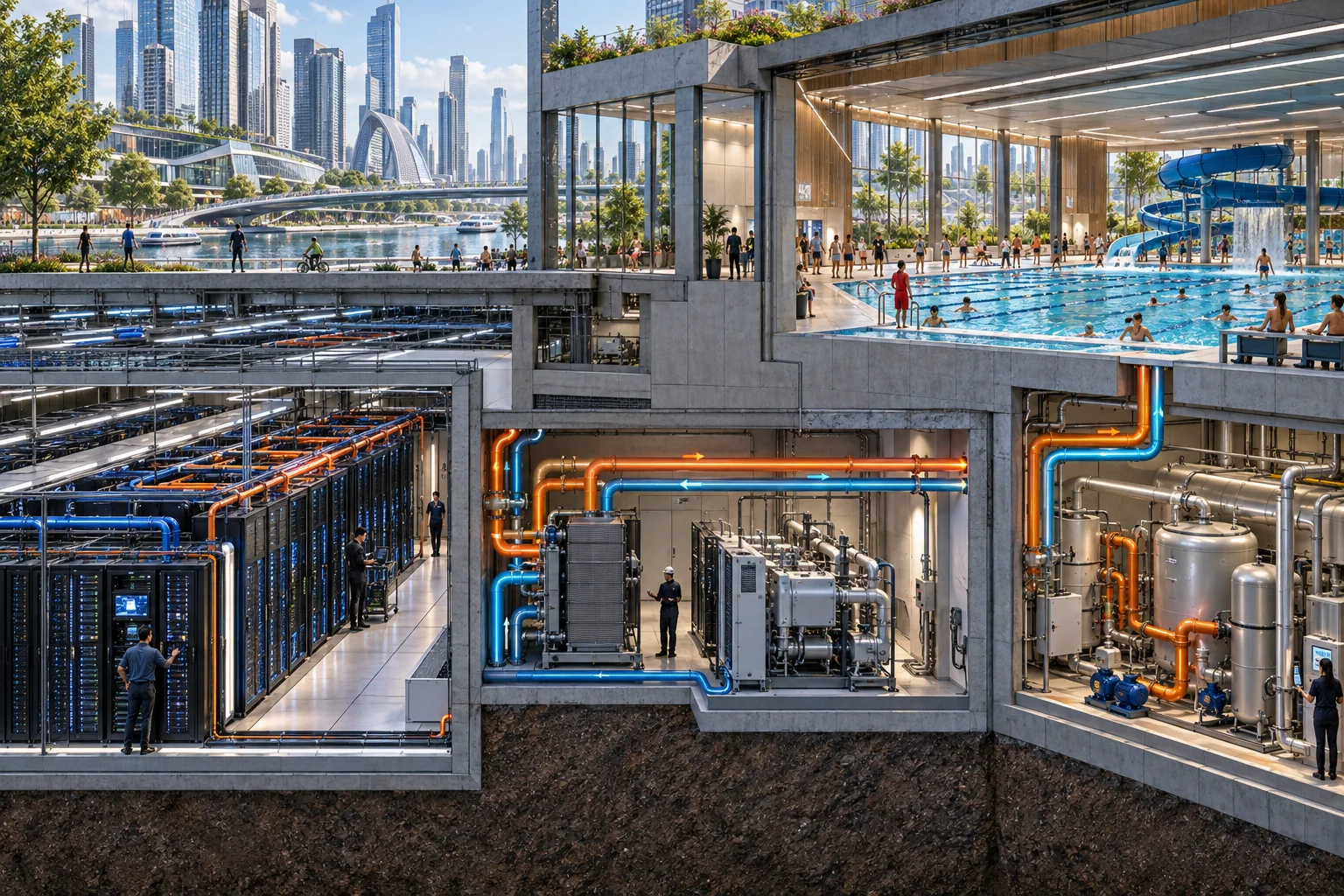
Nearly all electricity used by computers becomes heat. The International Energy Agency reports that much of it can be recovered with heat pumps, and data-centre heat already supports district heating in parts of Europe. Smaller computing facilities placed near communities should therefore be designed as thermal systems too.
They might heat water, buildings or swimming pools, support suitable agriculture, preheat industrial processes or store heat. A sauna would still require proper temperatures and engineering. Warm server water does not magically become one. The design question remains: why reject useful heat and then purchase more energy to create heat elsewhere?
Joyful Responsible Abundance uses energy for computation, then seeks another useful life for the heat.