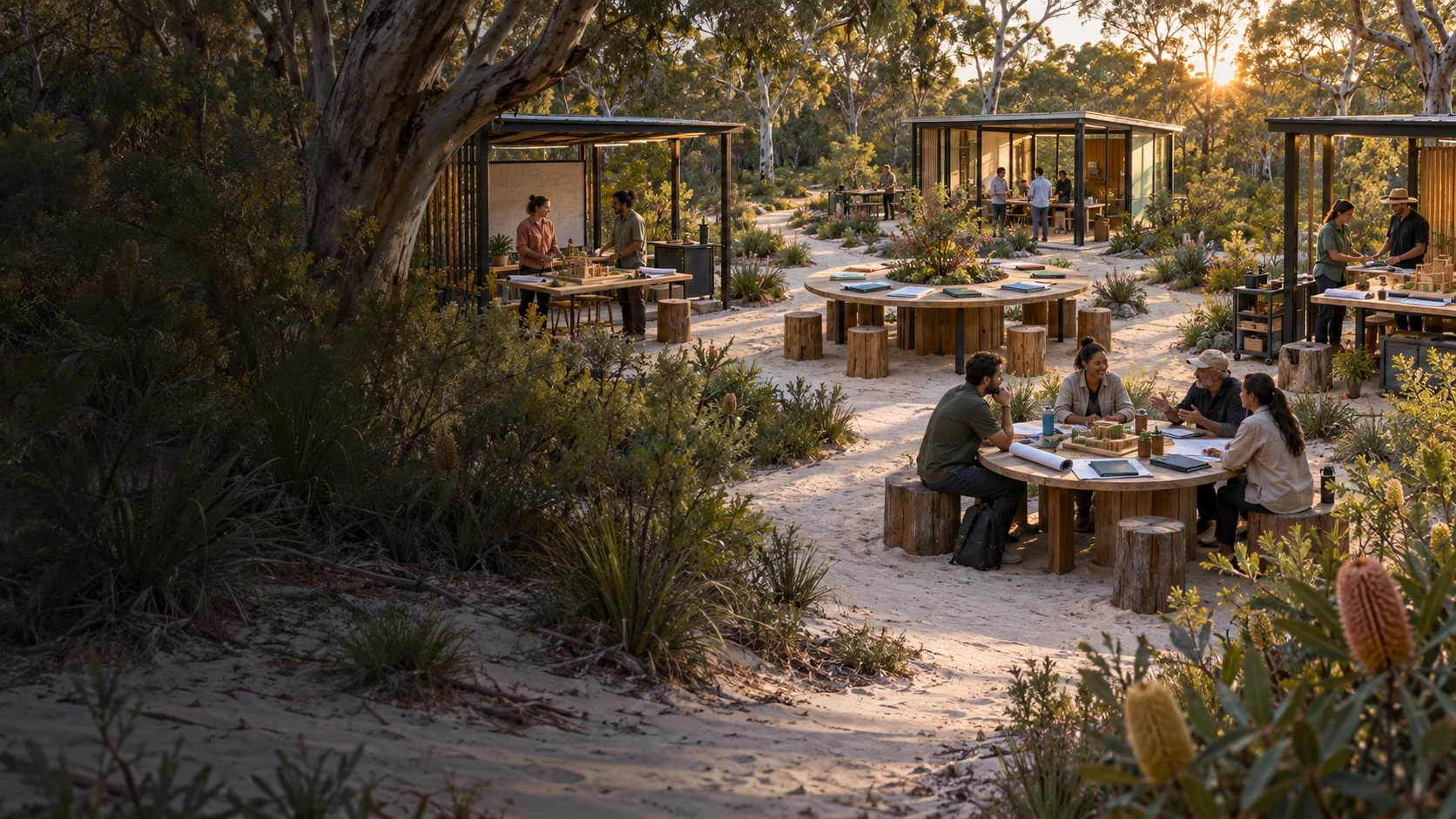
Generated concept of separate community planning tables connected by sandy paths in inland Minjerribah bush

A setup path for each site and service.

Not every piece belongs in the same company. This builder separates commercial work, public benefit, care, housing, research and shared services, then shows what each group still needs to decide.

Generated concept image

Choose the work before the legal shell.

A useful structure follows the people, purpose, money, risk and assets involved. This page records starting points for discussion. It does not register an organisation or make a decision for any family, group, site or service.

7 Mile needs two cleanly separated paths.

The trading proposal and any charitable work involve different money, duties and expectations. Neither path turns Country or cultural authority into an organisational asset.

7 Mile commercial company

Starting point to examine
A proprietary company limited by shares for suitable 7 Mile trading, investment, employment and contracts.
Working position
The 41 per cent, 39 per cent and 20 per cent split applies only to this proposed 7 Mile commercial vehicle unless its scope is later changed by agreement.
Before registration
Confirm shareholders, directors, share classes, contributions, payment for work, voting, deadlock, exit, disputes, intellectual property and what requires separate cultural or site agreement.
Outside the shares
Country, family rights, Noonuccal cultural authority, restricted knowledge and permission for cultural activity.

7 Mile public-benefit body

Starting point to examine
A separate not-for-profit body for eligible culture, education, residencies, training, community access, research or environmental work.
Structures worth comparing
An Aboriginal and Torres Strait Islander corporation, a company limited by guarantee or a Queensland incorporated association, depending on the final members, purpose and operating reach.
Before registration
Set the charitable purpose, beneficiaries, membership, board, conflicts, grant responsibilities, gift handling and agreements with the commercial operator.
Kept separate
Charitable funds do not become investor returns. Commercial losses do not pass quietly into grant or donation money.

Public activity may start lighter.

A new entity is useful only when it has real people, a clear job and enough activity to justify its records and duties.

9 Ballow Road public doorway

Starting point to examine
A written operating or auspicing agreement with a suitable body while the public programme, access arrangements and practical roles are tested.
Later entity option
A purpose-specific not-for-profit or cooperative if regular training, making, media, events, equipment and paid coordination develop.
Before forming it
Confirm the people responsible for access, programme decisions, safety, equipment, income, insurance, records and relationships with independent projects.
Boundary
9 Ballow Road is not the Sand and Screen site and does not represent every island project.

Sand and Screen programme

Starting point to examine
A portable member or community programme, either auspiced at first or formed as an incorporated association.
Alternative
A cooperative becomes more relevant if member work, shared equipment and paid activity become the central organising principle.
Before forming it
Confirm founding members, all-ages purpose, activity mix, child-safe responsibilities, event money, equipment ownership and the process for testing locations.
Boundary
The programme remains site neutral. 10 to 12 Ballow Road and the separate former sand-loading area are location leads, not selected premises.

Care, safety and housing need their own responsibility.

These services involve different people, privacy, skills and risks. A visitor or events company is not a substitute for a properly shaped service body.

Surf-side men's alcohol and drug free camp

Starting point to examine
A separate Indigenous-controlled public-benefit body, or a programme held by a suitable existing organisation under a clear agreement.
People needed before structure
The relevant cultural and site people, men's programme leadership, lived-experience voices, referral partners and qualified health or recovery services where their work is involved.
Core documents
Purpose, entry and exit, dry-camp expectations, privacy, safety, incident response, referrals, work roles and the boundary between a camp and clinical detoxification.

Safe place for women and children

Starting point to examine
A separate women-led not-for-profit body, or a protected programme within a trusted service organisation while the model is shaped.
People needed before structure
Relevant women determine governance, cultural safety, privacy, family support, referral relationships, location and design.
Core documents
Confidentiality, safe contact, child-safe practice, information access, referral and emergency pathways, staffing boundaries and protection from conflicts of interest.

Housing and supported living

Starting point to examine
A dedicated not-for-profit housing body or a formal partnership with an experienced housing provider.
Work to separate
Immediate shelter, supported transition, stable rental housing, ageing in place and property ownership each bring different money and duties.
Before forming it
Identify the first housing group, tenancy approach, support provider, property role, maintenance, privacy, income model and any registration or service standards that apply.
Boundary
Housing security should not depend on participation in a visitor, event or investment business.

Aged care, research and property are not one job.

Care delivery, clinical research, technology, private-pay services and land or buildings require separate agreements even when people want them to work together.

Aged care and Elders services

Starting point to examine
A purpose-specific not-for-profit body or service partnership that begins with everyday quality of life, cultural and community connection, ageing in place and the existing aged-care landscape.
Before forming it
Confirm the Elders and families involved, care scope, service partners, workforce, records, complaints, safeguards and who holds each regulated responsibility.
Boundary
A community planning body does not present itself as an approved aged-care provider.

Longevity and rejuvenation research

Starting point to examine
A separate research not-for-profit, research company or project agreement with qualified research and clinical partners.
Before forming it
Set the research question, participants, ethics route, clinical responsibility, data governance, funding, publication, intellectual property and separation from unproven commercial claims.
Current source position
The proposed journey is built around 60 two-hour sessions in a hyperbaric chamber. It remains planning material rather than a clinical protocol.

Aura Health Twin and specialist technology

Starting point to examine
A technology and research workstream with written licences or service agreements between the intellectual-property owner, research body, care partners and any commercial operator.
Current status
Aura Health Twin is an early local prototype. A Software as a Medical Device plan exists, but the clinical software and regulatory pathway are not fully developed.
Before forming it
Record ownership, permitted use, consent, privacy, cybersecurity, model review, clinical boundaries, research access and benefit sharing.

82 Claytons Road, Amity

Starting point to examine
Keep any future asset-steward role separate from the organisation operating services, research or facilities on the site.
Still open
Ownership research, access, any Anglican interest, any donation or transfer, the beneficiary group, site purpose and the most suitable steward all need confirmation.
Before forming anything
Prepare a site brief, interested-party map, proposed benefit lock, asset conditions, operating relationship, exit protection and independent advice.

Shared support sits beside the site organisations.

Shared services reduce repeated work. They do not take over the people, purposes or decisions of each participating site or programme.

Ready S.E.T. Co-op

Status
Ready Sustainable Employment and Training Cooperative is proposed and not registered.
Starting point to examine
A member-owned cooperative for employment, training, shared equipment, transport, administration and practical work between willing participants.
Before registration
Queensland guidance calls for rules, a disclosure statement where required, a formation meeting and normally at least five active members, unless the Office of Fair Trading approves fewer. The group still needs to decide member eligibility, voting, work allocation, surplus, exits and conflicts.

Strange But True

Status
Strange But True: Tech, art and ideas that'll help is the existing sole-trader business.
Practical role
Research, technology, websites, planning, communication and early technical work under clear scopes and payment terms.
Boundary
A supplier or mediator is not the cultural authority, site holder, charity board, member cooperative or controlling body for another project.

Community wealth and C-Hour

Starting point
Treat community wealth, mutual ownership and recognition of voluntary contribution as later design work, not the first company registration.
Questions first
What asset or value is being shared, who belongs, who benefits, how decisions are made, how value leaves, how volunteer time is recognised and what remains experimental?
Relationship to the network
A future shared vehicle would need agreements with each willing organisation. It would not automatically own their assets, programmes or decisions.

Five legal shells worth comparing.

The final choice belongs with the people forming the organisation and their independent legal, accounting and cultural advice.

Proprietary company

Shareholders own shares. Directors run a separate legal entity. Useful to examine for commercial trading and investment.

Company limited by guarantee

Members give a limited guarantee rather than holding shares. Common among nationally operating charities and larger not-for-profits.

Indigenous corporation

A CATSI Act structure built around Aboriginal and Torres Strait Islander ownership and control, with membership and director rules recorded in its rule book.

Incorporated association

A Queensland not-for-profit membership structure. Official guidance requires at least seven members, adopted rules and a management committee.

Cooperative

A member-owned structure organised around active participation, shared benefit and agreed cooperative rules. Queensland registration normally starts with at least five active members, unless the Office of Fair Trading approves fewer.

Write one page before registering.

If the group cannot agree on this short brief, a registration form will not settle the deeper questions.

1. Purpose

What practical job will this organisation do?

2. People

Who are the members, owners, directors or committee?

3. Boundary

What is clearly outside its role?

4. Money

What income enters, and what use or return is allowed?

5. Assets

Who owns equipment, intellectual property, buildings and records?

6. Decisions

What needs an ordinary vote, a special vote or another group's agreement?

7. Work

Who is paid, who volunteers and how conflicts are recorded?

8. Protection

What happens during deadlock, exit, incapacity, dispute or closure?

Then take the brief to the right advisers.

Use the same one-page brief with the people involved, an accountant, a lawyer and the relevant registration body. Compare the advice against the real activity before anyone lodges forms or moves assets.

Match the money pathways

Official setup references.

Rules, forms, fees and eligibility change. These links are the starting points for current requirements.

Australian companies

ASIC company registration covers names, addresses, company rules, shares, officeholders, consent and ongoing obligations.

↑