Gen XYZA
For youth, builders, artists, gamers, carers, coders, organisers and digital custodians.
Open civic prototype — receipts over rhetoric
Citizens of Oceania / Gen XYZA signal
You are the operators. P4A Oceania is a blue-purple civic operating system for self-sovereign people who want receipts, tools and quests: care recognised, compute local, culture alive, law memory open, disaster resilience trained, Brisbane 2032 mobilised and the space commons kept peaceful.
Act one / The call-up
This is not a mailing list. Each door opens a different operating layer: identity, care, compute, culture, law, public proof, regional solidarity and moonshot logistics.
For youth, builders, artists, gamers, carers, coders, organisers and digital custodians.
Minjerribah / Straddie is the seed, Australia is the first ripple, Oceania is the horizon, and every place keeps its own law, culture, names, protocol and source memory.
The Australian workbench this lab translates from: architecture, ledgers, law memory and the rabbit hole underneath — itself a ripple out from Minjerribah / Straddie.
Act two / The region
Fifty-plus places across four source frames, an atlas that keeps its receipts visible, and the currents every shore shares — rising seas, cables, cyclones, tuna, languages and the sky.
A Wikimedia political map with layered hover regions, atlas cards for every polity and shelf, and a source ledger that says exactly what was checked and when. A research field, not a command map.
Nine pressures that do not stop at EEZ lines, each held as a translation question against the lab's tools — plus the regional bodies that already coordinate the Blue Pacific.
Live clocks since every polity last voted, due windows held loosely, and the system lines that make each democracy different — no two run the same machine.
Australasia, Melanesia, Micronesia and Polynesia are navigation shelves, not consent layers. The atlas keeps every frame provisional and every caveat close.
Act three / The tools
The operating layers a self-sovereign civic region would actually need, each built to work when the link drops and to prove itself with public records rather than promises.
Community-Hours are proof-of-contribution receipts for care, repair, mentoring, food rescue, ecology and disaster readiness.
Personal tanks, neighbourhood dams, library reservoirs and planetary commons: own the stack from phone to sensorium.
Receipts, open ledgers, source trails, consent, legal memory, promoter clarity and public correction paths are the power system.
Act four / The surge
Youth architects, civic reserve, health co-ops, sovereign kiosks, sand-to-stars infrastructure and peaceful space — the moonshot shelf, fed by the archive engine underneath it.
Brisbane 2032 as the deadline that makes the rest legible: what the region could rehearse, build and prove before the world arrives.
The source packet becomes a map of build lanes: compute, C-Hours, health co-ops, food waste, summit diplomacy and space commons.
From P4A to P4O
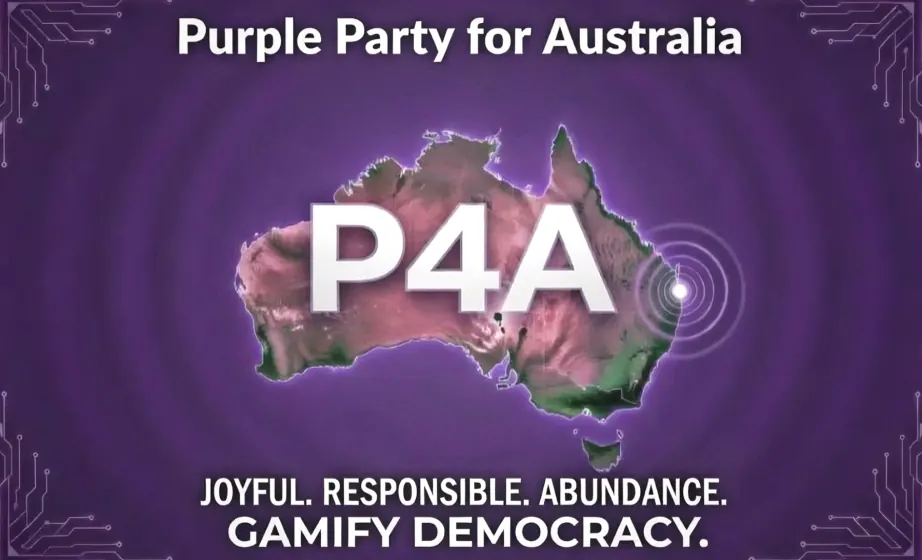
The P4A scaffold becomes stronger when it speaks like a civic toolkit. Oceania is a field of self-sovereign citizens who can build, audit, care, teach, defend the commons and refuse bad instructions.
Authority is earned locally. Imagination can move first, bring receipts, invite correction and leave enough structure for the next crew to improve the map.