
A shared asset
The agreement records who owns it, whose contribution is recognised and what happens to a member's interest when they leave.
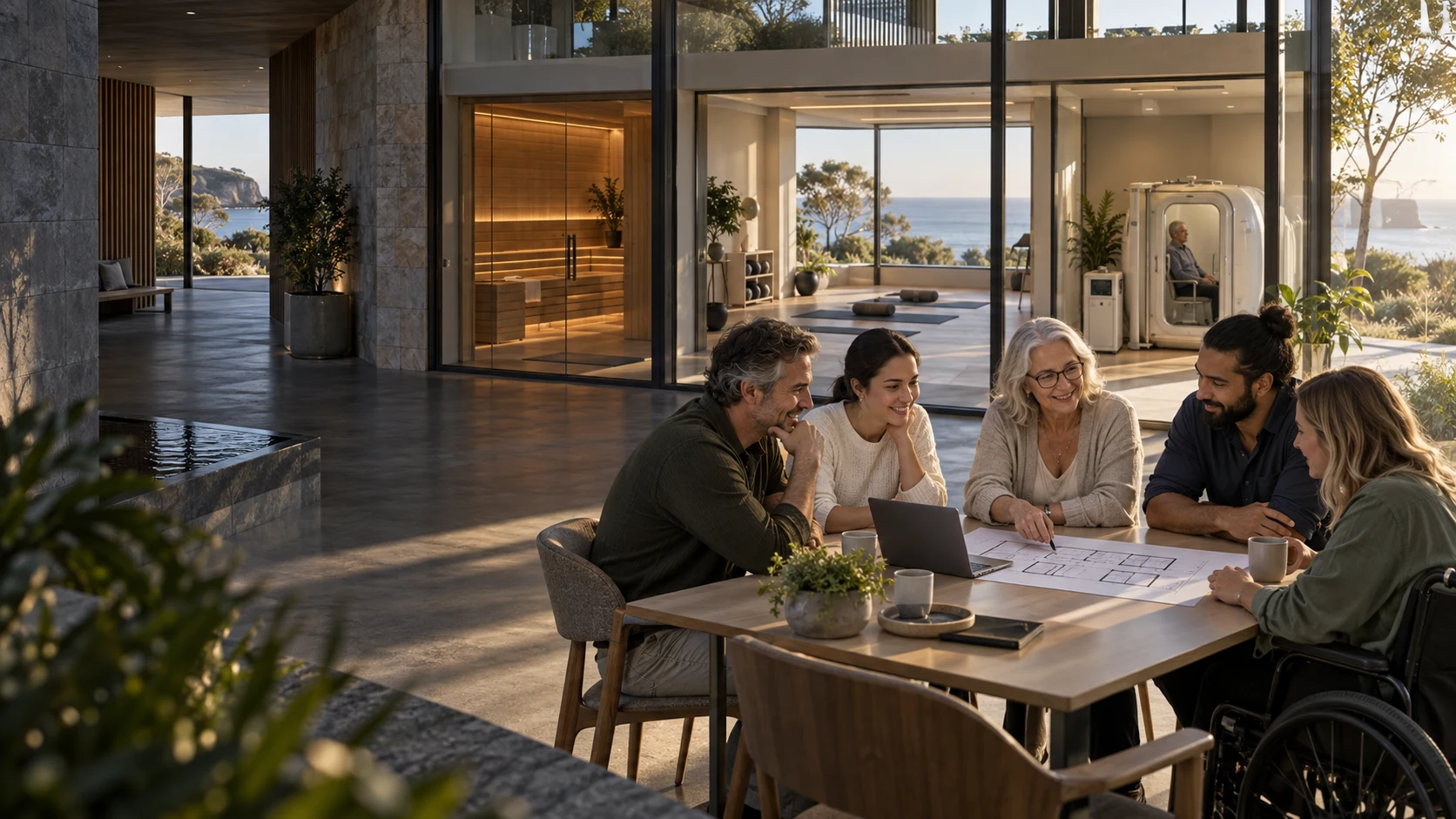
A co-operative offers one way for people to share expensive infrastructure while keeping purpose, membership, ownership and local relationships visible.
Imagined concept artwork
The regional idea invites locally shaped relationships. One group may share a sauna. Another may begin with local computing, food, rest or a supervised clinical relationship. Each group could write terms that fit its people and place.
Queensland is the first legal starting context in this source set. Other Oceania jurisdictions bring their own co-operative, health, privacy, cultural and financial settings.
Queensland recognises distributing and non-distributing co-operatives. The usual starting point is at least five active members, with a lower number subject to approval.
This regional project offers ideas and source material. Any future local co-operative would form through the people, rules and relationships of its own place.
Established information Queensland co-operatives informationEach topic opens a different local conversation. Together they offer guideposts rather than a ready-made rulebook.
A shared purpose may begin with wellbeing access, local digital infrastructure, food, resilience, research or a mixture shaped by the members.
Which shared benefit feels most alive in this place?
A funding source is also a relationship. Local terms give ownership, access, reporting and departure their own visible place.
The agreement records who owns it, whose contribution is recognised and what happens to a member's interest when they leave.
The agreement records which public benefit, access, evaluation or open learning travels with the support.
The agreement records how staffing, energy, maintenance, insurance, care relationships and member access sit together.
The full funding braid and editable arithmetic live in Public Value.
Membership, access, money, care, data, cultural relationships and exit arrangements receive their own space. Differences between communities make the regional family richer.