Who it looks after
People and trust
Nothing scales without hands, and nothing lasts without fair ownership. This is where the ladder gets its people: the trust that lets neighbours build together, and the ownership structures that make sure what they build stays theirs, for generations. The money side of that, the locked fund and the C-hour, has its own page: patient capital. And the work underneath it all, the caring, has its own page too: care is the first infrastructure.
Why this comes first
Trust comes before assets.
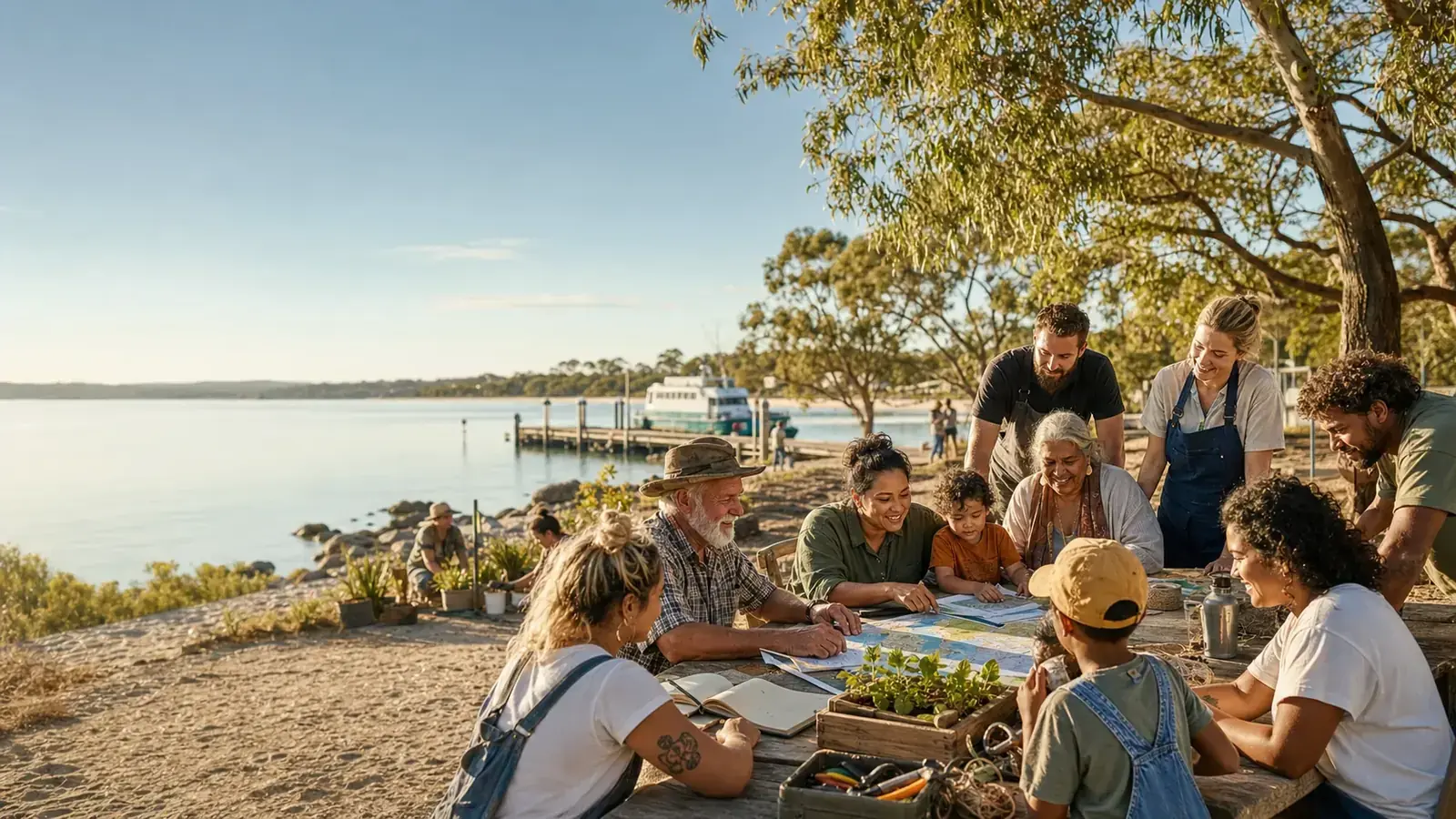
The Ready S.E.T. co-op trust hub (S.E.T. stands for Straddie, or Sustainable, Employment and Training), still a plan on paper, lays out the working ladder: start where trust already exists, turn repeatable support work into systems, training and paid roles, and only then talk about shared assets. That ordering isn't caution, it's engineering: everything built on top of it (the bench, the tunnels, the energy systems) is only as strong as the people and agreements underneath it.
The receipts
Fair ownership isn't a dream. It's documented.
Three Australian agreements set the standard this ladder holds itself to. They are not proposals or wishes: they are signed, operating structures, and they prove that Traditional Owner equity, community lock-box funds and aquifer-safe industry already exist in this country.
| Agreement | What was won | Why it matters here |
|---|---|---|
| Western Green Energy Hub × Mirning people (WA) | 10% free carried equity (non-dilutable, no debt attached), a permanent board seat, an activity-level veto grounded in free prior informed consent, a 15 km cultural exclusion zone, and a 50-year pathway to majority ownership. | Proof that Traditional Owners can hold equity and control, not just royalties. This is the shape any real project on Quandamooka Country should expect to meet. |
| Noongar Boodja Trust (WA) | A ~$1.3 billion settlement split into a spendable operations fund and a future fund locked for 12 years to compound, with a planned handover from professional trustee to community control. | The working blueprint for a community wealth lock-box: money that compounds for grandchildren instead of leaking out in a decade. |
| Sundrop Farms (Port Augusta, SA) | Twenty hectares of greenhouse tomatoes grown on sunlight and desalinated seawater: 23,000 heliostats, a 115 m solar tower, a 5 km seawater pipeline, and roughly 15% of Australia's truss tomatoes. | The concrete answer to "how do you grow food and industry without touching the island's aquifer": manufacture water from the sea and the sun. |
The measuring stick
Hold every deal up to the light.
Once you know what the best agreements look like, you can measure the existing ones against them. Start with the water: roughly twenty megalitres leave this island's aquifer for the mainland every day, more than ten times what the island community uses, under long-term bulk arrangements. Would that deal pass the Mirning test: equity, a board seat, a veto, and value flowing back to Country? The numbers are on the walls page, with receipts.
That's what this is for. Not grievance: standards. The same measuring stick applies to every future deal the ladder might ever touch, including its own.
First small steps here
- Walk the trust ladder at the Ready S.E.T. hub: it starts with support work that already happens.
- Read the WGEH and Noongar structures until they're familiar enough to explain at a barbecue. That literacy is the foundation.
- When any project comes to the island with a deal, ask the three questions: equity or royalties? Who sits on the board? Who can say no?