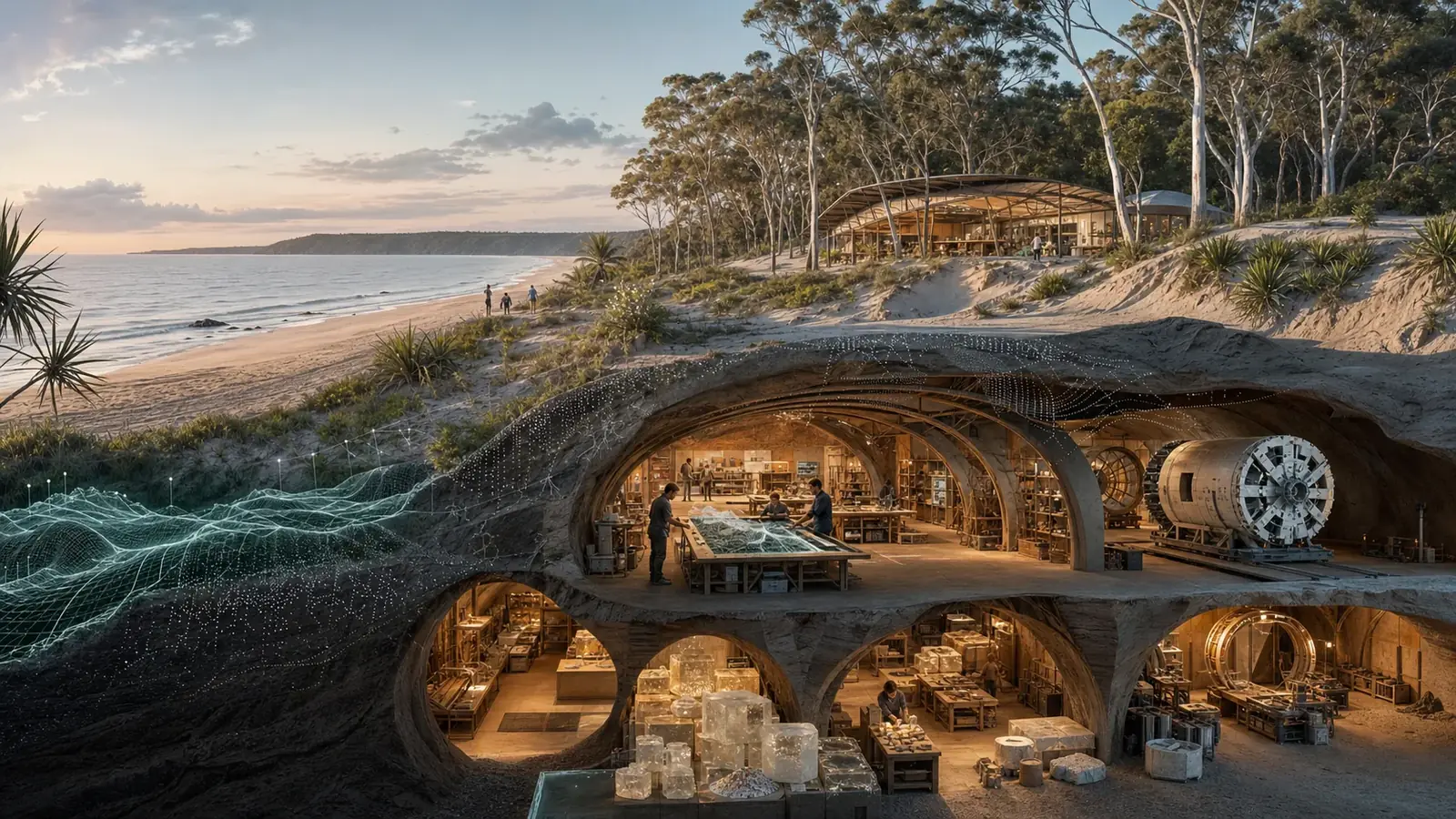
Building under the dunes
Tunnels
Boring through soaked sand is solved engineering: machines do it under rivers and harbours every week. Making rooms down there, in a wet island's soaked ground, is the frontier nobody has crossed. These pages hold both truths at once, and you can count the sand a tunnel gives as you go.
The toolkit
Wet sand has been conquered before.
Every method below is standard practice somewhere in the world right now. None of them is science fiction, and none of them needs the Boring Company: Elon's tunnels are a measuring stick, not a template. Our ground is different, our scale is smaller, and the industry that matters most here is Australia's own.
| Method | What it does | Working precedent |
|---|---|---|
| Slurry-shield TBM | Balances pressurised bentonite slurry against the aquifer so the sand face can't collapse while the machine advances. | Standard worldwide for boring below the water table, under rivers and harbours. |
| Microtunnelling | Unmanned, remote-operated bores of one to three metres, jacked through wet sand for sewers and cables. Small, insurable, permittable. | Routine civil practice across Australia. This is the ladder's honest entry size. |
| Ground freezing | Freezes saturated sand into temporary solid ground using brine or liquid nitrogen, for shafts and connections. | Standard for cross-passages and shafts in soft wet ground worldwide. |
| Dewatering and jet grouting | Lowers local groundwater or injects stabilising columns so ground holds while work happens. | Everyday geotechnical practice, tightly licensed near sensitive aquifers. |
| Remote operations | Drive the machines from a control room. Rio Tinto runs autonomous trains and truck fleets from Perth, 1,500 km away. | Australia's autonomous mining sector leads the world at exactly this. |
The frontier line
Rooms in rock exist. Rooms in wet sand don't. Yet.
Underground urbanism is already real: SubTropolis in Kansas City is a limestone mine deliberately mined as real estate, now a vast business park. Coober Pedy has Australians living comfortably underground in a mining town. Helsinki has a formal underground master plan; Singapore stores strategic reserves in rock caverns. All of that is documented, visitable, KNOWN.
The frontier is one precise sentence: nobody has made habitable rooms in unconsolidated, water-saturated island sand. That is the genuine research question here, and the boldest idea on the whole ladder lives here: lateral wall mining, where the machine widens its bore, sorts the excavated sand into minerals and building feedstock, and lines the void it leaves as usable space. Excavation as part refinery, part architecture, told plainly on turning the dig into rooms. Where it could lead, far off, is a city under the dunes, held as a thought experiment. This one isn't built yet.
The first real build
The aquifer twin comes before everything.
The island's freshwater lens is non-negotiable, and it's already carrying a heavy draw for the mainland (the numbers are on the walls page). So the flagship here isn't a machine, it's a model: an open groundwater twin of the lens built in MODFLOW, the free, open-source standard tool, fed by the island's published hydrology. Even a fully approved, fully funded dig would have to start exactly there, which means students can start there today, and the community ends up owning the model that any future decision depends on.
The entry concept for hardware stays small on purpose: a two-metre logistics bore, narrow-gauge, unmanned, the size civil contractors already insure. Speed numbers stay honest too: quoted advance rates vary tenfold from one estimate to the next, so speed here is something to aim at, not a promise.
And the Sandworm itself, the great worm swimming through the dunes, printing its own glass tunnel behind it? That's the fiction, and it stays gloriously in the Screen lane: the film the frontier deserves while the models catch up. Back the fiction or the documentary.