Keeping the lights on
Energy
Ambition and arithmetic climb together here. The question isn't whether the island could power itself, the numbers say it comfortably could. The question is which technologies are ready now, which are research, and how honestly we can tell the difference.
The island budget
What we use. What's on offer.
These are our working estimates, labelled as such until checked against real network data: that check is itself a first task on this page. Even with generous margins for error, the gap between demand and potential is the story.
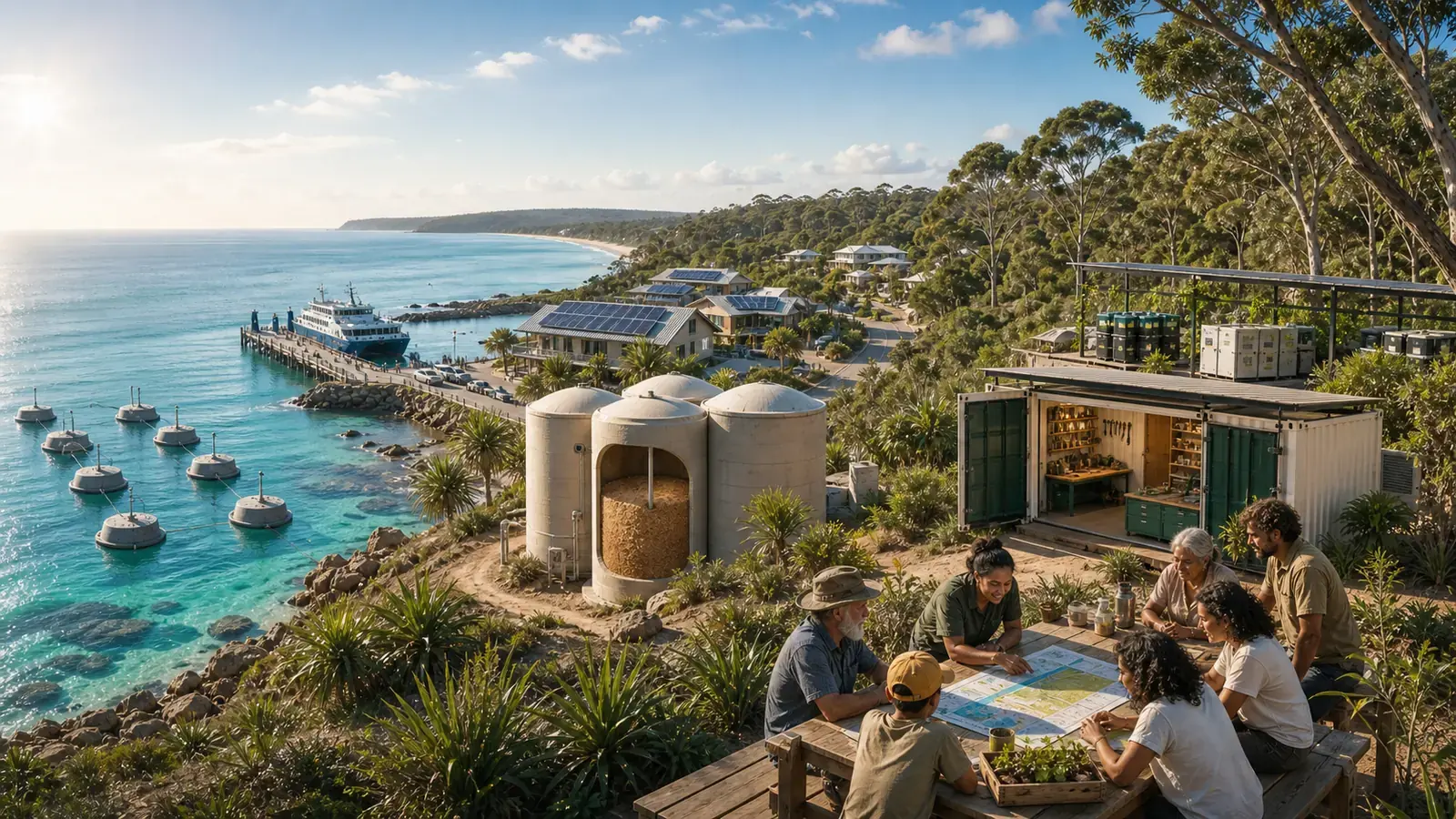
Rooftops alone cover roughly two-thirds of today's demand. Five hundred metres of wave frontage could carry six times demand on its own. Several times current demand is plausibly on offer before a single new square metre of bush is touched, and that is the rule this page is built on: no new surface disturbance, ever. Energy hides everywhere: on roofs, over carparks, in structures, in the swell, the tide and the outgoing rip, and the aim is to find every hiding place. The surplus is what makes everything else thinkable: desalination instead of aquifer draw, process heat for materials work, and hardened backup that keeps the lights on when the mainland goes dark. Space-weather resilience isn't a bonus feature here; it's the point.
The readiness board
Every option, labelled.
Every option, with real precedents attached. Readiness and indicative costs are industry ranges; the point of the board is the ranking, not the decimals.
| Technology | Readiness | Working precedent | Honest note |
|---|---|---|---|
| Rooftop and structure solar | Proven, cheapest | Everywhere in Queensland (~$40-60/MWh) | Start here. Roofs, carports and sheds only, never cleared land. |
| Sand thermal battery | Commercial pilot | Polar Night Energy, Finland: heating a town from a silo of hot sand since 2022 | Brilliant for heat; heat-back-to-electricity round trip is poor (~25-30%). Sell it as stored heat. |
| Wave: enclosed OWC | Demonstrated | Mutriku breakwater, Spain: 16 turbines in a working harbour wall | No external moving parts near wildlife; costs still above solar. |
| Bladeless tidal (VIVACE-style) | Research | University of Michigan vortex-induced-vibration converter, works at 2 knots | Fits the "no spinning blades near dugongs" rule; not yet commercial. |
| Flow batteries | Commercial | Vanadium redox installations scaling in Australia | The grid-storage workhorse candidate alongside the sand silo. |
| Pumped hydro | Proven, huge scale | Snowy 2.0, Wivenhoe, and Kidston (built in an old gold mine) | The world's biggest store; sealed turbines, not open water. Sand-island variants on the storage page. |
| Concentrated solar heat | Demonstrated | Kogan Creek Solar Boost (QLD); Sundrop Farms' 115 m tower (SA) | The desalination-and-greenhouse combination is the interesting one (see People). |
| Thorium reactor | A future fuel, blocked today | China's thorium reactor made its own fuel in 2025; India is building on it; Australia's ban stands but is moving (see Walls) | Modelled in the open now, built only when the law and the community both say yes. |
The options fan out from here. Solar on what's already standing covers roofs, carparks, tanks, fences and roads, zero hectares cleared. Ocean energy, wildlife-safe holds ten gentle machines from breathing chambers to piezoelectric kelp. Bladeless wind catches the breeze with nothing that can strike a bird. Storing power for the dark and the calm banks it honestly, from water uphill to hot sand to spinning steel, round-trip losses shown, not hidden. The breath of the city covers cooling and heating underground, where the air conditioner and the water heater become one machine. And because not every machine has been invented yet, the drawing board is where school kids sketch the next one and get quick honest numbers back. This is not energy maximisation for profit; it is a responsible harvest, everywhere, gradually, for generations.
The deeper dives also live on the chapter site: the reef and spoil calculator (which already talks live to the Sandworm data), storage, marine energy without blades, and the rest of the workbench.