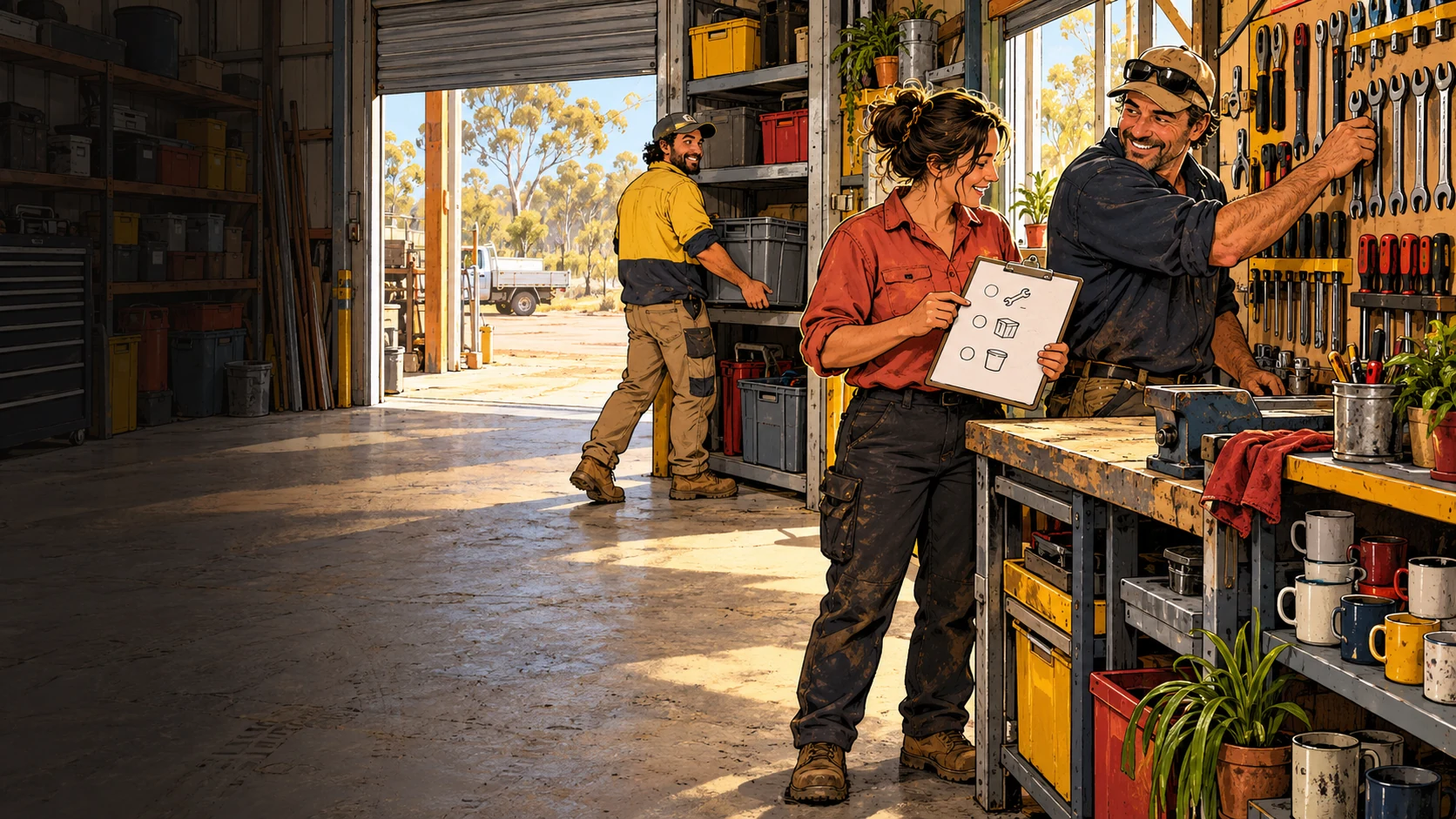
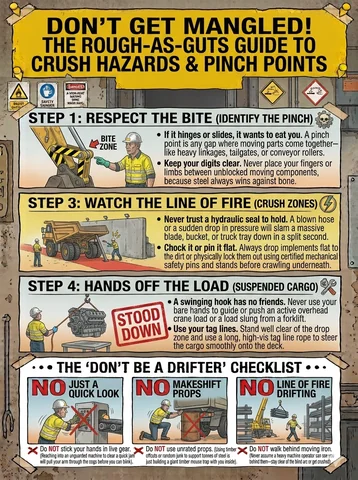
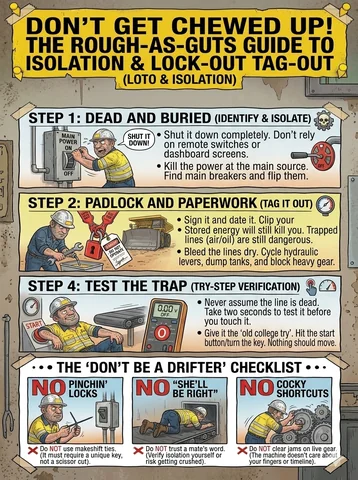
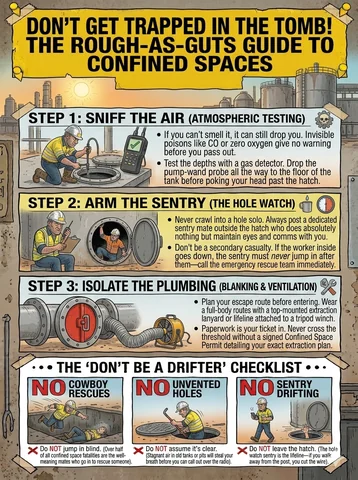
The purpose of a Rough as Guts work poster is a safer, healthier shift. A familiar shortcut can open the joke, but the picture needs to show a useful response and a crew willing to support it. Getting home well is the payoff. People need sound work systems as well as reminders.
A laugh with somewhere to go
Draft ideas to try with readers. Each shows a familiar habit, a different response and something worthwhile on the other side.
01
Temporary Storage Has Moved In
The walkway contains a crate described as “just for a minute”. It appears to be receiving mail.
The crate has a home now. It is not the walkway.
A way forward
Keep designated routes clear and report storage problems through the site’s process. Agree a suitable place for items rather than moving the obstruction onto somebody else’s route.
What it makes room for
People can move through the workplace and find equipment without inheriting the same problem.
Picture idea: The crew agree suitable storage, move the obstruction through the site’s safe arrangements and leave the designated route clear. A supervisor addresses the storage shortage.
Poster concept for task and site review
02
The Tool You Needed Was a Question
A new starter nearly nods along to instructions they have not understood.
“Which bit?” turns out to be an excellent piece of equipment.
A way forward
When a task or control is unclear, pause and ask the appropriate person. Check the actual instructions and arrange the support needed before proceeding.
What it makes room for
Asking becomes a sign of care and competence, with fewer assumptions passed to the next person.
Picture idea: Work is paused. The worker asks, a colleague explains using the actual instructions, and the supervisor confirms the needed training and arrangements before work resumes.
Poster concept for task and site review
03
The Replay Can Wait
The off-duty camp television is commentating directly through somebody’s day sleep.
The match has a replay. Your mate has another shift.
A way forward
Follow the camp’s agreed quiet arrangements and talk through repeat noise problems using its support channels.
What it makes room for
People have a better chance to recover and still enjoy their time together.
Picture idea: A person notices the sleeping-crew reminder, lowers the off-duty lounge volume and moves the conversation to the agreed area. Later both crews enjoy the replay together.
Camp communication draft to try with residents
Show the action that protects people
A worker balancing on the wrong thing may get attention. A useful poster also makes the appropriate alternative clear for that actual job. Use the site’s equipment, controls and reviewed procedure, and show who can help when something is uncertain.
Give the intended action more visual weight than the unsafe example.
Keep the hazard, the control and the caption consistent.
Use the actual task team and competent reviewer to check the scene.
A way forward
Ask a crew member to explain the action shown without prompting. Have the responsible task team check it against the job before it is displayed.
What it makes room for
A message people can use in the real setting, rather than a memorable picture of the wrong method.
Make speaking up part of belonging
A cartoon should never make the person asking a safety question the fool. The experienced hand can model listening and checking. Supervisors and managers have a part in the ending too: respond, provide what is needed and report back.
Name the site’s reporting route.
Include workers and their health and safety representatives in developing the message.
Treat a concern as information to act on, not disloyalty.
A way forward
Show someone raising a concern, the right person listening and the resulting change. Leave room for workers to identify what still does not fit.
What it makes room for
Problems can be discussed and addressed before confidence, silence or pressure is mistaken for safety.
A slogan about being careful cannot supply missing training, fix equipment or make an impossible workload reasonable. The story can show people changing the conditions of the job as well as their own decisions.
Identify the real hazard and how it is controlled.
Ask what equipment, staffing, maintenance or work design needs attention.
Show management following through as well as workers participating.
A way forward
Use the poster discussion to identify a real control or support that is missing, assign responsibility through the site’s process and check that the response happened.
What it makes room for
Responsibility is shared by the people able to change the conditions of the work.
After a shift, rest, food and shared space still matter. The joke can follow the person who turns the television down, cleans their dishes or makes room for someone coming off nights. Nobody needs a boot through the wall to be heard.
Agree quiet arrangements around sleeping crews.
Leave shared kitchens and amenities ready for others.
Raise repeated problems through the camp’s support channels.
A way forward
Discuss the actual shared-space problem and agree who will do what. Make the considerate option easy to use, such as a clear quiet area or an accessible cleaning kit.
What it makes room for
More rest, less conflict and a camp that feels livable.
An illustration can support the actual SWMS
Safe Work Method Statements concern high risk construction work. Illustrated support must match the relevant task, hazards, controls and current document. The proposed service is to help communicate that work clearly, using a review with the responsible people.
Use the current task document and the actual work conditions.
Resolve visual ambiguity before approving the illustration.
Keep the responsible reviewer, version and source identifiable.
A way forward
Put the drawing beside the task document and walk through it with the people responsible for that work. Correct any missing, invented or misleading detail.
What it makes room for
Humour supports a reliable work method and does not become a substitute for one.
From draft to a poster on a real site
A page becomes useful through factual review, crew input and follow-through. Show it at the size and location intended, ask what action it communicates, and revise what is unclear. After use, ask whether the action is practical and what conditions still get in the way.
A laugh is one response to observe, not proof of improved safety.
Check whether the better action is understood and supported.
Keep feedback about the work conditions with the content revision.
SWMS, in plain English
SWMS stands for Safe Work Method Statement. Safe Work Australia describes its role in high-risk construction work: identifying the activities, hazards and risk controls. Humorous illustration can support clear communication, while the actual task and site details belong in the reviewed document.
These examples attempt to connect a familiar shortcut with a corrective action and a reason to care. They also contain technical gaps. They are source material for revision, rather than finished posters to put on a site.