Energy everywhere · the ocean

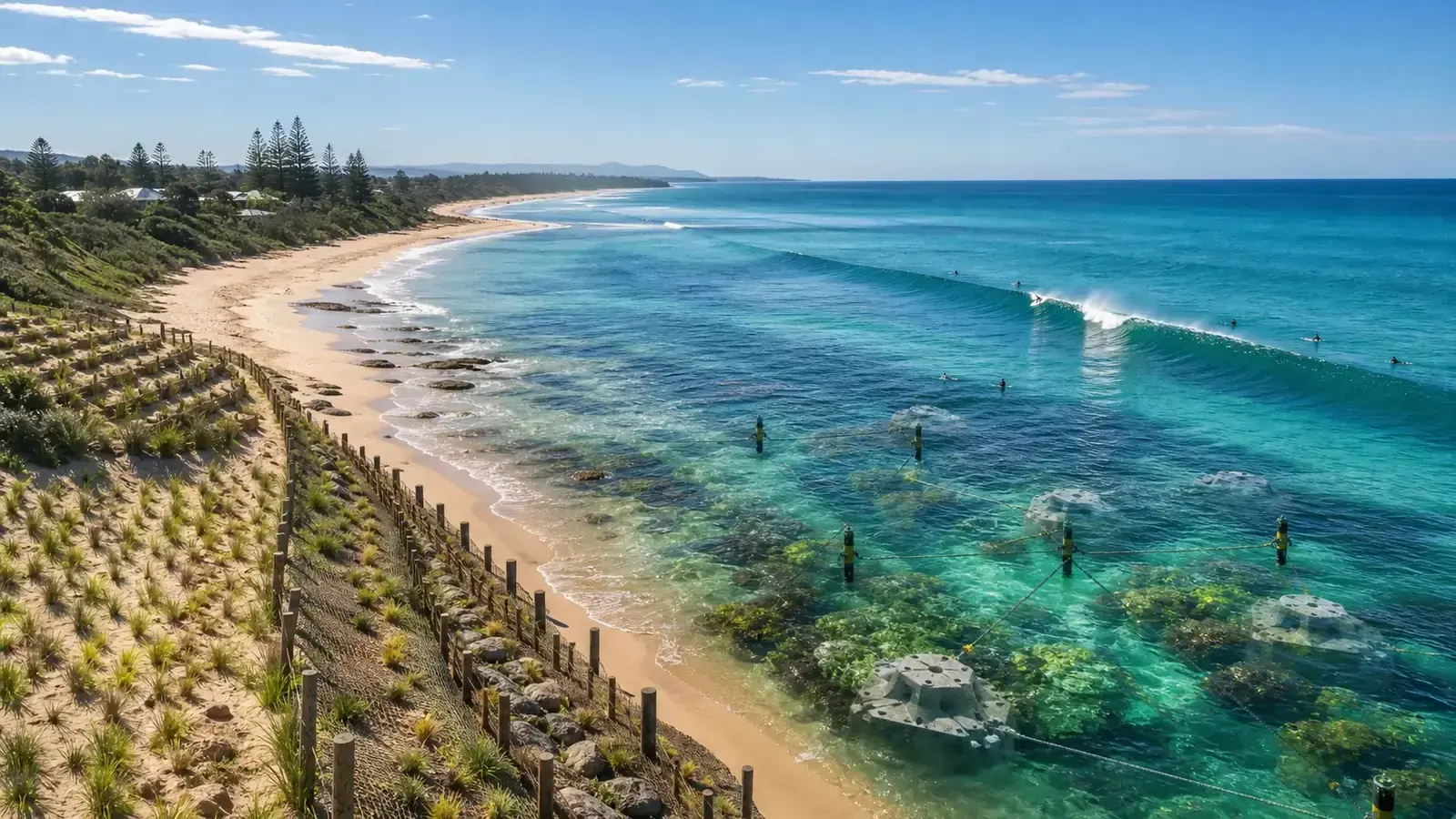
Power from the sea, safe for everything in it

The rule here is firm, and it comes first: no spinning blade, no snapping jaw, no moving part that could injure a whale, a turtle, a dugong or a kid on a bodyboard. Inside that rule sits a whole family of machines, some proven, some being invented, all of them harvesting gently and gradually. Not energy maximisation for profit: a responsible harvest, built to last generations.

The mind's eye first

How much is actually out there?

Known

Measured wave power off this coast averages roughly 10 to 20 kilowatts arriving at every metre of swell front, day and night. In plain terms: catch even a fifth of what lands on one metre of surf and you're running four or five households around the clock, from one metre. A footy field's width of gentle harvesters starts to matter fast, and none of it clears a single square metre of land.

The catalogue

Ten ways to catch the sea gently.

Plain names, plain words, honest labels. Each machine goes by what it does, because the mechanism is the point.

Breathing chambers

oscillating water column

A concrete chamber in a breakwater with an open mouth below the waterline. Waves push the water level up and down; the chamber breathes air through a duct up top, and that moving air spins a generator. The only spinning part sits in an air duct above the water, where nothing living can ever reach it.

  • Working precedent Mutriku, Spain: sixteen units in a harbour wall since 2011
    KnownThe proven, insurable end of wave energy. Costs still above solar; pairs naturally with reef and breakwater builds.

Wave-following panel arrays

many small pushes, summed

Rows of hand-sized hinged panels lining the edges of an artificial reef. Each breaking wave nudges panel after panel as it peels along; a mechanical summing shaft collects thousands of small pushes into one strong, steady stroke at the end of the line. Nothing bites, nothing spins; the panels just rock.

  • Status a design concept on paper, awaiting its first tank test
    SpeculativeThe maths of distributed absorbers is real engineering; the integration is this project's own invention to prove, starting at bathtub scale on the bench.

Spring-and-ratchet accumulators

calm-day harvesting

Small waves aren't worth generating from one at a time, so don't. A ratchet quietly winds energy from many weak wave cycles into a strong spring, then releases it in one quick burst that drives the generator at its sweet spot. (Nature got there first: it's how a mantis shrimp cocks its famous punch.)

  • Status real components, unproven combination
    SpeculativeSprings, ratchets and burst generators all exist; tuning them to a lazy sea state is the research question. A perfect maker-space bench project.

Stretch generators

electroactive polymers

Sheets of smart rubber that make electricity when waves stretch and relax them, like a muscle working in reverse. No gearbox, no hydraulic oil, no rotating anything: the material itself is the generator.

  • Status a real research field (look it up as "dielectric elastomers")
    ModelledReal devices already work in laboratory wave tanks; surviving years at sea is the open question. Soft, silent, and safe for animals by its very nature.

Adaptive stiffness control

gather · direct drive · storm-lock

The same hardware behaves three ways. Calm days: gather mode, feeding the spring accumulators. Good surf: direct drive, one wave one pulse. Cyclone: storm-lock, where panels freeze rigid and the surge's brute force pumps hydraulic accumulators instead, turning the storm from the thing that wrecks the machine into the thing that charges it.

  • Status control concept; nearest kin is CETO surviving storms by submerging
    SpeculativeSurvivability is where most wave machines have died. Designing for the storm instead of against it is the whole idea.

Engineered return channel

a rip you can rely on

Chevron-shaped reefs don't just break waves; they funnel the backwash into one deep channel, creating a steady, predictable outgoing current where a natural rip is chaotic and wandering. That flow runs between wave sets, a quiet baseload the ocean provides for free once the reef exists.

  • Status real coastal fluid dynamics, engineered on purpose
    SpeculativeRips and reef channels are well understood; building one deliberately as an energy artery (and keeping swimmers clearly warned away) needs modelling first, in the twin.

Piezoelectric kelp stalks

a flexible seabed carpet

Flexible stalks lining the return channel's floor and walls, swaying in the flow like kelp and generating a trickle of power every time they bend. No blades, self-cleaning by their own motion, and to a passing turtle they're just weird seaweed.

  • Status piezoelectric harvesting is real at small scales
    ModelledWatts per stalk, not megawatts: its jobs are trickle-charging sensors and proving the principle. Lead-free piezo materials are the materials-bench tie-in.

Vortex wobblers

bladeless tidal

A smooth cylinder held in a gentle current starts to shimmy side to side as the water sheds swirls behind it, the same wobble that makes power lines sing in wind. Harvest the shimmy and you have tidal power with no propeller: nothing for a dugong to meet but a slowly swaying post.

  • Working precedent VIVACE converter, University of Michigan: works in currents as slow as two knots
    KnownResearch-proven, not yet commercial. Two knots is exactly the speed of the flows around Amity and the bay channels.

Oscillating foils

a slow fin, not a propeller

A broad fin that flaps slowly up and down in the current, the way a whale's tail does, driving a generator through its lazy sweep. Sensors watch for animals and surfers; when anything living comes near, the foil feathers flat and simply stops being anything at all.

  • Status research devices exist; feather-on-detection is the added rule
    ModelledSlow, visible, stoppable: the opposite of a turbine. Detection tech comes free with the island's sensor mesh.

Salt-gradient power

where fresh meets salt

Where fresh water meets the sea, the mixing itself releases energy, harvestable through special membranes with no moving parts whatsoever. Every desalination outfall and treated-water release is a candidate site.

  • Status real pilots overseas; not yet cost-competitive
    ModelledWatch-the-science lane: membranes keep improving, and the island's water loops would feed it for free.

The standing rules of this catalogue

  • No exposed rotating blade, ever. Any spinning part lives sealed in air where nothing living goes.
  • Everything retracts, feathers or locks safe when sensors detect wildlife or people. The sea is theirs first.
  • Quiet by design: acoustic footprint is a wildlife issue too, and it's measured, not assumed.
  • Gradual by design: pilots at bench scale, then one reef arm, then patience. Multi-generational abundance doesn't sprint.
  • Nothing here waits for academic permission, and nothing here dodges an honest label either.

And whatever comes next

The eleventh machine isn't invented yet.

Not every way to catch the sea has been thought of, and there's no rule saying the next one comes from a laboratory. It might come from a kid with a pencil. That's what the drawing board is for: sketch it, get quick honest numbers, and if it holds up, the maker-space builds it.