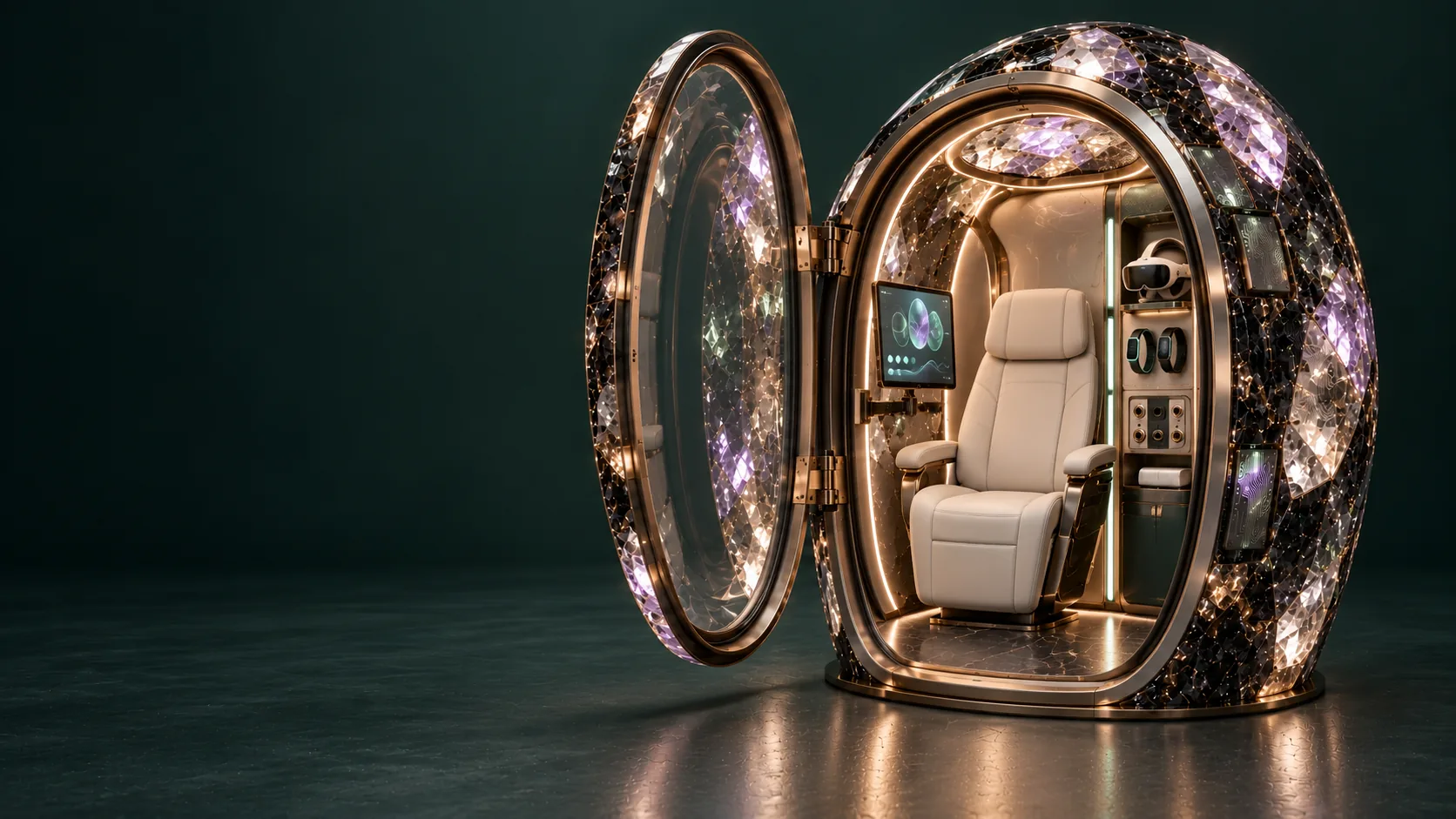
PATHWAY 04 / INTEGRATED CRYSTALLINE COMPUTE · VERSION 3
When the shell becomes a system.
Version 3 aims for integrated crystalline compute: sensing, routing, memory and computation within the crystalline Geode itself. Atomically precise manufacturing is required for the completed vision.
Integrated crystalline compute is the destination.
The intended architecture makes computation part of the crystalline material system. Device specimens, replaceable tiles, connected regions and integrated layers provide development stages towards that goal. Each stage develops the function, interconnects and thermal structures needed for the integrated Geode.
An active self-reflection workspace.
The Geode needs usable space for haptic touchscreens or VR/XR, wearable sensors and receiver hardware. The seated participant must be able to reach the controls, move comfortably and review records, with equipment stowed clear of entry and assisted exit.
- A reachable adjustable display and a defined VR/XR use envelope, with a headset dock beside the seat.
- A serviceable sensor connection bay, cable management and provision for a compatible wireless receiver where selected.
- Screens and accessories stow alongside the seat, keeping the entry, assisted-transfer route and door operation clear.
- The complete equipment configuration requires review for the actual chamber environment; experience interfaces remain separate from independent chamber controls.
The scale of the ambition.
Luke Nathan Hayes describes the intended completed Geode as making GB300 “look like a smartphone”. This is the project’s long-term design ambition for Geode-scale integrated crystalline compute, developed over time through Aura of Intelligence. Atomically precise manufacturing is a required foundation of that endpoint.
Computation has physical costs.
Each workload states inputs, expected outputs and a test set. Trials measure task fidelity, latency, memory, power and energy per completed task. Heat generation, conduction and rejection require an explicit model and full-workload measurements.
- Memory · retention, endurance, read errors and restoration.
- Routing · bandwidth, synchronisation, isolation and fault recovery.
- Integration · interface quality, yield, drift and lifecycle response.
- Service · access routes, replaceable regions, keys and recoverable records.
Research provides starting points.
Published photonic processors and optical-memory experiments offer architectures to study. NIST describes atom-scale fabrication, metrology, encapsulation and electrical contacts.
Atomically precise manufacturing is required.
The completed architecture requires control over the placement of its functional structures. Development identifies the structures to place, intended functions and inspection methods. Placement accuracy, defects, contacts, device yield and stability guide progress from specimens to integrated regions and the Geode-scale system.
The person’s record travels across generations.
The same provenance, correction and permission controls are intended to persist within the integrated crystalline compute architecture. Material repairs and personal data recovery need independently serviceable paths. The integrated architecture is intended to support personal AI training and simulation as its compute capacity develops.
Emergency egress is an acceptance gate.
Entry, door operation, assisted transfer and emergency extraction must conform to the applicable requirements for the actual chamber and site. The project retains dimensioned evidence, a reviewed emergency procedure and rehearsed acceptance before participant use.