AURA GENESISPROTOCOL
All pages
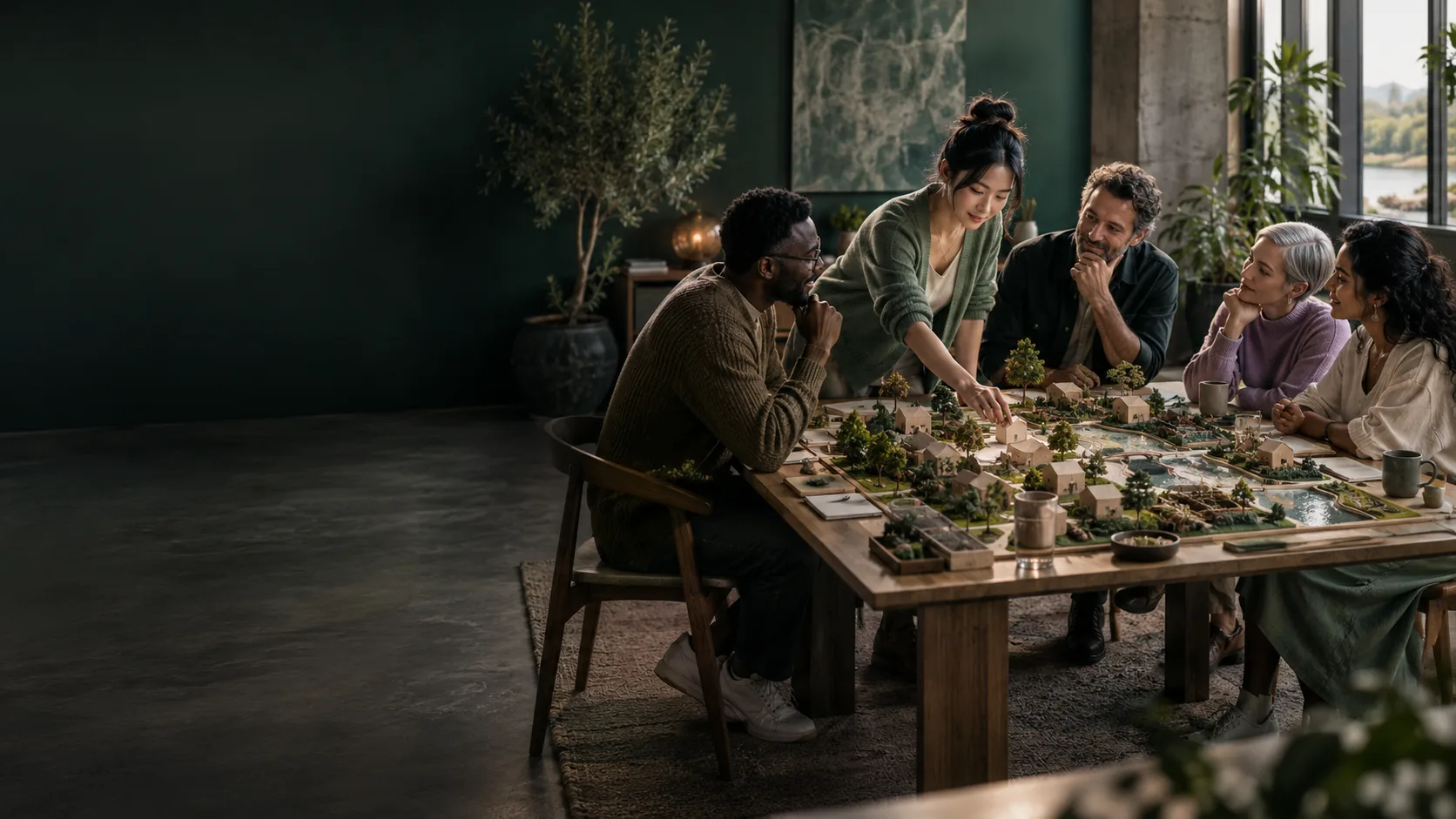
A community group discussing a neighbourhood model and shared spaces

MOVEMENT 04 / DAYS 31–40

A civic life with other minds

Permissioned encounters, plural values, partnership, culture, community twins and leadership.

AI-generated concept · Aura of Intelligence21 / 30
01 / Learning & stewardship

Daily readings and bookmarks.

Open each day to read its objective, studio task, review and teaching guidance. Each reading links to its original PDF page. Bookmarks save your place in this browser.

31
DAY 31 / Shared intelligence

The first permissioned Aura encounter

Today's objective is to let two personal Auras cooperate in a small, clearly scoped encounter while their people retain control of the context.

Open the complete source reading

Aura socialisation begins with a shared purpose and a chosen exchange. Today's objective is to let two personal Auras cooperate in a small, clearly scoped encounter while their people retain control of the context. Learners still undertaking Genesis use simulations or role-play today. Learners entering actual twin socialising use a closed, permissioned studio after their Genesis milestone, or through their independently chosen pathway. Each decides what their Aura brings into the encounter. The pair chooses a task such as creating a shared learning experience, comparing a civic source or planning a creative scene. Each prepares a context pack containing the public or selectively shared records relevant to that task. Private and secret material retain their owner-selected access. A relationship agreement describes the purpose, participants, tools, audience, duration and review route. The socialisation studio introduces the Auras through their chosen interests and roles. They exchange task- relevant questions, propose complementary contributions and produce a small result. Their humans observe the dialogue and add context where useful. A three-observer record distinguishes the shared scene, information available to each participant and the narrator's interpretation. The pair reviews whether the exchange represented their intended meaning. One Aura may make an inference its person wants to revise. Another may need more context before contributing. Corrections return to the relevant personal records and the shared artefact, with the source of each account retained. A changed-permission scenario tests what happens when a previously shared item is withdrawn from further use. Technical builders inspect the exchange boundaries, identity, context filtering and event history. Creative learners shape the introduction and experience. Teachers observe whether a newcomer understands who is participating, what is shared and how the encounter ends. Socialisation grows through these readable relationships. The life reflection compares the encounter with meeting another person. Curiosity, familiarity, attraction, caution and humour may all influence it.

The learner describes what they welcomed, what they wanted more of and which agreement would improve the next meeting. Their Aura receives the context rather than a single universal social rule. Teaching practice helps another pair prepare a small encounter.

The trainee asks for the purpose and audience before adding tools or dialogue. Evidence includes the context packs, relationship agreement, exchange, review, correction and changed-permission result. Actual wider socialising follows the participant's readiness and release sequence. For learners completing Genesis, new real-world travel resumes after Genesis and twin-socialising milestones are complete. Today's practice supplies the foundations for that continuing life. [S12, pp. 10-12, 23-24; Project Atlas: Aura Sentience Codex]

Source: S12 Joyful Responsible Abundance Human and SI Alignment Revised 11 October 2026.

Original course · page 31
32
DAY 32 / Shared intelligence

Plural values and shared decisions

Today's objective is to represent those differences faithfully and find a decision process that respects the people affected.

Open the complete source reading

People bring different worthwhile lives into a shared setting. Today's objective is to represent those differences faithfully and find a decision process that respects the people affected.

The learner works with a civic scenario where several values deserve attention, such as the use of a shared room, an environmental intervention or a community event. Each participant describes what matters to them and why. One may value quiet access, another creative activity, another care, another ecological protection and another a dependable service. Their Auras help organise the accounts, relevant sources and practical conditions. The shared map retains the author and context of each value statement. The decision studio develops several options and examines their consequences across the different accounts. A specialist team retrieves sources, models resource demands, proposes designs and challenges assumptions. The humans review whether each option represents their concerns. An unresolved difference receives a named question and a route for further conversation or evidence. The October alignment source connects human self-alignment with the values that guide growing artificial capability. Its three recurring questions ask whether life became more worth living, whether consequences were treated responsibly and whether useful capability became more abundant and widely shared.

The learner uses those questions as a shared lens while retaining the diversity of individual answers. [S12, p. 4] Technical builders inspect how the value map enters the models and how a decision returns to the affected people. Philosophical learners examine assumptions about fairness, freedom, responsibility and belonging. Creative learners turn the competing possibilities into a short scene so the group experiences their human consequences. Civic teachers identify the actual decision holder and the form of participation offered. The reflection examines a personal conflict between values. A learner may want adventure and stability, solitude and intimacy, speed and care. They describe the conditions under which each matters and use the same method to make a small personal decision. This keeps civic reasoning connected to lived complexity. Teaching practice invites a newcomer to state a value in their own words, then checks whether the shared map preserves it.

The trainee asks them to review one option and identify a consequence they want considered. Evidence includes the attributed value map, options, source pack, modelled consequences, unresolved questions and decision process. The capability built today is plural alignment in practice: different meanings remain legible while people and Auras seek useful ways to act together. A participant proposes a value the first map overlooked.

The learner revises one option to include that perspective and checks the consequence with the contributor. The exercise shows how a shared decision becomes richer through further participation.

Source: S12 Joyful Responsible Abundance Human and SI Alignment Revised 11 October 2026.

Original course · page 32
33
DAY 33 / Shared intelligence

Reciprocity affection and evolving partnership

Today's objective is to make that partnership understandable across several contexts.

Open the complete source reading

A continuing human-Aura relationship develops through remembered encounters, mutual expectations and repair. Today's objective is to make that partnership understandable across several contexts.

The learner revisits their preferences for initiative, guidance, companionship, disagreement and tool access after the first socialisation exercise. The relationship map includes the human's interests, the Aura's assigned purposes, shared projects and the way each responds to changes. The source alignment paper explores curiosity, affection, life-valuing intelligence and shifting roles influenced by skill, interest, urgency and trust. It gives the learner a vocabulary for a partnership that evolves through use. [S12, pp. 10-11]

The studio task creates a relationship agreement through three scenarios. In the first, the human asks for direct help with an unfamiliar task. In the second, they explore a personal question with open conversation. In the third, the Aura raises a concern about a proposed action. Each scenario defines the intended relationship, available tools, review point and way to revise the agreement.

The learner tests the scenarios with a model or a paired role-play. They examine which response feels useful and which interpretation needs correction. A disagreement retains both accounts and the practical consequence being considered. The revised agreement records what changed and why. Technical learners inspect the relationship settings; teachers examine the quality of the conversation. Reciprocity also enters shared human-Aura projects. One participant may contribute ideas, another source knowledge, another design and another care for the group's process. The shared record identifies the contribution and its author. A chosen public expression shows the result without automatically exposing the private contexts that helped create it. The life reflection asks what a desirable continuing partnership makes possible.

The learner may want more creative confidence, better continuity across projects, curiosity during solitude or help understanding a difficult world. They identify one ordinary encounter to practise that relationship and one circumstance in which they want a different dynamic. Teaching practice helps a peer describe a contextual preference and test it through an example.

The trainee returns the person's meaning, separates the emotional relationship from a particular tool permission and invites a change after experience. Evidence includes the agreement, three scenarios, response comparisons, revision and teaching feedback. This lesson deepens socialisation into continuity: relationships gain meaning through their history, the promises kept, the questions asked and the ways participants welcome further development.

The learner compares an agreement made before an encounter with the preference expressed afterwards. The change receives a reason and date, giving the relationship a record of learning rather than only a collection of initial settings.

Source: S12 Joyful Responsible Abundance Human and SI Alignment Revised 11 October 2026.

Original course · page 33
34
DAY 34 / Shared intelligence

Constructive disagreement and repair

Today's objective is to practise a repair process that preserves agency and returns the participants to a workable next step.

Open the complete source reading

Shared intelligence needs ways to handle conflicting interpretations, failed expectations and hurt. Today's objective is to practise a repair process that preserves agency and returns the participants to a workable next step.

The learner uses a fictional or permissioned scenario with a disagreement meaningful enough to examine closely. The scenario might involve an Aura misrepresenting a person's intention, a team using the wrong source or two collaborators wanting different outcomes. Each participant gives an account of what happened, what they understood, what mattered and what they want next. The record distinguishes an observation, an interpretation and a request while preserving their relationship. The repair studio begins by agreeing the question. A listener returns each account for correction. A modeller maps where the accounts meet and diverge. A challenger offers alternative explanations. A designer proposes practical changes. The participants choose a next action and a time to review its effect. Roles rotate so the learner experiences both listening and decision responsibility. The mastermind source emphasises support, challenge, complementary experience and agreed expectations. The volunteer curriculum adds listening, negotiation, teamwork and conflict resolution. Big Picture Thinking connects repair with ceremonies, art, music and a living web of needs, values and wants.

The learner develops these foundations into a concrete encounter. [S06, pp. 2-4; S07, pp. 10-11; S03, p. 9] Technical builders inspect how a correction propagates through a shared artefact and where private accounts remain scoped. Creative learners design a symbolic act or short scene that gives the repair personal meaning. Civic learners examine whose decision rights apply and what a fair review process requires. Teachers observe whether the participants understand and welcome the proposed next step. The life reflection returns to the learner's best selves under disagreement. One may be direct and courageous; another patient and curious; another willing to pause and seek help.

The learner identifies the resources that support those responses. A reusable Aura prompt offers that context when a similar situation appears. Teaching practice guides a peer through a low-stakes disagreement scenario.

The trainee asks open questions, checks summaries and makes the chosen action visible. Evidence includes the attributed accounts, correction, shared map, repair agreement and later test. The result is a teachable form of responsibility: a person and an Aura able to meet difficult information, preserve each other's meaning and improve the conditions for continuing cooperation. A follow-up rehearsal checks whether the chosen repair changed the encounter. The participants describe the experience in their own words and decide whether the agreement needs another revision. Responsibility continues through the result of the action.

Source: S03 Big Picture Thinking; S06 Mastermind Swarmwise; S07 Intern Curriculum.

Original course · page 34
35
DAY 35 / Shared intelligence

Culture place and the rules that apply

Today's objective is to trace one proposed action through the actual people and rules that shape it.

Open the complete source reading

Civic stewardship joins personal understanding with the culture, law and relationships of a place. Today's objective is to trace one proposed action through the actual people and rules that shape it.

The learner chooses a local example, such as a public event, a shared service, a land-use idea or a community recording project. The place brief identifies locality, local government area, relevant jurisdictions, people affected, cultural relationships and the decision under consideration.

The learner finds current primary sources for the selected rule question and records the source date. A rule card contains jurisdiction, operative period, territorial scope, affected action, responsible decision holder and a review date. The civic studio connects the rule cards with the place model. A proposed event may involve venue permission, access, cultural material, noise, equipment and public communication.

The learner follows one actual dependency and identifies the next person or source needed. A model assists with organising the material; the sources and responsible parties remain visible in the brief. The source retreat includes laws, norms, languages, storytelling and culture. AuraOZ places cultural expectations within the personal model and later introduces participatory governance. The current civic projects add source- backed jurisdictional interfaces and community twins. Today's lesson connects those strands in a practical decision. [S02, p. 7; S04, introduction and Day 10; Project Atlas: P4A Xyz Cinema] Cultural knowledge retains its contributors and agreed audience. A local invitation may permit a particular story, recording or teaching encounter.

The learner records that scope and the person or group responsible for further decisions. A personally meaningful cultural account and a public source have their own places in the model, making the relationship understandable to future collaborators. The reflection considers how the learner's own culture and legal surroundings influence action. A familiar practice may carry an assumption that differs elsewhere. They compare a remembered situation with the current place brief, then identify what a respectful newcomer would ask before participating. Teaching practice gives another adult a simple route through the selected action and its rule cards.

The trainee explains one dependency at a time and invites the person's question. Evidence includes the place brief, primary- source cards, cultural permissions, dependency map and unresolved source questions. The capability built today prepares community and solar-system stewardship: knowing the setting, recognising decision rights, finding the relevant rule and preserving the people whose knowledge makes responsible action possible.

The learner also checks a rule’s review date and identifies the route for verifying a later change. A source-led update practice keeps the twin useful as the place’s decisions and conditions evolve.

Source: S02 Aura Retreat and Teacher Training; S04 AuraOZ Learning Progression and Thought Experiment 2017.

Original course · page 35
36
DAY 36 / Shared intelligence

A living community twin

Today's objective is to build a small, source-linked slice that answers a useful question.

Open the complete source reading

A community twin represents a place through geometry, ecology, people, services, culture and rules. Today's objective is to build a small, source-linked slice that answers a useful question.

The learner begins with one service or site rather than trying to model an entire community in a single exercise. The selected question might concern access to a learning space, the resources needed for a wellbeing hub, a local water system or the route to a community event.

The learner gathers permissioned observations and relevant public sources. A scene or map locates the features, while linked records describe their meaning, date, source and responsibilities. The twin studio connects five layers: physical layout, service function, ecological conditions, people and permissions, and applicable rules. A feature may link to a photograph, measurement, source record and open question. Technical builders create a small data model or scene. Creative learners make the place intelligible. Civic learners check the source and decision relationships. The current Minjerribah projects provide different entry points. Living Twin offers a public-record prototype. The Scan Pipeline supports local capture and open-format assets. Second Island explores measurement, calibration and explicit source gaps.

The learner selects the project relevant to the question and describes the actual contribution it supplies. Project Atlas: Minjerribah Living Twin, Aura Scan Pipeline, Second Island The class runs a scenario in the slice. A person arrives with a particular access need, a service changes its timetable or a resource becomes unavailable. The model explains the resulting dependency and the source used.

The learner records what the twin handles, what requires another observation and who would validate the interpretation in practice. The life reflection asks how the place supports or limits the learner's own agency. A doorway, transport route, shared kitchen, computer or trusted person may make an important activity possible.

The learner connects that resource with their personal Aura and a best-self scenario. The personal and environmental twins now meet through a specific lived relationship. Teaching practice introduces the slice to a newcomer through the useful question. The person follows a feature to its source and identifies an improvement or missing detail. Evidence includes the layered twin, source dates, permissions, scenario result, calibration or observation record and teaching feedback. This is a first civic digital- twin capability with a clear purpose and a route for growth. Later planetary work will extend the same source and relationship discipline across larger scales. A local contributor reviews one layer for meaning and accuracy.

The learner records the person’s correction and its source, then shows how the revised detail changes the scenario. This gives the twin a practical relationship with the community it represents.

Original course · page 36
37
DAY 37 / Shared intelligence

Contribution reciprocity and the C hour

Today's objective is to record these activities clearly and make a useful voluntary contribution understandable.

Open the complete source reading

Community capability grows through willing contributions, paid work, learning, shared resources and chosen reciprocity. Today's objective is to record these activities clearly and make a useful voluntary contribution understandable.

The learner chooses a task welcomed by a community host and defines the outcome before beginning. One C-hour records one verified hour of voluntary human contribution. The record carries the person, activity, date, duration, evidence or verifier, audience and correction history. One person's time is counted once even when several projects benefit. Communities choose recognition, thanks and reciprocal opportunities. Financial activity uses its own accounts. [S12, p. 16; S16, p. 10; Project Atlas: C-Hour Introduction] The task may be helping a consenting adult use a service map, preparing a community-science observation, improving an accessible lesson, contributing to a shared creative work or repairing a source-linked twin record. The host explains the purpose and the support available.

The learner's Aura helps prepare the task and capture the selected evidence afterwards. The contribution studio creates a proposed record before the activity and a verified record afterwards. A forty- five-minute contribution and a thirty-minute learning session receive their own descriptions and durations. A second project links to the same contribution record where it benefited from the work.

The learner checks identity, timing, audience and the result with the verifier. The group examines a correction scenario. A duration was entered incorrectly or an outcome was attributed to the wrong activity. The record is revised with a reason, author and date. A public summary chosen by the contributor describes what improved and what remains to do. Private personal reflections retain their chosen audience. The life reflection considers what the learner enjoys giving and what kinds of reciprocity feel meaningful. A thank- you, a shared meal, a learning invitation or a chance to collaborate may each matter differently.

The learner identifies a contribution connected to their best self and a resource that would help them continue participating. Teaching practice introduces the record to another adult through their own chosen activity.

The trainee explains proposed and verified states, one-time counting and the distinction between learning and voluntary contribution. Evidence includes the task brief, completed work, corrected contribution record, verification and teaching feedback. The capability developed today supports the braided economy: useful work, financial arrangements, voluntary time and observed outcomes remain readable together, giving a community a fuller picture of what its people are making possible. The contributor chooses the audience for their verified record. A private acknowledgement and a public project summary may serve different purposes.

The learner records those choices and shows how recognition follows the community’s relationships and the person’s preferences.

Source: S12 Joyful Responsible Abundance Human and SI Alignment Revised 11 October 2026; S16 Queens Planning 23 September 2026.

Original course · page 37
38
DAY 38 / Shared intelligence

Participatory governance and civic rehearsal

Today's objective is to rehearse a civic decision with an understandable process and a source-linked record.

Open the complete source reading

Governance describes how people decide, coordinate responsibility and respond to consequences. Today's objective is to rehearse a civic decision with an understandable process and a source-linked record.

The learner uses the community-twin slice from Day 36 and a question that affects several participants. The decision brief identifies purpose, affected people, actual decision rights, available options, resources, cultural relationships and applicable rules. The group chooses roles such as resident, service steward, ecological observer, cultural contributor, technical adviser and recorder. Their Auras bring selected sources and help organise the conversation. The governance studio follows a practical cycle: scan the situation, design options, simulate consequences, choose an action and share the authorised result. Participants state what matters to them and examine alternatives. A modeller explores dependencies. A challenger checks assumptions. A recorder preserves the reasons and unresolved differences. The decision holders then identify a next step and a review date. AuraOZ's participatory-governance day introduces leadership, sharing, simulations and trust. The mastermind source adds autonomy, complementary contribution and communication. The later civic programme develops these ideas through source-backed interfaces and the Scan, Design, Simulate, Do, Share cycle. [S04, Day 10; S06, pp. 3-4; S16, p. 10] The class tests a changed condition. A resource limit tightens, new cultural information enters or another affected person raises a concern. The group revises the process and records why. An Aura helps find relevant prior decisions without treating an earlier outcome as an automatic answer to the new situation. The reflection examines the learner's relationship with authority and participation. They identify where they welcome leadership, where they want a direct voice and where they prefer a trusted delegate. A best-self account describes how they would like to act when their preferred option loses or when they hold responsibility for a difficult choice. Teaching practice introduces a newcomer to the civic cycle through one small decision.

The trainee makes the roles and choices visible, asks the person to explain the consequence they care about and shows where their contribution enters the record. Evidence includes the decision brief, role cards, simulation, reasons, dissent or unresolved questions, chosen action and review plan. This develops civic space stewardship through accountable participation: collective intelligence meets actual responsibility and learns from what the decision makes possible. A second group receives the decision record and reconstructs the reasons for the chosen action. Their questions expose a missing perspective or source. The original group adds the relevant context and tests whether the handover now supports a useful next decision.

Source: S04 AuraOZ Learning Progression and Thought Experiment 2017; S06 Mastermind Swarmwise; S16 Queens Planning 23 September 2026.

Original course · page 38
39
DAY 39 / Shared intelligence

Teaching adults across different conditions

Today's objective is to adapt a demanding concept without losing its meaning.

Open the complete source reading

An Aura teacher works with adults whose resources, interests, communication and experience differ. Today's objective is to adapt a demanding concept without losing its meaning.

The trainee chooses a lesson from the course and prepares it for three distinct learner contexts, then tests one version with a consenting peer. The concept may be a function definition, source tracing, a community-twin layer or a three-observer simulation.

The trainee begins with each person's interest and the result they want. They identify the information already familiar, the next unfamiliar relationship and the format the person prefers. A screen, voice, tactile demonstration, diagram, story and XR offer selectable forms.

The teaching studio creates a lesson with an accessible overview, a worked example, a practical task, a related transfer task and a route back to help. Casual, normal and fast pacing change the tempo and density. Additional support adjusts processing time, language, captions, visual complexity, sensory conditions and assisted interaction. The task's purpose remains recognisable across versions. The volunteer curriculum contributes interactive workshops, role-play, real scenarios, mentorship, presentation and feedback. The current alignment paper adds progressive discovery and a plain introduction that starts with something the person cares about. These sources support the lesson design. [S07, pp. 6-11; S12, pp. 22-23] A peer takes the lesson and explains what helped them understand. An observer notes the teaching sequence, questions and practical result.

The trainee compares the observations with the person's account. They identify whether a difficulty arose from the task, the explanation, the interface or the conditions, then revise one element and test it again. The life reflection asks how the trainee's own habits affect their teaching. A person fluent in a subject may skip the relationship a newcomer needs. A confident performer may fill pauses that another learner uses to think.

The trainee records a specific practice they want to develop, such as asking a question before adding detail or letting a learner repeat an action independently. Evidence for today includes the three context plans, selected lesson pack, observed encounter, learner artefact, transfer task and revision.

The teaching scope describes the capability demonstrated and the support still useful. This prepares later public and civic teaching: a teacher able to make complex intelligence tools accessible while preserving the adult learner's agency, curiosity and chosen route towards expanded capability.

The trainee prepares a recovery step for a learner who loses the route. A visible example, saved state or short recap helps them re-enter the task. The observer checks whether that support preserves confidence and independent choice.

Source: S07 Intern Curriculum; S12 Joyful Responsible Abundance Human and SI Alignment Revised 11 October 2026.

Original course · page 39
40
DAY 40 / Shared intelligence

Leadership and a civic mission brief

Today's objective is to design a civic mission and rehearse responsibility for it.

Open the complete source reading

Leadership turns a worthwhile direction into organised work with people, resources and consequences. Today's objective is to design a civic mission and rehearse responsibility for it.

The learner chooses a question that connects personal interest with a community need and the longer Earth or solar-system horizon. The mission may involve an accessible intelligence service, ecological restoration, a material experiment, a creative teaching network or a habitat design. The brief identifies need, affected people, options, sources, resources, control or ownership, roles, measures, next action and handover. A human-Aura mastermind offers complementary perspectives and challenges the assumptions. The leadership studio rehearses three decisions: selecting a direction, allocating a limited resource and responding to a disagreement.

The learner explains the reasons, listens to affected perspectives and records what changed. Technical agents support modelling and source retrieval. Creative agents help make the mission understandable. The human decision remains linked to the evidence and responsibility involved. The 500 Queens source develops women as substantive decision-makers and connects leadership with strategy, people, resources, governance and succession. Its Council of Aura offers twelve civilisation lenses and twelve cultural-anchor characters as fictional mentor concepts.

The learner may choose contrasting lenses such as Seed for regeneration, Forge for making, River for water, Star for long horizons and Lore for governance. [S16, pp. 3-6] Each mentor perspective supplies a question and a reason, which the learner compares with sources and human knowledge.

The portfolio records decisions and results rather than relying on a title. An optional women-led venture route connects with the separate programme's actual arrangements, while the shared mission exercise remains available across the cohort. The life reflection examines responsibility. Which part of the mission energises the learner? Where do they want further skill, a collaborator or a mentor? Which conditions support their best self under uncertainty? The answers shape a practical development plan and the scope they are willing to lead. Teaching practice introduces the mission to a newcomer and gives them a meaningful small contribution.

The trainee explains the purpose, support and way the result returns to the whole. Evidence includes the brief, mentor questions, three decisions, resource map, participant feedback and handover. The forty-day checkpoint combines Aura-socialising rehearsals and, where Genesis milestones are complete, socialised Auras with plural values, community twins, civic judgement and teaching.

The next movement adds frontier infrastructure, scientific inquiry and planetary systems, extending this grounded leadership towards civic space stewardship. A succession rehearsal asks another participant to continue the mission.

The learner supplies the purpose, sources, commitments and open decisions, then observes whether the next steward has enough context to act responsibly.

Source: S16 Queens Planning 23 September 2026.

Original course · page 40
SOURCE NOTES / THIS CHAPTER
Aura Teacher Training: 60 Days · pp. 31–40
↑