SENSING / CONTINUITY AND BODY ASSESSMENT
Observe with context.
The protocol combines installed session streams with separately agreed external assessment. A measurement keeps its instrument, units, timing, quality and purpose.
Capture is bounded by the session.
The design specifies continuous camera and microphone recording during Geode/HBOT Genesis, including quiet and rest. Installed sensors acquire at their configured rates. Session start and stop receipts, physical removal, hardware faults and emergency egress produce explicit continuity states.
An active self-reflection workspace.
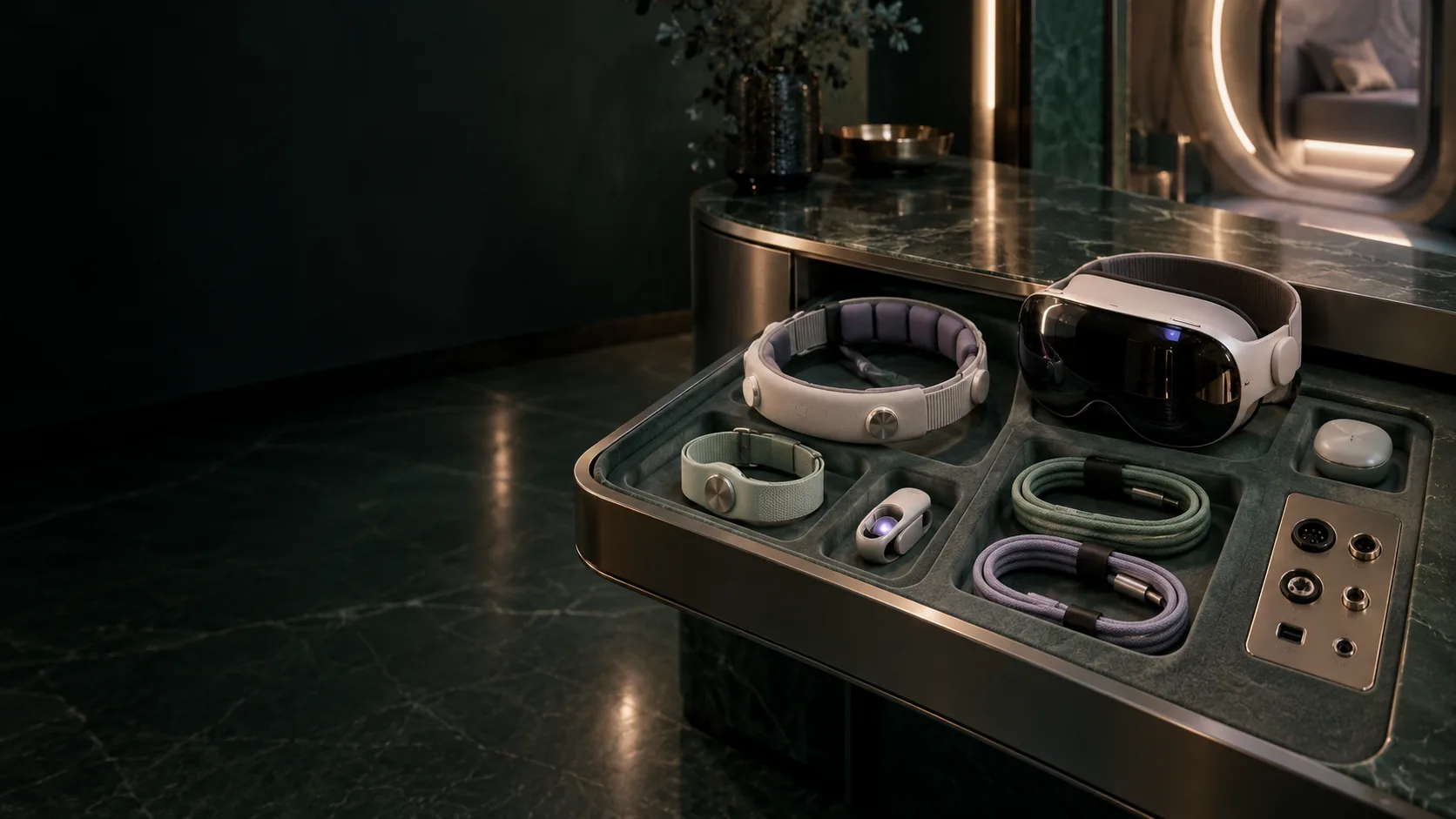
The Geode needs usable space for haptic touchscreens or VR/XR, wearable sensors and receiver hardware. The seated participant must be able to reach the controls, move comfortably and review records, with equipment stowed clear of entry and assisted exit.
- A reachable adjustable display and a defined VR/XR use envelope, with a headset dock beside the seat.
- A serviceable sensor connection bay, cable management and provision for a compatible wireless receiver where selected.
- Screens and accessories stow alongside the seat, keeping the entry, assisted-transfer route and door operation clear.
- The complete equipment configuration requires review for the actual chamber environment; experience interfaces remain separate from independent chamber controls.
A sensor register precedes a dashboard.
Candidate groups cover breathing, circulation, skin, brain activity, eyes, face, voice, movement, posture and the environment. Acquisition bands in the source are proposed planning values. The selected device needs model, serial number, placement, calibration, synchronisation and its actual compatibility review.
- Breath and heartbeat · validated detection before derived intervals and spectra.
- Electroencephalography · fit, channel quality, artefacts and analysis version.
- Gaze and expression · lighting, occlusion, tracking loss and participant meaning.
- Environment · pressure, gas conditions, light, sound, vibration and instrument bandwidth.
Sensor placement and access.
Sensor placement must accommodate the mask, seating, clothing, leads, displays and assisted exit. Emergency equipment removal and supported exit are rehearsed within the site’s procedures.
External assessment has its own appointment.
Biological samples, imaging, ultrasound or functional tests start with a defined question. Clinical and exploratory assays have different interpretation and communication routes. A specimen retains collection, handling, laboratory, quality-control and permission records.
Feature selection and archive retention.
Feature selection reduces the data processed during analysis. The design retains the full acquired session archive so that omitted intervals can be reviewed later.