What the island's made of · reclaiming
The tip loop
The richest ore on this island isn't under the dunes. It's at the tip, right now: a dead fridge, a cracked telly, a seized pump motor, a coil of old cabling. Every one of them is a parcel of copper, steel, aluminium, rare-earth magnets and circuit-board gold, and every one gets buried or barged back to the mainland for a single reason. No local system exists to catch it. That's not a waste problem. It's an unopened mine, one the island could start opening. If you want the argument for why the pile exists and why it isn't a sin, read the wasteful age first.
The honest problem
Everything leaves. Nothing comes back.
An island imports almost everything and exports almost nothing except its rubbish. When a washing machine dies here, the steel, the copper-wound motor and the magnets in it don't become anything: they become freight. The mainland gets the value, the island gets the hole in the ground and the barge bill. Meanwhile the same island wants to build things, and pays freight again to import the exact metals it just sent away.
Kerbside recycling already handles the easy part, and the container scheme proved Queenslanders will absolutely sort their rubbish when the system is worth using. The prize is everything bigger than a can, and everything more complicated than a bottle.
The loop
Five gates before the hole in the ground.
Nothing here is exotic. Every gate is something ordinary Australians already do somewhere, just never all in one place, on one island, on purpose. The rule is simple: burial is the last resort, not the default.
Refuse the burial
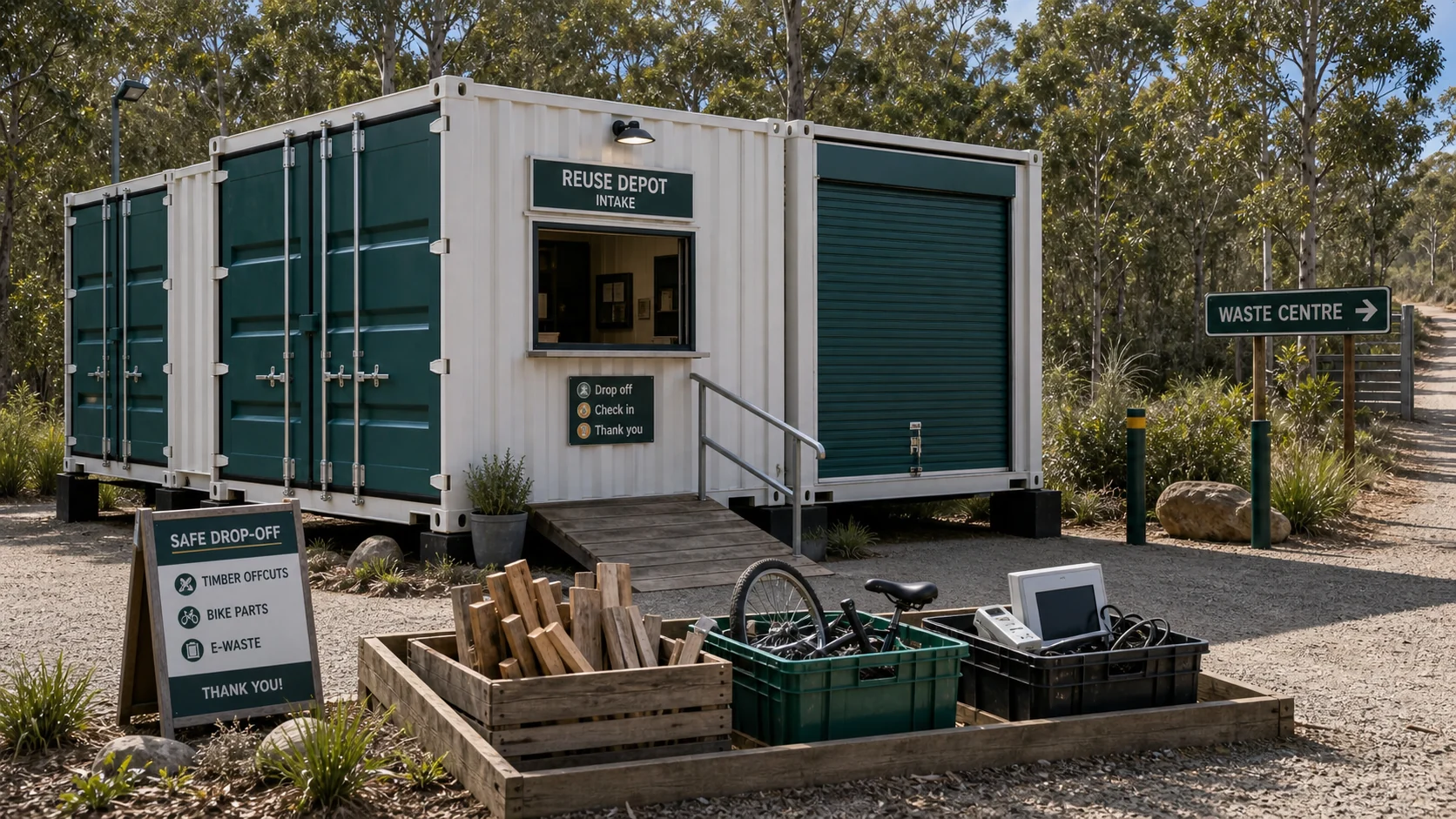
- Anything with value gets pulled off the tip face before it's crushed.
- One sorting bay, a roof, and someone whose job it is to look.
- That's the whole intervention. Everything below follows from it.
Repair first
- If it can be fixed, it doesn't get stripped.
- Fixed at the maker-space bench, back into a home the same week.
- Repair cafés and Men's Sheds already prove the model across the country.
Harvest the parts
- What can't be fixed gives up its good parts: motors, pumps, boards, bearings, glass.
- A shelf of known-good spares is what makes gate 2 work next time.
- The tip shop is the oldest, best-loved version of this idea in the country.
Strip to clean streams
- The carcass gets separated: steel, aluminium, copper, boards, plastics, glass.
- Clean and sorted is worth real money; mixed and crushed is worth nothing.
- This is urban mining, and it is a genuine global industry.
Feed the ladder
- Those clean streams are feedstock, not rubbish.
- They flow straight into the alchemy: alloy, wiring, magnets, glass, carbon.
- The loop would close. Nothing worth keeping would ever reach the hole.
And the jobs are real
- Sorting, fixing, stripping, testing, selling: all of it is work.
- All of it is teachable at the bench, on the island, to anyone.
- The tip would stop being where value dies and start being where it's caught.
What's actually in it
Read a dead appliance like an ore body.
Nothing on this list is speculative. It is simply what these objects are made of, and where those materials could go instead of into a hole.
| What lands at the tip | What it's actually made of | Where it goes on this ladder |
|---|---|---|
| Whitegoods: fridges, washers, dryers | Mostly steel, with a copper-wound motor, aluminium, and refrigerant gas that must be captured by law | Steel and copper straight back into use; the gas handled properly instead of vented |
| Televisions, computers, phones | Circuit boards carrying gold, silver and copper; aluminium frames; glass; batteries | Boards are the densest ore in the whole stream; batteries never, ever go in a bin |
| Motors, pumps, hard drives, speakers | Copper windings and rare-earth magnets | The magnets loop back to the same job the monazite stream is chasing |
| Cabling and wiring offcuts | Copper or aluminium inside a plastic skin | Strip it and it's clean metal; burn it and you poison the air, so nobody burns it |
| Trailers, boats, roofing, fencing | Structural steel and aluminium, sometimes galvanised | Remelted into the island's own alloy stock |
| Glass and bottles | Silica, the island's defining material, already refined once | Cullet for new glass, or aggregate; it came from sand and it goes back to sand |
| Plastics | Long carbon chains, mostly still intact | Sorted for reuse, or cracked into gas, carbon and chemical feedstock |
| Timber, green waste, food scraps | Carbon, water and nutrients | Compost, feed for mushroom-grown insulation panels, or biochar |
| Tyres and mattresses | Rubber, steel wire, foam, springs | The awkward ones, and the honest test of whether a loop is real or just a poster |
Already proven, just never assembled
Australia has every piece of this already.
The tip loop isn't an invention. It's an assembly job. Every gate above exists somewhere in this country, run by ordinary people, working fine.
Tip shops and resource recovery centres have been rescuing good gear from the tip face for decades, and they're beloved wherever they exist. Containers for Change proved that Queenslanders will sort and return their rubbish in enormous numbers the moment the system respects them. Men's Sheds and repair cafés already fix what would otherwise be dumped, and build community while they do it. E-waste recycling is a real industry with real buyers for clean streams of board, copper and steel. And the right-to-repair conversation is winning, slowly, because the alternative is indefensible.
None of that is on this island in one place. That's the entire gap, and it's a small one.
The receipts we're missing
What we don't know yet.
This page refuses to invent numbers it hasn't got. Here is exactly what nobody on this ladder can currently answer, and every one of these is a real first task, not a rhetorical question.
Open questions, worth actual money to answer
- How many tonnes does the island's waste stream actually carry a year, and what's in it? Nobody here has the breakdown.
- What does it cost, per year, to barge that off the island? Who pays it: council, ratepayers, or both?
- What happens to it once it leaves? Landfilled, sorted, or shipped further?
- What are the clean streams worth at the gate: copper, steel, aluminium, boards?
- What would gate 1, one sorting bay and one person, actually cost to run for a year, against what it catches?
Answer those five and the tip loop stops being an idea and becomes a business case with a number on it. That's a weekend of phone calls and a spreadsheet, not a research program, and it's the most valuable unglamorous work on this whole ladder. When the numbers land, they get published here with their sources, in Olympic pools and tip-truck loads, the way every number on this site has to earn its place.