What the island's made of · the Silica Stack
What the island is made of
Most places sit on dirt. This one sits on a sorted mineral inventory that the wind and the sea spent hundreds of thousands of years refining, grain by grain, and then a mining industry spent eighty years proving was there. Here is the honest stocktake: the five minerals, the elements inside them, and a straight line between what we can actually claim and what we can't. What it all becomes is the alchemy page's job. This is just the inventory.
The Silica Stack
Five minerals, one beach.
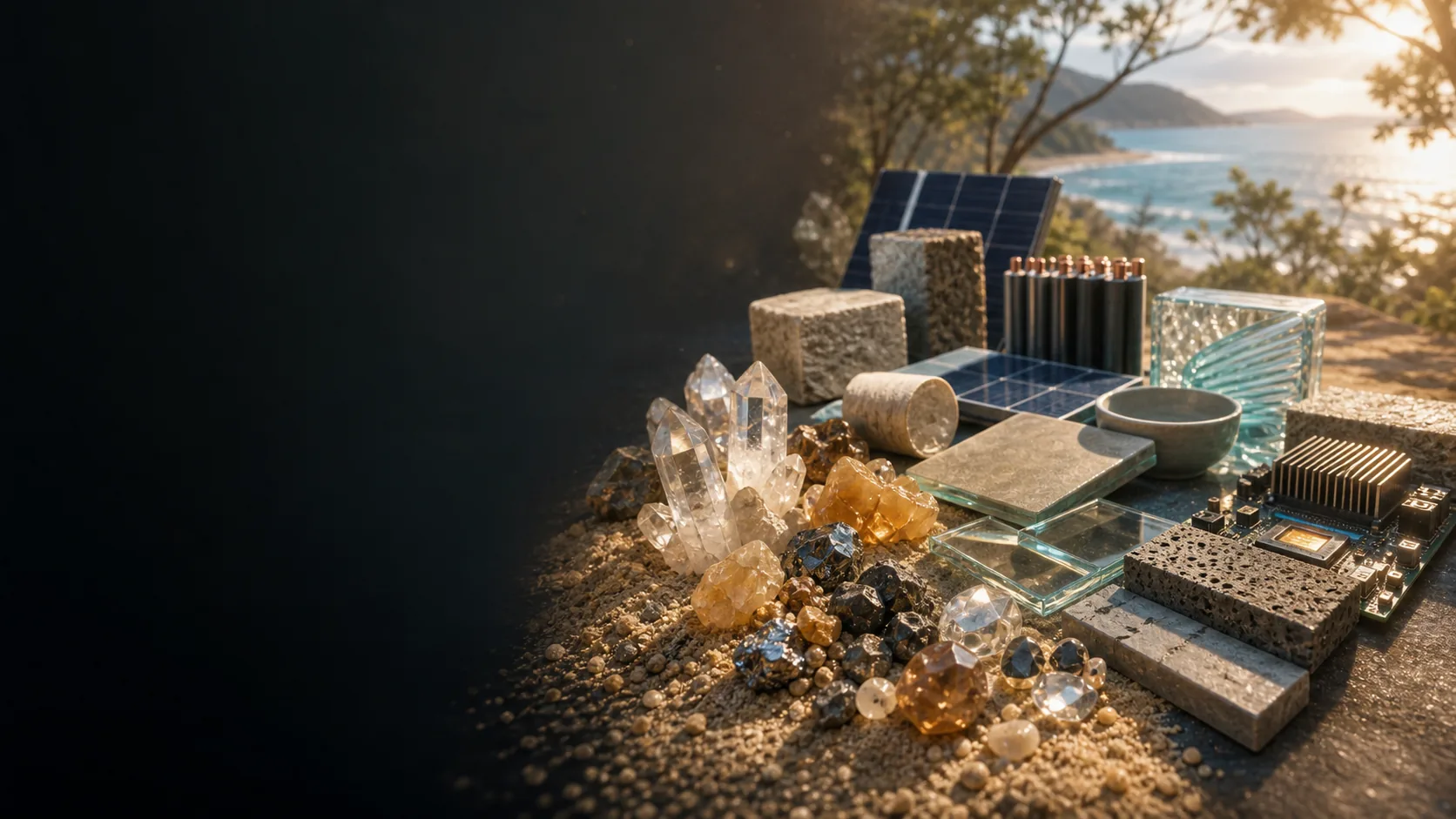
These aren't hypotheses. Every one of them was commercially mined out of these dunes, which is the strongest evidence a mineral claim can have: an industry made money on it for decades. Quartz is the overwhelming bulk; the rest are the heavy minerals the waves concentrated into dark seams through the sand. Each name in the table opens its own page, up close.
| Mineral | Formula | In plain words | Why it matters here |
|---|---|---|---|
| Quartz | SiO₂ | Ordinary sand, and almost all of the island by weight | Glass, solar cells, computer chips, silicone, and the sand battery's heat store |
| Rutile | TiO₂ | The best natural ore of titanium there is | Metal that shrugs off seawater forever, and the white in white paint |
| Ilmenite | FeTiO₃ | Titanium and iron together in one black grain | The bulk heavy mineral: structural metal and magnetic cores |
| Zircon | ZrSiO₄ | A tough, heat-proof crystal older than most rock on Earth | Zirconia ceramic for cutter heads and heat shields, plus the byproduct that feeds the silicone and aerogel loop |
| Monazite | (Ce, La, Nd, Th)PO₄ | A phosphate grain holding rare earths and thorium together | Magnet metals for every motor on the island, and a fuel the world walked away from |
The honest periodic table
Ours, within reach, or just for context.
It's easy to wave at a periodic table and imply an island can make anything. This one refuses to. Three tiers, and the difference between them is the whole point: gold is documented in our sand, teal is something the island can honestly get from the sea, the air, living things or the tip, and the faded rest is here so the first two can't be oversold. Tap any lit-up element.
- In our sand: documented, and mined here for decades
- Within reach: from seawater, air, water, life, or the tip
- Context only: real chemistry, not our story
Start anywhere
Ten elements, one beach
Ten of these are documented in the sand under your feet, and another handful are a pump or a tip run away. Tap a gold or teal tile to see what it is and where it goes. The faded ones aren't clickable, and that's deliberate: they're not ours to claim.
The receipts, and the wound
They already proved it was there.
Mineral sand mining ran on this island for around eighty years and stopped in 2019, phased out by law. That history is the reason this page can speak plainly instead of guessing: the minerals are documented because somebody dug them up and sold them. It's also the reason the island is wary, and rightly so. An extraction industry took the ore and left the holes, and no page on this site is asking for a rerun.
And whose sand is it, really? Not anyone's to just dig. Under the Quandamooka people's native title, the island's sand, gravel, clay and rock are named as their natural resources. Mining was ended by law, and a big part of the island is now national park, looked after jointly by the Quandamooka people and the state. So using any of this sand for building or making isn't a call one person or one council can make alone. It would take the community, the Quandamooka people through QYAC, and government all agreeing, and today that's a hard road, though not a closed one. Which is why this whole page is a thought experiment about what the sand could one day be, not a plan to start digging.
The sharpest part of the record is monazite. Australia was once the world's biggest producer of it, and then in the 1990s the industry walked away, because the thorium riding inside it made the rare earths too radioactive and too costly to bother separating. The monazite went back in the ground, buried under the depth of cover the safety rules required: not scattered, just parked, and still down there. The very thing that made it worthless then is the thing China now runs a reactor on. The sand didn't change. The century did.
Still to work out
- The actual tonnages: how much ilmenite, rutile, zircon and monazite came out of these dunes, per year and in total. Those numbers aren't known well enough here yet, so they aren't printed.
- What grade the remaining sands actually run, and where. The old mining reports exist, but that answer isn't known here yet.
- Where the monazite went, and how deep. Buried back under a required depth of cover is the general story; the actual depths, volumes and locations on this island are worth knowing, because they decide whether it's ever winnable again.
Where to next
Inventory, then imagination.
Now you know what's in it. For each mineral up close, read quartz, zircon, rutile and ilmenite, and monazite. The alchemy page is what they become, and how the leftovers of one process feed the next until nothing is spoil. The bench is how you learn to read this sand with a hand lens and a magnet, which costs nothing and is the plain first step. And the tip loop is the island's other ore body, the one that arrives by truck already refined.