Community builds · the shoreline

Holding the coast, softly

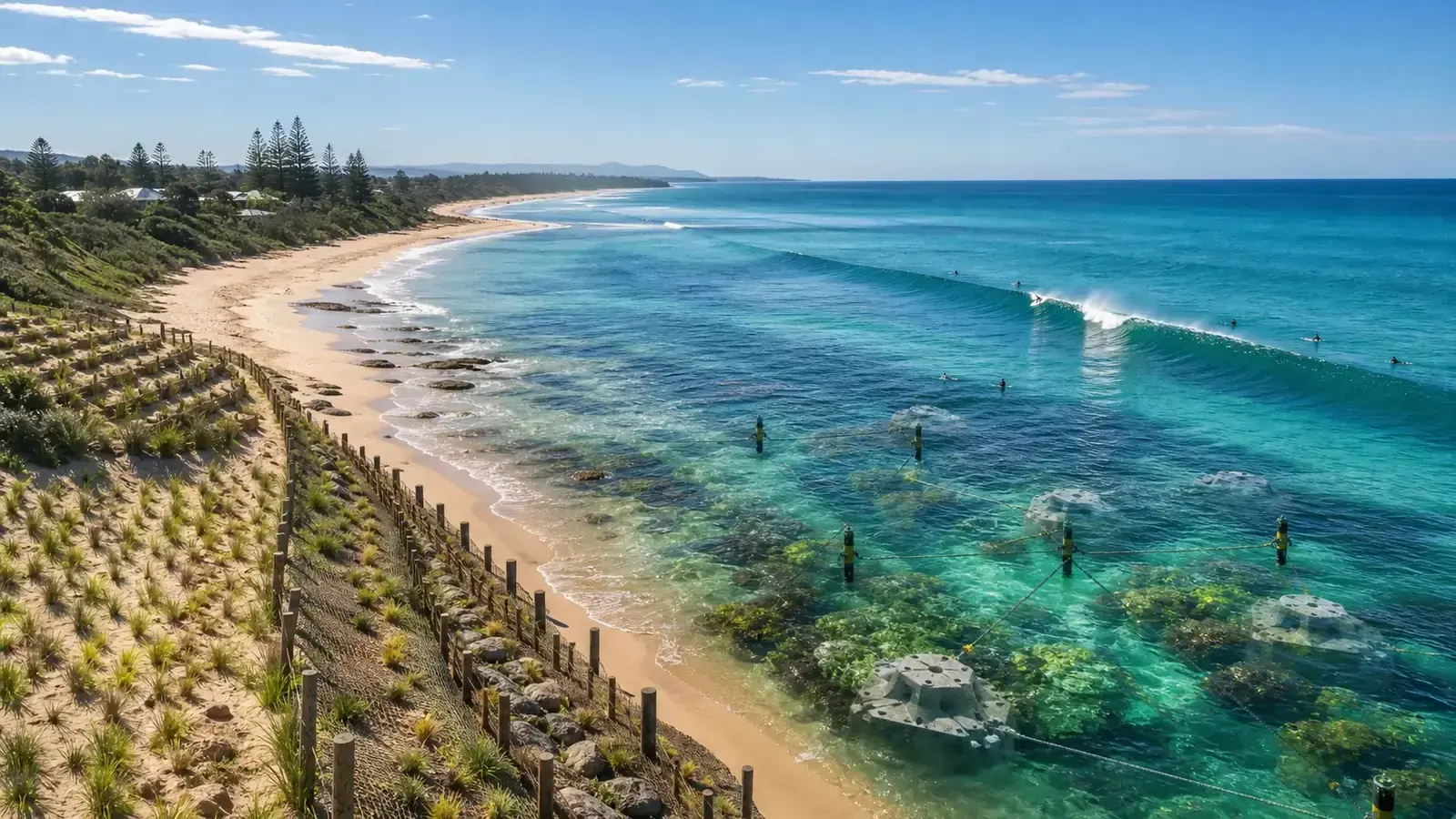
A concrete sea wall is a hard answer to a soft problem: it holds for a while, then the sea gets in behind it and the beach in front of it disappears. There is a gentler way. A living shoreline of plants, mangroves and easy sloping edges could hold the sand, give young fish a place to grow, and heal itself after a storm instead of cracking. And the sand to shape those edges could come from a tunnel dig.

What already works

The plants already hold the coast.

Known

Mangroves and saltmarsh are the quiet workers of a healthy shore. Their roots grip the mud so it stops washing away, they take the punch out of a storm surge, and their tangle is a nursery where young fish, prawns and crabs grow up safe. That part is not a guess: it is how these coasts have worked for a very long time. The idea here is to lean on that instead of fighting it, and to shape the sand from a dig into edges the plants can hold. You can count the sand a tunnel would give and picture it becoming a shoreline.

Living edges

Soft edges that hold the sand.

Small first, then bigger. Each of these swaps a crumbling hard edge for a planted, sloping one, using sand a dig could spare. The last is the ambitious one.

Eroded path-edge pocket

stops a favourite track washing away

One of those spots where the beach path has crumbled and a little cliff of sand is falling away. The idea is to tuck sand back in behind planted grasses, so the edge knits together again rather than eating further inland.

  • about 3 tip-truck loads of sand, the spoil from roughly 6 metres of a people-sized tunnel
    Modelled

Living shoreline pocket

a soft edge instead of a hard wall

A short stretch where a low, planted edge could stand in for a failing hard one. Sand shaped into a gentle slope and held by roots lets a wave run up and drain away, rather than slamming into concrete and scouring out the beach.

  • about 11 tip-truck loads of sand, the spoil from roughly 22 metres of a people-sized tunnel
    Modelled

Saltmarsh and mangrove nursery edge

a nursery for young fish

A shallow, muddy shelf built up to just the right height for saltmarsh and young mangroves to take hold. Once they settle in, it becomes a safe nursery where small fish and prawns grow, the way these plants do wherever they get the chance.

  • about 19 tip-truck loads of sand, the spoil from roughly 38 metres of a people-sized tunnel
    Modelled

Storm-recovery shoreline reach

brings a beaten stretch back

The big one: a longer run of coast that a bad storm has chewed back, rebuilt as a living edge in one patient effort. It would go in slowly and be planted as it goes, so the shore can settle and the roots can take a firm grip before the next blow arrives.

  • about 99 tip-truck loads of sand, the spoil from roughly 197 metres of a people-sized tunnel
    Modelled

Caring for the dunes

Looking after the dunes that protect us.

The dunes are the island's first line against the sea. These are small acts of care for them, each using a little spare sand, so they can go on doing that job.

Access track sand ladder

kinder steps down to the beach

A worn beach access where people scramble down loose sand and drag more of it away with every step. A built-up ramp of firmer sand, held with matting and grasses, gives an easier way down and stops the dune bleeding out through the gap.

  • about 3 tip-truck loads of sand, the spoil from roughly 6 metres of a people-sized tunnel
    Modelled

Stable dune-foot edge

holds the foot of the dune

The foot of a dune is where the sea nibbles first. Topping it up and planting it out gives the whole dune a firmer base to stand on, so it keeps its shape right through the season.

  • about 10 tip-truck loads of sand, the spoil from roughly 21 metres of a people-sized tunnel
    Modelled

Viewing-platform toe

firm ground under a lookout

A quiet lookout spot needs solid ground beneath it, not shifting sand. Sand packed and planted at the base could give a small viewing platform a steady footing, without pouring a slab of concrete into the dune.

  • about 19 tip-truck loads of sand, the spoil from roughly 38 metres of a people-sized tunnel
    Modelled

Storm blowout repair kit

patches the gap a storm tore open

When a storm punches a gap clean through a dune, a blowout, the wind widens it fast. The idea is to keep sand and plants ready to fill that gap quickly, closing the wound before it grows and the sea finds a way in behind it.

  • about 38 tip-truck loads of sand, the spoil from roughly 76 metres of a people-sized tunnel
    Modelled

Dune and surf-access corridor

one cared-for way through

Instead of a dozen goat-tracks all chewing at the dunes, one well-made corridor through: a firm path, planted edges and clear sides, so people get to the surf the easy way and the dune around it gets a chance to recover.

  • about 83 tip-truck loads of sand, the spoil from roughly 166 metres of a people-sized tunnel
    Modelled

Whose coast this is

The sea and shore aren't ours to reshape.

This is Quandamooka sea country. Nothing here moves a grain of it without the Quandamooka people's agreement, given through QYAC, in their own time and on their own terms. These are sketches of what could be, offered for that conversation, not a plan waiting on a start date. If the answer is no, or not here, or not yet, then that is the answer, and it is a good one to hear.

Keep going

Where this goes next.

See how these edges sit beside the other community builds, look at the oyster reefs that could grow in front of them and do some of the same work, or go back and see what a dig gives before it becomes a shoreline.