Better waves · back to the builds

Better waves, tested first

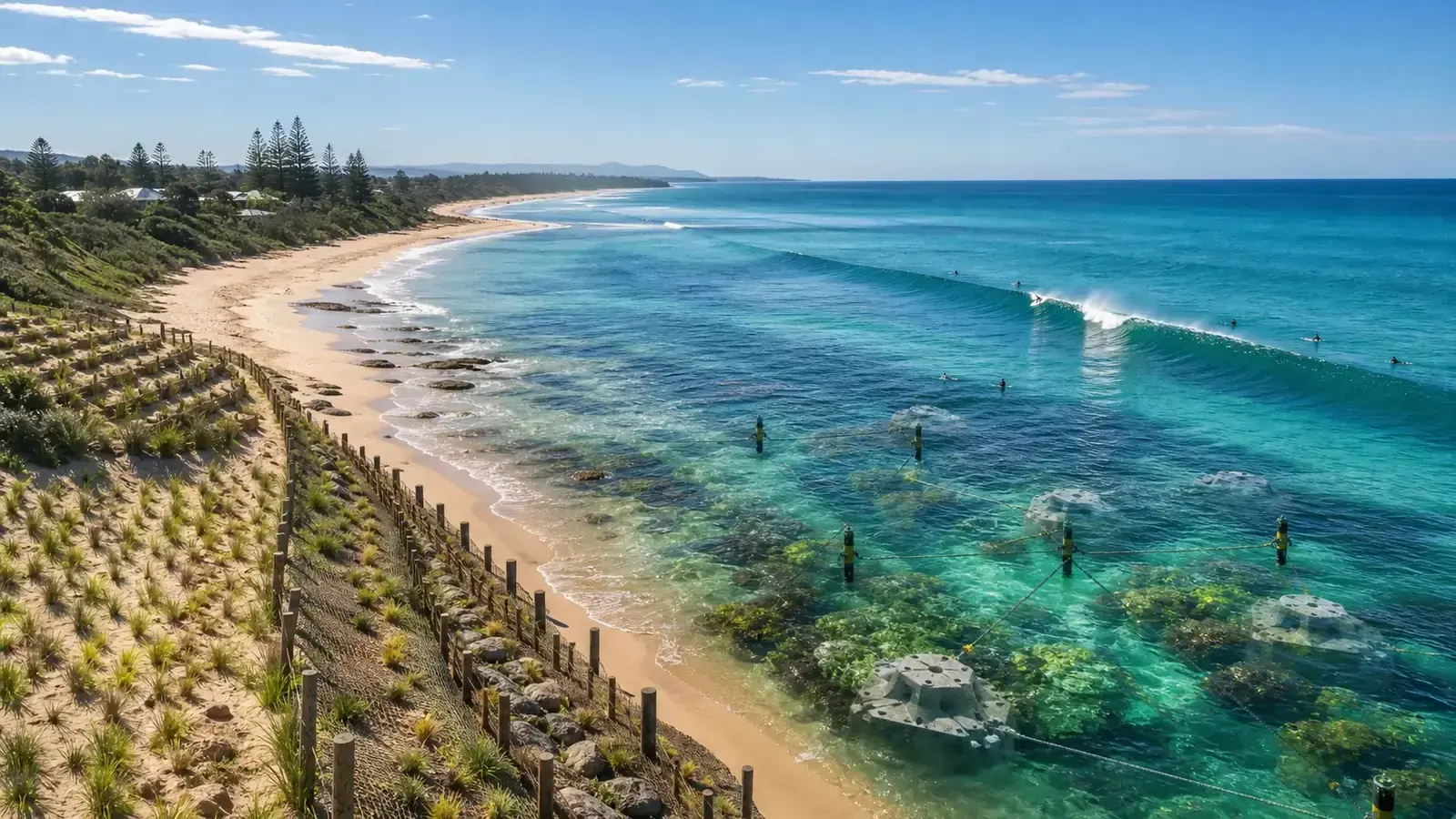
A carefully shaped bank of sand could give the beach a kinder wave and help hold the sand in place. This is the unproven end of the idea, so it would start as a model on a screen and one small test patch, not a promise.

Start small

Shaping surf is hard to get right.

Speculative

Move a bank of sand in the wrong spot and you can spoil a good wave or wash the beach away, so the honest way is to start tiny, watch a full season, and only scale up if it earns it. You can count the sand a tunnel gives and see the same numbers below. Anything in the water or on the shore would need the Quandamooka people's agreement, through QYAC, before a grain is moved.

One small step at a time

From a bench tank to a whole break.

Five steps, smallest first, each one only tried if the one before it worked. The little tank you could set up today; the last one is a long way off.

Wave tank model kit

surf you can try on a bench

A shallow tank of water and shaped sand, the kind of thing a school science fair might set up, where you could watch a little wave break over a bank before touching the real beach. Cheap, safe, and easy to get wrong without any harm done.

  • under a truckload of sand, the spoil from roughly 0.8 metres of a people-sized tunnel
    Modelled

Point-break field marker set

read the break before touching it

A few quiet markers set out at a known surf spot to watch how the sand and the swell already move together across a season. This one reads the beach rather than changing it, so you learn the place first. In the water, so only with the Quandamooka people's say.

  • about 2 tip-truck loads of sand, the spoil from roughly 5 metres of a people-sized tunnel
    Speculative

Surf-bank trial patch

one small bank, watched for a season

One modest bank of sand, shaped and set at a single spot, then left alone and watched for a season to see if the wave comes in kinder or the sand simply drifts off. Small enough to walk back from if it does not work out. On the water, so QYAC agreement comes first.

  • about 19 tip-truck loads of sand, the spoil from roughly 38 metres of a people-sized tunnel
    Speculative

Superbank learning reach

a longer wave, if the small one earns it

A longer stretch of shaped sand, aiming for the sort of long, peeling wave the Gold Coast Superbank is famous for. It would only be tried if the little trial patch had already proved kind and steady, and it would want a longer, more careful look before anyone commits.

  • about 77 tip-truck loads of sand, the spoil from roughly 153 metres of a people-sized tunnel
    Speculative

Point-break digital-twin field

the whole break, mapped and modelled

The big idea: a whole point break shaped and wired to a working copy on a screen, so a change could be tried a hundred times over, through a hundred make-believe seasons, before the water ever sees it. The most ambitious step here, and the furthest off.

  • about 192 tip-truck loads of sand, the spoil from roughly 382 metres of a people-sized tunnel
    Speculative

Where it stands

Test small, watch, ask first.

None of this is built, and shaping surf is the kind of thing that is easy to get wrong. So the idea is to test small, watch a full season before scaling up, and drop any step that does not earn its place. It would be for the island's own good, a kinder wave and a beach that holds, not for export or profit. And the sea and the shore belong to the Quandamooka people: nothing moves without their agreement, through QYAC.

Keep going

Where this goes next.

Step back up to what the sand could build to see the other families of build, work out how far one dig would stretch across the list, or wander over to power from the sea for the other side of the island's water.