
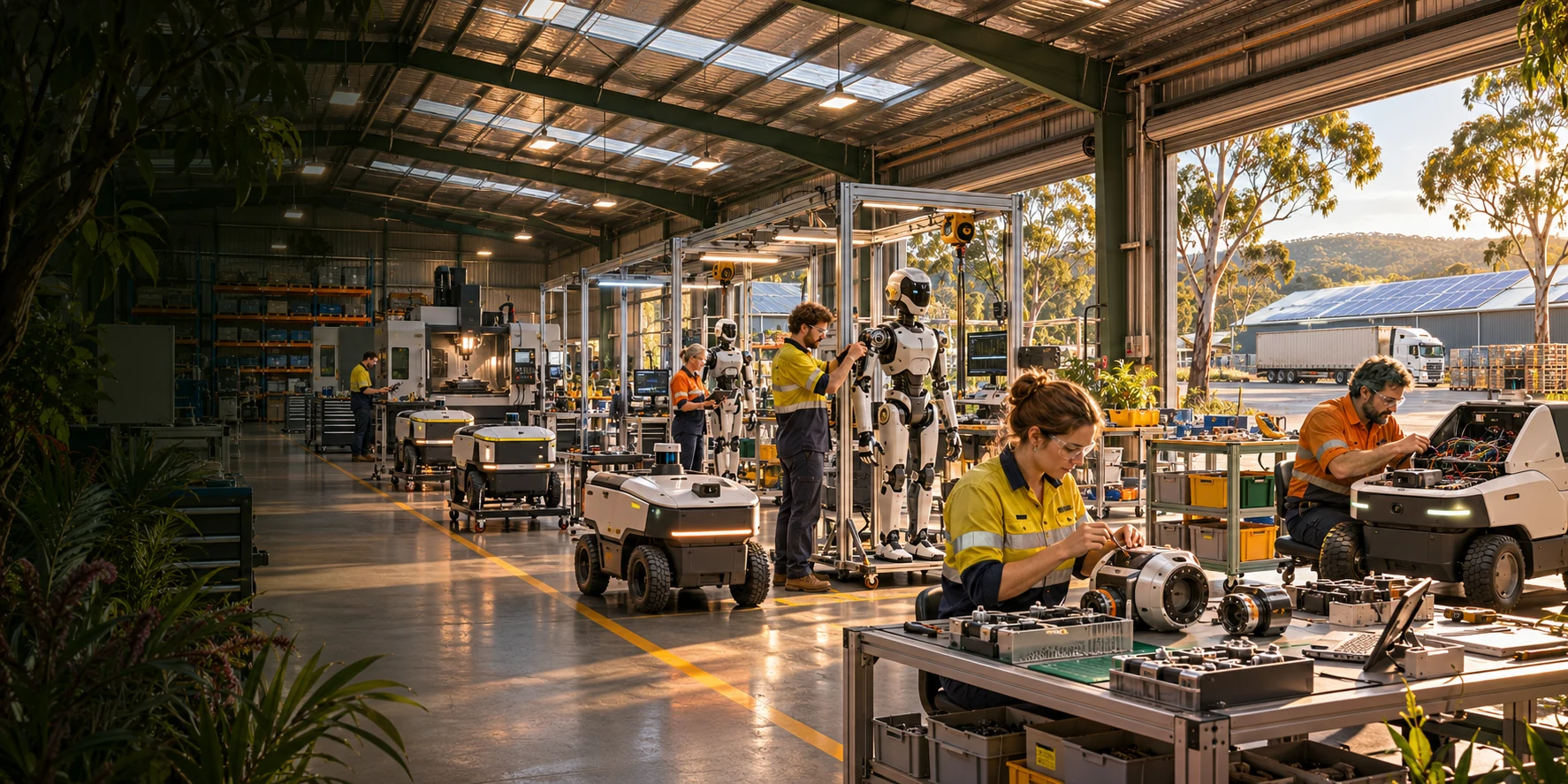
Twenty million people in the Quandamooka design. An Australian scenario of 100 million-plus by 2045. Useful infrastructure starts the work before a confirmed emergency changes its pace.
Explore the 2045 requirements Read the integrated paper
Hayes's design brief, clarified on 7 November 2026, is a 20-million-person closed-loop city beneath Quandamooka Country, an Australian scenario of more than 100 million people by 2045, and a distributed network of subterranean cities across the Earth. The ambition is world-leading quality, rapid learning and industrial scale. The earlier 1.687-million-a-year Australian robot case is a modest worked ramp. Its quarter-reference throughput and factory schedule are modelling choices, not national limits.
The early activation case is useful housing, transport, clean power, water, local manufacturing and independent repair. Each stage creates assets people can use immediately. A confirmed celestial threat could change construction priorities, funding and isolation requirements. The programme can begin earlier on the strength of its everyday benefits. The Grain by Grain documentary mission, checked 7 November 2026, connects a useful Dunwich gateway to transport corridors, material processing, industry and the eventual generation city. A generation city carries food, skills, culture, ecological reserves and the capacity to repair and rebuild through successive generations.
The supplied PDFs record different thought experiments and earlier LLM responses. They supply design history and candidate processes. Their numbers and proposed mechanisms require their own evidence. The Aura of Intelligence subterranean cities page supplies the worldwide scope; the Civilisation of Sand city page supplies a city-design workbench. The Micronova and Excursions building page connects energy, water, food, shelter, knowledge and community across several hazard cases. These public pages were checked on 7 November 2026.
Put the population and space together
The public thought experiment uses 100 cubic metres of private dwelling volume per person. Twenty million people therefore require two billion cubic metres of private space. This 7 November calculation adds an editable 200 cubic metres per resident for food systems, industry, services, circulation and shared space. Total: six billion cubic metres. That is 2.4 million defined Olympic swimming-pool volumes, each 50 metres long, 25 metres wide and two metres deep. Structural layout determines the excavation and support actually required.
Construction from 2027 through 2045 provides 19 annual building periods. Six billion divided by 19 is about 316 million cubic metres per year on average. Starting at ten million cubic metres in 2027 requires annual excavation to multiply by about 1.319 to reach the total. The final year's requirement is about 1.46 billion cubic metres. This is a growth rate solved from the design target. Excavation, permanent lining, fit-out and operating life support each need a delivery programme.
At the same space allowances, capacity for 100 million people requires 30 billion cubic metres, averaging 1.58 billion annually over 19 years. This is a complete new habitat-capacity test. Population growth and relocation determine who uses that capacity. Australia's ABS estimate for 31 March 2026, released 17 September, was about 27.92 million. Reaching 100 million would add about 72.08 million people. At 2.5 residents per home, that increase alone requires 28.83 million additional occupied-dwelling equivalents, roughly 1.52 million annually over the selected 19 building years. The 20-million-person city fits within the national programme; it is not added to the national population again.
Close each loop and size its power
For the city, 200 litres circulated per resident per day equals 1,460 gigalitres annually. At a chosen 99.5 per cent recovery, makeup is 7.3 gigalitres annually. Changing recovery to 99 per cent doubles makeup to 14.6 gigalitres. These 7 November design tests concern the entered water circuit. Food, nutrients, process chemistry, leaks and stored reserves need explicit balances. Closed-loop operation is a performance target for each stream.
Food is a major power variable. At 2,500 kilocalories per person per day, edible food carries about 2.91 kilowatt-hours of chemical energy. A chosen five per cent electricity-to-edible-energy conversion requires about 58.1 kilowatt-hours of electricity per person per day. For 20 million people that is 48.4 gigawatts continuously. Another 1,000 watts per resident for other city services adds 20 gigawatts. Total: 68.4 gigawatts average, or 599 terawatt-hours annually, about 2.1 times Australia's 2025 electricity generation. Five per cent is an editable research target dated 7 November 2026. Crop yields, nutrition, lighting, microbial food, recovered nutrients and process losses determine actual performance.
At ten per cent conversion, the same food-energy target and other services need about 44.2 gigawatts in total. At two per cent, they need about 141 gigawatts. Better processes therefore change the industrial requirement substantially. Surface-assisted food and light can reduce normal electricity use; the sealed operating case sizes independent supplies. Electricity used inside ultimately becomes heat unless energy leaves in products or storage. Food produced from that electricity is counted once. Heat rejection needs a continuing route out of the habitat. Aquifer storage and long-term heat disposal have different capacities.
Optimise the industry around available atoms
Australia's October 2026 mineral tables record 961 million tonnes of iron ore, 102.5 million tonnes of bauxite and 730,000 tonnes of contained mined copper in 2025. Processing gives a different picture. The USGS Australian production table, data available through 24 March 2026, records 433,500 tonnes of refined copper in 2024 when electrowon and other primary refining are combined. The Australian Aluminium Council reports 1.57 million tonnes of primary aluminium in 2025. The World Steel Association data updated 28 July 2026 records 5.223 million tonnes of Australian crude steel for 2025. These are dated output benchmarks. Allocation, additional plant, energy and qualified feed determine what a new programme receives.
For a transparent material test, allocate ten per cent of each processing benchmark to robots and apply 95 per cent net manufacturing yield. At six kilograms of copper, 21 of aluminium and 20 of steel in each finished machine, the copper account supports about 6.86 million robots annually; aluminium about 7.10 million; steel about 24.81 million. Together, those three accounts support the smallest figure, 6.86 million. The allocation is a scenario choice. City infrastructure, power equipment, existing customers and exports need their own accounts. Motors, chips, batteries, other materials and factory capability also require supply.
For 100 million robots annually at the same intensities and yield, factory feed needs about 632,000 tonnes of copper, 2.21 million tonnes of aluminium and 2.11 million tonnes of steel. If robots receive ten per cent of national processing output, the corresponding total outputs are 6.32 million, 22.1 million and 21.1 million tonnes annually. Increasing allocation or reducing material intensity reduces those totals. This turns the ambition into specific processing, procurement and power requirements. It does not impose today's output as a permanent ceiling.
Excavated sand belongs in the same mass balance. At 35 per cent pore volume, grain density of 2.65 tonnes per cubic metre and pore-water density of one, the six-billion-cubic-metre city handles about 10.34 billion tonnes of dry solids and 2.1 billion tonnes of pore water. Suitable tested streams could supply structural products, glass, ceramics, thermal stores and recovered minerals. Assays, recovery, purity, structural qualification and manufacturing energy determine the usable products. Sand does not supply every element. Substitution research can improve the design while each process retains a stated performance target.
Let useful work build the next stage
Start with transport, water, repair and material-processing projects that improve daily life. Manufacture machines that help expand clean power, excavation, processing and further manufacturing. Replicate accepted production cells and repair systems across independent owners. Measure useful task hours, intervention rates, wear, energy per task and the time from a verified improvement to a qualified production change. These measures connect quantity with quality and rapid evolution.
The target remains joyful responsible abundance: lives people choose to keep living, with functioning communities and the ability to disconnect. Individual Auras are owner-directed software. The Web3 sensorium connects the intermediary layer. The physical missing middle supplies locally governed racks, power, workshops and civic machines. Purple Party for Australia, or P4A, is the proposed civic layer. GAJRA Earth, the Global Association for Joyful Responsible Abundance on Earth, supplies the proposed international setting. The 2045 city calculator exposes the first volume, growth, water, food-energy and metal-allocation calculations, dated 7 November 2026.
Explore the 2045 requirements
Design tests dated 7 November 2026. Change an assumption from the dropdown. The year, population and engineering performance targets remain editable. The annual curve solves for the expansion required to reach the selected volume.
The fixed city case requires six billion cubic metres over 19 years, averaging about 316 million cubic metres annually. JavaScript enables changed inputs, the annual graph and downloads.
Metal benchmarks: refined copper 433,500 tonnes in 2024; primary aluminium 1.57 million tonnes in 2025; crude steel 5.223 million tonnes in 2025. Ten per cent allocation is a design test. These are gross production stages; qualify the feed and enter uncommitted allocations before procurement. City structures and new power systems require their own inventories.
Food conversion and water recovery are selected performance targets. The calculator does not contain a validated crop, nutrition, oxygen or complete nutrient model. The graph counts excavation volume. Operating habitat delivery requires lining, fit-out and functioning services.